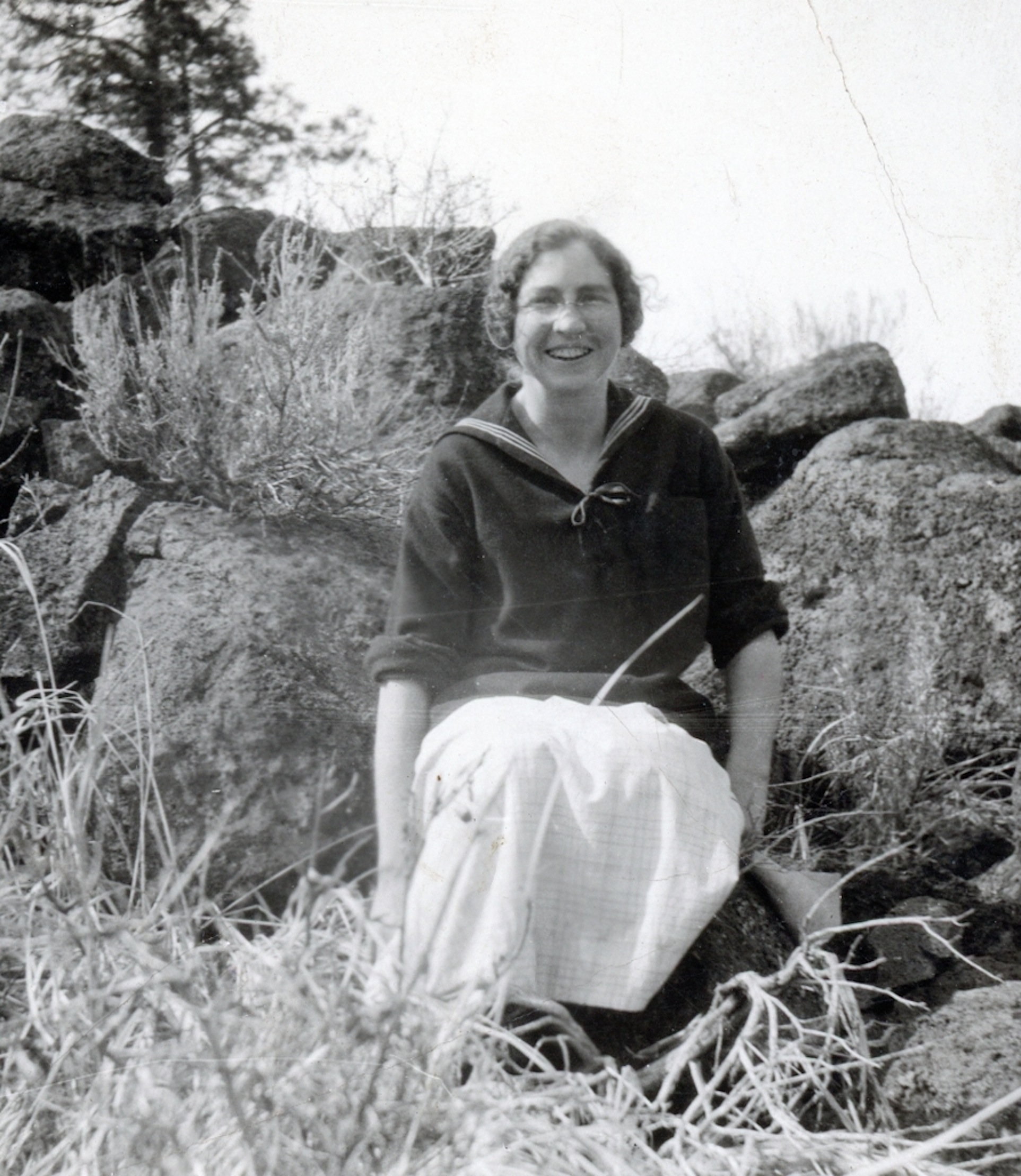
Today, marks the fiftieth anniversary of the passing of Lola Lillie Murrer Tanner, my grandmother. She was born on September 11, 1899 at Willow Creek Valley, the eldest and only daughter of Edward and Mary (Knoch) Murrer. She had two brothers, Leo, born 1906, and Alfred born 1914.
Lola while growing up enjoyed the outdoors and exploring her “backyard” the east side of Eagle Lake. One of her early passions was photography. Because of her, she captured Eagle Lake at is highest level, but equally important the construction of Bly Tunnel.
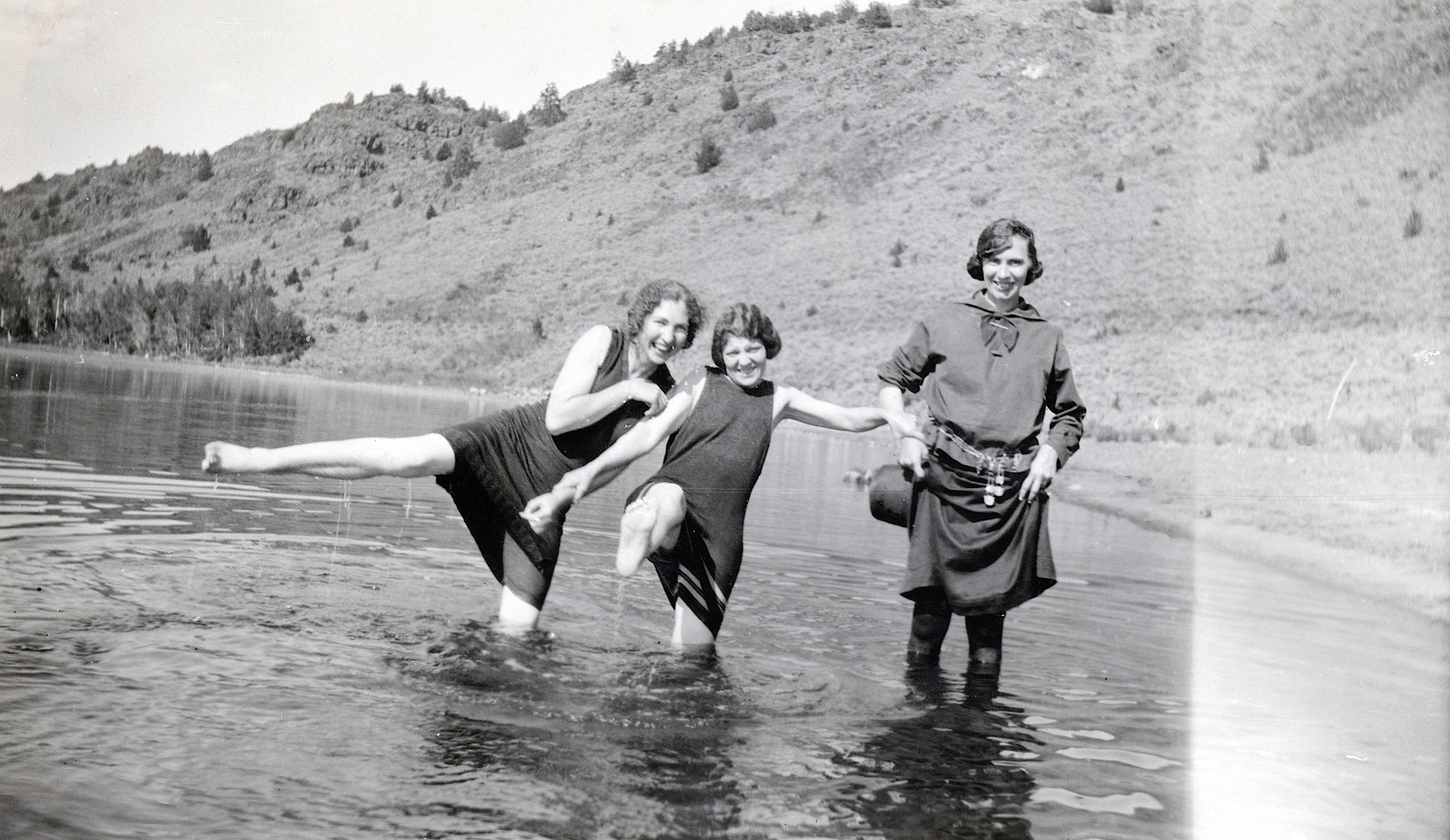
Fun times at the north shore of Eagle Lake, Lola to the far left, 1923
In 1927, she married John Tanner and the following year they acquired the present Tanner Ranch, now sandwiched between the Dakin and Fleming Units of the State Wildlife Refuge, and still owned by the family. In 1945, she was widowed having to deal with raising three daughters and operating the ranch, yet with all those and many other challenges, she never complained.
While she did not have a high profile life, to me her legacy has been her photographs that I share with you the reader—priceless.
Long before Lake Almanor was conceived Big Springs and Hamilton Branch were popular camping/fishing spots at the then Big Meadows. A portion of that would change in the early 1900s when Great Western Power Company began land acquisition there. The company issued a statement that all camping and/or recreational activities were prohibited on their land, though initially permits could be obtained That is a story for another time.
When the first phase of the construction of Lake Almanor was completed in 1914, a great deal of the activity was logging by the Red River Lumber Company who had a contract to remove the standing timber from the reservoir. One of Red River’s earliest and best known logging camps, was Camp 14 located near Hamilton Branch.
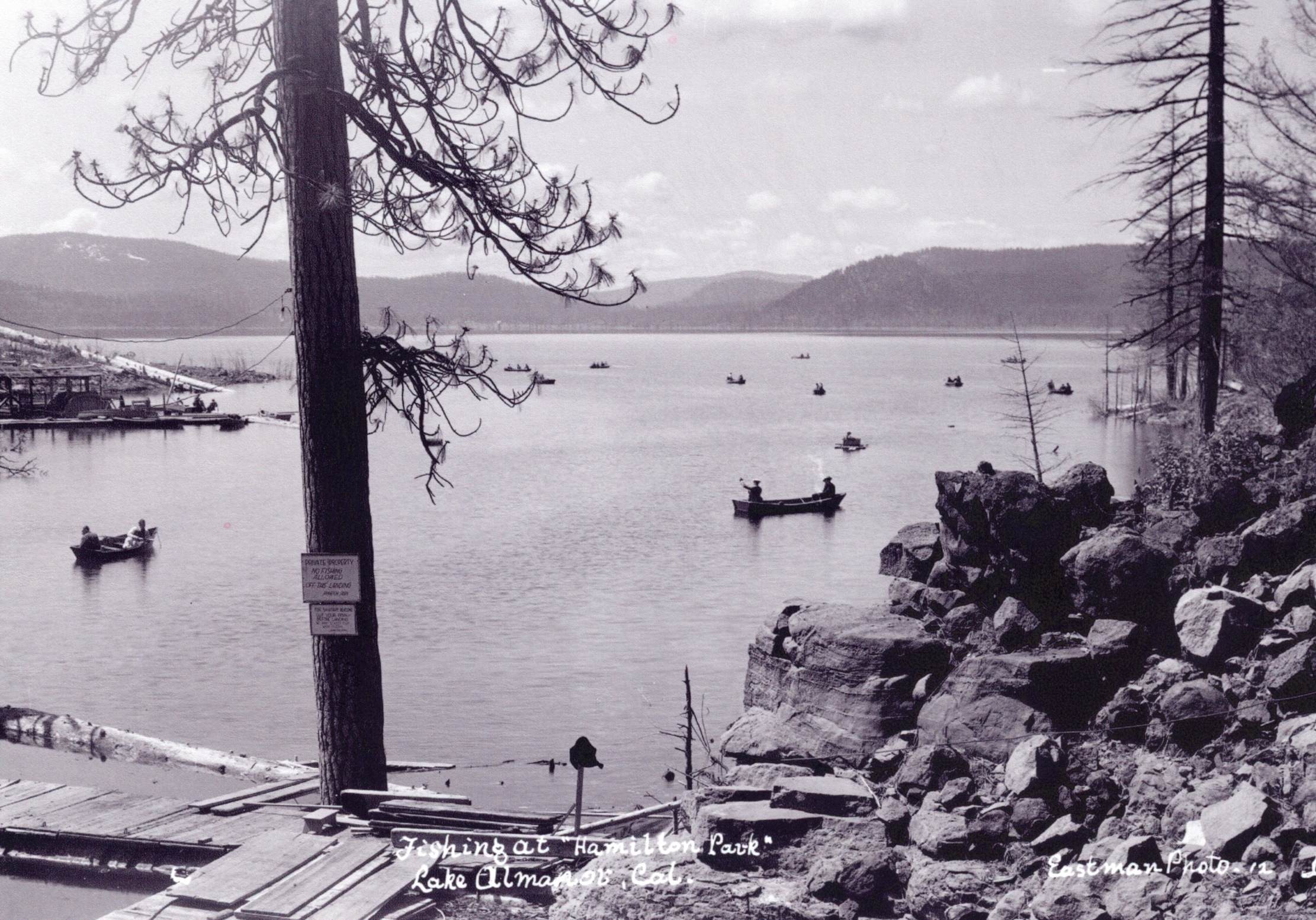
In 1923, J.N. Boshoff contacted Red River officials about converting a portion of abandoned Camp 32 at Hamilton Branch into a little resort. Red River agreed, seeing it as an opportunity to provide recreational opportunities for its employees and their families. Boshoff then converted some of the cabins at Camp 32 into bath houses for changing and others into overnight sleeping accommodations. He dubbed his new enterprise Hamilton Park. Boshoff leased the property from Red River for the next fourteen years. Hamilton Park eventually became known as Lassen View Resort.
The railroad giveth and the railroad taketh could easily describe Wendel. In 1996, the Union Pacific Railroad received permission to abandon an 85-mile segment of the railroad from Wendel to Likely. The railroad implemented a plan to demolish most of the buildings it owned there. Among the first buildings demolished were a two-story railroad section house and the foreman’s house. Also torn dorn was a local favorite, the 24-hour cafe known as the Milepost Inn, which provided meals and housing for railroad crews laying over between trips, but was open to the public.
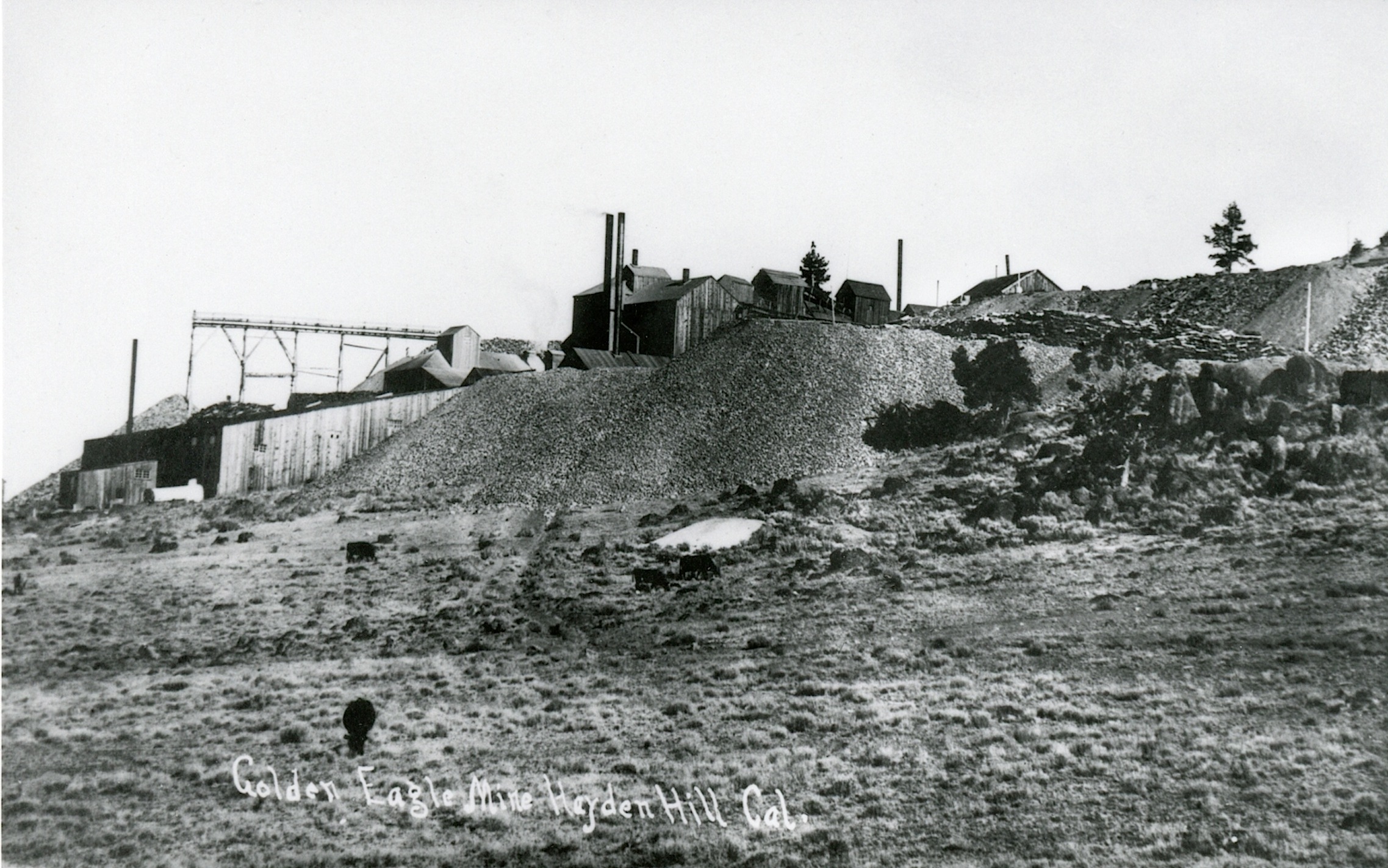
Golden Eagle Mine, Hayden Hill December 9, 1909—-Dallas & Joyce Snider
By 1900 it was becoming apparent that so-called “Wild West” had become to an end. In the early 1900s, in California, one was now required to go before the County Board of Supervisors to petition for a liquor license. If there was sufficient opposition, the Supervisors would deny the license. Thus, in the same county, one town would be “wet” and another one “dry.”
In 1902, T. Ed Driskell applied for a liquor license to operate a saloon at Hayden Hill, and it was granted. Times were quiet on the Hill (as it was referred) and therefore no opposition. By 1906, mining conditions were picking up and the mine operators opposed Driskell’s saloon. In mid-May 1907 the Golden Eagle Mine shut down, implying the problems associated with Driskell’s saloon. In reality there were a scarcity of miners to be found.
While the owners of Golden Eagle fought to revoke Driskell’s liquor license, the matter would resolve itself in a peculiar manner. On July 12, 1908, Driskell’s was found dead at his saloon. A Coroner’s Jury was assembled, the cause of death—alcohol poisoning.
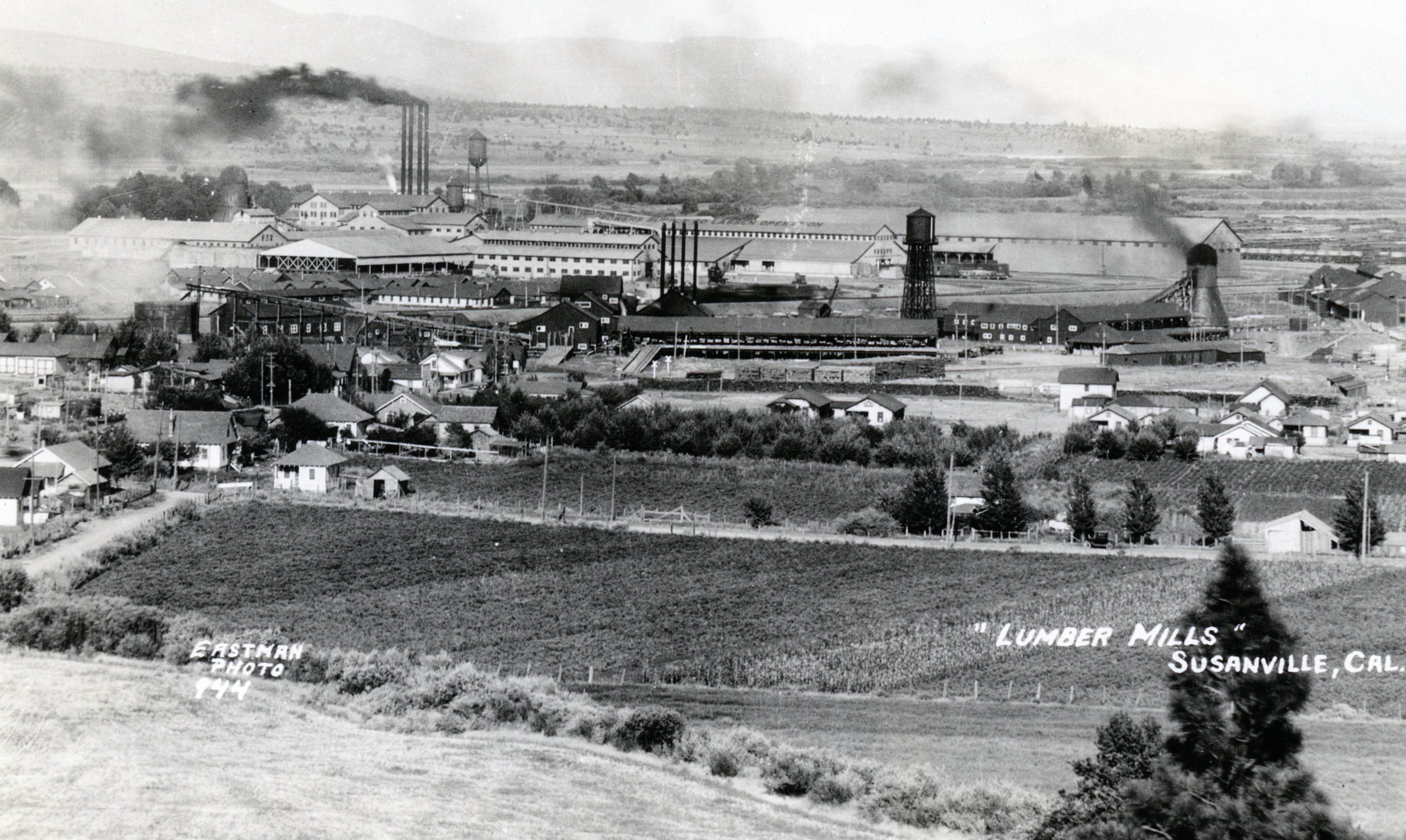
Fruit Growers and Lassen Lumber in their glory days.
Recently, someone wanted to know when the various large lumber mills closed. The first casualty occurred in 1953, when the last of the decked logs were milled at Lassen Lumber & Box Company. The sawmill was dismantled. However, Fruit Growers who bought Lassen Lumber in 1952, sold thirty acres including the box factory to the T&M Sash & Door Factory, operated by A.I. Lucero and Walter Wirth. The building was destroyed by a fire on April. 3, 1966.
Next on the chopping block was Fruit Growers plant in Westwood, which shut down during 1955/56. Fruit Growers had purchased it from the Red River Lumber Company in 1944. Next, in what was kind of an off shoot of Red River was the Paul Bunyan Lumber Company. The Susanville mill closed in 1967, though the company operated another facility in Anderson, Shasta County. One of the shorter lived operations was the Susanville Lumber Company that was established in 1941. In changed ownership several times and then was reincarnated at Coin Lumber. In 1979, it became Susanville Forest Products, a division of Jeld-Wen Corporation. They closed the mill in 1993.
Lastly, was Sierra Pacific Industries. They acquired the mill in 1963 from Fruit Growers Supply Company. Sierra Pacific closed its Susanville mill on May 3, 2004, thus marking an end of era, of a once predominant industry in Lassen County.
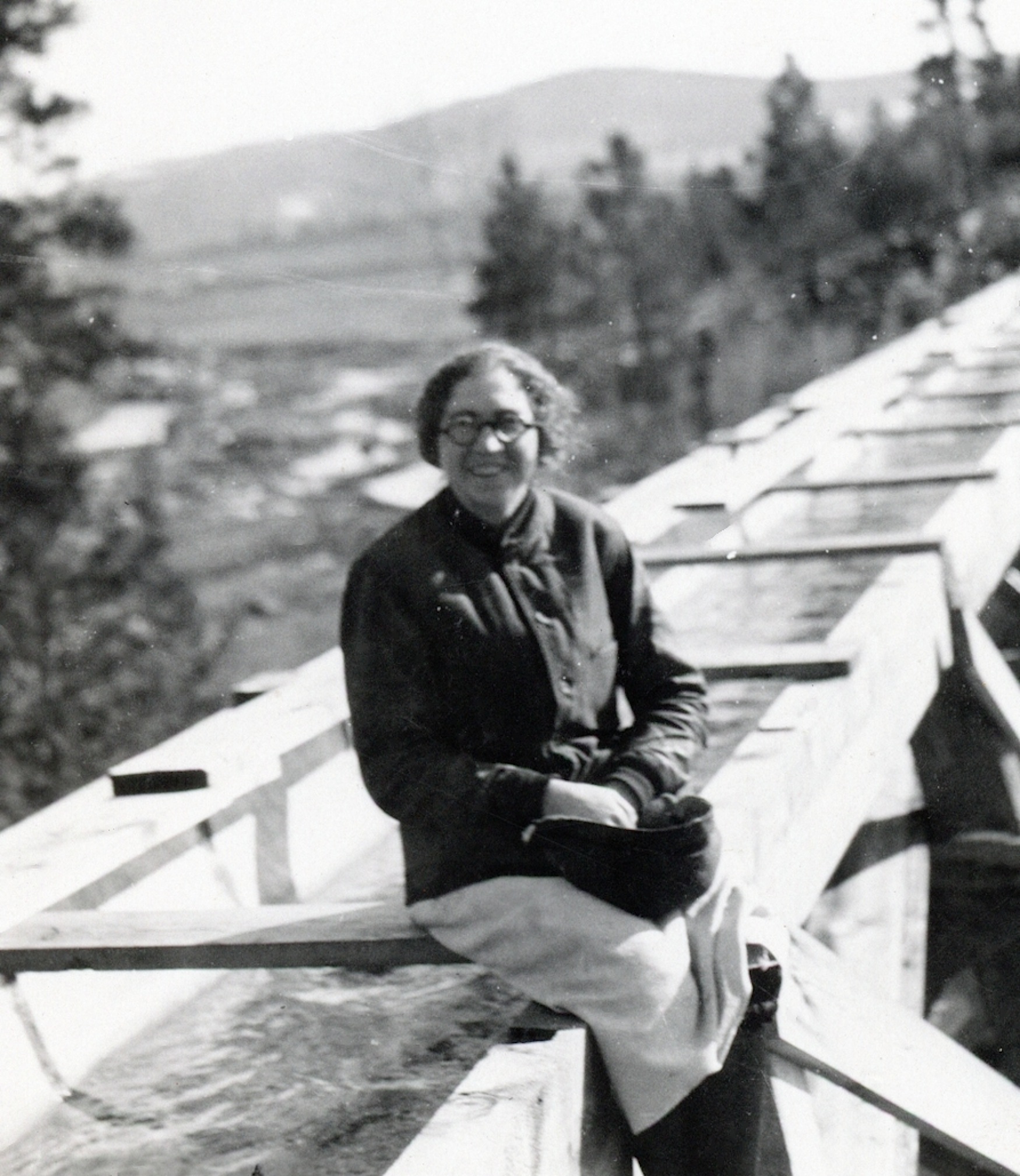
Here is a your Tuesday tidbit. This flume at the upper end of Willow Creek Valley was part of diversion of Willow Creek for the Murrer Ranch to convey the water into an irrigation ditch on the south side of the ranch, which then provides gravitational water flow for the fields.
Tim
I may use a different photograph of the flume for the 2024 calendar. Time will tell.
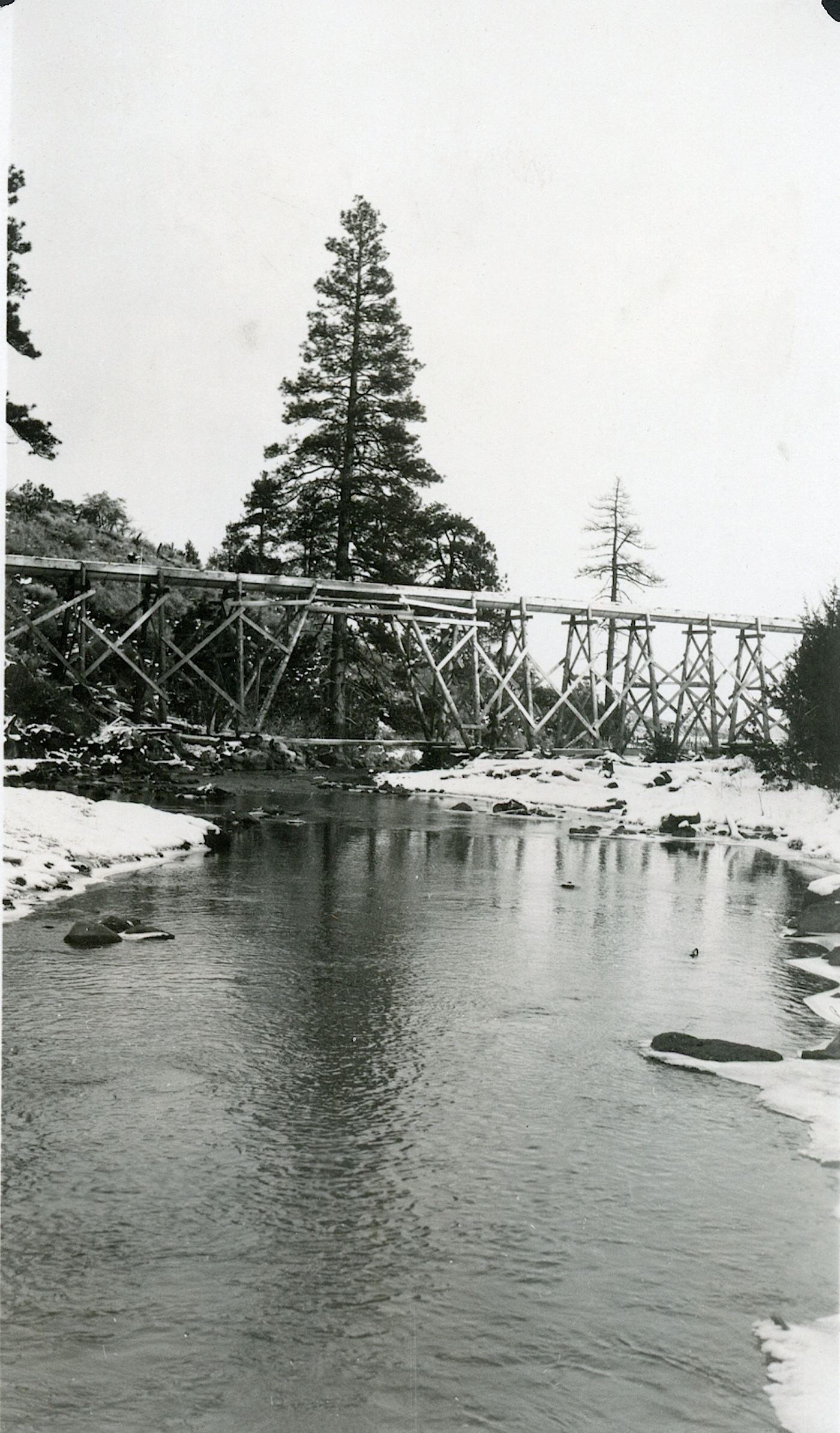
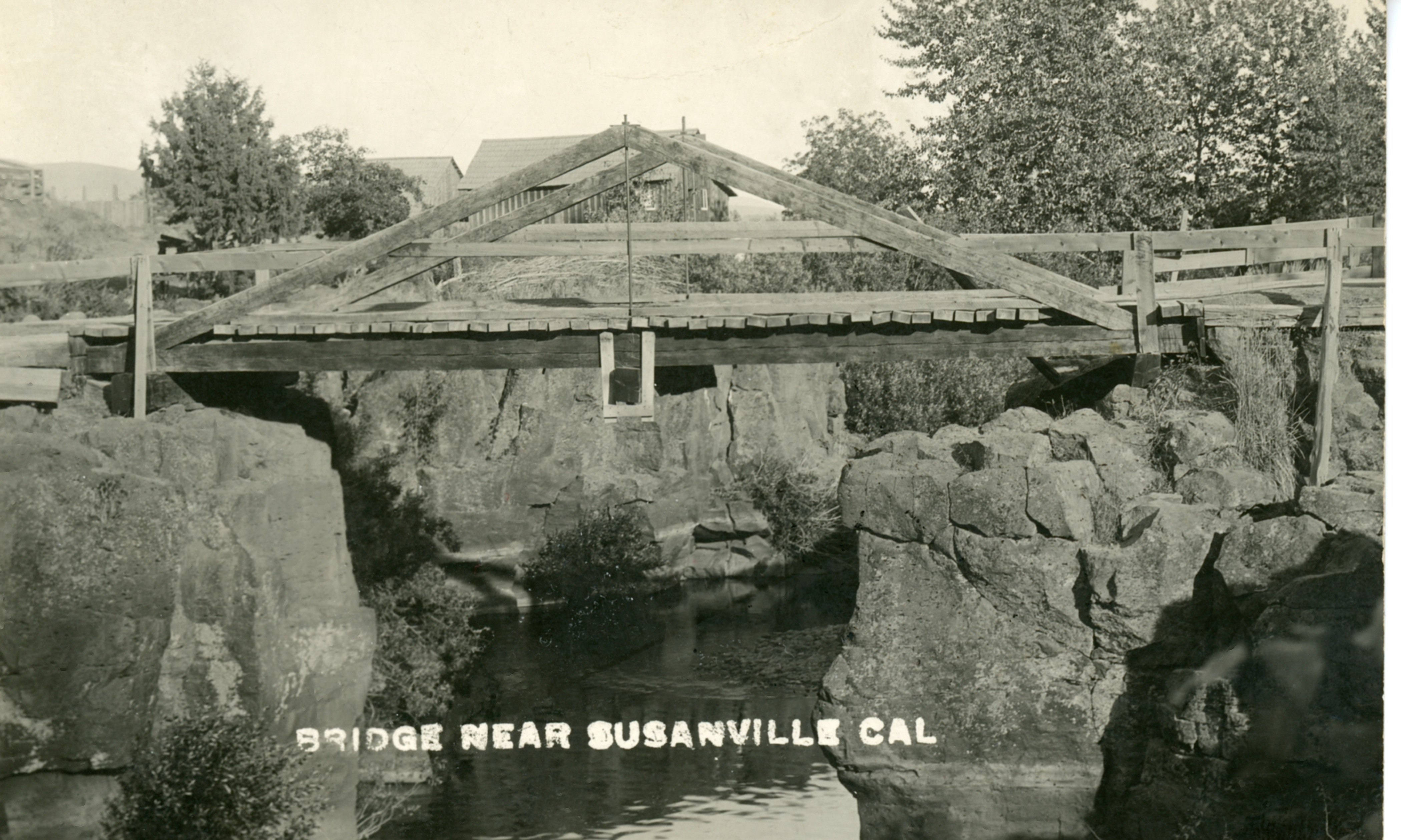
Richmond Road Bridge, circa 1910. Courtesy of Lola L. Tanner
One of the stranger side effects of the national prohibition had to do with a one time fish kill in the Susan River. There was the issue what do with the confiscated alcohol usually referred to as jackass brandy or “dago red” wine. In the summer of 1923, Lassen County Sheriff Carter seized 500 gallons of red wine at Westwood. He did not have ample room to store the evidence. He asked the District Attorney’s. Office for approval to dispose of it, which was granted. Carter instructed his deputy sheriff A.C. Hunsinger to bring a truck to the jail to dispose of the wine and it was poured into the Susan River. However, the wine killed some of the fish in the river. Game Warden W.J. “Spade” Lee was not pleased. He asked the Sheriff to find an alternative way to dispose of confiscated wine in the future.
From the 1890s through the 1920s, there was a colony movement in the American West. As readers may recall Standish was a planned utopian colony based on the beliefs of Myles Standish. When Litchfield came to being in 1913, the promoters took a much more subtle approach with its Litchfield Acres.
The next proposed colony, one comprised of Scandinavians to be located on the east shore of Honey Lake, south of Amedee. This was in 1915, Rosendal Minster was the promoter, He even named the settlement after him—Rosendale. Minster had a lease/option to purchase the lands and the pumping plant of the Standish Water Company. He then formed the Farmer’s Land Company to operate the holdings.. The properties were split into 40-acre tracts with a price range of $45 to $65 per acre. He was able to attract a handful of settlers. While Minster vigorously promoted the project, but due to debts he quickly accrued, he abandoned it the following year.
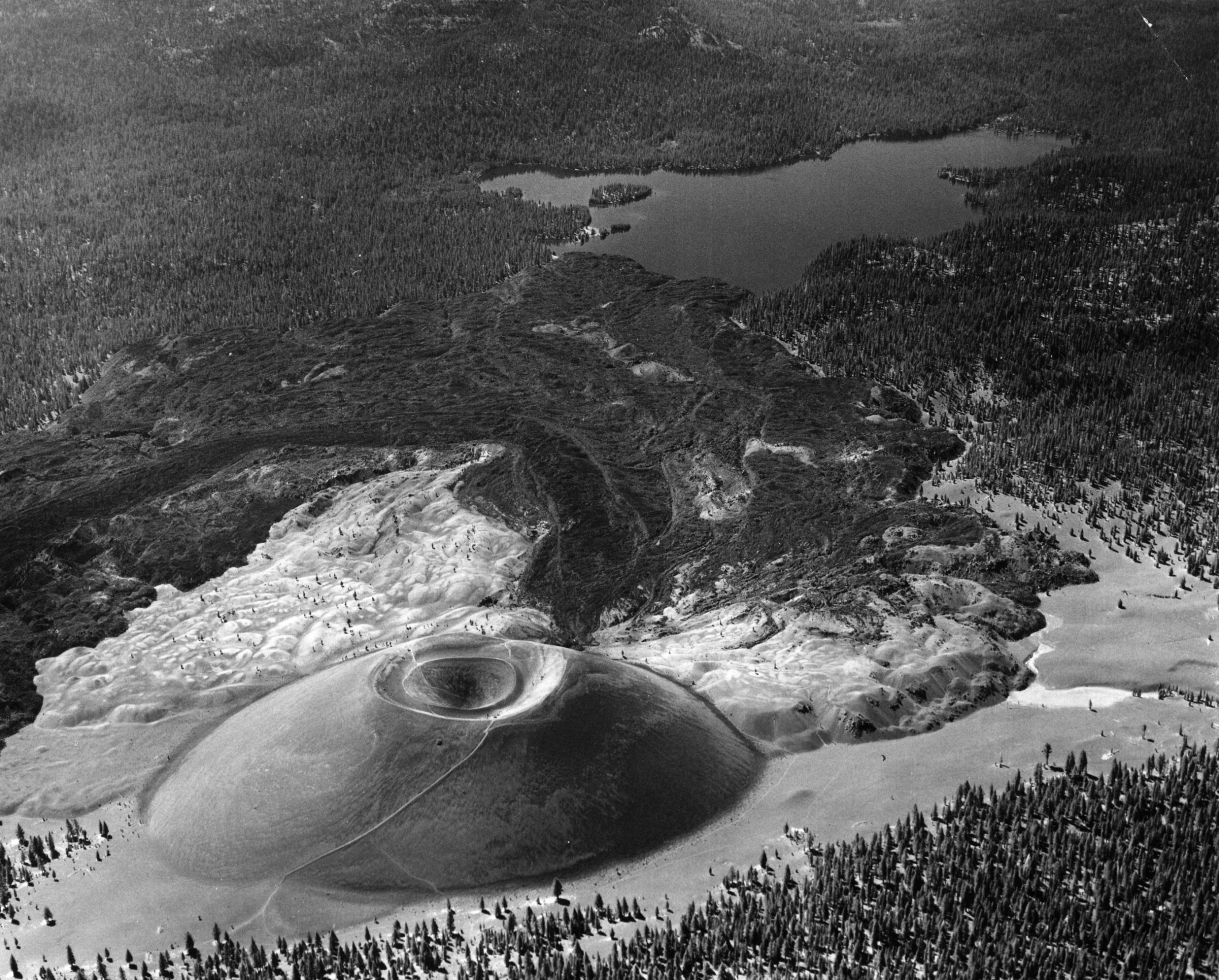
On June 8, 1906, President Theodore Roosevelt signed into law the Antiquities Act. In its initial conceptual form was to protect to prevent looting of archaeological sites. It was later revised to include historical sites and also landmarks of scientific importance. Once a site designated it became a National Monument.
Louis Barrett of the Lassen National Forest was concerned about two sites within its jurisdiction that could be developed into commercial tourist attractions—Cinder Cone and Lassen Peak. In the spring of 1906, in an effort to ward off future claimants he started a petition to make Cinder Cone and Lassen Peak into a national park. This did not gain the traction Barrett desired.
For Barrett, the passage of the Antiquities Act came at an opportune moment. It provided him with another way to protect the features of Cinder Cone and Lassen Peak. He surmised the opposition to make them National Monuments would be minimal, for less than 10,000 acres of public land would be withdrawn, versus 100,000 acres for a Lassen Peak National Park. At the same time, the national monument designation would not interfere with the establishment of a national park at a later date.
In early 1907, Barrett submitted the necessary paperwork for the creation of two national monuments—Cinder Cone and Lassen Peak. U.S. Secretary of Interior James Garfield liked the concept of two smaller national monuments better than a proposed national park. Of course, the maintenance of national monuments would be nominal compared to a national park. With no opposition, proclamations were prepared and submitted to President Roosevelt. On May 6, 1907, Roosevelt established the Cinder Cone National Monument (5,120 acres) and Lassen Peak National Monument (1,280 acres). They became the six and seventh national monuments established under the Antiquities Act.
The movement, however, to create a Lassen Peak National Park did not fade away. One of the biggest obstacles was it was not well known, even in a regional sense. That all changed on May 30, 1914, when Lassen Peak erupted, and with it nation wide publicity. On August 9, 1916, Lassen County lost its only national monument, when it was incorporated into the newly created Lassen Volcanic National Park.
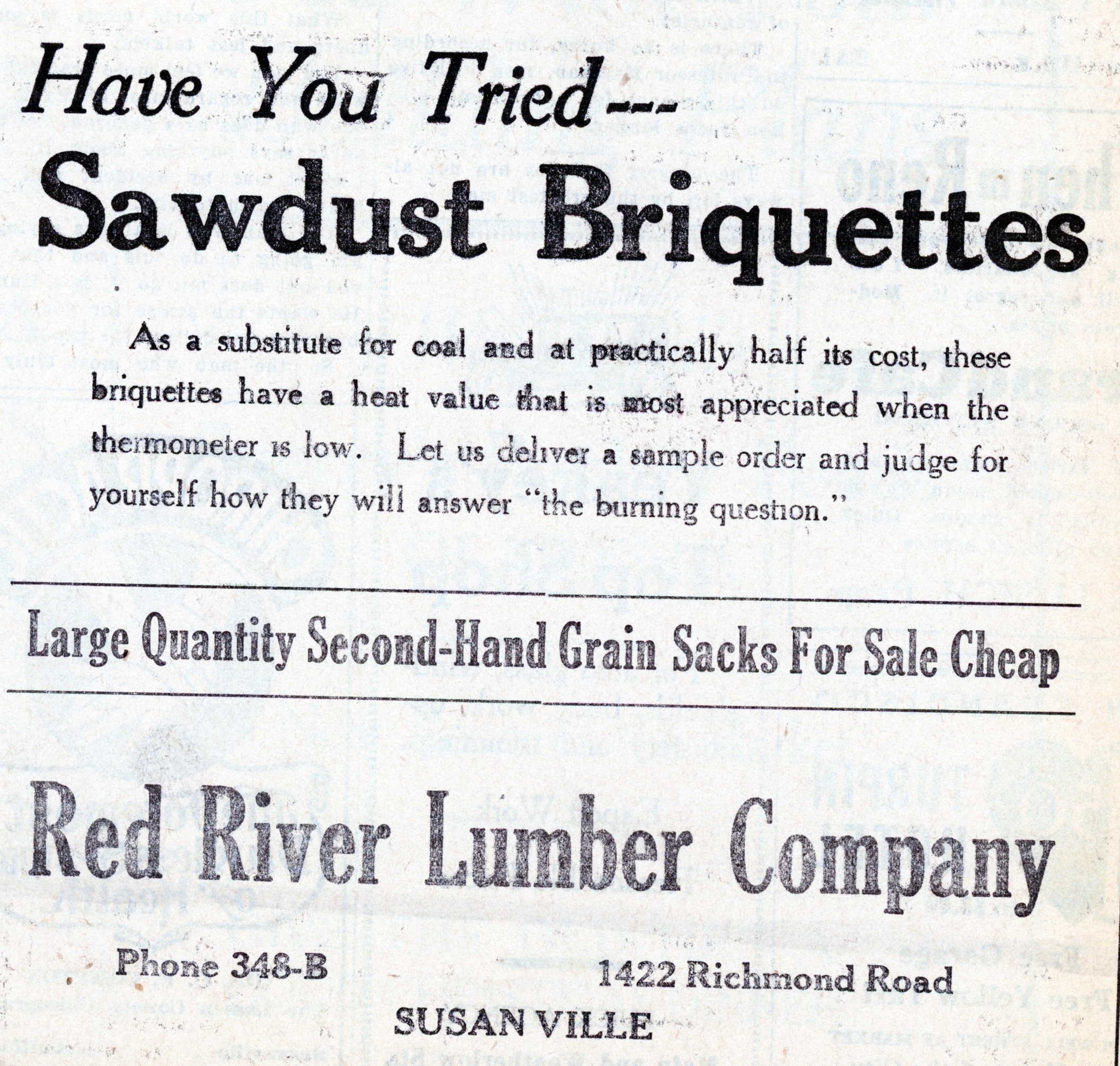
Red River’s advertisement for Sawdust Briquettes, Lassen Mail, December 14, 1928
Red River Lumber Company’s Westwood Operation were very innovative and looked at various ways to utilize lumber byproducts. After all, this was just not a sawmill/box factory plant. It produced a wide variety of goods, even venetian blinds.
In 1922, Red River was about to have an abundant supply of electric power. First, with their own hydro-plant at Hamilton Branch at Lake Almanor and another with a deal with Pacific Gas & Electric for power from Hat Creek.
This, of course, created a new problem, since they did not have to rely soley on its sawdust/wood waste pile that fueled the mill’s powerhouse. When the mill operated at full capacity it produced 400 tons of sawdust and wood chips in a twenty-four period, over half of which was used to fuel the boilers in the powerhouse. In February 1927 Red River installed an interesting piece of machinery, one that manufactured the modern day version of briquettes. This impressive device was capable of compressing a ton of wood waste into briquettes every hour. About a third of the wood waste which it compressed into briquettes could be used for home use (instead of coal), camping or even at the plant itself.