How Susanville’s Elks Lodge Came to be

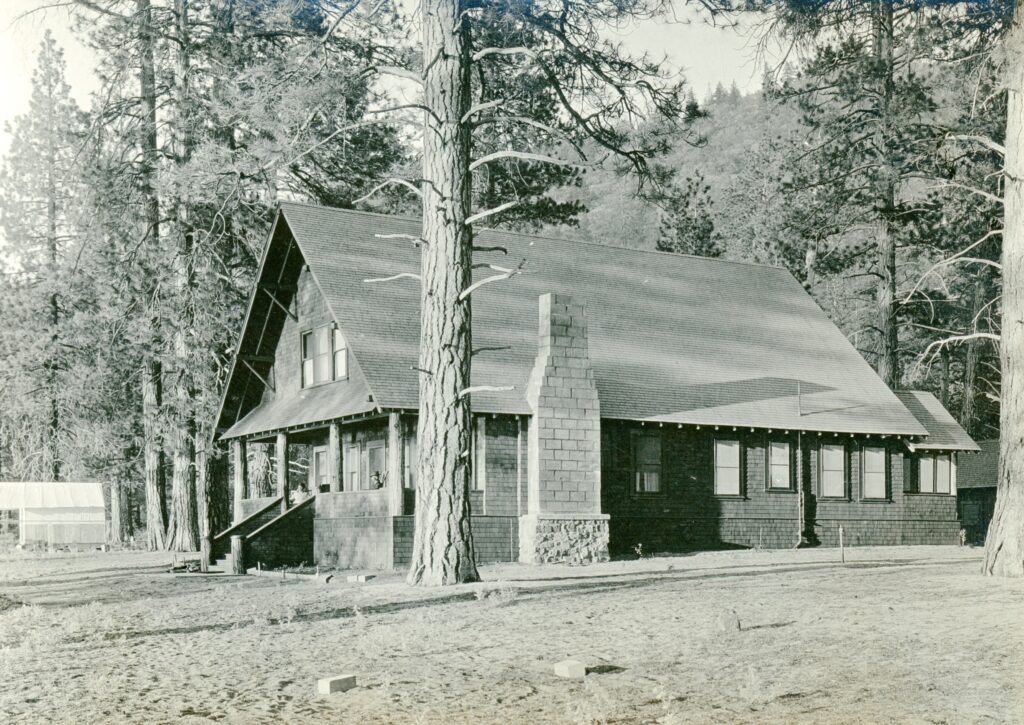
Susanville’s Antler’s Club, later Elk’s, 1925

The following account appeared in the Lassen Advocate’s Christmas Edition of December 14, 1923 that I thought some people may find of interest.

”About two years ago a small band of stray Elks got together in Susanville and decided that to properly carry out the wonderful principles of Elkdom a campaign would have to be launched to increase the little band’s numbers. This was done and a class of about forty good fellows were then taken into the Reno Lodge. A year later another class was taken in about the same size.

”Shortly after this the Antlers Club was organized and this property was purchased for the Antlers Clubhouse. The general plan of the building and the wonderful location, together with street improvements made it an ideal proposition to the purpose. It is admired by all city visitors and lately has become the social center of any events of the County.

”The fondest dreams of the members of the Antlers Club are about to be realized by turning their clubhouse into a Elks home. A charter has been applied for to the Grand Exalted Ruler, and has 162 members that are located here have signed the petition agreeing that as soon as the charter for a lodge in Susanville to demit from the Lodge which they belong and become charter members of a Susanville Lodge. In addition, about 100 good fellows are ready to join the herd.”

Tim
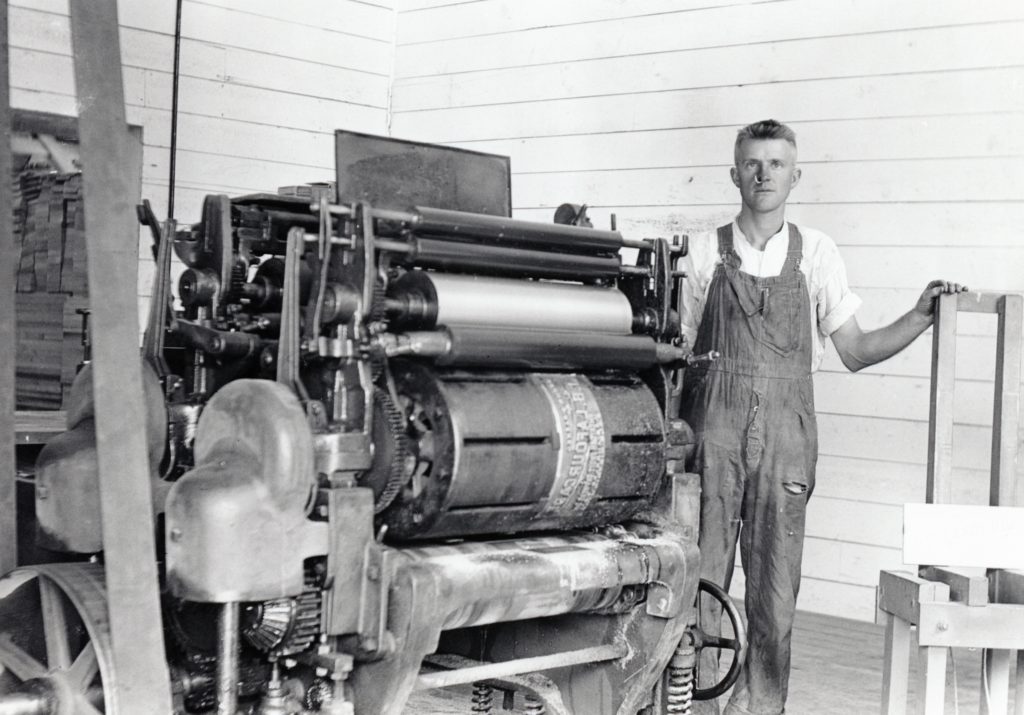
Remember the Mimeograph?

Fruit Growers Box Factory, Susanville, 1922–Ed Standard

While examining a Lassen County Chamber of Commerce file, it contains a number of mimeograph prints of various literature of the 1960s and 1970s.. The mimeograph machine was an economical way to make copies, since at that time copy machines were on the expensive side. If you have come across one of the old Lassen County Historical Society bulletins, they, too were mimeographed. It was a simple machine. A typed stencil produced, and it was then placed on a drum of the. mimeograph. Then one used the crank and printed out as many copies as desired. One could even change the color ink, though dealing with the ink could be a messy process.

While the above photograph is a press that worked similar to the mimeograph. In this case, wooden box slats were fed through press imprinting them with the name of the citrus grower.

Tim

Secret Valley CCC and Wildlife Matters

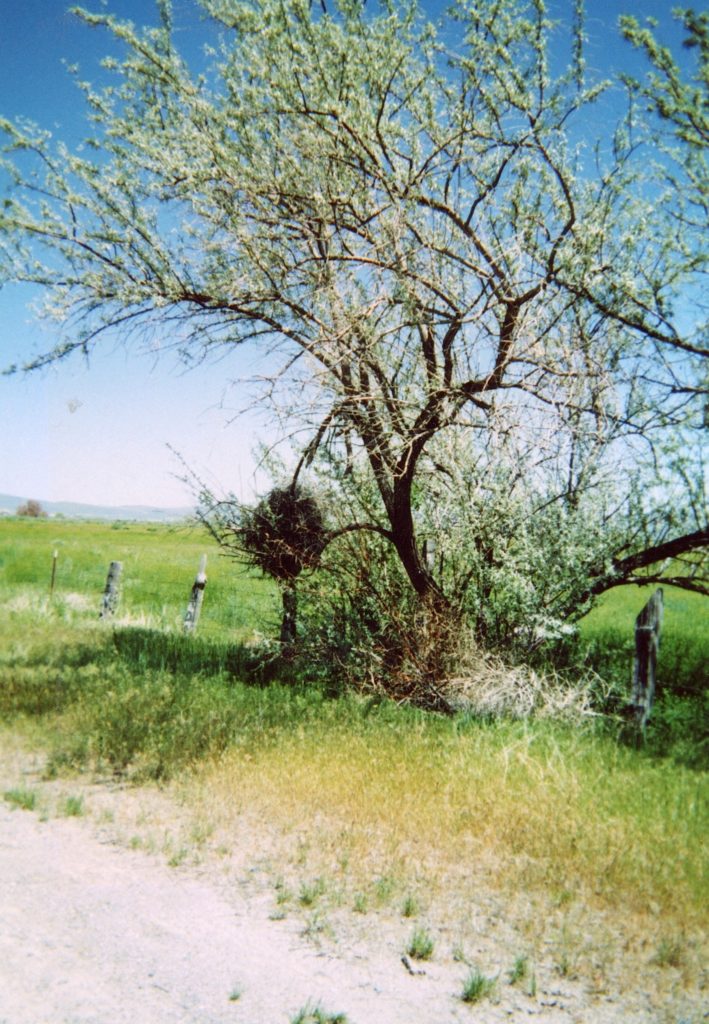
A magpie nest along Mapes Road.

Not all of the CCC projects required a substantial workforce. Back in 2018 I wrote about the Magpie Menance. In May, 1936, Ray Bowen of the U.S. Biological Survey had a small crew of men working on duck and goose nesting grounds in the Standish-Litchfield area. Another concern was predatory fowl, namely crows and magpies. These birds would attack duck nests and destroy those eggs.

Bowen requested from the CCC for five men to conduct a predatory fowl drive to at least reduce their numbers. In two days 285 crows and 450 magpies were killed, along with their nest. Asa Brown, State Predatory Animal Trapper expressed his belief, based on experience in this field, that the two days work would save approximately five thousand game birds.

Tim

Tee Off Time Skedaddle Dam

Skedaddle Dam, 1992. Courtesy of Ginger Martinez

My one and only golfing experience was history related. It was, one of the unique golf courses designed, and only used once. There were no greens, sand traps or water hazards. But there were hazards. I now understand why golf courses are devoid of boulders or anything that could send a golf ball ricocheting  in any direction. However, of the dozen or so participants, only one had ever played golf.

The course, it should be noted, was a one-hole course, a mile in length. Tee off was on top of one of most historical remnants the Skedaddle Dam. The course went due north to Chalk Bluffs, which was the 1890 construction camp site for the dam. There is a nearby spring, with names carved in stone by some of the construction workers.

The dam site, 1916. Courtesy of Betty Barry Deal

In a footnote, Anne Bixby, whose home was at the Emerson Lake Golf Course gathered and donated hundreds of stray golf balls that she collected daily in her yard. Another person checked routinely at the Salvation Army and provided this eccentric group with golf clubs. In the end, a good time was had by all.

Enjoy your Thanksgiving holiday weekend. — Tim

Thanksgiving Day, 1935

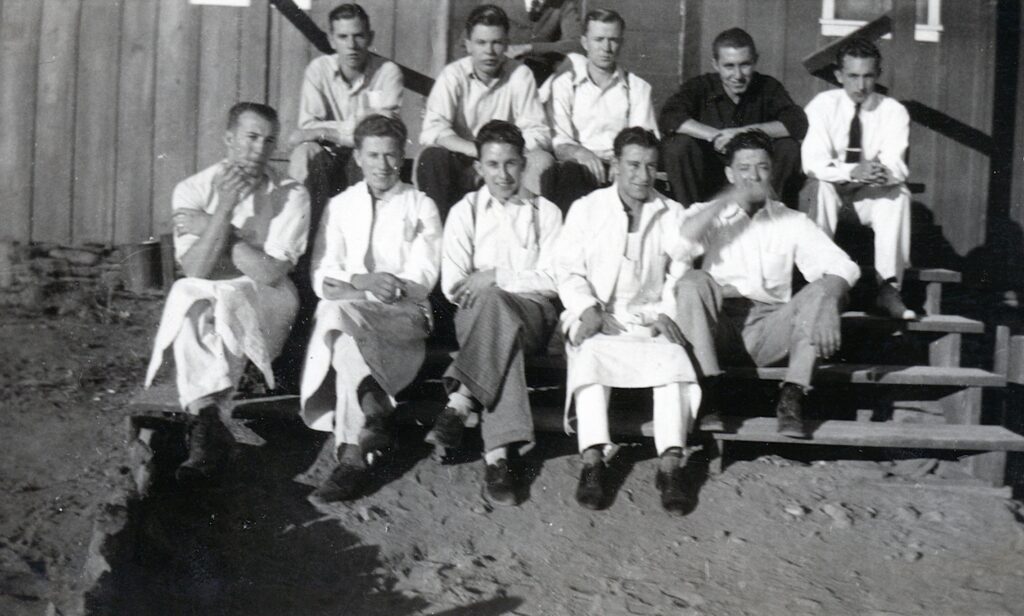
The kitchen crew at Secret Valley CCC camp—C.H. Bennett Collection

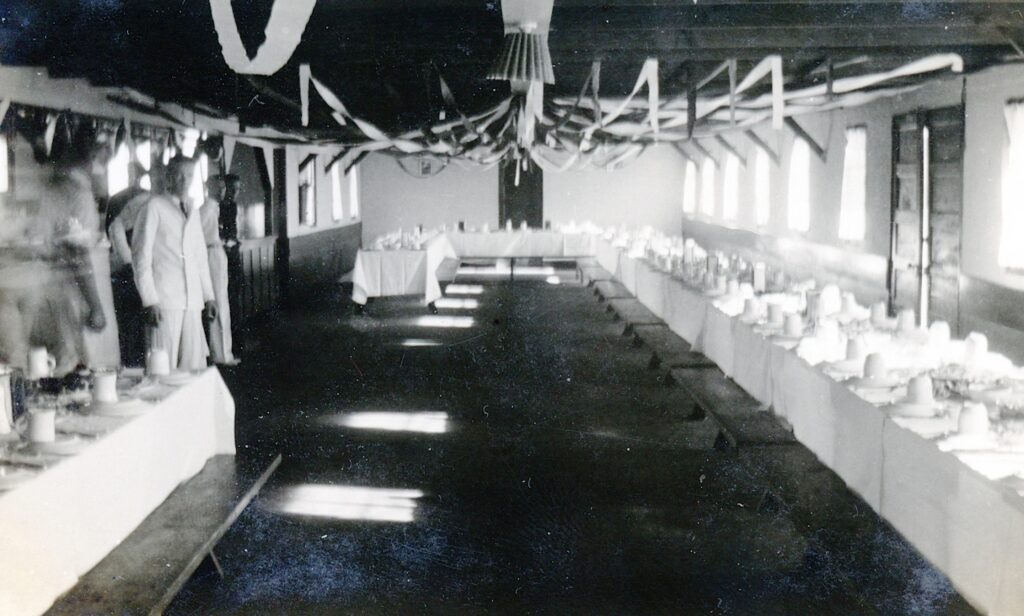
The CCC Secret Valley Camp correspondent with his news release of camp activities concluded in his column how Thanksgiving was celebrated there in 1935: “Thanksgiving Day here in the camp was one day the boys will not forget for a long time to come. The menu was indeed very well cooked and served. Turkey was all over the camp. One of the boys stated, ‘it sure was a well eaten meal.’ I should say it was. In fact there was so much turkey and mince pie and what not that some of the boys did not feel like working the next day. But, ‘we can take it.’ Yes, sir.”

A decorative mess hall at Secret Valley CCC—C.H. Bennett Collection

Tim

A Tribute to C.H. Bennett, Secret Valley CCC Company Clerk

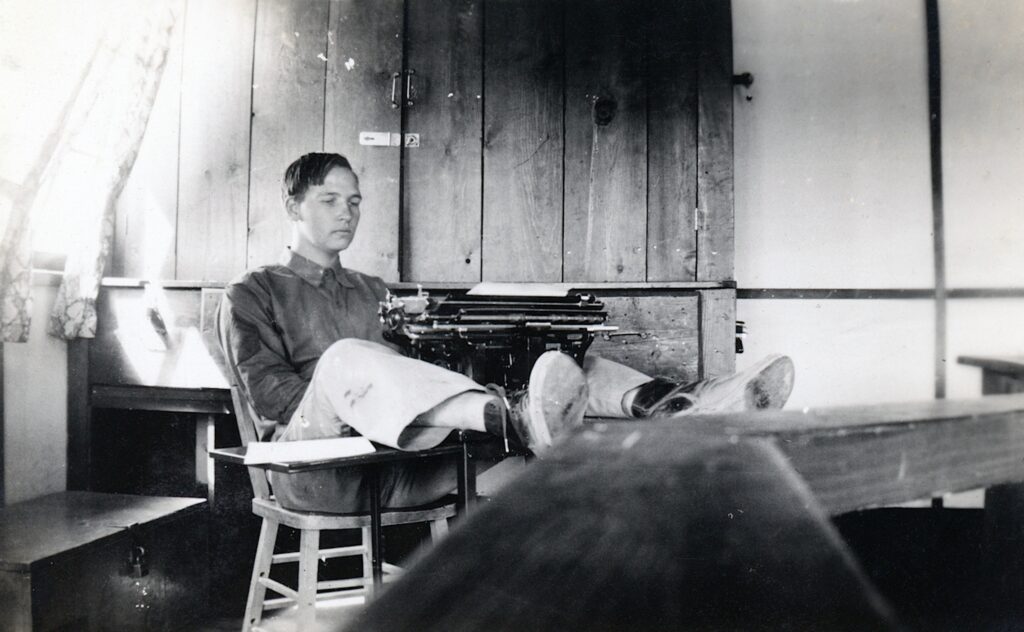
Bennett wrote whimsically of this photograph of him at Secret Valley, “hard at work.”

It is Thanksgiving and throughout the year I am so grateful for many things, some big and some small, but it all matters just the same. For the past several months, we have examined the activities of the Secret Valley Civilian Conservation Corp Camp through the photographs of Charles H. Bennett, the Company Clerk. First and foremost I am thankful that he took the time to photograph the activities, but equally important that he carefully labeled and placed them in albums.

Bennett was born in Louisville, Kentucky, but at a young age the family moved to southeastern Missouri. There he graduated from Benton High School in 1934. Shortly thereafter, he joined the CCC and became Company Clerk for the 740th Company at Piedmont, Missouri. One of their major projects was the construction of buildings at Sam A. Baker State Park. In 1936 Company 740 was relocated to Secret Valley, Lassen County, California.  He remained at Secret Valley until 1938 eventually returning to Missouri. He graduated from the University of Missouri, Columbia in 1942, then served in the U.S. Army until discharged in 1952. His next journey was with the Christian Board of Publications in St. Louis and after 32 years retired in 1979. Bennett passed away in 1984. His wife, Lucille, kept her husband’s possessions, and when she passed away in 2001, her daughter, Kathy Seitrich did the same. Fast forward to the spring of 2023, and I received an email from Kathy about her father’s CCC photographs. Within a short time of my communication with Kathy, the photograph albums arrived. I was so elated and told her so. She was happy, too, that they found a good home. For a short while I was amiss in my emails to Kathy, as I was busy scanning the photographs and writing the stories.  When I finally sent her an update, there was no response for the longest time. This was unusual as she was always prompt in responding. In early July, I received an email from her daughter, who relayed that her mother was diagnosed with cancer in late May/early June and that Kathy passed away on July 1. It was heart breaking news for me, as she never saw the posts about Secret Valley. Even though it was a sad ending, I am so thankful to the Bennett family in preserving history of our little corner of the world..

Tim

The Gallatin House Initiative

Gallatin House, 1924, Wyn Wachhorst

In June 1986, I received a letter from Thomas Mawer of the Eagle Lake Ranger District of the Lasen National Forest.. The topic Gallatin House, and included with the letter a report. It confirmed what many had known, the forest service wanted to demolish the building, After all, some speculated that during the 1984 Aspen fire, the forest service had opportunity to let it go up in flames. No matter what, for me a battle was born.

First, I would need assistance to tackle this. My initial contact was with Valerie “Val” Campbell who was a. historical archaeologist for Caltrans. I had met her a year earlier when she was evaluating Highway 139. We plotted out a course of action and began a letter campaign. She recruited colleagues and pointed out that Gallatin House met the criteria to be included on the National Register of Historic Places. I recruited the Friends of Eagle Lake. This group had organized several years earlier when Lassen County was putting together its Eagle Lake Area Plan. Some of the key figures of “Friends” were located in Santa Cruz. This group was very well organized and a major letter campaign had begun, the old fashioned way before email, etc.

Time was of the essence in my opinion. When I had a discussion with Richard Henry, Lassen National Forest Supervisor, he was adamant about the building’s demolition. What may have been decision day of the fate of the building came at the September 1986 meeting of the Eagle Lake Interagency Board meeting. The topic was addressed. There was plenty of public supporters there to address their concern, but the board had the letters of support. While the board had no authority, it gave the preservationists approval in the court of public opinion. The forest service remained silent, for a long time and gave no indication what their next move might be.

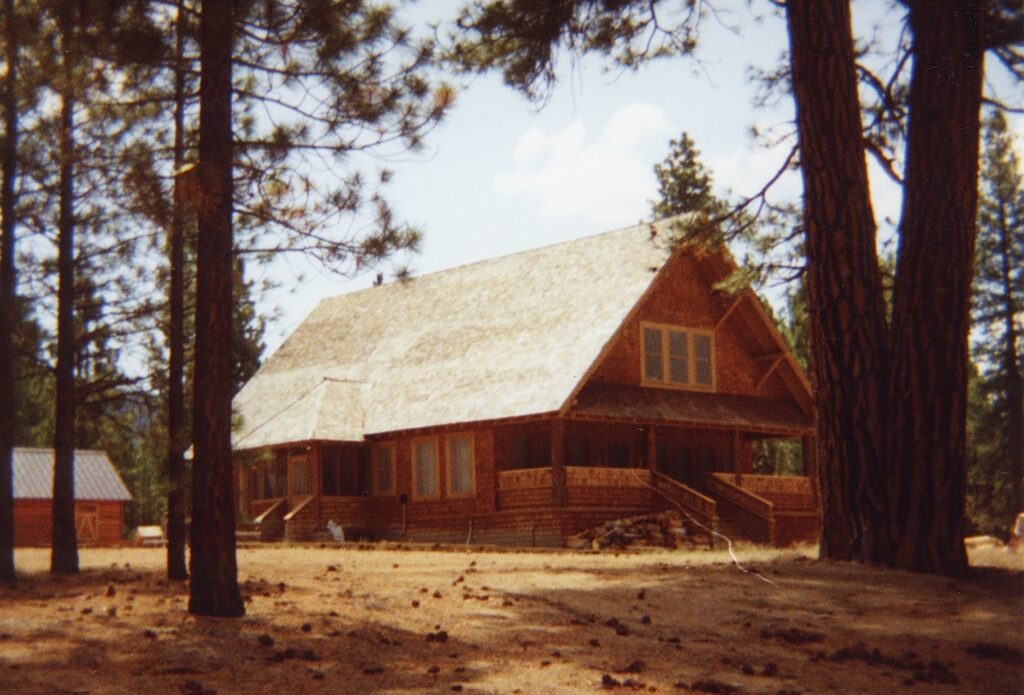
Gallatin House, 1992

In 1988, the forest service announced that they had approved a special use permit for thirty-five acres on the southeast side of Eagle Lake to the McDonald’s Corporation—the well known fast food chain. The property was transformed into a Camp Ronald McDonald for disabled and disadvantaged children. The Gallatin House is part of the complex. It houses some of the staff and administrative office space. However, it should be noted that front portion of the Gallatin House is still in its original state. An interesting piece of trivia, the last time I was able to inspect the house, with Gallatin descendants in tow, there was an oak table  the Gallatin family left behind in 1944, and it is still there.

Donate

The Early Origins of Coppervale Ski Area

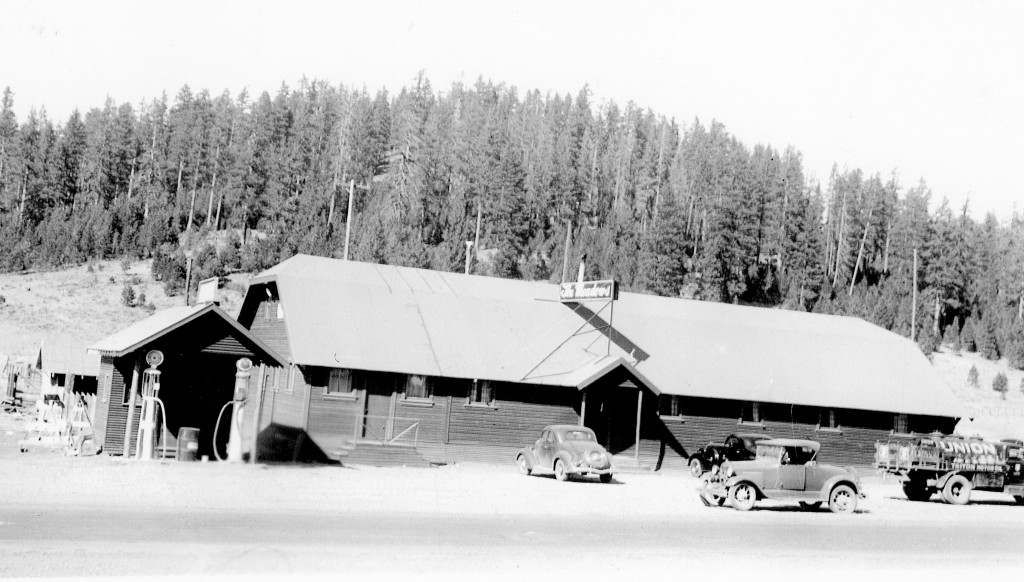
The Meadows. Courtesy of Darryl Hattenhauer

For those who enjoyed skiing at Coppervale this last season, you need to thank Bert and Mary Bain who established it and then Lassen College who has been operating it since the end of the World War II.

First a little background. Back in the 1930s several road houses were established along highway 36 between Susanville and Westwood. They initially started out simple first with a gas station and restaurant, and later expanding. One of these was The Meadows which was located across the highway from the base of Coppervale.

At the same time, skiing, and more particularly ski jumping was all the rage throughout Northern California, where numerous professional events were staged. In 1934, the Paul Bunyan Ski Club of Westwood even sponsored one which they built a ski jump on Fredonyer.  In the spring of 1935, Bert and Mary Bain purchased The Meadows. First they expanded operations with an enlarged restaurant, but added a bar and dance floor. To attract amateur skiers, Bain had a ski jump constructed across the highway from The Meadows. Bain recruited noted skiers Sid Knudson and Phil Brown to design and build a small jump for his guests, and thus the Coppervale Ski Hill was born.

Support by subscribing.

Pearl of Lassen County

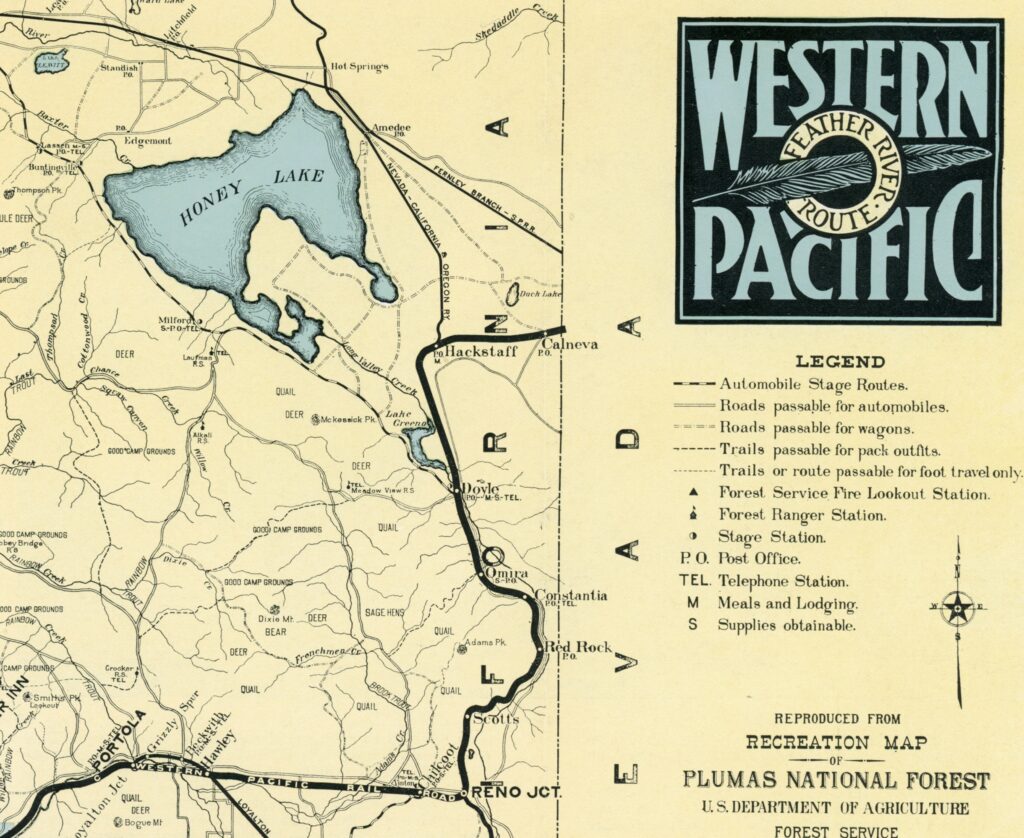
A portion of the map from the brochure

Personally, travel brochures, past and present,can provide for some interesting creative writing. Case in point is the Western Pacific’s Railroad brochure: A Story of the Feather River Canyon. While it has no date, there are details inside that is was probably published for the Panama Pacific Exposition held in San Francisco in 1915. While the brochure focus on the many attributes of the Feather River Canyon, it had this interesting piece about Honey Lake.

“Away from the Feather River are the lakes—the most wonderful lakes of the American continent—and these are reached by rail in connection with the ever convenient automobile stage. The pearl  of Lassen County is Honey Lake, so long famous for its waterfowl that even pioneers knew of it in their day; and one of the most traveled overland trails, branching off in Wyoming, had this lake as its objective. Honey Lake and the country thereabout is readily reached by leaving the main line at Doyle.”

Support by subscribing.


Exploring Lassen County's Past