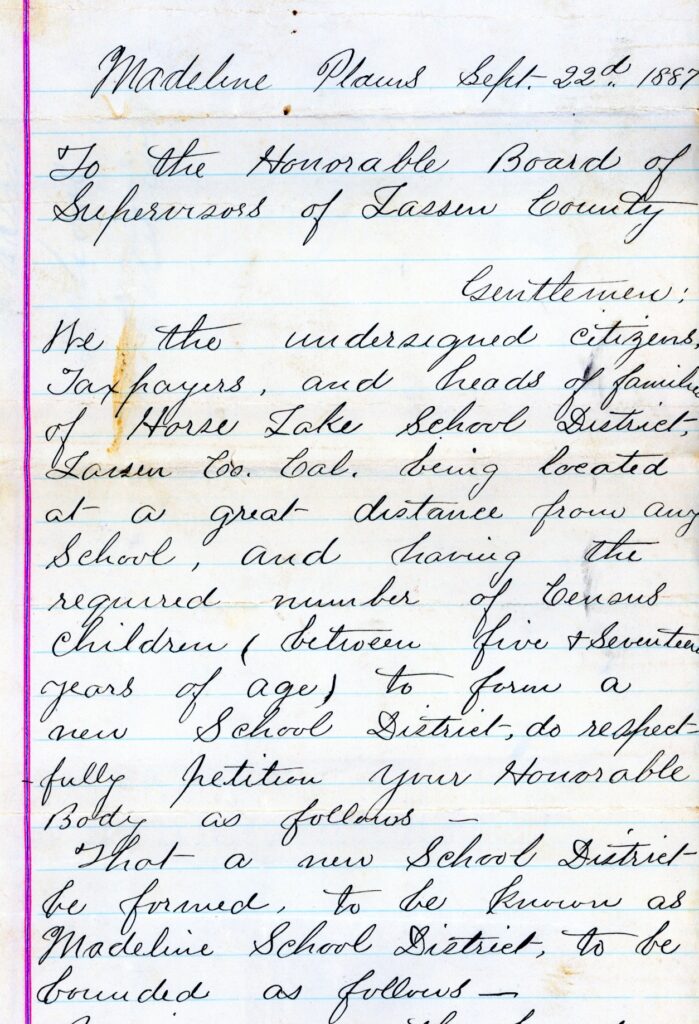
In the fall of 1887 Madeline Plains residents petitioned the Lassen County Superintendent for a new district to be named Madeline. It was signed by thirteen residents who have sixteen children. After all, they cited the nearest school was Horse Lake. In 1888 the petition was granted.
A school house built at the A.W. Pinneo, three miles south of the present day Madeline. Then, in 1902, courtesy of the NCO railroad saw the creation of the town of Madeline. The district hired Ike Metcalf to construct a new school there. In the fall of the 1927, that school was destroyed by fire. The school trustees had planned to construct a new building. But another opportunity arose, and they purchased Cliff cCarter’s house and converted into a school. The Madeline School closed in 1968.
An astute Fish & Game deputy, C.O. Fisher who was stationed in Susanville during 1920s kept records of the wildlife in the region. He noted that was a band of forty big horn sheep (Lava Bed Bighorn) that lived on Observation Peak of the Madeline Plains country. Fisher believed that they all had perished during the severe winter of 1922. In the summer 1923, Fisher found horns and skeletons of the sheep on the mountain.
By happenstance, in 1927 Fisher discovered a small herd consisting of four females and two males in upper Smoke Creek/Painter Flat region. What is became them is not known.
This Amedee business partnership lasted less than a month. Courtesy of Tom Armstrong
Today marks the fourteenth anniversary of the passing of the famed jazz musician Dave Brubeck. One of his most notable pieces was Take Five.
Many people may not be aware that Dave’s family played an integral role in the region’s history. His grandfather, Lewis Warren Brubeck, settled on the east side of Honey Lake at a place known then as Lower Hot Springs in 1881. To build his home and outbuildings he rafted the lumber across Honey Lake from Milford. Dave’s father, Peter Howard was born there. In 1890, the NCO Railroad arrived at Brubeck’s Ranch and it was transformed into the bustling community of Amedee. Lewis was married to Louisa Grass. That family had deep ties in the region’s history. Seasons residents might not beware the late Beth Doyle and Erma Haley, were both Grass descendants.
Dave’s aunt, Mabel Brubeck was the first person buried in the Amedee Cemetery. After the family sold their holdings and moved to Concord, one member would return, William. Will Brubeck had a small homestead across the highway from the wild horse corrals. Of course he had numerous cousins in the region. After all, Litchfield was named for his aunt and uncle (Mary Grass and Andrew Litch). One of the more interesting cousins, who happen to marry in the George Wingfield family was the intrepid explorer, Leonard Clark.
Subscribe today to receive daily notifications and more about Lassen County history.
Just a friendly reminder to buy your calendar, as inventory is low at this point. Margie’s Book Nook has three, I have one available and that is it. Of note, I had several people comment to me that this was an especially excellent calendar.
The 1878 staff of the Lassen Advocate-Marge Hansen
During the month of December I will be examining the Lassen Advocate newspaper of 1898 and 1914. If you are interested in people, places or events, please let me know. I do have a long overdue request for Edward Hilder. In addition, obituary requests for Jesse Cole (1898) and John F. Hulsman (1914).
Ted Friend, publisher of the Lassen Advocate, 609 Cottage Street, Susanville, June 1944
It was on December 2, 1987 that the last issue of the Lassen Advocate rolled off the press. U.S. Bankruptcy Judge David Russell ordered the shut down of the 122 year-old newspaper. Richard Myers publisher, said, “They just took over, marched in with a locksmith and changed all the locks on the doors and told us to leave.”
Lassen County Times, October 19, 1978
Of course, there were the chatter of all arm chair quarterbacks as to what went wrong. There was debt of new building, now home of the Susanville Police Department. Also, on October 18. 1978 the Lassen County Times made its debut and now the Advocate had competition.
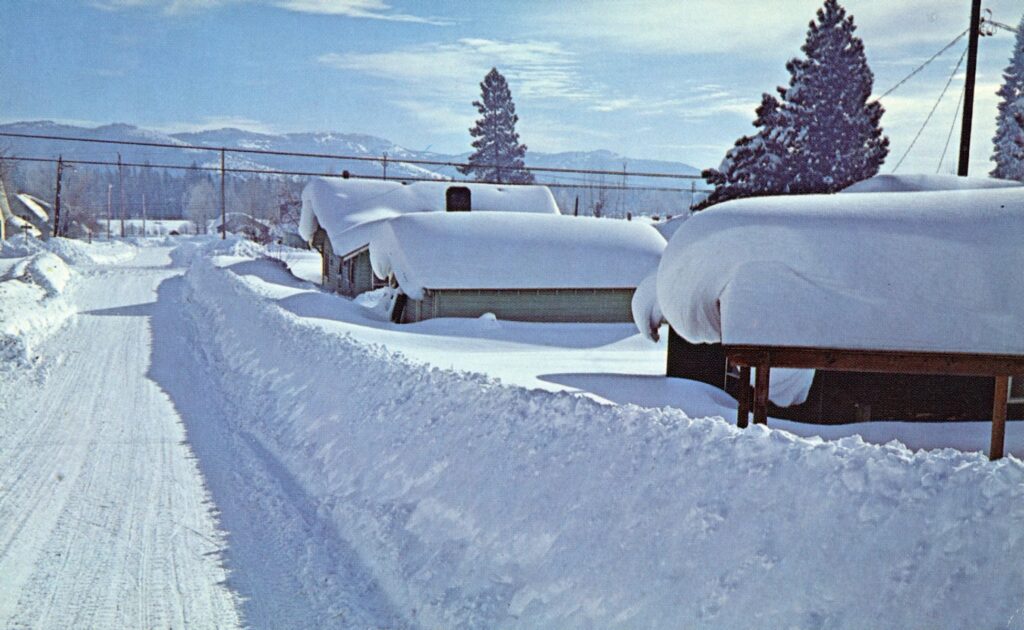
Today marks the beginning of meteorological winter. Leading up to December some people approach me for a winter prognosis. First of all, my background is in law and history, a meteorologist I am not. Of course, I have studied the region’s weather history. That aside, as a life long resident, there is one winter prediction I can almost guarantee—no two winters are alike.
When I was growing up, I asked my Uncle Bob Rea the question what kind of winter will it be. His reply, “I will tell you in March.”
Tim
P.S. – For those out of the area, yesterday, the high temperature in Susanville was 25, with 92 % humidity and fog.
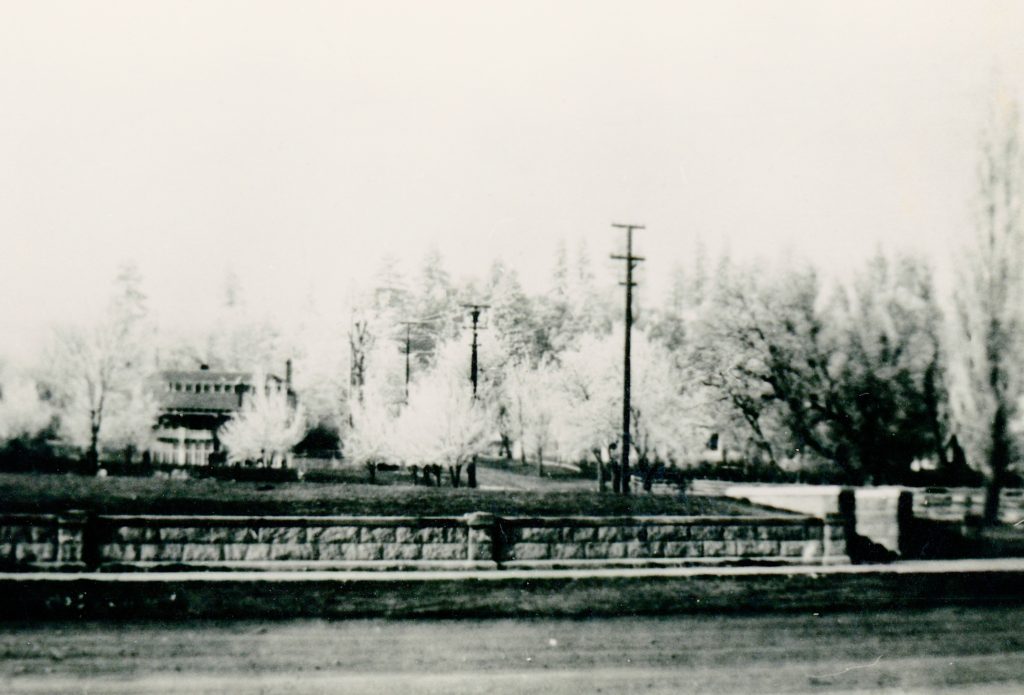
Pogonip by definition is ice fog found in mountain valleys, especially in the Great Basin, in the winter. Ideal conditions for its formation is lots of ground moisture’s and high pressure weather system. Thie result is an inversion, when moisture laden clouds were forced down the valley floor, and the dominant high pressure blocks storm systems and with no wind, so inversions is trapped. One can ascend a few hundred feet above the valley floor, bask in sunny temperatures and overlook a sea of clouds.
North side of the Lassen County Courthouse during a pogonip. Notice the trees are coated with ice crystals due to the freezing fog.
The term pogonip loosely translates into “white death,” for many Indians caught pneumonia and died. Pogonips vary in severity. A mild one might linger a few days or a week.The worst variety is when it turns into a literal ice fog, coating everything. The first day can be spectacular with ice crystal formations on everything. After several successive days of those bone chilling temperatures, it quickly loses its appeal. The pogonip of 1859 was one of severest on record in the Honey Lake Valley. The heavy cold fog lasted six weeks. So much frost accumulated on the grasses that cattle could not eat it. In addition, since the first settlers had been accustomed to mild winters, very little hay was put up, and a great many cattle starved to death that winter.
This is one the earliest pogonip on record in this territory. Long range weather forecast indicate no storms through mid-December. Time well tell when the pogonip breaks up. Hopefully, they are wrong, and the fog lifts by Sunday.
More than a decade ago, my book sales saw a deep decline. The last profitable book was that of my Red River Lumber Company series. If the truth be known, if it had not been for the Walker heirs of Red River, I would have been doomed. Another example, released in 2002 , and considered by many as my best work was the Lassen County Almanac: An Historical Encyclopedia. Even with rave reviews it did not sale out until twenty years later. Ouch.
Yet, from time to time, I have been asked to reprint a book, especially Eagle Lake and Lake Almanor. That is a pricey proposition that is a doomed financial failure. After all, I would be competing myself since BookFinder.com and other entities have my used books listed.
There is a related subject–calendars. Calendars have also seen sharp decline. I struggle to sale fifty. When I first corroborated with the Lassen High School Graphic Arts in 1979, we published 500! While program ended in 1999, I resurrected it. In 2017 I had 100+ calendars produced and that number has been reduced to half.
Dining Room, Folsom Ranch, Willow Creek Valley, circa 1900. Courtesy of Mary Dale Folsom
I wish every one good tidings and hopefully you enjoy holiday surroundings with family and/or friends.
I have not encountered any historical Thanksgiving observance of late 1800s in this region. It should be noted that there were a lot of New Englanders settled in Lassen County. The above photograph of Folsom Ranch, now the Willow Creek Wildlife Refuge just north Susanville was an example. Orman Folsom, the patriarch, settled in Willow Creek in 1871. He was a native of Maine. Ben Leavitt, the father of the Susan River Irrigation System, also hails from Maine. Two other notables from Maine: John Doyle, an early settler of Long Valley and for whom town Doyle for and Capt. C.A. Merrill the original promotor to tap Eagle Lake for irrigation to reclaim the sagebrush lands of Honey Lake Valley.
For the trivia minded, it was on October 31, 1939, that President Franklin Rosevelt signed a proclamation that designated the fourth Thursday of day of Thanksgiving. Prior to this, each region or states held their observance at different dates.


 Dave’s aunt, Mabel Brubeck was the first person buried in the Amedee Cemetery. After the family sold their holdings and moved to Concord, one member would return, William. Will Brubeck had a small homestead across the highway from the wild horse corrals. Of course he had numerous cousins in the region. After all, Litchfield was named for his aunt and uncle (Mary Grass and Andrew Litch). One of the more interesting cousins, who happen to marry in the George Wingfield family was the intrepid explorer,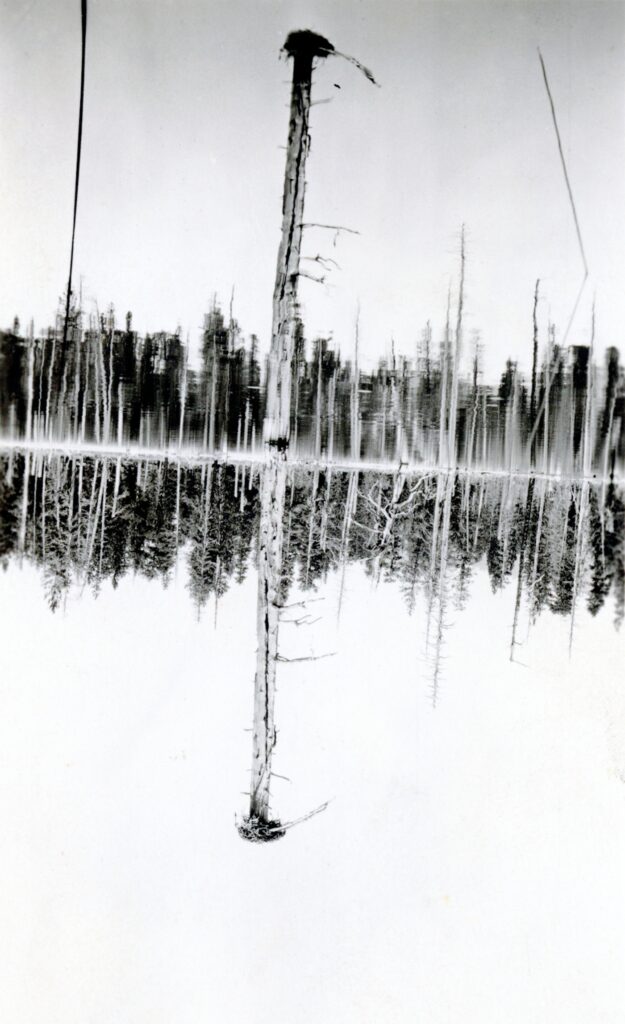



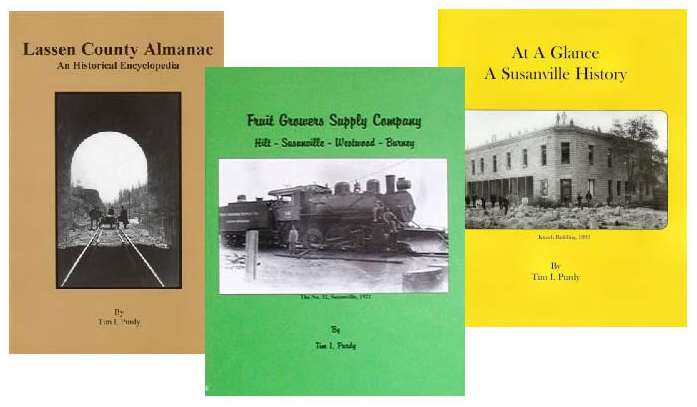 More than a decade ago, my book sales saw a deep decline. The last profitable book was that of my Red River Lumber Company series. If the truth be known, if it had not been for the Walker heirs of Red River, I would have been doomed. Another example, released in 2002 , and considered by many as my best work was the Lassen County Almanac: An Historical Encyclopedia. Even with rave reviews it did not sale out until twenty years later. Ouch.