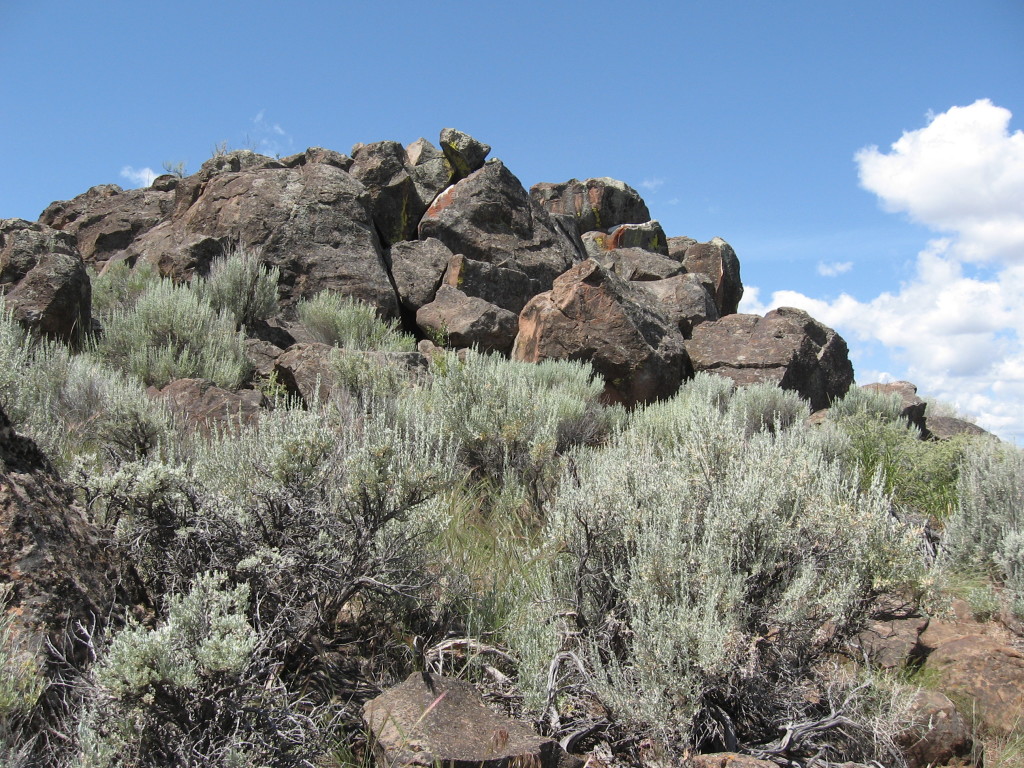
The site looking towards the sunrise chamber, June 2, 2015
On Sunday morning [June 21, 2015] about a dozen subscribers were determined to rise early to witness the summer solstice at Belfast—best known for its petroglyphs. However, it is known internationally among those in archeoastronomy field. Upon our arrival, were a group of three from San Francisco who had the same intentions. Continue reading 2015 Summer Solstice Update→
After Heath departed from Spanish Springs his next stop was at the McKissick Ranch in Secret Valley, managed by C. L. Hudgins for J.L. Humphrey owner of the ranch. Hudgins wife gave the following warning to Heath for his next destination, Wendel:
On finding we were to cross considerable real desert, Mrs. Hudgins warned me, in crossing the desert there was a plain trail, never to leave that trail in trying to cut across. The Hudgins knew all about that whole country, I may say, for hundreds of miles around. She told me that in leaving the trail many people got lost and frequently perished. First they would find themselves lost, got confused and get to weaving back and forth or traveling in a circle, and frequently never would get out of alive. Continue reading Frank Heath, Part II→
Many an interesting character has passed through Lassen County over the years. In early 1927, was World War I veteran Frank Heath. He was on a mission to ride horseback through every state of the Union on a single horse. He left Washington, D.C. on April 1, 1925 on his horse he named the Gypsy Queen. In all he would travel 11,523 miles and on November 14, 1927 arrived back in Washington, D.C. Continue reading Frank Heath→
Susanville’s first hotel, if you could call it such was Cutler Arnold’s story and half structure of hewn logs. For two years, beginning in the Spring of 1857, it housed the town’s only dining establishment, meals costing seventy-five cents.
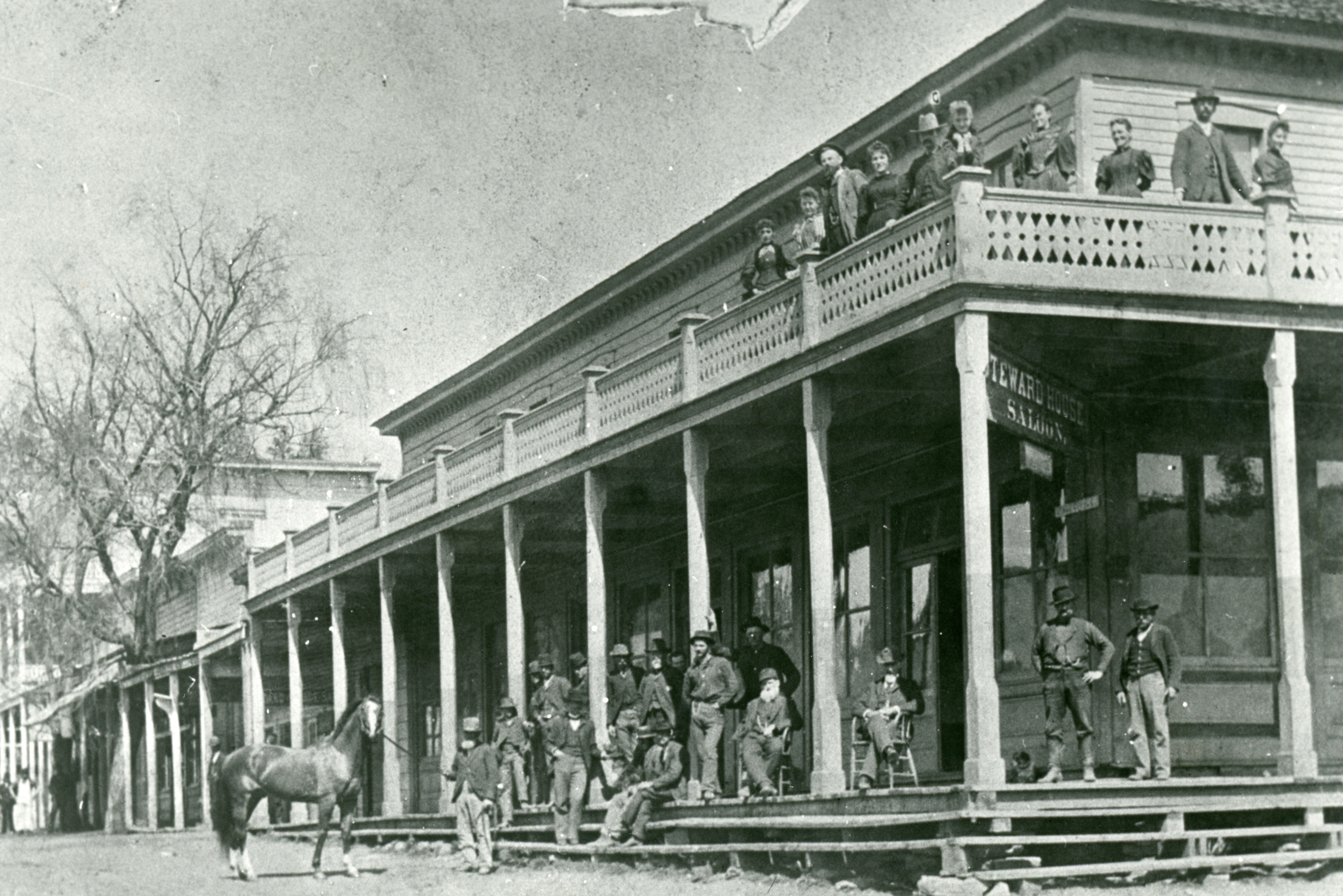
As the town progressed so did the accommodations. In 1860, Emanuel “Mike” Brannan built a two-story hotel on the northeast corner of Main and Lassen streets. It was a transitional period, as the days log structures were being placed with wooden framed ones. Brannan operated the hotel for the next four years, and due to some financial problems lost the hotel. Just as the Brannan House had replaced Arnold’s, Brannan’s was replaced by the superior Steward House in 1864.
The Brannan House did not fade away entirely. Its second floor was converted into lodge hall for the Masons and the Oddfellows. The first floor was used for a variety purposes including that of the post office and the government land office. In 1880, it was torn down and replaced by a new Oddfellows Hall.
Gallatin is one of the many intriguing figures in California history. This native New Yorker arrived in California in 1860, and the following year located at Sacramento. It was fortunate timing on his part to land a job in hardware store owned by Huntington & Hopkins. At the same time, Huntington and Hopkins would join forces with Crocker and Stanford, to become the “Big Four” and establish the Central Pacific Railroad. As a junior partner in the hardware business, became quite lucrative providing materials for the railroad. In 1877, he built the Gallatin House and in 1903 it became the California Governor’s Mansion.
The prosperous Gallatin began branching out into numerous endeavors including the sheep business. Gallatin needed summer range for the sheep, and discovered Eagle Lake. In a two year period in the late 1880s he purchased nearly 5,000 acres of Eagle Lake properties for $9,000. The bulk of the purchases were timberlands, with the exception of Hall’s Papoose Meadows and William Dow’s ranch near present day Spaulding Tract.
With the exception of Gallatin being Eagle Lake’s largest property owner, his influence otherwise was minor. In 1905, he passed away and his second wife, Malvena, had the lasting impact on Eagle Lake. After all she introduced Leon Bly to Eagle Lake.
Names of places changed quickly when the gold seekers rushed into Honey Lake Valley. This stream was a prime example. It was first called Commanche Creek, then Irishman’s Creek, and, in 1860, became known as Lakes Creek. Sometime in the early 1860s, it finally became Baxter Creek named for John Baxter (1812-1880), a native of Dundee, Scotland, who came to California in 1849 and to Honey Lake Valley in 1857. Baxter located along the lower end of the creek, about a mile east of Buntingville. On May 27, 1867, Baxter, with his partner, Edward Bartlett, sold this property to Robert C. Hayden for $3,750. This sale led to a fatal mistake for both Hayden and Bartlett.
For the first day of summer, I thought I would share this picture of Constantia taken on June 21, 1907. Unfortunately, I do not possess any other documentation and no reference made in the newspaper, other that it was unseasonably cold. I went through my various notes of Phil Hall, who provided me with the photograph. His parents at that time resided at Constantia. However, anyone who has resided around these parts, have experienced numerous strange weather events. In a related matter, Claude Wemple told me in a 1978 interview that Milford received four inches of snow on July 4, 1902.
Susanville’s Stewart House, 1881. It sometimes was used as a hospital. Courtesy of Dallas & Joyce Snider
Susanville’s first hospital was not built until 1883, and prior to that it was druggist that played a key role in medical care. In the summer of 1860, Dr. Zenas J. Brown arrived in Susanville and began dispensing drugs from a canvas tent. He met with commercial success and at 802 Main Street, he had an octagonal drug store built—which the locals gave him the nickname of Doctor Eight Square. The following year he was joined Dr. Robert F. Moody, and Moody would become sole proprietor of the firm within three years. Dr. Brown it should be noted introduced the first apple trees to the region, which at one time was a major export crop.
For indigent care, those person’s were housed in a local hotel, until they either recovered or not, which the county picked up the tab. For instance, in September 1864, Emanuel “Mike” Brannan, proprietor of the Brannan House, submitted a claim to the county in the amount of $75.31 for lodging, medical and burial expenses of John Tuskey.
Then there is Dr. Zetuz N. Spalding’s arrival to the region in 1857, and would later be the founder of the venerable Spalding Drug Store. One of Spalding’s earlier advertisements noted his many skills: “Z.N. Spalding, Physician, Surgeon and Accoucheur. Teeth extracted without pain, by use of Anaesthetics.”
On a final note, the Lassen County Historical Society’s April 2015 newsletter had a short piece on R.F. Moody. A little known fact, was Moody placed Lassen County’s first billboard back in the late 1870s on the Horse Lake Road. Carved in stone he advertised his Sagebrush Liniment.