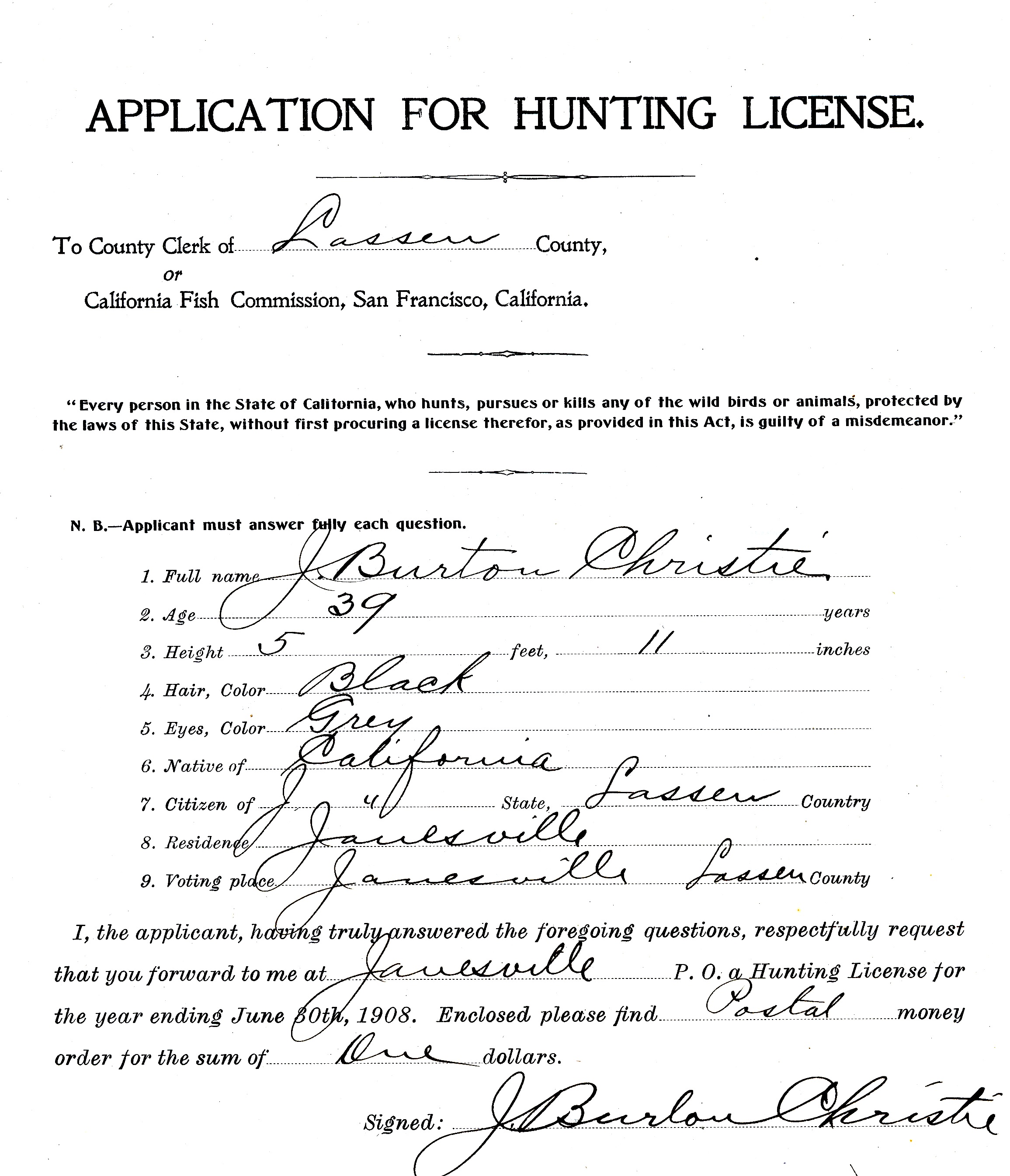
Did you feel that little nip in the air the other morning? Hunters in the Honey Lake Valley area know what it means—dove season. Doves are not fond of cold weather, and start their southward migration. If I could fly south for the winter with them I would.* Continue reading Hunting Licenses→
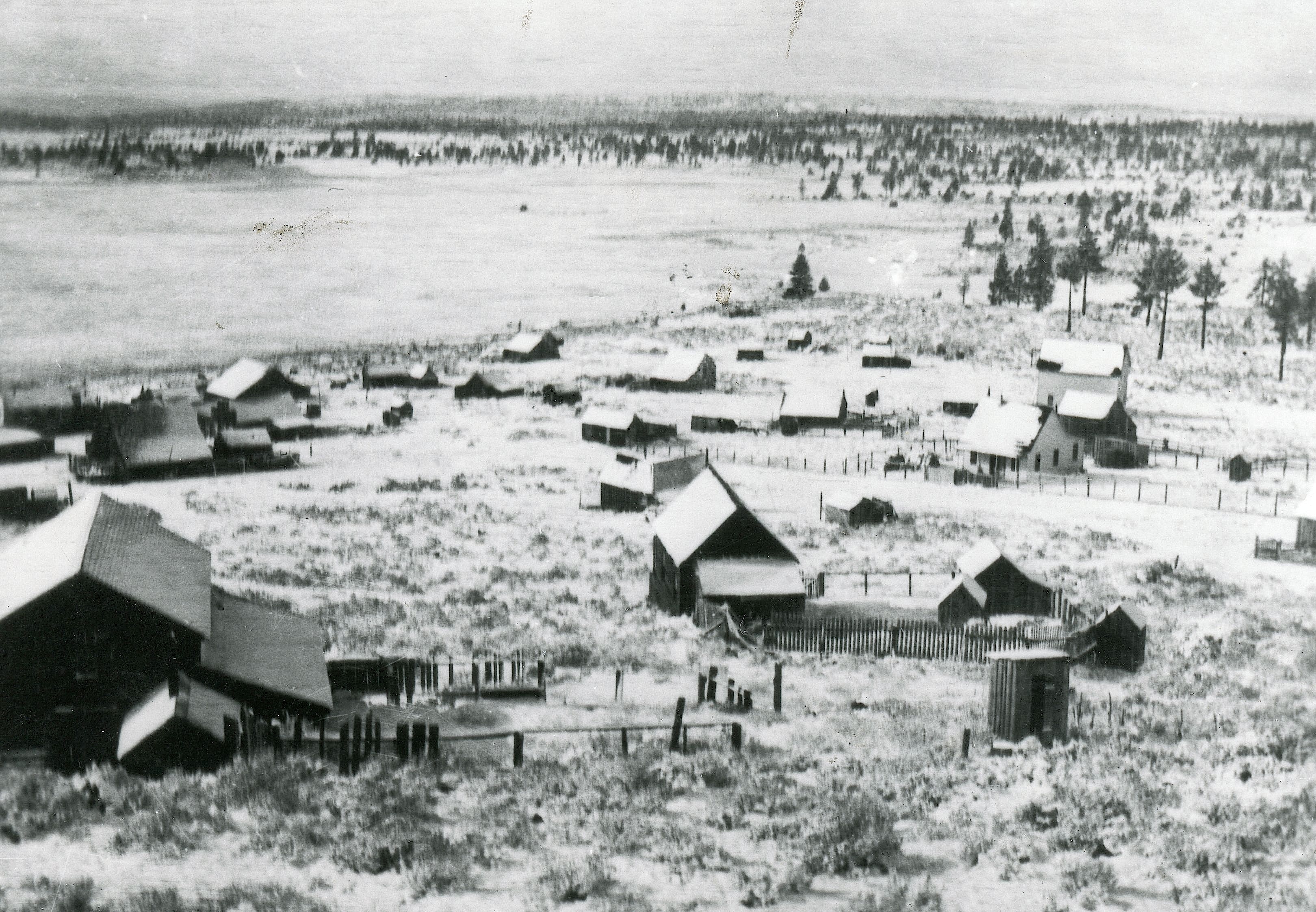
Today, it being Saturday and its August, it means it is Farmer’s Market at the Susanville Depot. However, it was not always scene of lively times. On October 12, 1979 the Southern Pacific closed the depot. Continue reading Susanville Depot Closed→
On May 11, 1896, the Diamond Mountain Creamery was incorporated which consisted of William Brockman, John T. Masten, Charles Lawson and M.W. Hoffman. In their initial stock offering they raised $4,750, far short of their goal of $10,000. However, that did not prevent them from their goal of a creamery for the Honey Lake Valley. Continue reading Diamond Mountain Creamery→
Some may remember when I posed a question earlier, who was the most influential person in Lassen County. Well, it is T.B. Walker, founder of the Red River Lumber Company. His impacts are far and wide, and still lingers today. The historic Lassen County Courthouse came to be with Walker’s influence at the ballot box to pass the bond measure. Off tangent for a bit, there are some who think Isaac Roop is the most revered figure Lassen County has ever experienced. If you look at the record, Roop made a killing so to speak as a realtor, selling land that he did not own. Benevolent and generous, I do not think so, he sold—not donated—the courthouse block, and put in a covenant that if no longer used by the county it reverts back to his heirs. Enough said. Continue reading T.B. Walker→
Hayden Hill was Lassen County’s only mining community. Like so many others it went through boom and bust cycles. In 1908, a new vein of gold was discovered and another resurgence was on its way. The Golden Eagle the Hill’s largest mine, hired 100 men for the initial operation and more were added to the payroll. In addition, the Lassen Mining Company’s Juniper Mine enjoyed good fortune and they had over 100 men on the payroll. Continue reading Hayden Hill, 1910→
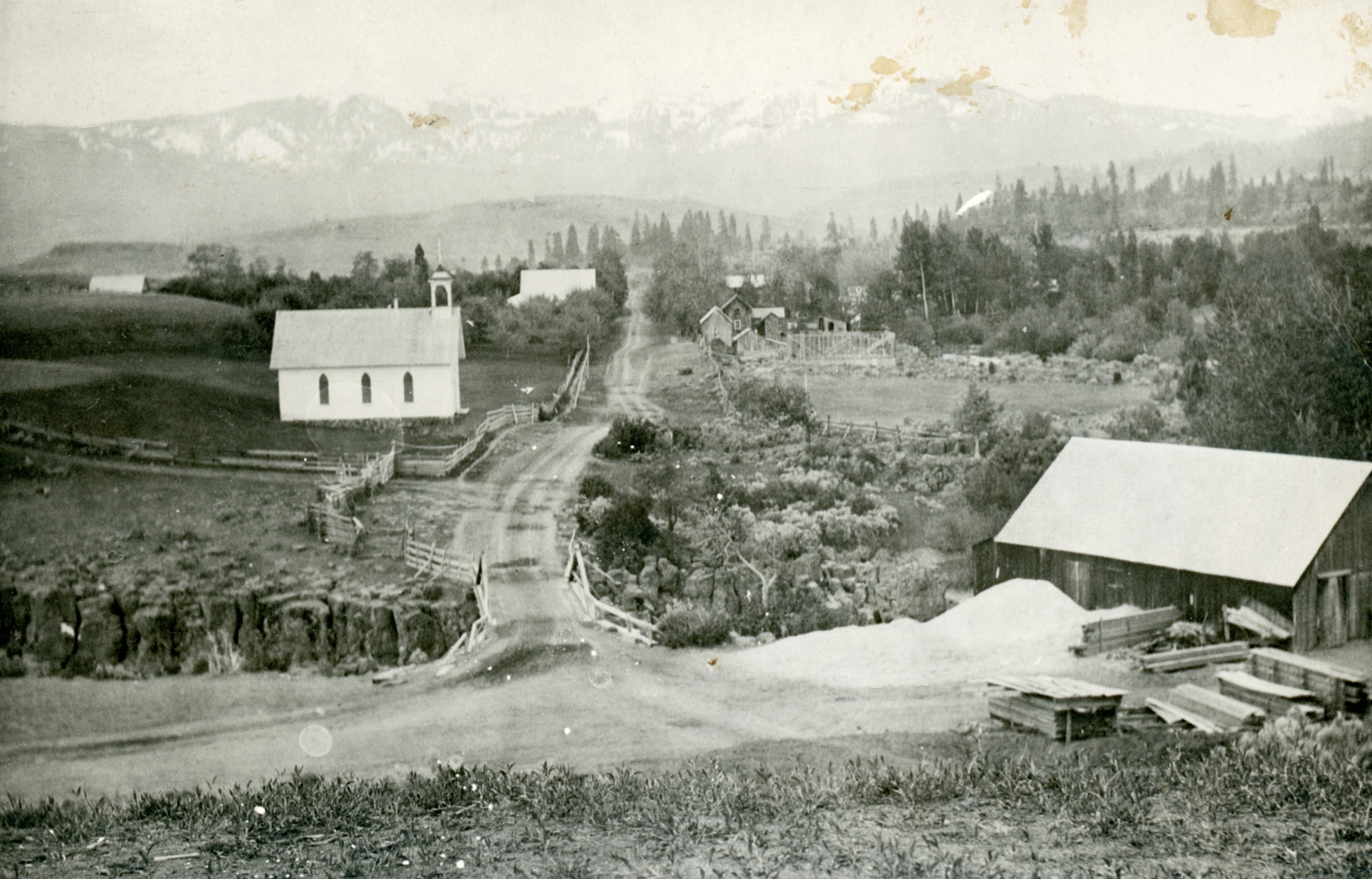
Prior to the Fernley & Lassen Railroad’s arrival in 1912, Richmond Road, just across the Susan River was a bucolic dirt road. It consisted primarily the homes of the Cains and Winchesters, with their apple orchards. Though during the 1890s, along the Susan River was the town’s first Catholic Church, its Chinatown and of course the iconic landmark Arnold Planing Mill. Continue reading Susanville – Richmond Road→
In December 1856, Manly Thompson located near the base of this mountain and built one of the first cabins in the region. Like so many of the original settlers of the Honey Lake Valley he moved onto he did remain in the region and moved on. On October 27, 1875, Thompson sold his 276-acre ranch to James P. Sharp for $6,000 and moved to Elko, Nevada. His lasting legacy of the region is his name applied to this prominent peak.
Recently, I had accidentally stumble upon this most interesting website concerning Thompson Peak. It is worth the gander. For me it brought back some interesting memories when my brother, Gary and others, including yours truly, gave serious consideration of climbing its rock face back in the mid-1970s.
Subscribe and support this site for as little as $4.17 a month.
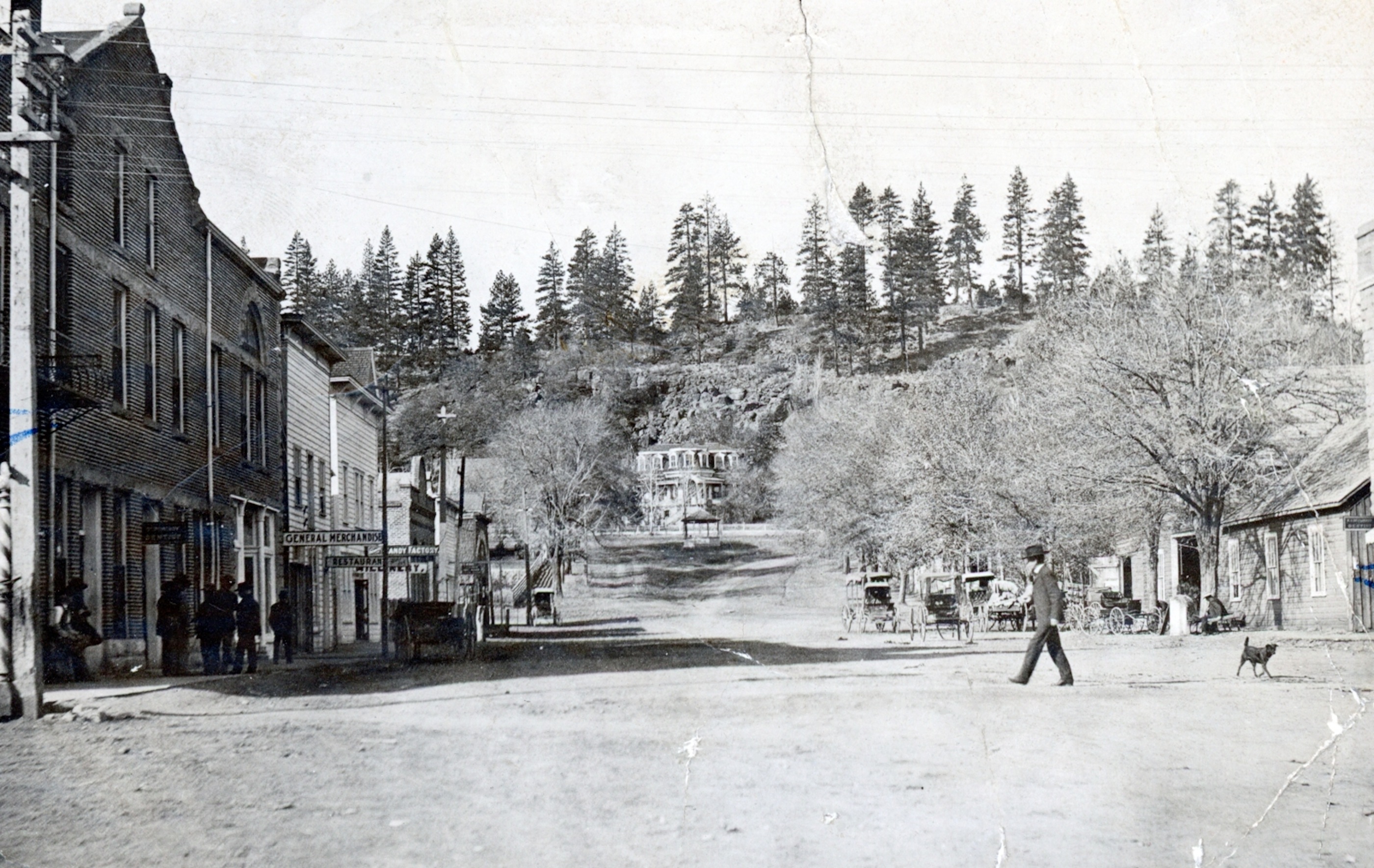
Looking west on Main Street, at Lassen, 1906. You can see the bandstand in the background. By the way, the gentleman crossing the street is Dr. W.E. Dozier. Photograph courtesy of Betty Barry Deal
A little known fact is that Susanville had its own bandstand. It was located at the top of Main Street. It was through the energetic efforts of the Mountain Echo Band. In September 1902, the octagonal bandstand was constructed and even adorned with electrical lights. On September 14, 1902, the bandstand was dedicated by the Mountain Echo Band with their first concert. Two weeks later it was focal point of royal pageant during the county fair. A few years later the Mountain Echo Band disbanded and the bandstand fell into disrepair. By 1906, one observer said the relic had become eyesore on the community. In 1908, it was torn down.
Subscribe and support this site for little as $4.17 a month.
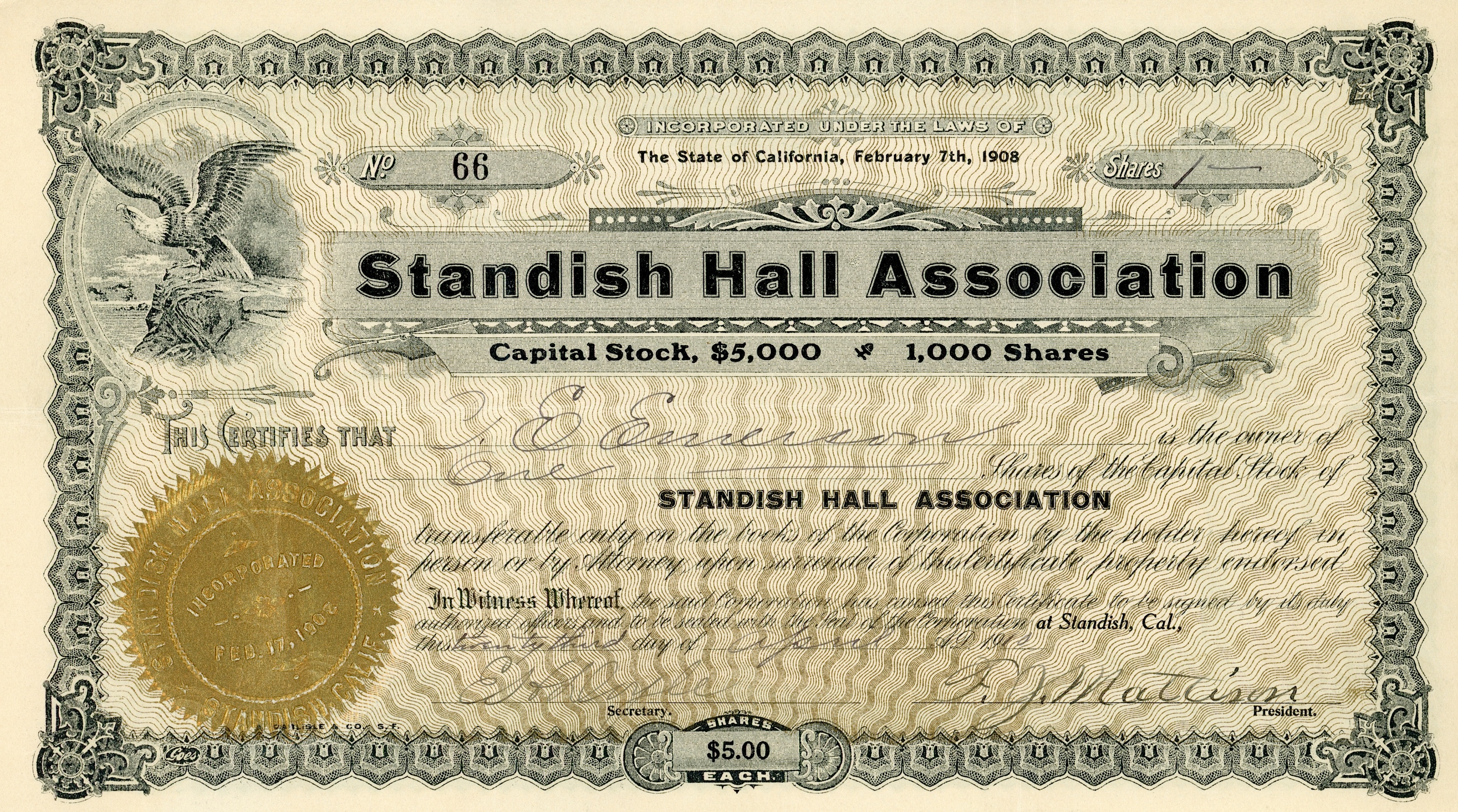
Stock certificate courtesy of Dick and Helen Harrison
On a recent trip to Standish, to see if the gossip was true that work on the demolition of Neil’s Mercantile was underway. Suffice to say, it was not true, but discussions have been in the works for the past few years. Continue reading Standish Hall Association→
In reality, Westwood had two distinct communities—the town proper and the neighborhood on the other side of the millpond. Mill B and the initial housing quarters were constructed on the east bank of Robbers Creek. All of the permanent facilities, including Mill A and the town proper were built on the west bank. The older community had been referred with several designations. In the early years, some called it Oakland, others Baytown. Whatever the case may be, residents of Westwood stated it was where the “foreigners” lived—mainly Italians and Mexicans. References in a pre-politically correct era dubbed the place Dago Town. Eventually, using a less derogatory tone it evolved into Old Town—being the original location of Westwood.
In the summer of 1943, a contest was held to rename Old Town. Thirty-nine people suggested ninety-two names. The new name selected was Pine Town submitted by Roger Mentick who received a $15 prize in War Savings Stamps.
Subscribe and support this site for as little as $4.17 a month.