Noble’s Emigrant Trail

This sign was located for many years in Lassen Volcanic National Park.

In the late summer of 1850, William H. Nobles (1816-1876) arrived in California to locate a direct route to that state’s Northern sector. Once travelers left south of the City of Rocks, Idaho and arrived at Lassen’s Meadows (now Rye Patch Reservoir, Nevada) the choice of routes to Central and Northern California were limited. They had the option of crossing the 40 Mile Desert, then being confronted with Carson or Donner Passes. The other option was to take the Applegate and Lassen Trail. The Lassen Trail had its drawbacks too, one being that it was 250 miles longer than the 40 Mile Desert route. In the spring of 1851, Peter Lassen guided Nobles to the Honey Lake Valley via Indian Valley. At that point, Nobles and Lassen parted company and Nobles made a thorough evaluation of the country. Nobles found a direct route from Lassen’s Meadows, that went in a westerly direction across the Black Rock and Smoke Creek Deserts, to the Honey Lake Valley. From there, the course went in a northwestern direction to Pine Creek Valley and turned due west along the northern base of Mount Lassen and into the Sacramento Valley, near Redding. In February 1852, Nobles led a party that included Peter Lassen over the route that he had explored the previous year. Nobles had hoped they would join him in forming some type of partnership to develop the new route, but they were not interested. In April 1852, Nobles addressed the citizens of Shasta, informing them that he had indeed discovered a direct route across the mountains. This trail would be a great benefit to Shasta and the northern mining communities. Nobles requested a $2,000 guide fee. If the Shasta business community found the route unacceptable, Nobles would decline his fee. On May 3, 1852, Nobles, and a group of nine men, left Shasta to travel over the route. When they reached the Humboldt River at Lassen’s Meadows, the Shasta delegation declared the new route had more than met their expectations. Nobles was paid his commission and, at the Humboldt, he parted their company to join another outfit that was returning to the Eastern U.S.
Subscribe!

Sacred Heart’s St. Patrick’s Dinner

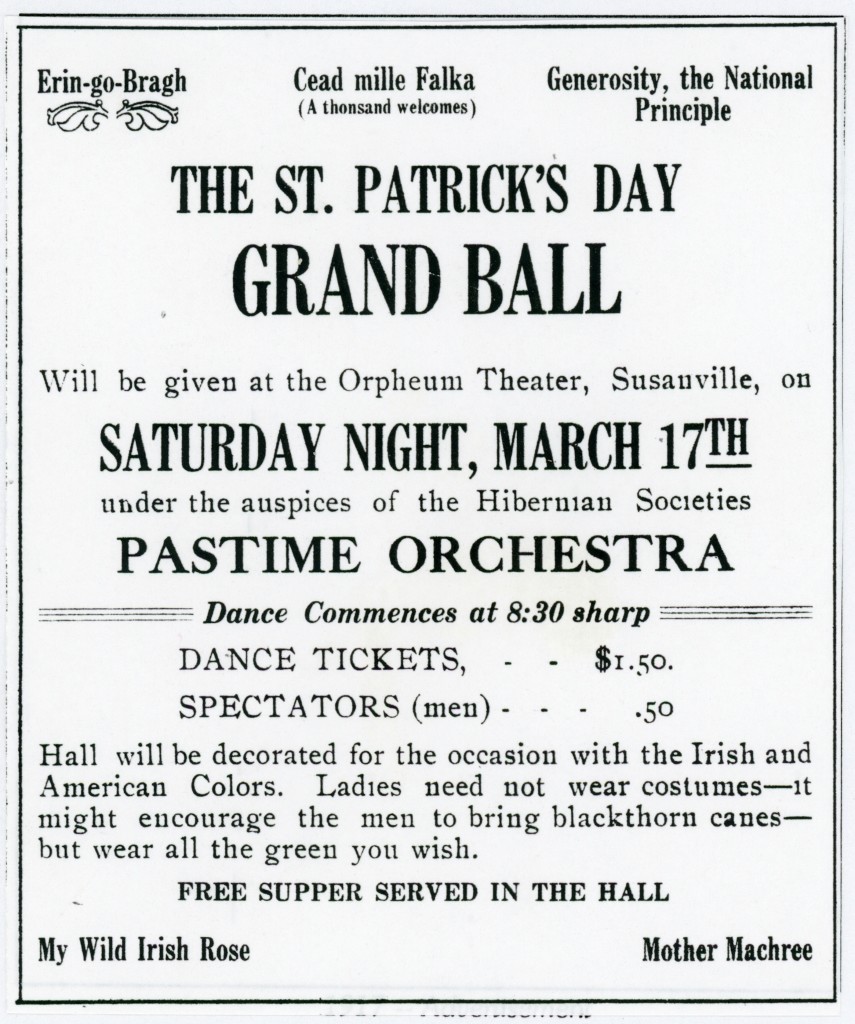
1917 Advertisement for the first St. Patrick's Dinner sponsored by the Sacred Heart Church
1917 Advertisement for the first St. Patrick’s Dinner sponsored by the Sacred Heart Church

Who knew back in 1917, when Father P.J. O’Reilly announced the Sacred Heart Church would celebrate St. Patrick’s Day, that it would be an enduring tradition now in its 100th year.  It is the oldest continuous event in Lassen County, surpassing even the Lassen County Fair. This year’s event will be held on Saturday, March 18 from 4 p.m. to 7 p.m., at Monsignor Moran Hall on Weatherlow Street  Believe me, as I can attest they serve the best corned beef around. There is always the cake wheel that can be very entertaining.

Father O’Reilly’s first event was nearly an all nighter.  As was the custom of the day, entertainment and dancing occupied the first half of the evening. Then at 11 p.m. a supper was served and then the dancing resumed into the “wee hours of the morning.”  At the conclusion, Father O’Reilly commented that it was a  a very successful affair  socially and financially.

Subscribe!


Milford Flour Mill

Milford Flour Mill
The abandoned Milford Flour Mill as it appeared in 1901. Courtesy of the A.J. Mathews family

One of the first agricultural enterprises undertaken in Lassen County was the establishment of flourmills. Due to the region’s isolation during the 1800s it was important for the region to self sustain itself. One of the most important products needed by the residents was flour. In 1861, J.C. Wemple and Judson Dakin built the region’s first flour mill at Milford. In 1882, H.H. Dakin, built a larger, more efficient mill at Janesville, which eventually replaced the Milford mill. The Milford mill did remain in operation until the late 1880s. In the 1890s, the mill was abandoned and in the early 1900s it finally collapsed. Other flourmills were established at Bieber, Janesville, Johnstonville and Susanville, more on those later.

Subscribe!

Red River: End of an Era

The installation of the Hammerhead Crane at Westwood, was one of many improvements to entice buyers.

Estate Sale: I need to make room for items from my mother’s estate. This a great bargain 50% off, a big deal your cost $12.50 plus shipping. What a deal!

It is only appropriate to feature this volume, number four in the Red River series, as last week featured volume number three.  It was originally thought that Red River’s Westwood mill would operate into perpetuity.  However, in less than thirty years in operation proved that theory wrong. There was the family drama, not all wanted to dispose of Westwood, but those that did out numbered those wanting to exit. On the bright side, with World War II, the demand for lumber soared, and so for once did Red River’s profits.  Thus, it seemed conditions were ideal to unload it, but Westwood was an albatross. No one wanted a mammoth mill, let alone a company town. Red River’s bargaining chip, it still owned vast swaths of timber and that is what the buyers wanted.
In addition to the saga of Red River’s departure from Westwood, this volume also wraps up a lot of loose ends. Included are such issues of what became of many of its landmarks, and that of the roadhouses that was once a dominant feature between Westwood and Susanville.  In addition, are Westwood institutions such as the Westwood Auto Club, the Westwood National Bank among other topics. To order your copy, is just a click away, here.

Subscribe!

Cemetery Tours

The grave of Daniel Cramer, September 21, 2016. This was part of the Oktoberfest Cemetery Tour.

Last year at this time I conducted a St. Patrick’s Cemetery Tour, in which we visited the graves of the various Irish immigrants who played a role in the region’s heritage. Last October we did a Oktoberfest Cemetery Tour, similar to the St. Patrick’s, but the focus was on the German immigrants.

While, of late, I have not given much consideration of future cemetery tours. There has been an informal discussion about a cemetery tour this fall to focus on the county officials buried in the Susanville Cemetery as part of the centennial Lassen County Courthouse celebration.  Whatever, the case may be I am always open to suggestions.

Subscribe!

1940 Population Figures

Lincoln School
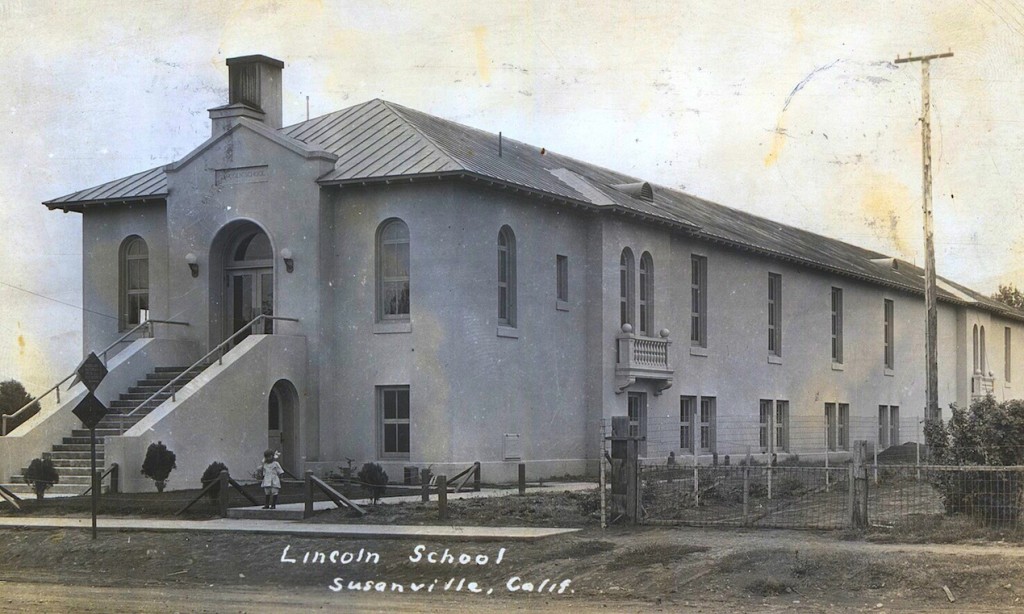
Lincoln School, 1924. I purchased this photograph on Ebay. Your donation and/or subscription is a great boost to acquire and save  items, to share with everyone.

While researching the pre-history of Eagle Lake’s Spaulding Tract, one just never knows what I locate in the search. I thought the following would be an interesting tidbit to share.

In 1940, the school enrollments for elementary (Washington, McKinley, Lincoln and Roosevelt) along with the Lassen High School and the junior college totaled 1,445. In contrast, the population for Susanville was 1,575. Confused? First of all, the Susanville city limit stopped at Weatherlow Street to the east, and to Susan River on the south. The Lincoln and Roosevelt elementary schools, as well as Lassen High School, were located in the county.

Support by subscribing.

Eagle Lake’s North Shore

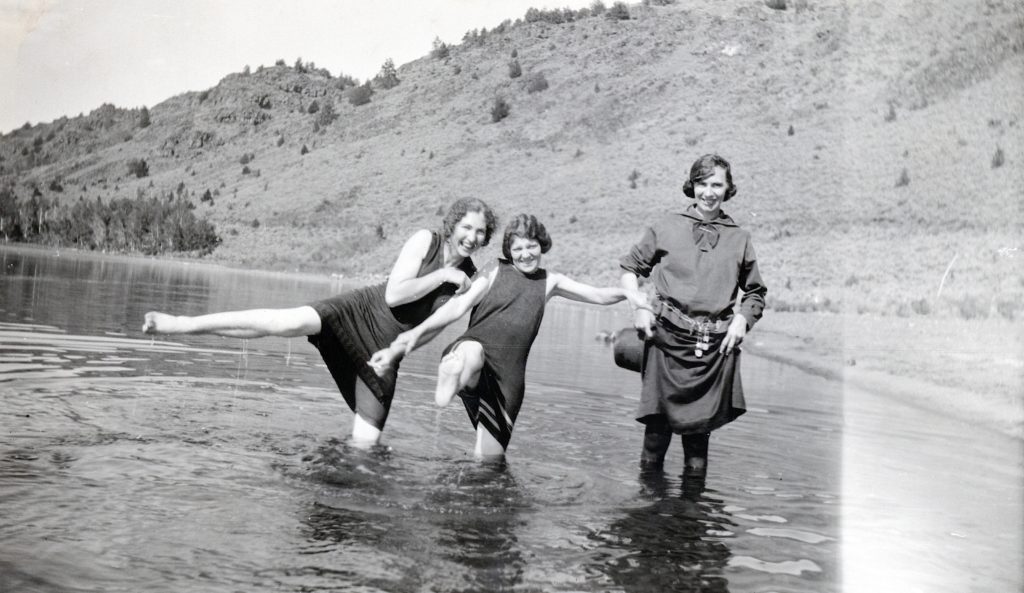
Having a bit fun at Eagle Lake's north shore, 1923.
Having a bit fun at Eagle Lake’s north shore, 1923.

While the calendar and the weather indicates it is March, many us can start thinking of a variety activities for the coming summer. For recreational aspects at Eagle Lake, the emphasis is usually centered around the south shore.  Those who resided closer to the lake’s northern shore did not prevent them frolicking in the water. Continue reading Eagle Lake’s North Shore

Red River: The Turbulent Thirties

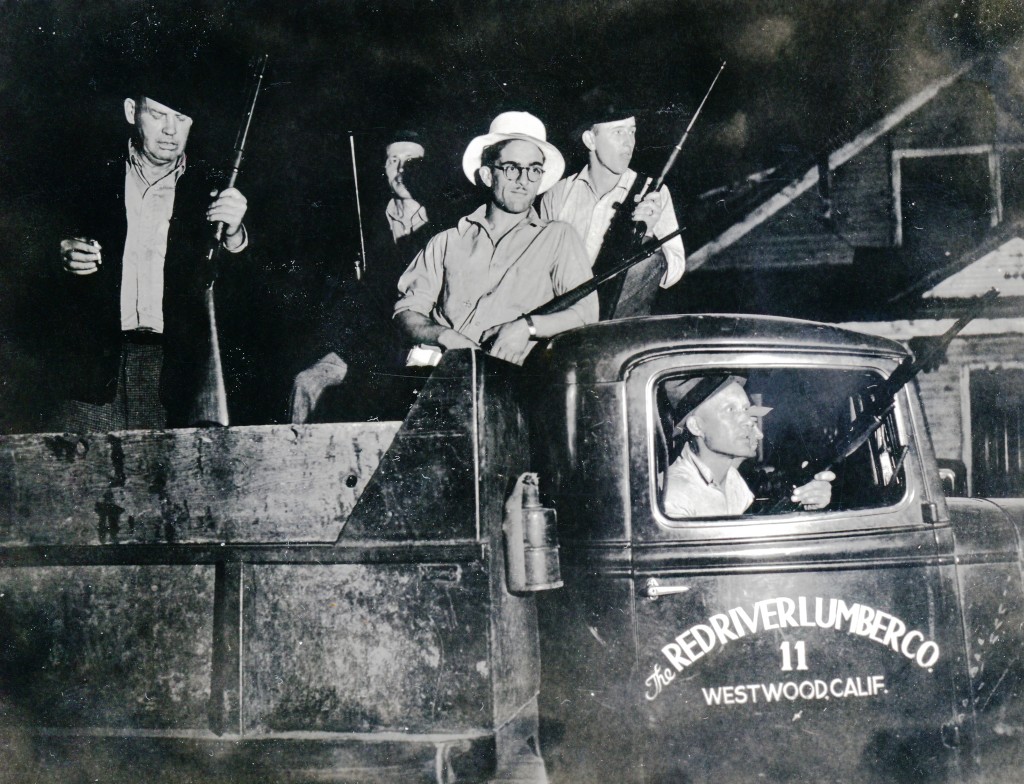
Purge Night, July 13, 1938. Courtesy of Frank Davis

Estate Sale: I need to make room for items from my mother’s estate. This a great bargain 50% off, your cost $12.50 plus shipping. What a deal!

The carefree spending days of the Red River Lumber Company came to an abrupt end. Bonds were used to finance the construction of Westwood came due. On the other hand, Fletcher Walker continued expanding operations, each at an additional cost. The bondholders on the other end were not pleased with the delinquent payment and return. A free for all battle occurred as to whether the banks or the Walkers would control Westwood. The Walkers, made concessions to keep the banks at bay.
Then there were labors problems. It began with the purge of the CIO members and their families who were driven out of Westwood in 1938.  That was the tip of the ice-berg. The following year the AFL went on strike over the same issue of wage restoration that the CIO wanted. It was a mess, to say the least, and it would be one of many factors that would seal Red River’s fate. Click here to order.

Subscribe!

Alfalfa Weevil Infestation

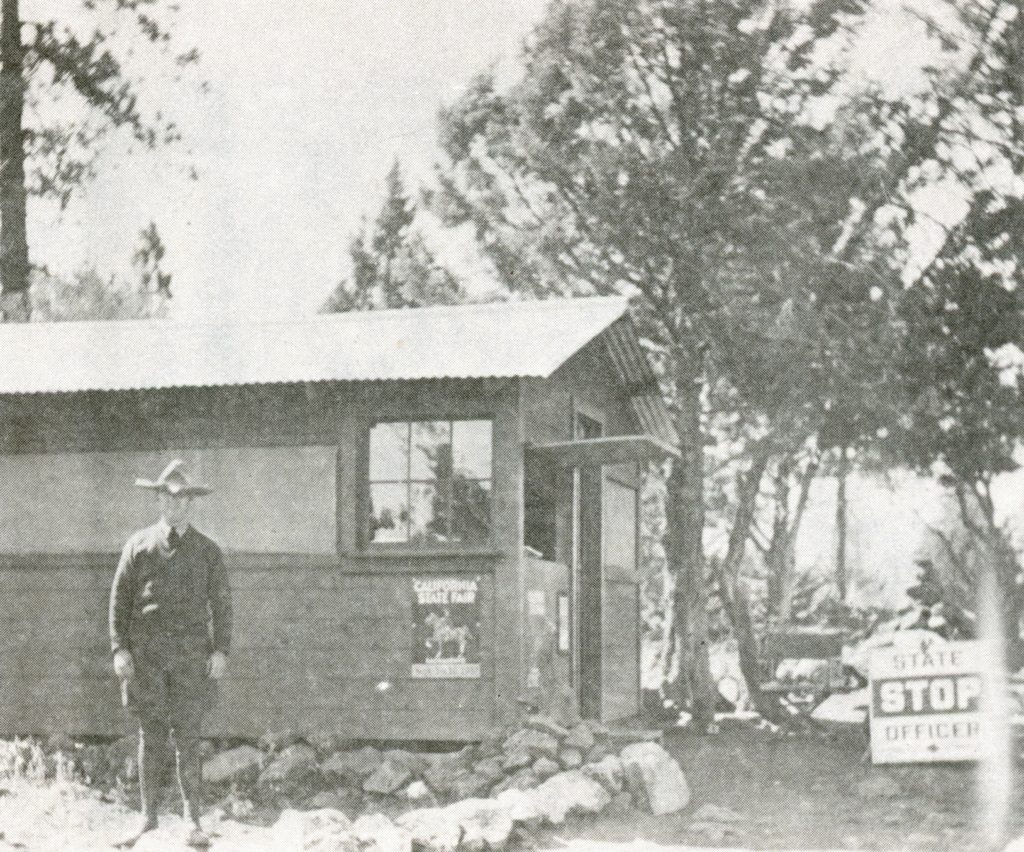
The inspection station at Jacks Valley, ten miles north of Susanville. It operated from 1931-1934.  Many folks know the location as the cement water trough on Highway 139.

Most people may not be aware the agricultural inspection stations originated with an alfalfa weevil infestation in the southern portion of Lassen County in 1921. The county originally conducted the operations, and in 1923, the state took over.

The infestations spread and more stations were opened one just west of Susanville near the present day intersection of Highway 36 and Eagle Lake Road. Another one ten miles north of Susanville, just before approaching Willow Creek Valley.  These would later be replaced and in 1953, the main station was at Long Valley. In 1976, when the segment of highway 395 was to become a divided highway, the station was in limbo, and the current one was put into place in 1986.

Subscribe!


Exploring Lassen County's Past