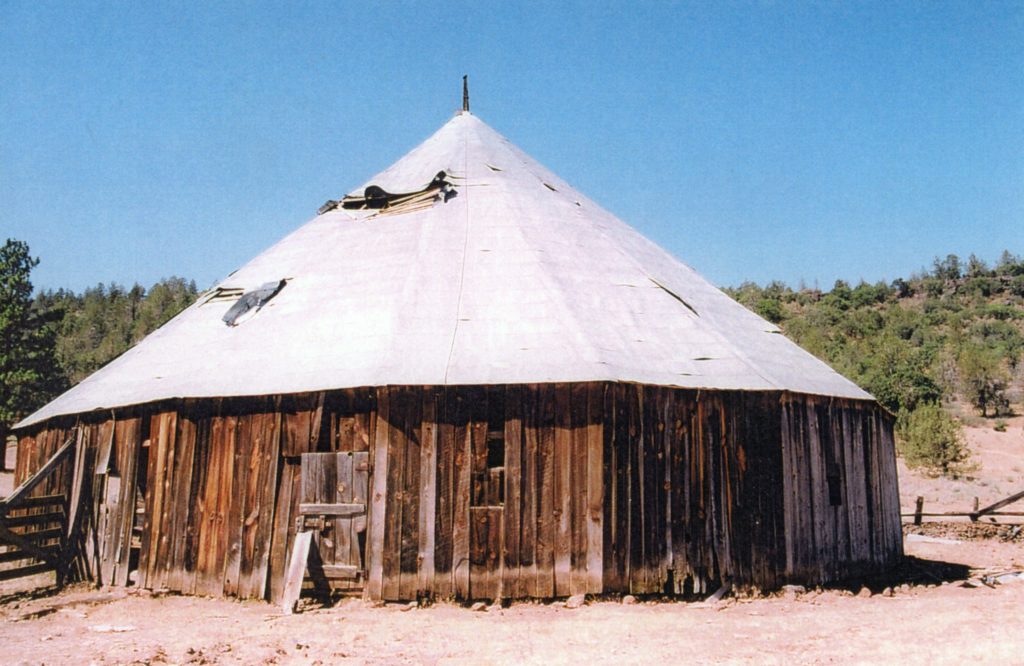
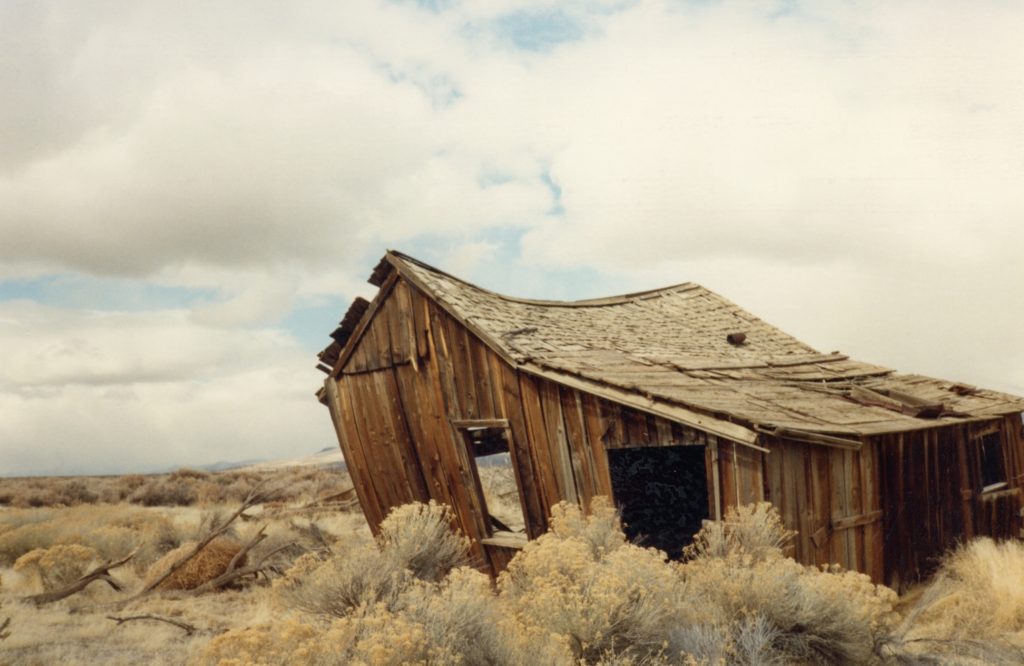
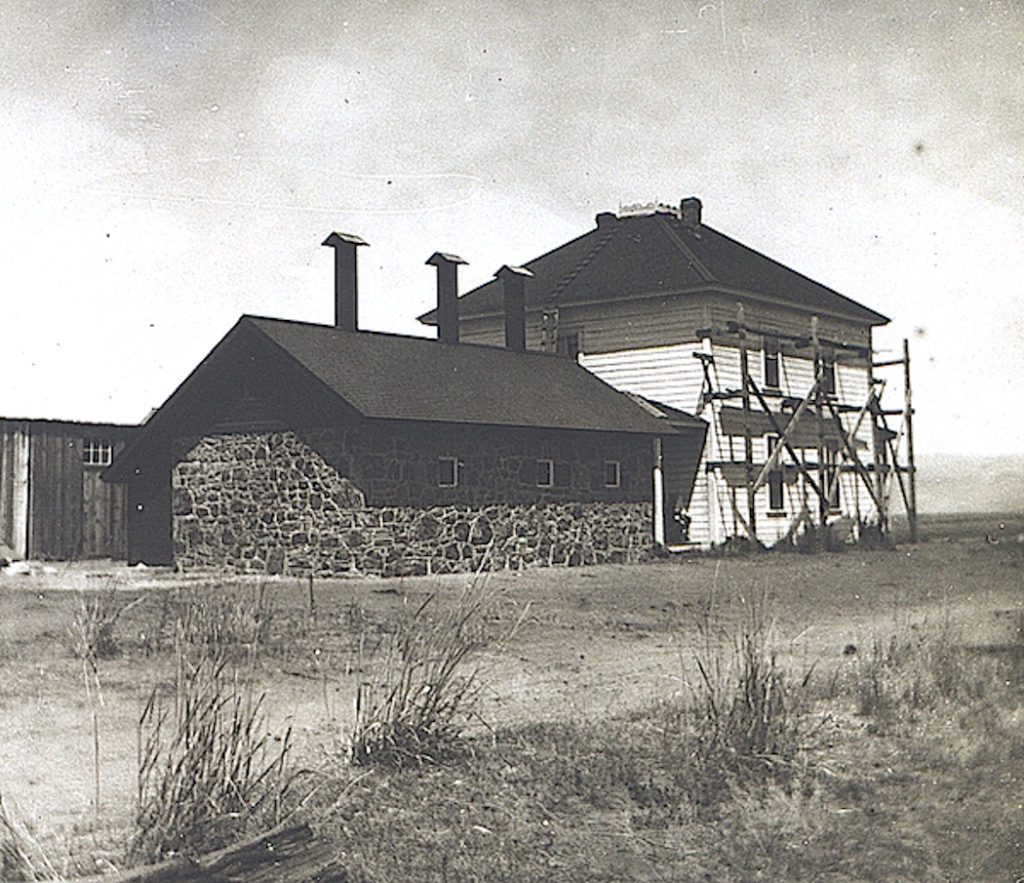
The Round Barn, Little Valley, Lassen County, prior to it being moved to Fall River Mills. Courtesy of Tom Glunt
Little Valley tucked away in the northwest section of Lassen County was first settled in 1870. In 1916, R.L. “Bob” Johnson constructed the area’s most notable landmark, referred to as the “Round Barn.” Johnson needed a structure where he could train horses during the winter months, as they were in great demand in World War I. Over the years, the elements, etc., took a toll on the building. By 2004, the Fort Crook Historical Society had started a movement to relocate the barn to their museum complex at Fall River Mills. It was a slow process, but they succeeded, and is now restored to its glory.
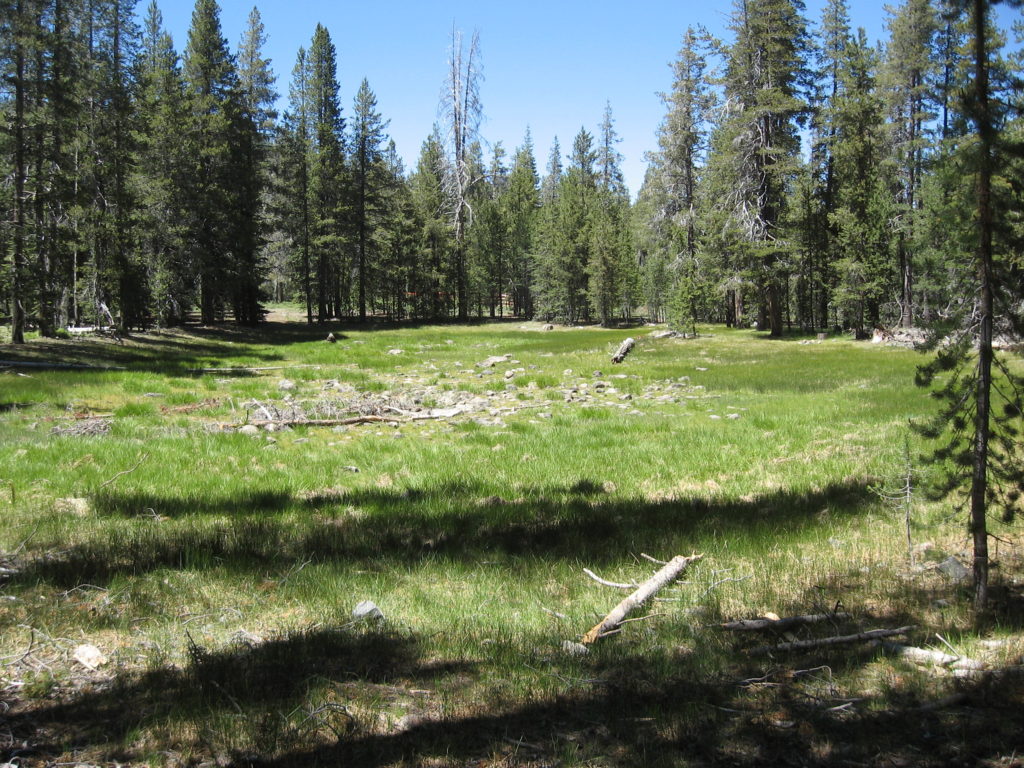
Cone Lake is situated in far western Lassen County, next to the Caribou Wilderness. In 1850, Joseph Spencer Cone (1822-1894), a native of Ohio, came to California, arriving in Tehama County in 1857. Originally, Cone was a cattle rancher who sold beef to the Nome Lacke Indian Reservation. When that enterprise failed, Cone turned to raising sheep and continued with that endeavor for the remainder of his life. In the early 1870s, Cone, like of many Tehama outfits, incorporated western Lassen County for grazing stock during the summer. It took nine days for the Cone outfit to herd some 20,000 head of sheep from Paynes Creek, Tehama County to Harvey Valley, Lassen County. At the time of his death, Cone owned nearly 100,000 acres of land—4,636 of these acres were located in Lassen County. The Lassen County property remained in family ownership until November 10, 1934, when Marie Cone sold to the Lyon Cattle Company. Marie Cone had disposed of some parcels earlier to the Red River Lumber Company. One of Cone’s legacies was his impact on the geographical names of western Lassen County. Cone’s many sheep herders filed rights to strategic springs and grazing lands—Logan Mountain, Pat Morris Spring, Norvell Flat and Puls Camp, to name a few.
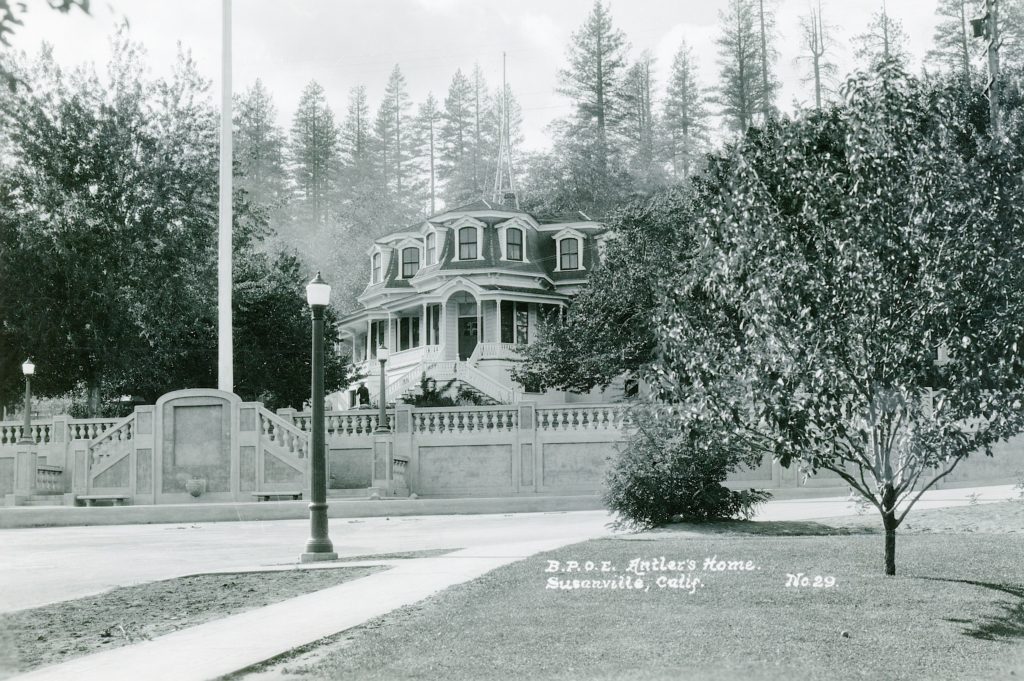
Back in April, quite a few readers responded about items they wanted to learn more about. One topic was Lake Lahontan. Now, you are probably wondering why today’s featured photograph has anything to do with an ancient inland sea. Some 10,000 years ago, the lake was at its peak, then slowly began to recede leaving such remnant lakes as Honey and Pyramid. Had Susanville’s Elk Lodge existed back then, it would have been lakefront property.
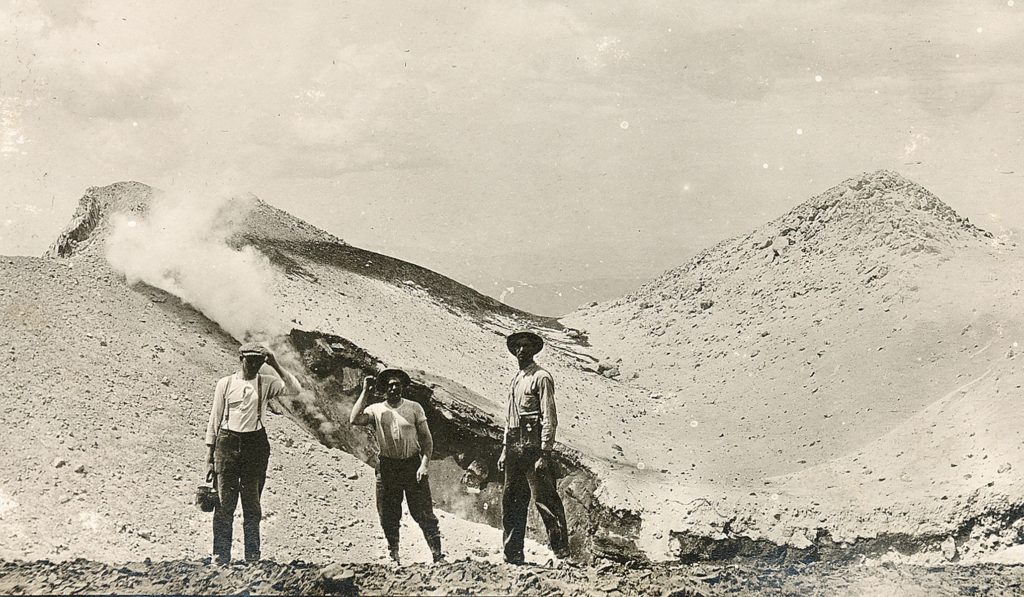
When Lassen Peak came to life as an active volcano in the spring of 1914, it brought an avalanche of curisoity seekers to examine the mountain. At this time, the peak fell under the jurisdiction of the forest service. Attempts to discourage climbers were fruitless, after all there was only one ranger for the vast territory. What was rather remarkable there was one serious injury from a climber during a volcanic blast.
The photograph is a little bit deceptive, since the lake went dry or as one of my companions on this excursion, noted someone must have pulled the plug. It was named for a prominent Tehama sheepman of the 19th century. There is also a mountain and spring in western Lassen County that bears his name.
With the passing of former Nevada Governor and U.S. Senator, Paul Laxalt on Monday August 6, 2018, many may not realize that family is part of the heritage of the Madeline Plains. Dominique was the youngest of the three Laxalt brothers who had various interactions on the Madeline Plains. Unlike his brothers, Dominique was a true tramp sheepman (though many today use the term itinerant instead of tramp). Dominique would take his band of sheep and move them place to place in search of feed and water. Other Basque sheepman, like his brother, Pete, eventually acquired a home place. During World War I when sheep and wool price went soaring, Dominique and fellow Basque sheepman, Pete Etchecopar formed a partnership. It was during this time when Dominique married Therese Alphetche in Reno, where he moved. In the early 1920s, when wool prices crashed Dominique, Therese and their infant son, Paul, returned to the Madeline Plains. While residing there, the second son, was born, Robert, who became the well known author of Sweet Promised Land. Things did not work out well on the Madeline Plains and Dominique moved his family to Carson City, and started a new chapter in his life.
John Hamlin was a frequent visitor to the Lonkey Ranch, known today as Five Dot in Willow Creek Valley. Of course, it should be noted that he was a brother to Georgianna Lonkey. Hamlin was a writer and his stays in the area provided him with lots of material for several novels. In 1925, Beloved Acres was published about the saga of the Hill Ranch in Willow Creek Valley, though he renamed it Clover Valley, after all it is a work of fiction. He published two other works borrowing on the local color namely Desert Dancer and Range Rivals.
The Jules Alexander residence, circa 1911. Courtesy of Dick and Helen Harrison
Certain Susanville residences have undergone major renovations over the years. Take for instance the former Alexander residence at 145 North Roop Street. It was built in 1893 by Susanville merchant Abe Alexander, and was originally Italiante style, a style popular with Susanville’s Jewish community. Abe did not enjoy his new home for very long, for he moved to San Francisco. In the meantime, he sold the house to his brother, Jules Alexander. In 1910, Jules had the home transformed into a Craftsman’s style. He continued to reside there until his death in 1935. Shortly, thereafter, his daughter and son-in-law, Jeanette and Jess Worley moved in to take of her mother, Rae. The Worley’s remained in the home until 1947, when they had a new brick home constructed next door, and that too has been significantly altered.
In 1922, John Hamlin, novelist and part time resident of Lassen County wrote an article for Sunset magazine about Asa Fairfield and his Pioneer History of Lassen County. When asked why he devoted so much time and effort to the book, Fairfield replied, “The book just had to be written. I knew I would have no piece of mind until it was done and in print. I had never used a typewriter, but I secured one and went to work, transcribing all my notes for a volume of five hundred pages. Nobody was asked to subscribe. I published at my own expense. It was a labor of love. I could not bear to think that the early history of Lassen County would die with its pioneers. It had been an isolated section, no railroads connecting it with other points. No one else had taken the trouble to compile its history. The responsibility seemed to rest upon me.”
Unfortunately, my family heritage, at times has a lot to be desired. Take for instance the 19th century two most prominent Lassen County bachelor uncles—James Byers and Jake McKissick. Both settled there in 1859, and both amassed a huge ranching empire. With their passing they left behind an incredible amount of wealth for the heirs to fight over, which they did.
That was not the case with my Uncle Jake Murrer. In 1898, Jake with his brother Ed, bought Joseph Eddy’s ranch at the headwaters of Willow Creek, now known as Murrer’s Upper Meadow, though the family refers to it as the upper ranch. This is where Jake’s claim to fame was born. Jake made his home at the upper ranch, while his brother remained on the home place. For whatever unknown reason on September 2, 1907 he literally blew up the ranch house with dynamite stored at nearby Eagle Lake tunnel works. When authorities inquired where he was at the time of the explosion, he stated he was seated on the sofa. This could not be as pieces of fabric from the sofa were now decorating the cottonwood trees. After a brief stint at the Napa State Insane Asylum, he later returned and sold his interest to Mary Murrer, and would later spend the rest of his life in Susanville, with his sister, Rose Bagin.
Another bit of his legacy, is how and where he is buried. Not only was he not buried in the family plot, the family selected one the furthest possible from the family plot. Not only that they cemented the top of his grave, as his sister-in-law Mary Murrer, remarked they were not leaving any chance behind for him to escape.