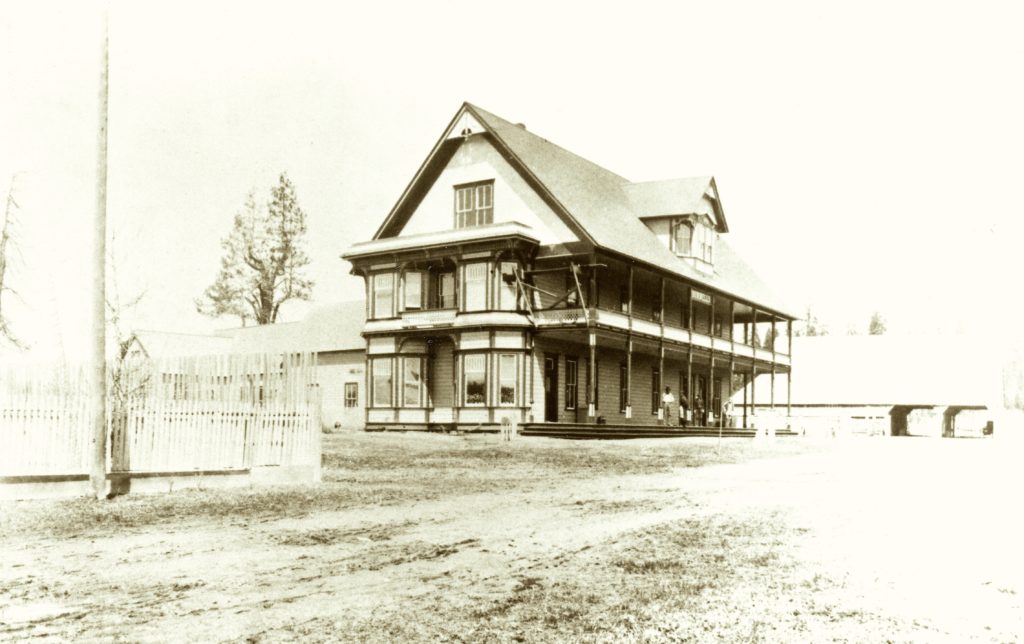
Westwood’s CIO Building

CIO headquarters. Courtesy of Frank Davis

After the rioting broke out from the court hearing a small group of CIO sought shelter in their building, (it being a small structure measuring 16 by 24 feet). It was only a matter of time that angry mob would descend. Aid arrived in the nick of time before matters got completely out of control with Lassen County Sheriff Olin Johnson and his deputies. Johnson had Jack Granger, a respected AFL member, be his spokesman. Granger’s is plea to the angry mob stated: “Fellows I ask you on behalf of Sheriff Johnson and those women and children in the building to open way and let them be taken out of here. We are aware of the hysteria that got us all and there is no thought of fear. Let’s play ball with the Sheriff.” The mob obliged and all those inside—29 to be exact—were escorted unmolested from the structure by the sheriff deputies. It was still a harrowing experience as the crowd had slashed the car tires of the sheriff deputies and they had to drive away on the rims!

The AFL resented the CIO headquarters; many considered it a symbol of the labor problems of Westwood. Exactly what the AFL’s intention were was anyone’s guess. Once the evacuees were escorted out of the building, the mood of the crowd changed and then someone yelled, “Let’s do something.” Within in moments, the American flag on top of the building was lowered. Then in a wild frenzy the mob began dismantling the building. Within thirty minutes it had been reduced to rubble.

Tensions between the two labor groups would continue for years. Even after the AFL in a 1941 special election to become the sole union to represent Red River Lumber Company employees, resentment lingered with many CIO’s for decades.

The Westwood Riot

Fourth Street, Westwood, March 2, 1939. Courtesy of Bill Ashenhurst

The Red River Lumber Company faced many issues during the 1930s at its Westwood operation. Two major factors were finances and labor. Two labor unions were involved, first the Congress of Industrial Organizations (CIO) followed by the American Federation of Labor (AFL). Initially, the two groups appeared to be on the same page in demanding wage increases. By 1939, that was no longer the case, as there were friction between the two groups.

The anxiety between the two, especially the AFL, worsened while the men grew impatient from being idle during the weeks passing in February during a strike and blamed the whole situation on the CIO. It was just a matter of time when the situation would once again become volatile. What ignited the spark is not clear, though one account stated it started with an encounter between Marjorie Scott, wife of a CIO and Earlton Shannon, the business agent for the local AFL. Scott, according to one account, made some insult to Shannon in front of the post office and Shannon retaliated with some extreme vile and abusive language. He also advised her to get into the car with her companions for her well-being. So incendiary were his remarks that it warranted his arrest.

On March 2, 1939, a preliminary hearing concerning Shannon’s behavior was held in the Westwood Justice Court to determine whether there was sufficient evidence bind him over to the Superior Court for additional charges. After Judge J. M. Lamson adjourned the hearing is when the chaos began. The courtroom was crowded with spectators. After the adjournment, a fight broke out between Ben Nissen (CIO) and Riley McComas (AFL). From this other fights erupted; some fifty or more were reported and the crowd slowly worked their way down Ash Street, to the CIO headquarters next to the Westwood laundry.

To be continued tomorrow.

The Three E’s

Roosevelt Pool
Remnants of Roosevelt Pool, February 21, 2015

On March 1, 2015, I launched an ambitious program to do a daily blog seven days a week. I know crazy, seven days a week, 365 days a year. For the most part I have delivered, though there have been a few bumps in the road. In the back recesses of my mind, there were the goals to enthuse, educate and explore readers to expand their horizons.

Enthuse – One of the best examples to introduce people to region and get them excited is the annual Sunrise Summer Solstice Tour at Belfast. Attendees are enlightened and excited to learn more about the region.

Educate – Equally, important and this post contains an unusual words that begin with the letter e. To visit a site, but are not informed, is an injustice. Once a person is informed, it provides a whole new perspective.

Explore –  Back in the 1990s, the Bureau of Land Management archaeologist and myself conducted prehistoric/historic tours. It was a popular venue. The current resource manager of the Eagle Lake Office of Bureau of Lonely Men informed me, he was enthusiastic about future endeavors, but it would be a solo endeavor on my part. The bottom line, was during those tours, it was the goal educate the participants and encourage them to do some exploration on their own, with an emphasis to respect and protect sites a person my visit.

Happy Trails!

Where are we – the answer

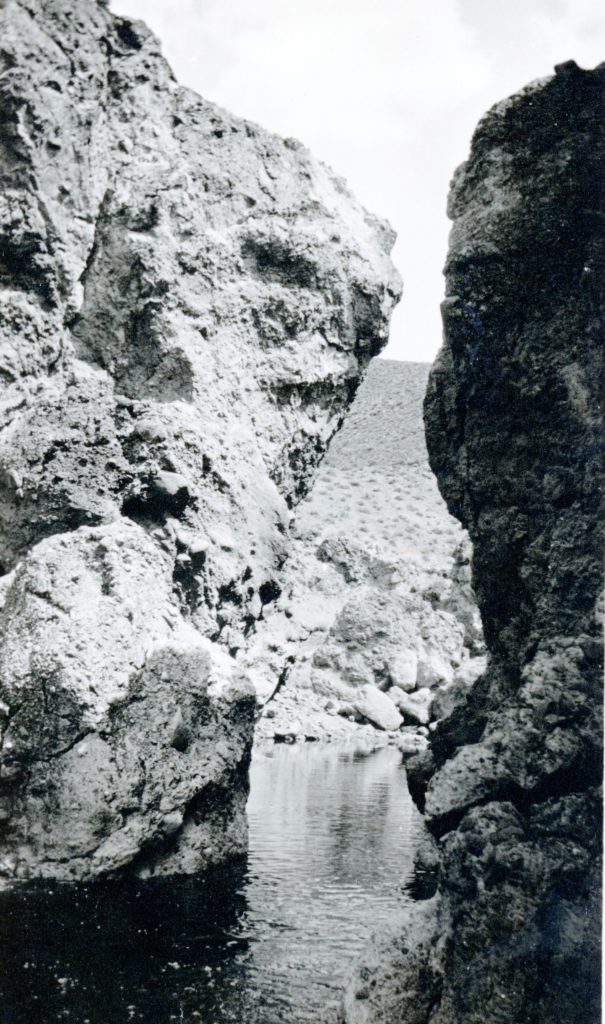
This is a portal midway through Bly Tunnel near Eagle Lake. The fenced off enclosure is easily seen from the road going up to the Eagle Lake Youth Camp. There are still numerous ditches, cement diversions of the canal system, extending all the way to the Sunnyside District near Janesville to past Wendel in another direction from the failed Tule & Baxter Creek Irrigation District’s Bly Tunnel project.

The outlet as it appeared in 2012. Courtesy of Barbara White

Subscribe

The Hilke Piler

In 1925, Fruit Growers Supply Company at its Lassen (Susanville) operation were always looking at innovative ways for efficiency and reduce labor costs at the same time. This year, they installed a Hilke Lumber Piler, the contraption had been invented in 1915 by Seattleite Henry Hilke. The piler was a very efficient means of stacking lumber outdoors. Not only did it reduce the aisle width for stacking of conventional lumber, but the machine allowed to make higher stacks. While a four man crew was involved, the piler could handle up to 10,000 board feet per hour. As one local observer noted: “To those who had never seen the new stacker in action, it is a most interesting and educational sight.”

Subscribe

Lassen Boulevard Funding

Highway 395 north of Hallelujah Junction.

Earlier this month the topic of Lassen Boulevard was discussed, i.e., the forerunner of Highway 395 between Susanville and the Nevada State Line. In 1924, Nevada officials had paved the route north of Reno to the stateline. Lassen County Board of Supervisors were anxious to make more road improvements on the California side. After all, they had already mounted a campaign declaring Susanville the eastern gateway entrance to Lassen Volcanic National Park. Before long, Susanville would host the state American Legion Convention, so good roads were essential.

On July 8, 1925 the Lassen County Board of Supervisors approved $5,000 to make road improvements on the highway segment between Constantia and Purdy (stateline). It was their intent that the State Highway Commission would match the county’s expenditure. They did. However, it would be many years before the highway was paved and redesignated as 395.

Subscribe

Secret Valley School

Secret Valley, as seen from the lower end of Secret Valley.

For some reason I have been stuck in a Secret Valley mode of thought, with Biscar Reservoir and Petroglyph Humor.  For those not familiar, Secret Valley is a long straight stretch along Highway 395 North, approximately thirty miles from Susanville.

Like so many places throughout the region, in a bygone era, lively times were had there. In addition, like so many rural outposts it had its own school district, that was established in 1890. Rural schools then, were not confined to a strict schedule that occurs today. The Secret Valley School during the 1920s and 1930s operated during the summer months and was closed from November to February. The school closed in 1938. The last graduating class consisted of Emelia Diaz and Ida Nye. In 1940, the school was annexed to Soldier Bridge, known today as Shaffer.

On a footnote, this is one of handful of Lassen County schools that I do not possess a photograph of. The late Faye Laver, thought she possessed one, but could never find it.

Subscribe

Member Login Feature

Honey Lake, from Tanner Ranch, January 1997.

Since early January, I have been working in due diligence to correct the flaw in this feature, without success. It has caused me a lot of grief. Making changes and upgrades has been created domino side-effects to other features.

Please refrain to use the login feature or change your password, because it does not work. At this time, nothing is blocked, so it is not necessary. Once a solution is done, everyone will be notified. I would appreciate your patience.

To complicate matters because of other outside influences has been the unexpected passing of my mother’s sister, Joyce Tanner Cunha, 1928-2019. Thus, among my other obligations, is to deal with the future of Tanner Ranch.

Tanner Ranch, March 18, 2017

Support

Pennies from heaven?

Bank of America, Main & Gay Streets, Susanville

In 1933, Lassen County residents and their counterparts throughout the Golden State witnessed something in their shopping routine. California had instituted a sales tax. This, of course, saw an increase of pennies in circulation.  As matter of fact, Charlie Bridges, then assistant manager of the local Bank of America, that in August 1933, 1,000 pennies every day were put in circulation in Susanville for a period of ten days. Bridges speculated that some of these pennies were going into piggy banks of local children.

Subscribe

Exploring Lassen County's Past