Susanville/Durbin Nursery

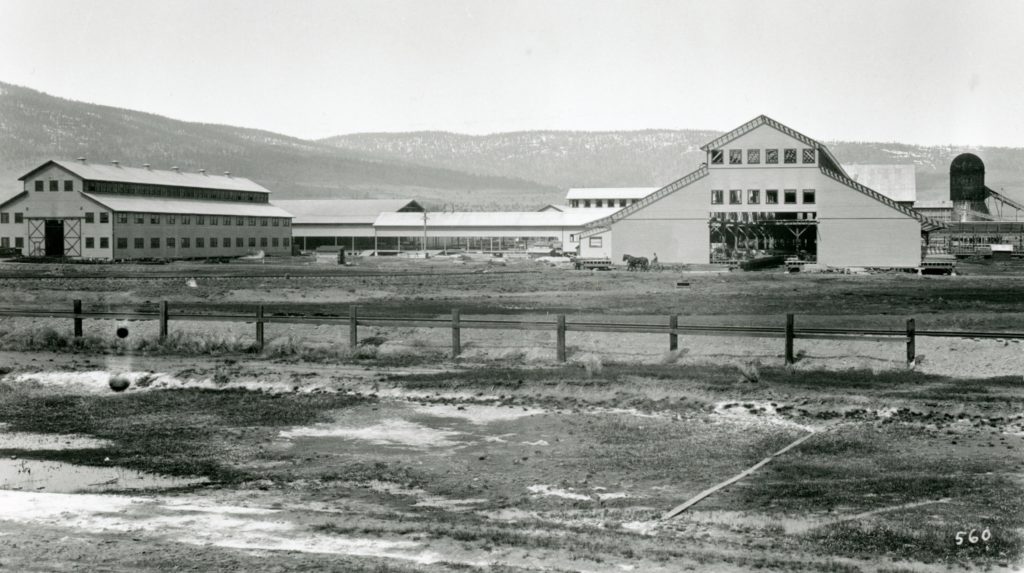
Durbin Nursery. Courtesy of Dick & Helen Harrison

In 1928, the Lassen National Forest Service leased seven acres from Lassen County on Richmond Road for a tree nursery, named the Susanville Nursery. It was done under the direction William G. Durbin, the Lassen National Forest Supervisor. In 1932, C.W. Corson, a recent graduate of the University of Minnesota has hired to be in charge of it and was so for many years. Anyhow, the initial goal was to raise 750,000 of pine seedlings over a five year period. In addition, experiments were done with cedar, fir and sequoia.

The first planting from trees from the nursery was done in 1930 to assist the reforestation of the  burn on Antelope Mountain west of Eagle Lake. In addition, the nursery provided seedlings to the various national forests throughout California. It was unique that it was only large Forest Service nursery in California. In 1936, after the establishment of Lassen College’s Forestry program many of those students worked at the nursery.

In 1938, after the passing of William Durbin, the nursery was renamed to Durbin in his honor. Durbin served as the Supervisor of the Lassen National Forest from 1922-32.

Unfortunately, I do not at this time, have a date when the nursery ceased operation, but it appears sometime in the early 1950s.  The property is best known today as Diamond View School.

Never miss a story, click here to subscribe.

Byers County

Byers' Store
Byers’ old Baxter Creek general store that was later moved his Tule ranch and operated by his nephew, Jim McClelland, May 1975

Today, is Lassen County’s birthday, it being created on April 1, 1864. Many people may not realize but the original proposed name for Lassen County, was Byers County. So who was Byers, and why was he to be honored? In 1858, James Davis Byers (1825-1902) purchased some property along Baxter Creek near Janesville. However, he remained a Quincy resident for sometime. In February 1863, Byers served as a Plumas County Deputy Sheriff, and played a significant role in the Sagebrush War. The final result of that conflict led to the creation of Lassen County the following year. Plumas County Assemblyman Robert A. Clark introduced the legislation to create the new county. Clark proposed to name it Byers County, but Byers declined. Byers suggested that it should be named after Peter Lassen, and thus the Lassen name was applied to the new county.

More about Byers in a later post, though by 1880 he was one of the ten wealthiest people in Lassen County.

Westwood Club

The Westwood Club, circa 1918.

When the Red River Lumber Company established its company town of Westwood in 1913, it had to provide numerous amenities due to its remote location at the time. It was necessary to not only attract employees, but to retain them, as the lumber industry experienced a high turn over rate in labor. The Westwood Club was one of several facilities designed to meet the recreational needs of its employees. It included a restaurant, lunch counter, soda fountain, cigar and newsstand, barbershop, reading room and a billiard room.

On early Friday morning, March 31, 1944 a fire broke out in the Westwood Club though the cause, was never determined. Within twenty minutes the whole building was engulfed in flames. The heat so intense, that Nick Kannier’s automobile which was parked in front of building, burst into flames. Even neighboring buildings from across the street were smoking, on the verge of spontaneous combustion, which with quick action by the fire department prevented the same.

The J.R. Bartlett Company were the concessionaire of the Westwood Club, which included the clubhouse, cafe, pool hall, bar and lounge. There were four other tenants in the building—Ehorn’s Pharmacy, Quitman’s Apparel, Westwood Market and Kilpatric’s Used Furniture department. Estimated loss for all parties was placed at $125,000.

A Church Revival

Standish Methodist Church, 1908. Courtesy of Prentice Holmes

The Standish Methodist Church was established in 1904. For a number of years, all was well. By the early 1930s, attendance was so low, that services were discontinued. In the fall of 1938, Rev. E.N. Dabritz, pastor of the Susanville Methodist Church attempted to rectify the situation. By November the average attendance of the congregation was 70. In the meantime, the church had fallen into disrepair and needed a new roof. The Rev. Dabritz issued a plea for funds throughout the Honey Lake Valley and enough donations were received to replace the roof.

How long the church continued or when the Methodist Church abandoned it, I do not know. For over the last four decades and probably more it is known as the Standish Bible Church.

Subscribe

Cottage Street, Susanville, 1885

A view of Cottage Street, 1885.

First of all, I have to admit that I have a special affinity for this town’s particular street. After all, I grew up on this street, and decades later I returned to reside on this street.

It was so named back in 1863, when the town was surveyed, because in essence it contained numerous “cottages” and became the town’s first residential district. In the 1870s, one could call the street, the town’s religious row. The town’s first two churches were built there, and depicted in the above photograph. The first church built was the Congregational Church, followed shortly thereafter by the Methodist Church.

Never miss a story, click here to subscribe.

An Answer to a Question

The Emerson Hotel ruins. Courtesy of Vivian Hansen

Someone recently wanted to know how the Emerson Hotel, a three-story brick building caught fire. First, a little background. The reason why Susanville came into existence as a municipality, had to do with the lack of fire protection. Its business district had been devastated by fire too many times.

In 1902, the City of Susanville introduced Ordinance No. 17 that structures in the business district be constructed of fire resistant materials, such as brick, native stone and concrete. The roofs of these buildings would use fire resistant material as well.

The Emerson Hotel was built in 1900-01. The one feature the brick building did not possess was a fire resistant roof. At around midnight on August 5, 1915, Emerson’s warehouse located on nearby Cottage Street caught fire. The wooden structure, built in 1873 originally housed the Congregational Church. By the time the fire was discovered, the building was engulfed in flames, with erratic winds sending embers into the air. In no time, the roof of the Emerson Hotel was on fire and containment was impossible, for now the fire had spread to two nearby structures the Hyer House Hotel and the Methodist Church, the latter a brick building. It should be noted the Methodist Church was built at the same time as the Emerson Hotel, and lacked a fire resistant roof.

Methodist Church
The aftermath of the 1915 fire.

Spread the word, and encourage a friend to subscribe.

A Name Dispute

Great Northern’s Depot, Bieber.

In June 1931 progress was in earnest with the Inside Gateway link between the Great Northern and Western Pacific Railroads. The two railroads would connect with each other just west of the Big Valley community of Bieber. Byron Greenwood saw an opportunity and had a townsite laid out where the railroads would connect. He named his new enterprise Big Valley City. However, when Greenwood applied for the establishment of a post office there, postal authorities were not impressed as they frowned on three word names for post offices.

The Great Northern was not pleased and intended to name their new station, Bieber. Some one came up with a compromised name of West Bieber, but it fell flat. While it took some time to resolve the dispute, everyone, but the railroad, finally agreed to the name of Nubieber.

Subscribe

L.D.S. Church Dedication

LDS Church
The Church was located on the corner of Main and North McDow.

November 3, 1929 was a big day for members of the Church of Latter Day Saints. The big event was the dedication of their new church in Susanville. According church officials, before it could be dedicated that it had to be paid for in full and the cost of the local church as $19,975.50.

Numerous church dignitaries were on hand including the President of the church, Heber J. Grant who made the journey from Salt Lake City. In addition, non-members from Susanville and Westwood were invited.

Subscribe

The Doyle Revival

Doyle, 1949- Eastman Collection, UC Davis

Doyle was the biggest beneficiary when the Sierra Ordnance Depot was established in the early 1940s. It was a much needed boost as the town struggled during the 1930s, like so many rural communities.

There was a tremendous amount business activity for the small community could boast of three grocery stores, along with other such amenities as two bars that also had restaurants, however, it should be noted after prohibition, a requirement for bars was to provide food service.

Another aspect of the Depot’s effect on the region, was with highway improvements, it created the area’s first commuters. The Janesville and Milford vicinities were popular for Depot employees to make their homes there and make the commute to Herlong.

Subscribe

Books, etc

You might want to take a moment to browse the selection of books found elsewhere on this site. Besides books, there is a lot of material that can keep you preoccupied. After all folks, having been self contained/quarantined from November 15 to February 15, due to my broken leg recovery—its not difficult or the end of world.. With the right attitude you might be amazed of all kinds of things to tend to around your immediate environs. Finally, at the same time be grateful for all things that surround you.

In addition, this is a good time as any that you may want to introduce a friend or two to this site. For some of them, it might be just a needed diversion for them to learn more about this fascinating territory. After all, I have some intriguing posts scheduled—Bocce Ball Courts in Susanville to fossil finds in the area. As always, stayed tuned.

Tim

P.S. – There are a few titles that are at a bargain price, because I never changed the special offer some time ago.

Exploring Lassen County's Past