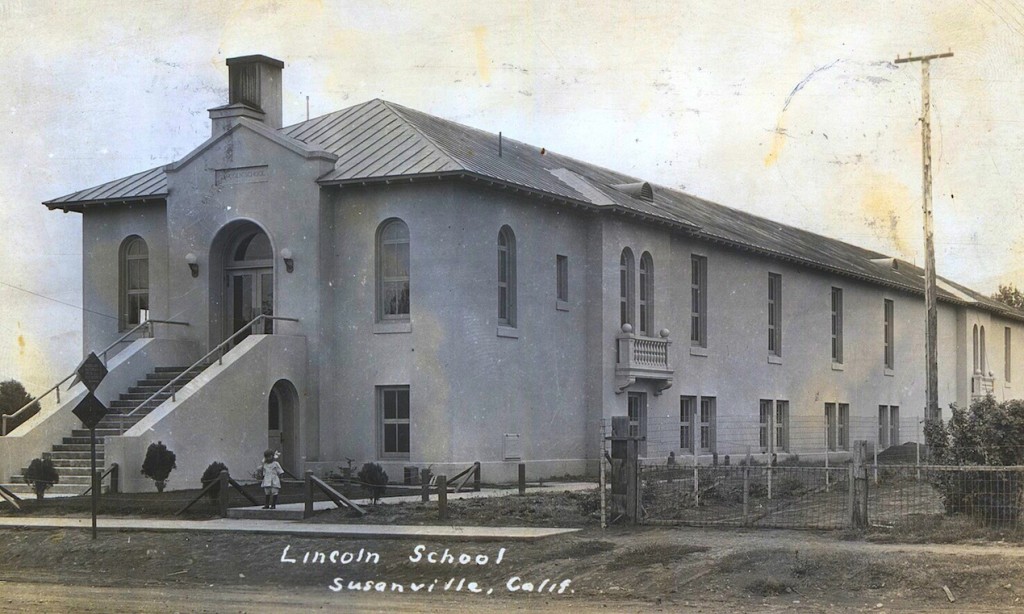
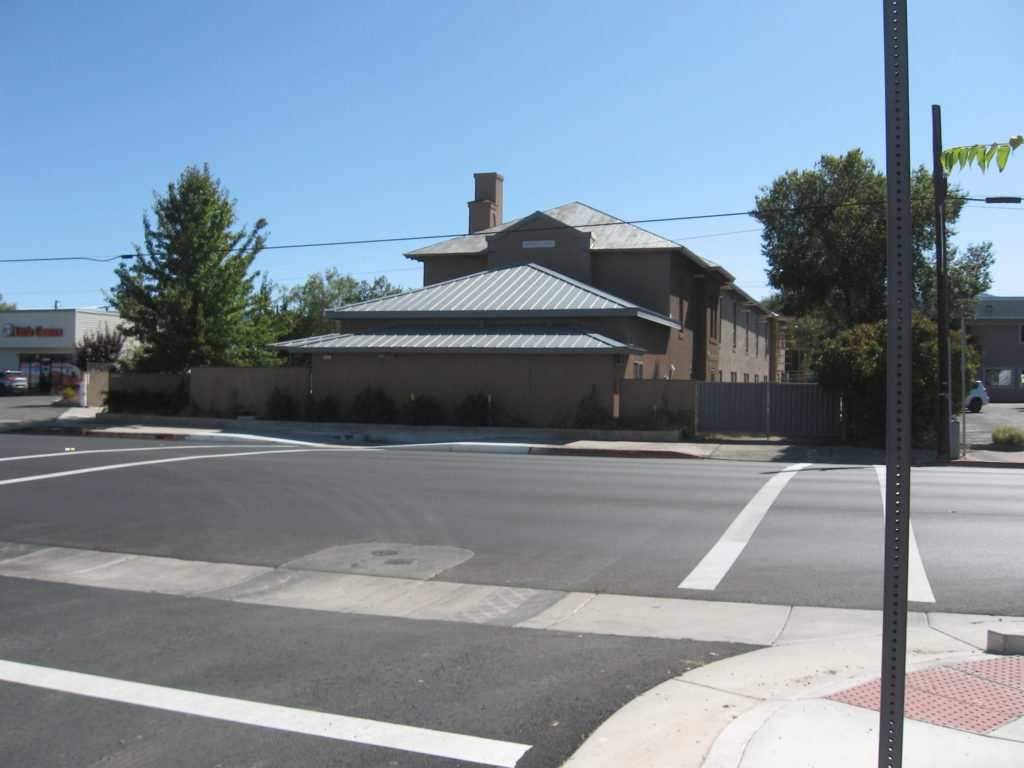
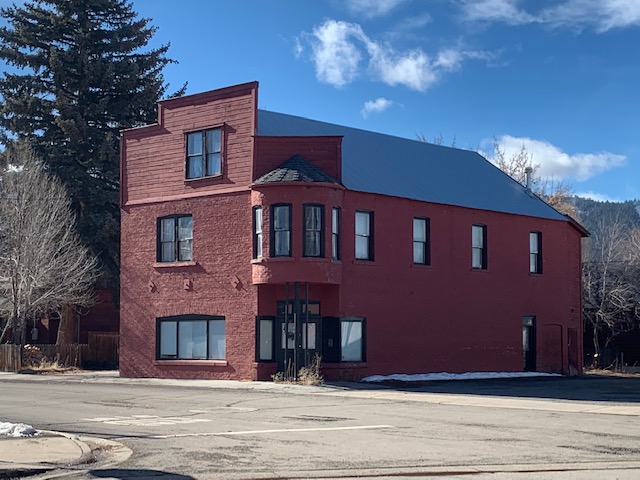
In 1922, Lincoln School was built for $35,000 on the south side of Main Street at the intersection of Hall Street. The school was completed and put into use in February 1923. It closed at the end of the 1966-67 school year being replaced by Diamond View on Richmond Road. In the early 1970s Lassen College used the facility until its new campus was built on Highway 139. It then found new life as the headquarters of the Lassen National Forest. For a number of years, it sat vacate and was heavily vandalized. It is slowly coming back to life again being converted into apartments
Over the years I have met a wide variety of folks who have made the pilgrimage to the Lassen region to learn more about a family ancestor who resided here. Equally important for many is to see the lay of the land.
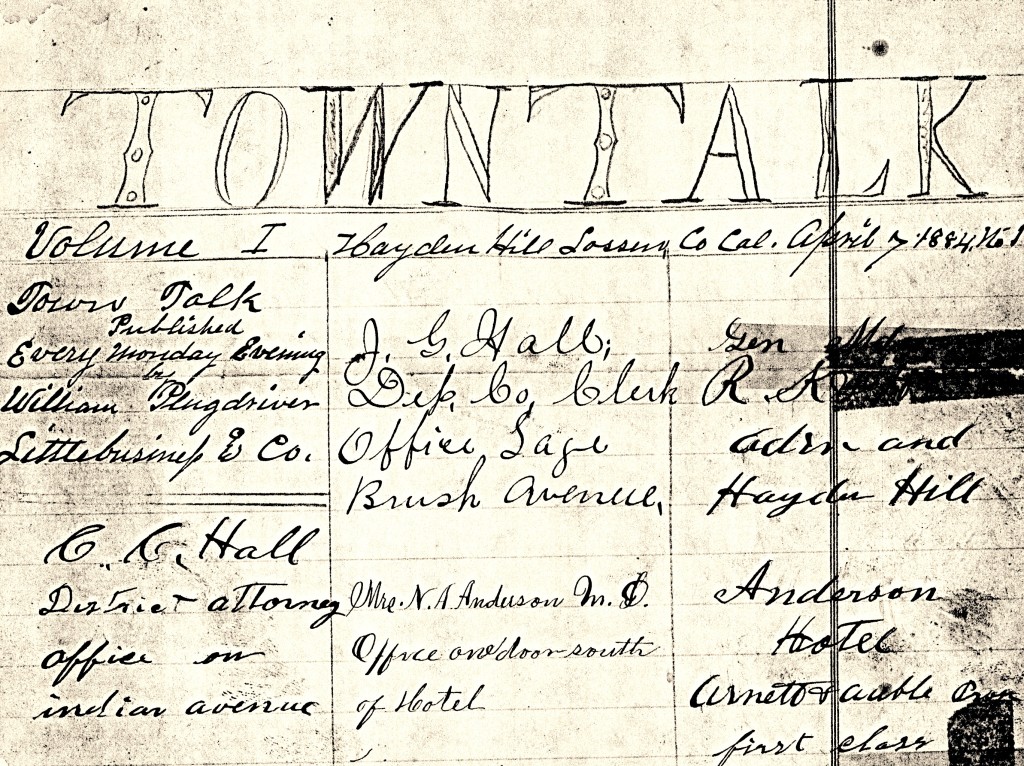
On many occasion they will bring with them interesting family mementos or documents. In one instant, I was literally overwhelmed what the grandsons of William B. Dillon had in their possession. It should be noted that their grandfather came to Hayden Hill in the early 1880s and died there in 1898. What these two men had were two issues of a handwritten newspaper “Town Talk” from Hayden Hill. These kind of documents are extremely rare.
There were two issues, with the first one published on April 7, 1884. The second issue, released a week later, the name was changed to Talk Town. The contents were rather whimsical in nature. Such commentary as “Snow fast disappearing” and “There was a social at the Hotel last evening. The music both instrumental and vocals was good.”
Spread the word, and encourage a friend to subscribe
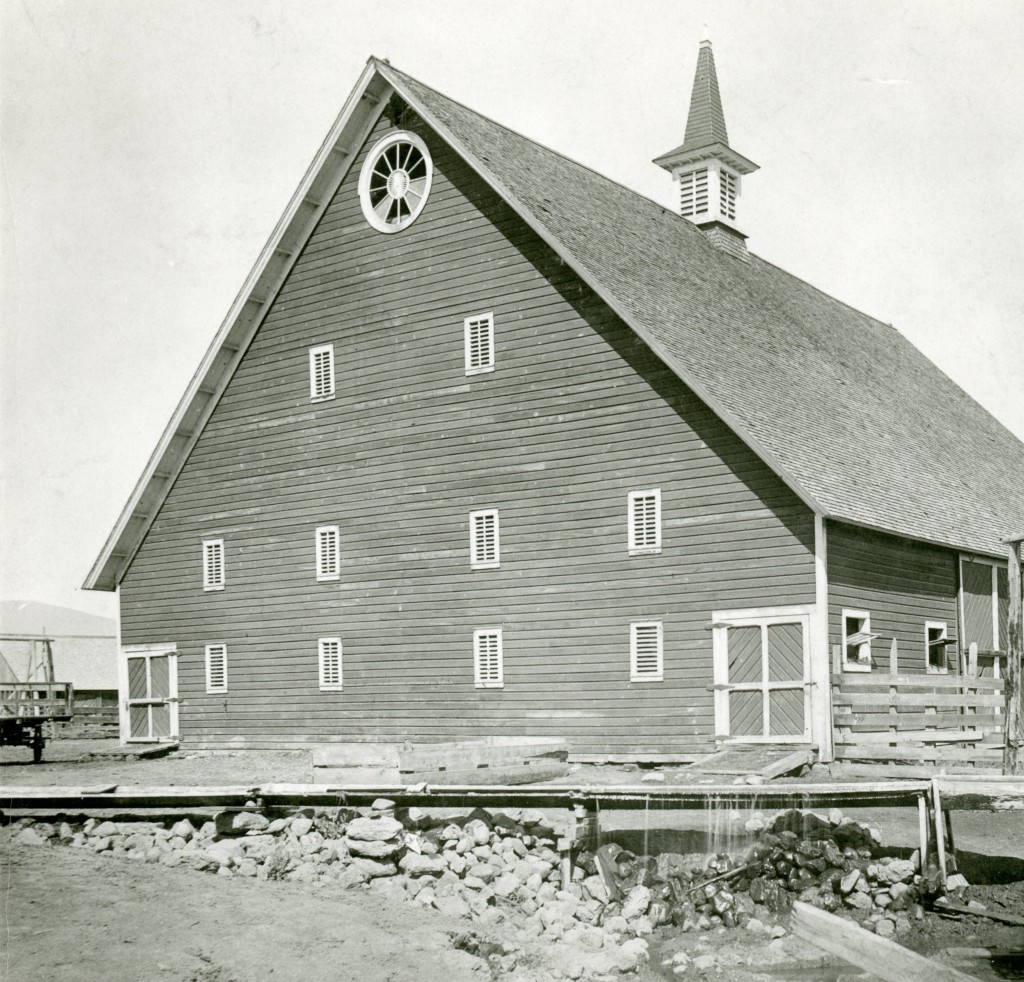
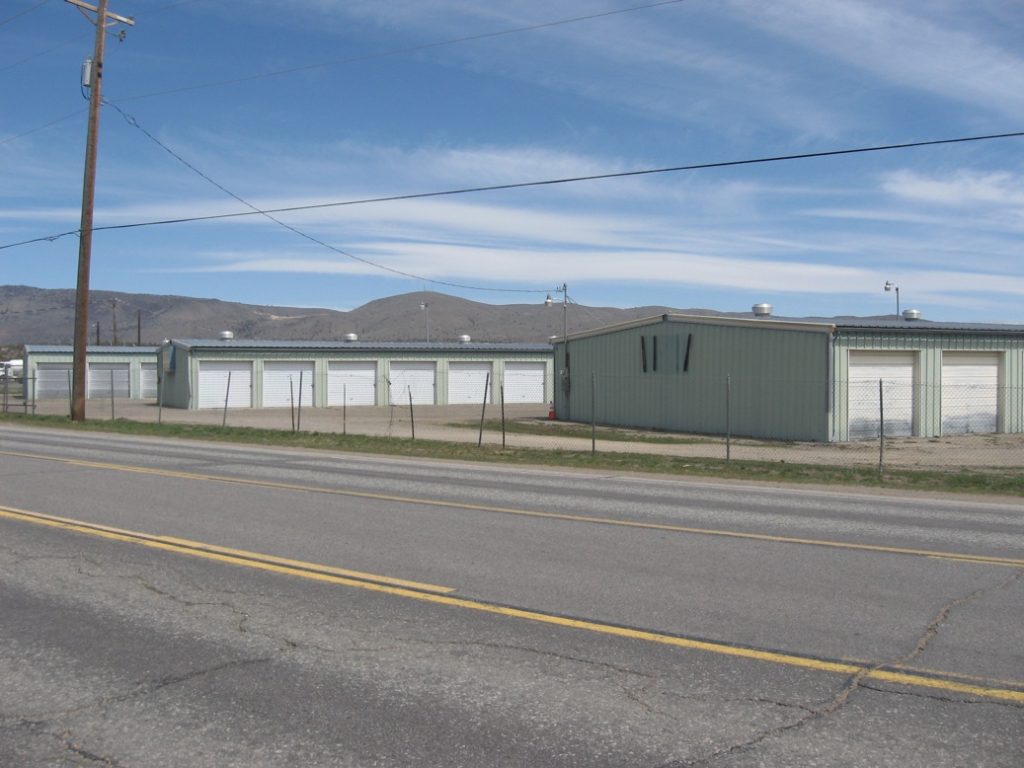
In 1866, Jurgen Jensen established his ranch some three miles east of Susanville, along what is known as Johnstonville Road. In 1891, Jensen had a large three-story barn built on his ranch. On September 11, 1923, the barn was destroyed by fire and it was believed to be caused by spontaneous combustion. Stored inside was 200 tons of hay, valued at that time around $3,500. The barn was insured for $1,500, but it was not enough to cover the cost to replace it.
April 12, 2020
Fast forward to 2020 the site now contains storage units.
Spread the word, and encourage a friend to subscribe.
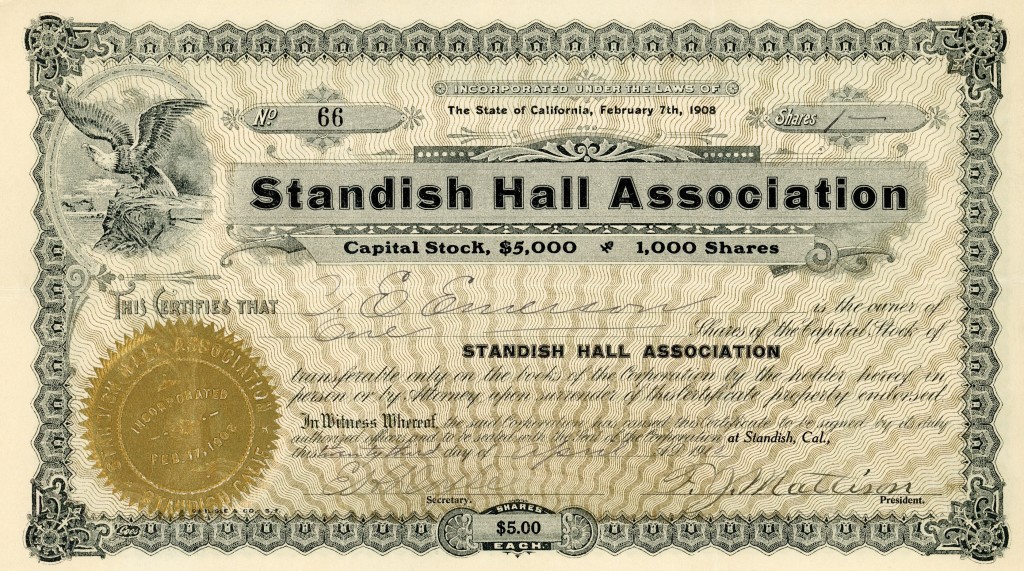
Stock certificate courtesy of Dick and Helen Harrison
In 1906, the fraternal organization Foresters of America built a two-story hall in Standish. As was customary of the day, the first floor was rented to a commercial enterprise, which in turn the rent money used to pay off the construction debt, plus for maintenance of the property. The second floor, of course, was a hall used for various functions. However, the Foresters’ struggled with the building and they found a solution. They turned to the community to form the Standish Hall Association. The Association needed to raise $5,000 to purchase the building, sold stock to raise the funds and were successful.
One of the first tenants was Susanville merchant, Charles Emerson, who expanded his operations to have a second store at Standish. For nearly a decade, all went well. Whenever, Emerson asked for improvements, the Association refused. Emerson’s solution, by members stock to gain a controlling interest. In 1920, Emerson wrote to L.C. Stephenson to purchase his stock and wrote, “The building is practically run by an old man named Wrede. I am a rentor of the store, lower floor and pay monthly rent. The cellar is wet and small and they will not fix it. The front lets in sand and dirt when the wind blows and they will not fix it. Now I am trying to get enough stock to be able to vote and have some say.”
Emerson used the old fashioned barter system. He would give store credit to owners of shares, in exchange for their stock. Emerson was successful and eventually purchased the building.
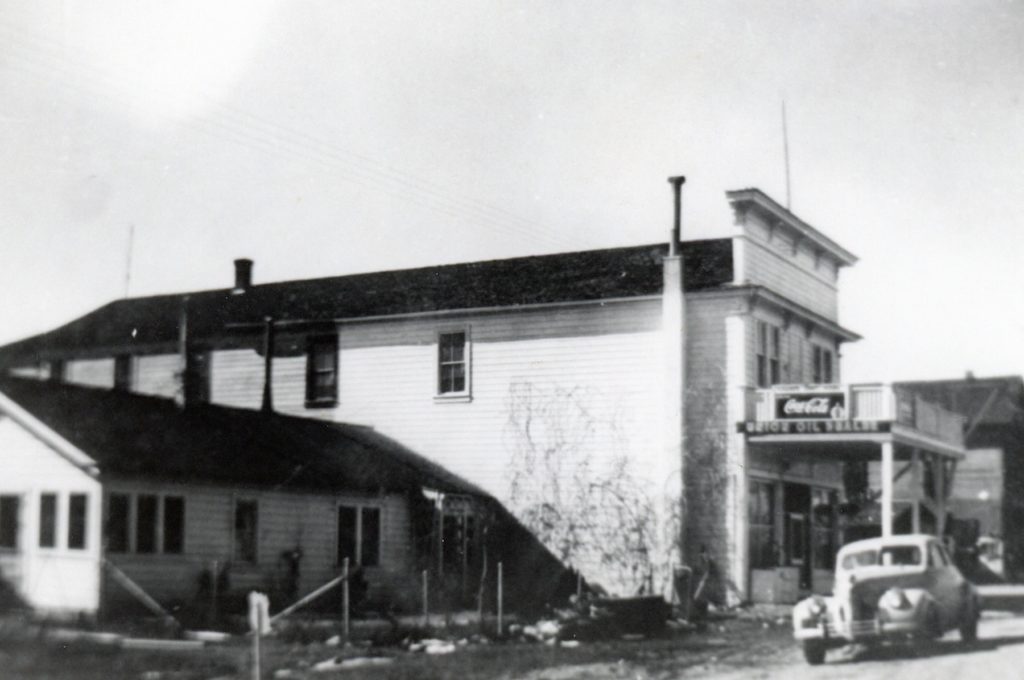
The Standish store, no date. Courtesy of Camilla Moody.
Seasoned residents will know the building as Neil’s Mercantile, though its doors have been shuttered for decades. There have been plans for the structure, but nothing has ever materialized.
Spread the word, and encourage a friend to subscribe.
One of the more interesting facts about this town, was when it was incorporated it was the second largest city in California—land wise, not population.
Spread the word, and encourage a friend to subscribe.
The Belfast District, with Coulthurst Hill in the foreground.. Courtesy of Bernard McCallister
Yesterday’s topic concerning Shaffer Mountain, spills over today concerning a natural feature on its western flank.
Every region has its cast of colorful, eccentric or bizarre characters. Isaac Coulthurst would make an interesting case study. He arrived in the Honey Lake Valley in the spring of 1857 and settled in what would later become the Belfast District. Among his firsts, was on September 23, 1857 he married Mary Jane Duvall, the first Anglo wedding in the Honey Lake Valley.
In 1873 Coulthurst stated that the Lord commanded him to go to the top of this hill. Coulthurst held communion with the Lord in a cave there. He spent a portion of the winter in that cave. Coulthurst stated it was warmed by supernatural heat, but the cave became unbearably hot in the summer. It was then that he discarded his name of Coulthurst and changed his name to the “Second Coming of Christ.” His wife, Mary, had him declared insane. Twice he was placed in mental institutions, each time he spent only a few months. In 1881, a third examination was held on his competency. The courts two examining physicians stated he was fine in all aspects, especially keen in business dealings. They admitted to his religious peculiarity but did not think he would derive any benefit from being institutionalized. After that court hearing, the court proceeded with the divorce proceedings that had been filed by his wife and the court approved it. Coulthurst agreed to the divorce and to pay alimony, but would not divide the property with her. Coulthurst’s refusal to divide the ranch property was based on his belief that it would be the site of a new Jerusalem. Coulthurst contended that a large city would be built there, the streets paved with gold. In 1893, Coulthurst transferred the ranch to his son, Henry, with the provision that his son clothe, feed, maintain, and support him during his natural life. Coulthurst signed the deed “Christ the Lord.”
Some attribute Coulthurst’s odd behavior from his discovery and recovery of the drowned body of the frenchman Harry Gordier in 1858. In 2020, there are people who are still intrigued of the story of Gordier and his gold. That aside, Coulthurst died in 1919, at the age of 95 and was the first person buried in the Lassen Cemetery. Even with all their marital strife, his wife, Mary was buried next to him.
Spread the word, and encourage a friend to subscribe.
A year ago, I wrote about Shaffer Mountain, but I really did not do it justice. For those who may not be quite familiar with it the mountain separates Honey Lake and Secret Valleys, and on its southern base is the community of Litchfield.
The mountain was so named after the Shaffer Brothers—Uriah and James. Their first business venture in the region was a warehouse at the then booming mining town of Richmond. On September 8, 1862, the Shaffer Brothers purchased the 1280-ranch of George Lathrop for $4,250. (This property known today as Mapes Ranch a few miles east of Litchfield). The place was located along the Nobles Emigrant Trail and Lathrop had a station there to cater to the travelers. In time, it became known as Shaffers Station. Trade there for a time was brisk, but that quickly changed with the transcontinental railroad to the south, and travel on the Nobles Road was greatly diminished. Making matters worse, the area was in a depressed economy. The property was auctioned off in two different transactions Thomas French and Andrew Litch became the new owners. The Shaffer Brothers moved on and it is not known whatever became of them.
The mountain at an elevation of 6375’ does provide a stunning view of the region. The California Division of Forestry took note of this fact and established a fire lookout there in 1931. The lookout remained in operation until 1949, when it was replaced with Landon Lookout near Eagle Lake.
Spread the word, and encourage a friend to subscribe.
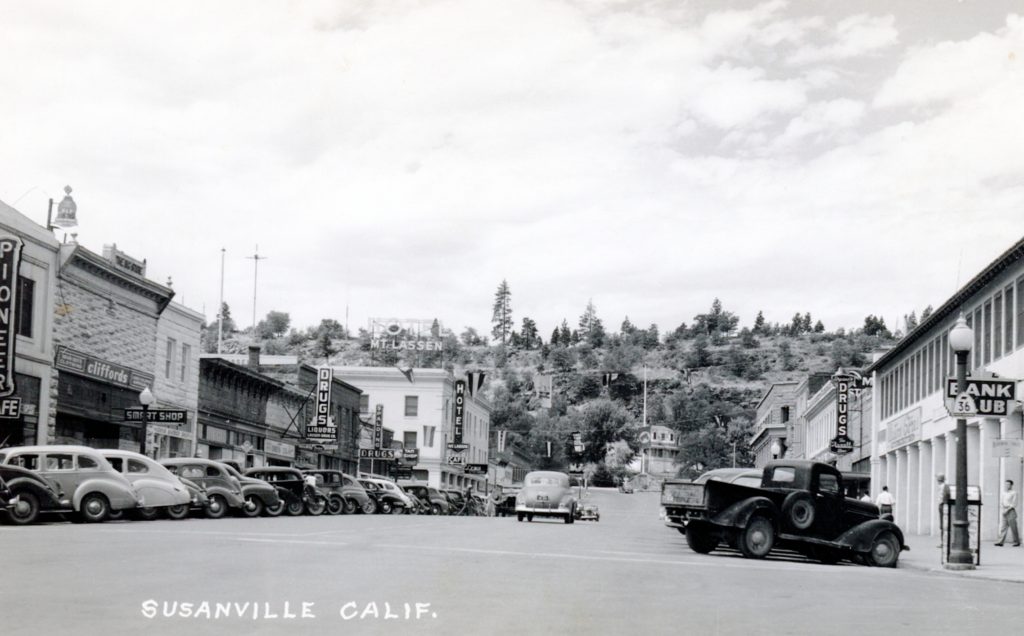
When the municipality was created in 1900, it’s status was that of a incorporated town. In 1911, the California Legislature added a provision whereby the word “Town” in any municipal corporation could be changed to “City.” The process was a simple one. A petition signed by twenty-five percent of the registered voters was required. Once presented to the Town Council, that body could introduce an ordinance and after thirty days it would take effect. A petition was provided to the council and at their May 6, 1940 meeting they passed the ordinance to rename the municipal corporation to the “City of Susanville.” In June, it was official—Susanville was a bona fide “City.”
What would you do if if you found a can containing gold coins in a field? That was dilemma for Charles E. Spoon in January 1906 when he found a can containing $280 in gold coins. Spoon was renting the H.J. Martin place near Buntingville where he made the find. It was speculated that some one had buried it a long time ago, and that the previous occupant, G.W. Reynolds* unearthed it when digging a post hole, but never examined it. It remained undisturbed until it was found by Spoon. In attempt to find the owner, Spoon placed a legal notice in the Lassen Advocate, though no one ever came forward.
*Reynolds was a cousin to Claude Heard, the founder of Heards Market.
Spread the word, and encourage a friend to subscribe.
Standish was a well designed utopian community. Yet, it shared a trait with many other communities that having a cemetery was an after thought. Those who initially passed away there were interred in the Janesville or Susanville Cemeteries. This changed in 1901 with the passing of Mary Pringle. Her husband, James and her were one of the first people to take up residence at Standish. She was buried in a field approximately 300 yards west of the Standish Bible Church on property at that time owned by Jim Elledge. Over the course of years only a handful people were buried there. As Jessie McKay Lowe who lived in Standish during the early 1900s noted the cemetery was abandoned because it would become completely under water at irrigation time. In 1909, the graves of Minnie Winslow and Bruce Ganyon were disinterred and moved to the Janesville Cemetery. The last burial to occur there was in 1918 for Mary Ann Penman.
A volunteer opportunity. If someone with a drone could take a picture of the site, it would be greatly appreciated.
Spread the word, and encourage a friend to subscribe.