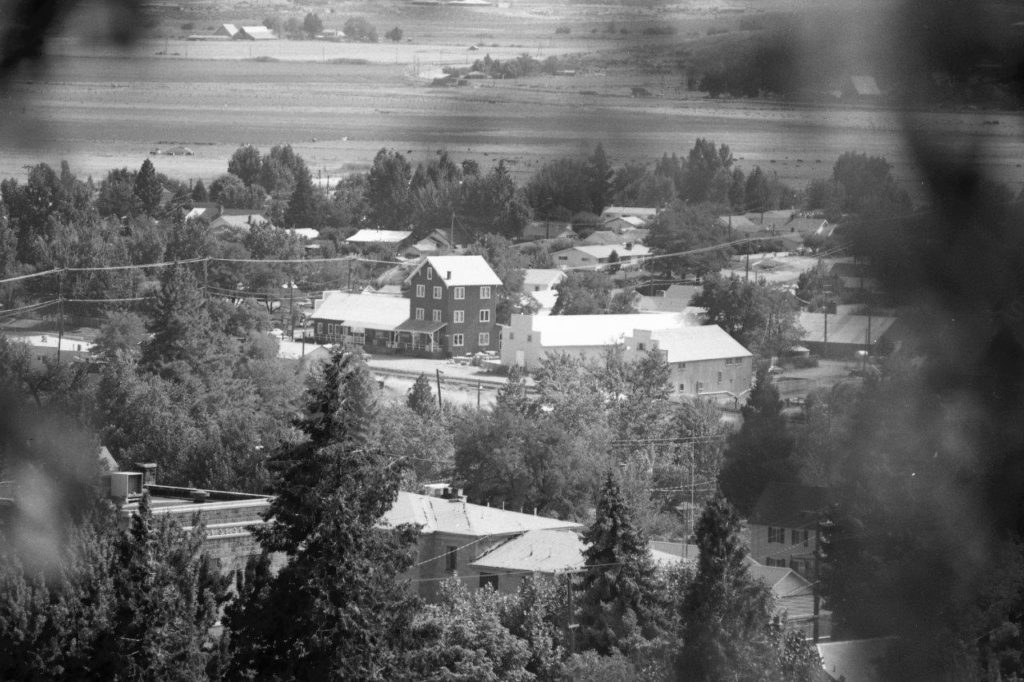
Susanville, 1973

Susanville vicinity, 1973–Hank Martinez

A lot has changed over the years. The one spot that has not changed is the area west of Susanville. Due to a number of factors, it is one area where development is limited.

Now a look to the north. As to residential Cherry Terrace was the only subdivision, and it is small compared to the neighboring ones that sprouted up to its east and north. The only activity north of the town, was the construction of the Lassen Community College campus.

The east end of Susanville more or less ended at Mesa Street. Notice the millpond is still in use at the Sierra Pacific Mill. To the south it was primarily agricultural and open space with very limited residential development.

Support

A Town Lot Promotion

 
An 1892 Amedee Real Estate Ad.

In 1891-92 during Amedee’s initial boomtown period, there were promotions of the town galore. One campaign to attract families to the town was for the first baby born there. The sponsors agreed the first child born in Amedee would receive a choice town lot. If the baby was a boy, the family would receive a month’s free board at the Hotel Amedee; for a girl a one-year subscription to the town’s newspaper the Amedee Geyser. Amedee’s first native son was born on August 19, 1892, a son to Marion and Hattie Bringham. They named the new addition to the family—-Robert Amedee Bringham. The family never received a town lot or free lodging at the hotel. The following year, Marion Bringham, who operated a saloon at Amedee, moved his family to Reno, Nevada. Robert A. Bringham served in World War I and would eventually have a career with the Veterans Administration. He died on November 19, 1973.

Spread the word, and encourage a friend to subscribe

A Different Era

Wiencke’s petition for the courthouse janitors job.

There was a time, albeit, a long time ago, when many county jobs were appointed by the Lassen County Board of Supervisors.* One of the “plum” county appointed jobs was that of the courthouse janitor and with it sexton of the nearby Susanville Cemetery..

*One of the more interesting political appointment positions on a national scale that effected the local level was that of postmaster. Postmasters changed whenever there was change of United States Presidents party affiliation. Not much for job security if you were local postmaster appointed by a Democratic President, you were out of a job when a Republican was elected, or vice versa not implying a specific political preference.

Spread the word, and encourage a friend to subscribe

Lookout, Modoc County

Lookout, 1910—-Big Valley Museum

Located approximately eight miles north of Bieber, in the northwest portion of Big Valley, Lookout is best known for the Leventon Blacksmith Shop and the Lookout Lynchings. However, unbeknownst, to the community back in 1916-1917, there were some major plans to transform it into a major lumber manufacturing center.

It all began back in 1912 when the Red River Lumber Company and the Southern Pacific Railroad entered into an agreement to the build the Fernley & Lassen Railroad. At Westwood Junction, the Southern Pacific built a spur line south to Red River’s newly constructed company town of Westwood.

Westwood Junction

It was Southern Pacific’s intent to extend the line north to Klamath Falls, Oregon. In 1916, Southern Pacific was eager to begin construction of the line to the north. Southern Pacific prodded Red River about its future plans to establish a second mill north to log its Whitehorse Tract in Siskiyou County. Red River somewhat obliged and in the summer of 1917 company officials traveled north to inspect future mill sites.

Hotel Lookout—-Beth Coppedge Walls

They found Lookout to be favorable. They were pleased with the cheap land prices, but also more important the weather. Lookout was much drier than Westwood. However, with the world conflicts Red River was not prepared to make any commitment to build a second mill. At the conclusion of World War I the economy was not conducive to proceed with such an endeavor and the plans for Lookout were tabled.

Spread the word, and encourage a friend to subscribe


Your Tuesday Tidbit—Hobo Wells Hydroponics

Wendel Hot Springs, February 15, 2018

Actually, this is slightly different take on things. In the 1970s, Philip Gutman’s Hobo Wells Hydroponic operation at Wendel seemed to have a bright future. By 1975, Lassen College incorporated into its curriculum an offered an Associated Arts Degree in Hydroponics.  By the late 1970s, Geoproducts, Inc. became involved to expand the enterprise. By the early 1980s the operation was abandoned. Does anyone know why it shuttered?

Tim

A Pete’s Valley Reservoir?

A 1916 view of the reservoir site—-Betty B. Deal

Over the years there have been many proposals to build a dam at “The Crossing” which is where Pete’s Creek flows into Willow Creek. While during the summer and fall, Pete’s Creek water flow in minimal. The idea was to capture winter and spring flows, which depending on precipitation, can be substantial enough to warrant a dam. Otherwise, the general opinion was that water was wasted where it would eventually flow into Honey Lake.

In 1916, the Honey Lake Valley Irrigation District did the most comprehensive study for this particular dam/reservoir. It was opinion of their engineer William Wales that the reservoir was capable of impounding 51,000 acre feet of water in an average year. This district like so many before it and after it was plagued with other problems, that their plans remained on paper.

Support


Illusions of Grandeur

The Hotel Amedee in its prime.

On January 9, 1892, the NCO Railroad entered into a contract with Fresno, California developer, Silas N. Griffith, to plot out and promote the railroad’s new terminus of Amedee, on the east side of Honey Lake. Griffith was required to build a hotel, bath house and livery stable. In return, Griffith received 50% of sales of the property. It appeared Griffith’s mission statement was Big. Beautiful, Bold.

Amedee Bath House
Amedee Bath House courtesy of John M. Gibson

Griffith saw opportunity in the hot springs to make the new town, among other things a health resort. In late April 1892, it was announced the bath house, would be on the same scale as the Hotel Amedee under construction. In reality when the bath house was completed, it was a modest one-story structure.

Spread the word, and encourage a friend to subscribe

When Christmas is a burden . . .

Christmas, 1917, in the Swain home, better known today as the Susanville Elks Lodge. Pictured are the Swain Children: Fitzhugh, Nellie, Blanche and Frances. Courtesy of Frances Swain

The full caption is “When Christmas Is A Burden And Not A Blessing,” was a short piece from Susanville’s Lassen Mail of December 6, 1929. It is a timely article that I thought worth sharing.

“Whether you have a happy, peaceful Christmas, enjoying the real meaning of the day or a much overworked and disturbed time, depends on the individual. So many of us overdo in the gift giving which is really only conventional giving and sometimes in bad taste. To give a little gift with no thought of ‘exchange’ but with a desire to show remembrance is a good thing. But in no case should one tax their means to such an extent that there is worry and ‘paying up’ for the next month. Sometimes a good home-made pie or cake is more acceptable to the friend who perhaps has much more means than we have, than a costly something. They can buy a costly something but perhaps they cannot bake a good home-made mince or pumpkin pie.”

Tim


Answers to some of your questions

Whitely’s Furniture Store, circa 1956—W.V. Laughead

Over Labor Day Weekend there was a post seeking information about Whitely’s Furniture Store in Susanville. Alas, no one came forward, so I am not able to provide any information. May be this time around, some thing might surface.

Ramelli butter wrapper. Courtesy of Eslie Cann

In the post about the White House at Constantia that was referred to as Monastery, I mentioned an elderly Indian couple by the name of Purdy who were the last occupants of the stately residence. The question posed whether any relation of mine. In the late 1800s it was customary of Native Americans to adopt an Anglo surname. Usually, the Indians adopted a Anglo name of a rancher they worked for, and/or resided next to one. Bordertown was originally known as Purdy. On the west side of the stateline in Sierra County, it was part of the Purdy Township, named for H.H. Purdy an early settler in that district. No relation of mine. Actually, Purdy is a fairly common name.

The “White House” at Constantia, circa 1960

Finally, I am amiss and failed to address a request about the Jeremiah Wood family. Some may remember during the St. Patricks  Cemetery tour we visited his grave. With file nearby I will address this.

Tim


The Job Jitters

Red River Lumber Company’s Westwood mill, 1931.

By 1930, the nation’s lumber market had suffered big time not only with the economy teetering but supply flooded the market where there was no demand. In the Lassen region, this was a new experience as everyone had been accustomed to the good times. The big three mills had not only scaled back their labor force, but curtailed production. This fueled the rumor mill, and in December 1930, the rumor on the street that the Red River Lumber Company was to permanently shut down its mill. Company officials had to put out the word, that this was utter non-sense. After all, in December there was the usual slow down with the end of logging season, and soon it would be time for annual maintenance of the mill.

On the other, Lassen Lumber & Box Company was in dire financial straits. They closed down Camp Lasco, their logging camp for good and would rely upon logging contractors for their future needs. The company also went through major refinance of all the other departments.

Support

Exploring Lassen County's Past