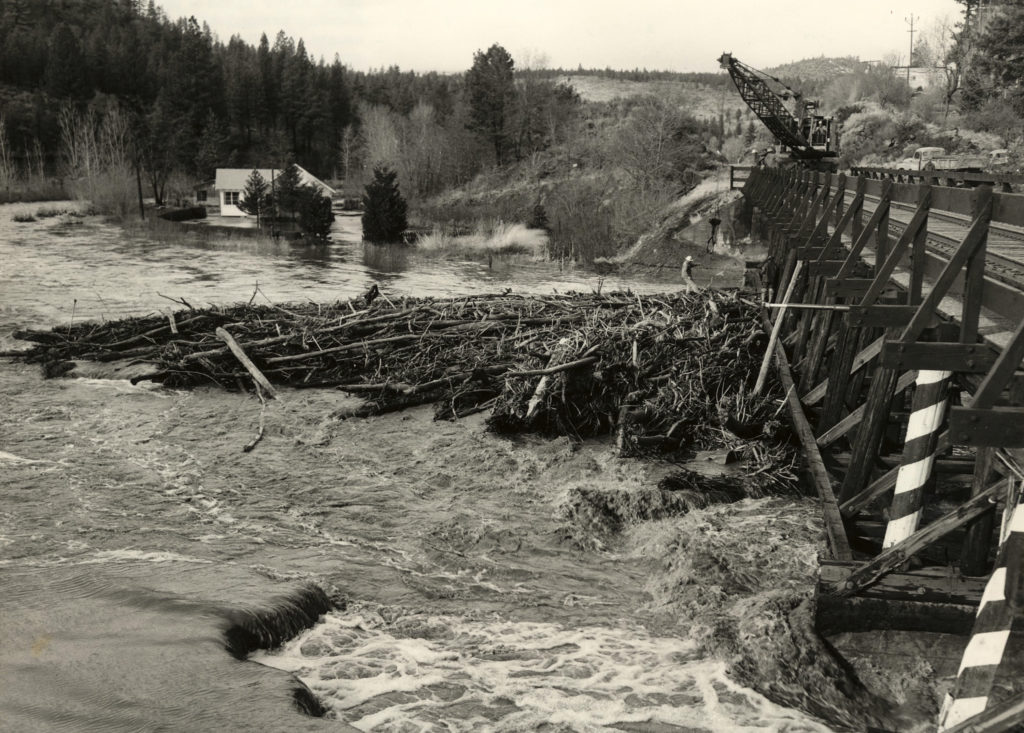
Southern Pacific’s railroad trestle at South Lassen Street, December 1955.
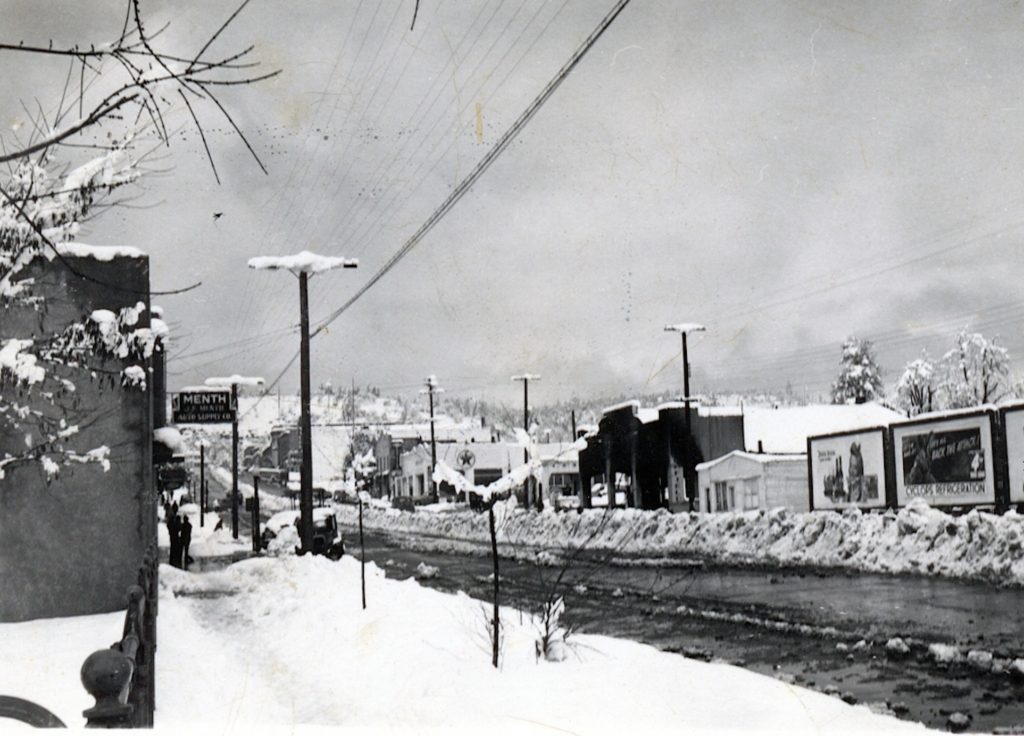
The floods of December 1955, locally and throughout California was a notable event to say the least. It began with warm rains on December 15th and by December 20th, 4.41 inches had fallen in Susanville. The snow elevation remained high, and on December 20th there was 21 inches of snow on Fredonyer summit. The rain continued turning the Susan River into a raging menace. Conditions worsened as the river brought assorted debris with the floodwaters. The debris became a major obstruction when it collided with the Southern Pacific’s railroad trestle at Susanville’s Lassen Street. On December 23rd Marvin D. Coltran, a member of Southern Pacific’s bridge gang fell into the water there. Efforts were made to reach him, but the river’s swift current swept him away.
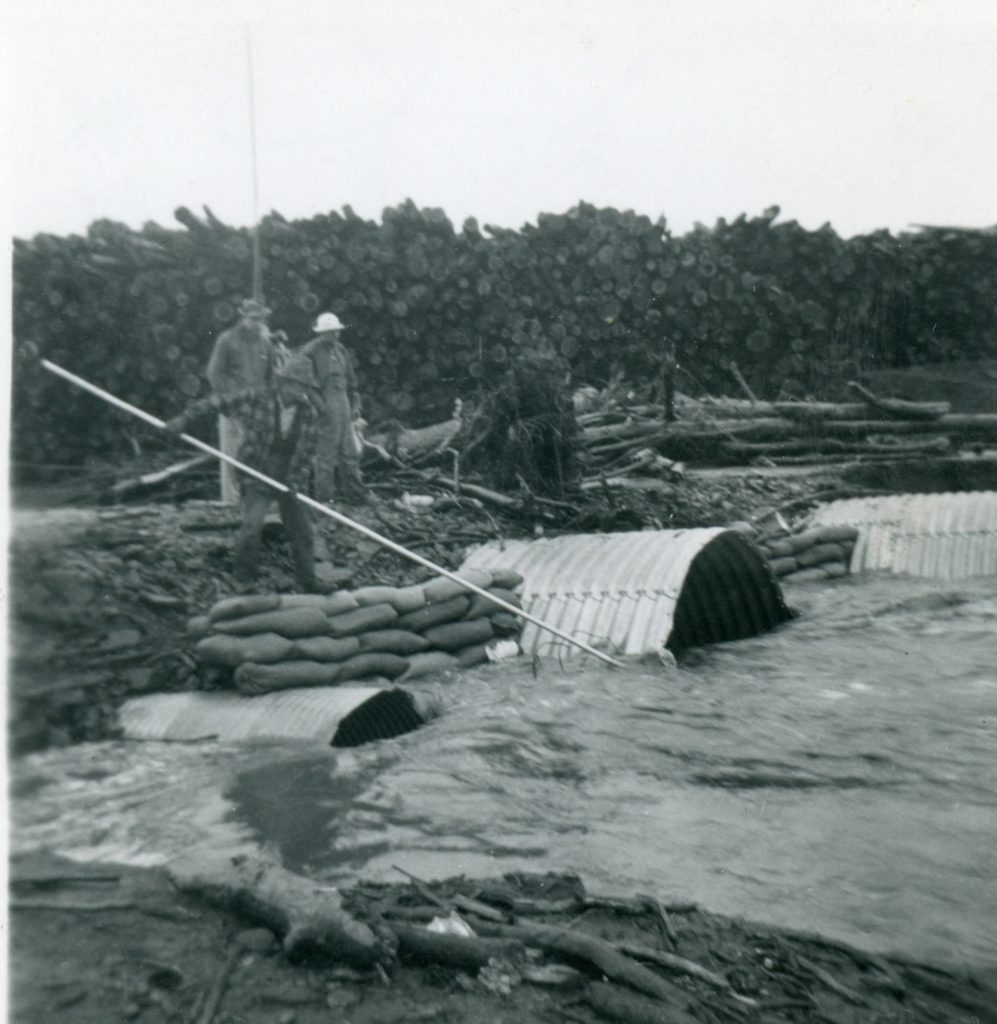
Riverside Drive, Susanville, December 1955
Relief from the rains arrived in the form of snow on December 28, when four inches fell in Susanville. In December 13.03 inches of rainfall was recorded in Susanville.
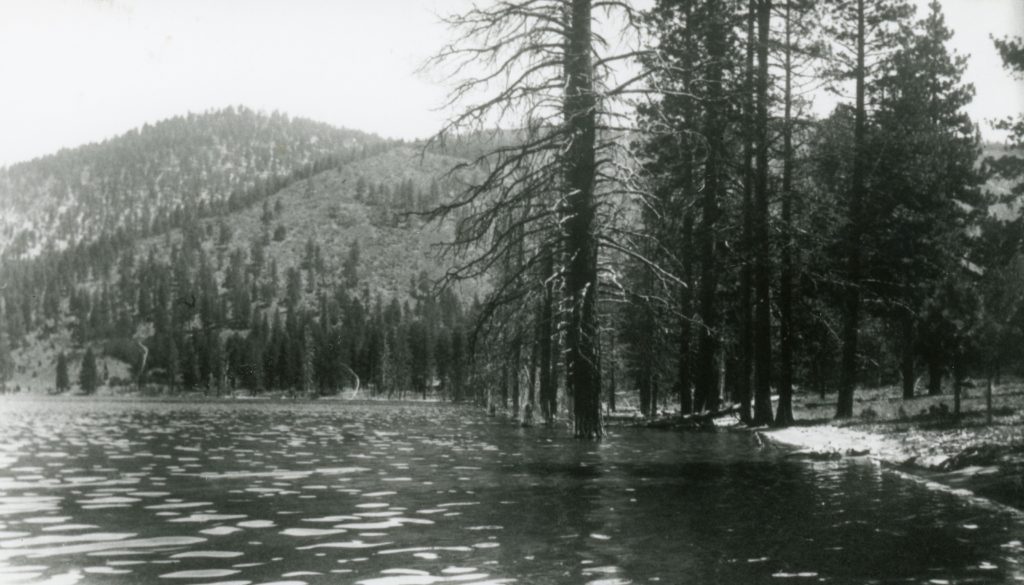
Gallatin Beach and Peak, 1916. Courtesy of Wyn Wachhorst
This was part of the headline statement featured in the Lassen Mail of November 20, 1931 when it was reported that the water level of Eagle Lake had reached its lowest level, yet. The newspaper stated from the lake’s highest point had now dropped by twenty-six feet. That over a ten year period the lake had dropped two and half feet each year. The paper blamed the unusually light winter precipitation that was cause of the drop. It went on to state that in normal times the spring run off into the lake varied from two to five feet. Had this occurred, according to their opinion, that was sufficient amount of water to cover from the effects of evaporation and the water drawn from irrigation.
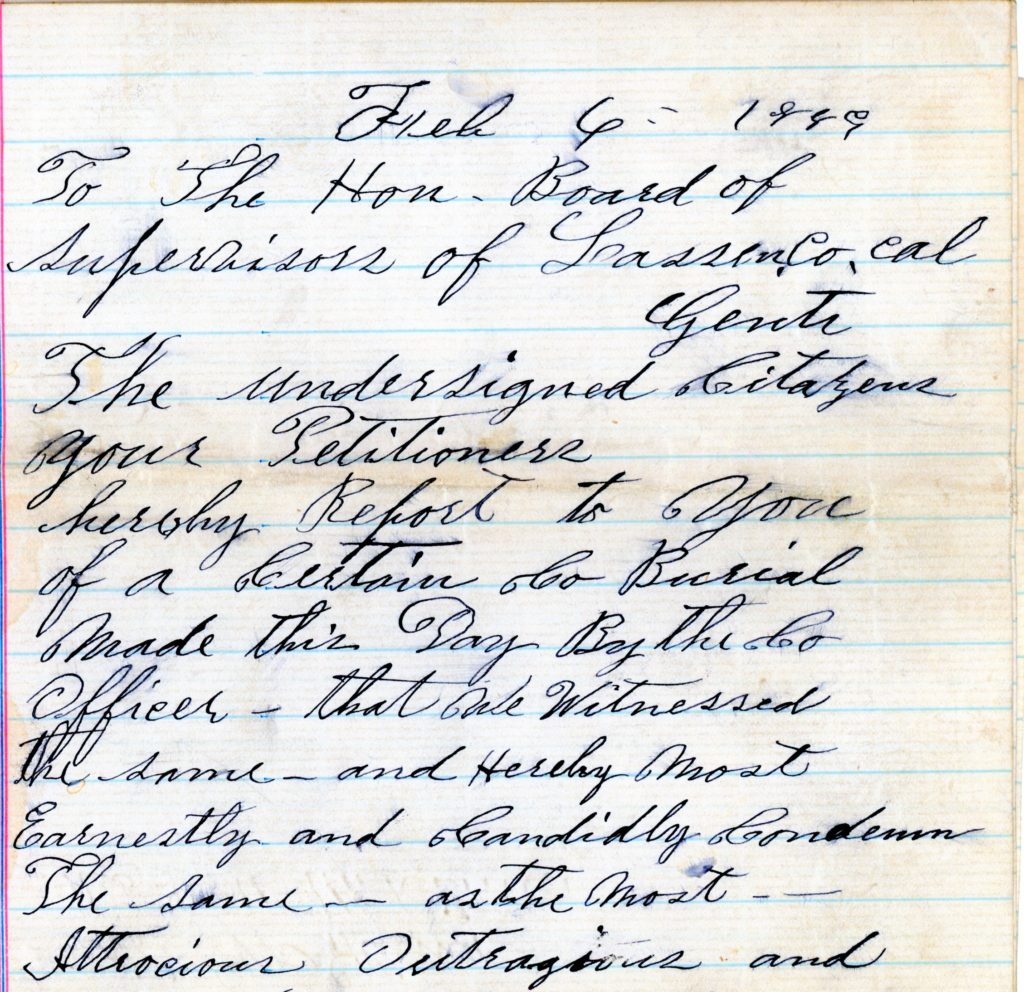
This is a tragic tale of a indigent burial in the Susanville Cemetery. It incensed those in attendance to petition the Lassen County Board of Supervisors to make sure it never happened again. The petition, which is transcribed below, fails to mention the deceased. Who that person was, we might never know. California law did not require that births and deaths be recorded until 1905. There are gaps in the local newspaper, so that avenue could not shed any light on the subject. The minutes of the Board of Supervisors might have information, but those early records are in storage during the courthouse renovation process.
February 6, 1889 — To The Honorable Board of Supervisors of Lassen County
”The undersigned citizens, your petitioners, hereby report to you of a certain burial made this day by the County Officer that we witnessed the same day and hereby most earnestly and candidly condemn the same—as the most atrocious, outrageous and indecent ever by us witnessed. There being no box nor covering for the coffin and the dirt thrown on the coffin lid and the treatment before burial of the corpse. The most inhuman barbarous and disgraceful. We therefore ask that hereafter the person who shall bury the county dead give bonds for at least a decent burial.”
Finally, it should be noted that of twenty-six people who signed the petition, nineteen of them would eventually be buried in the Susanville Cemetery.
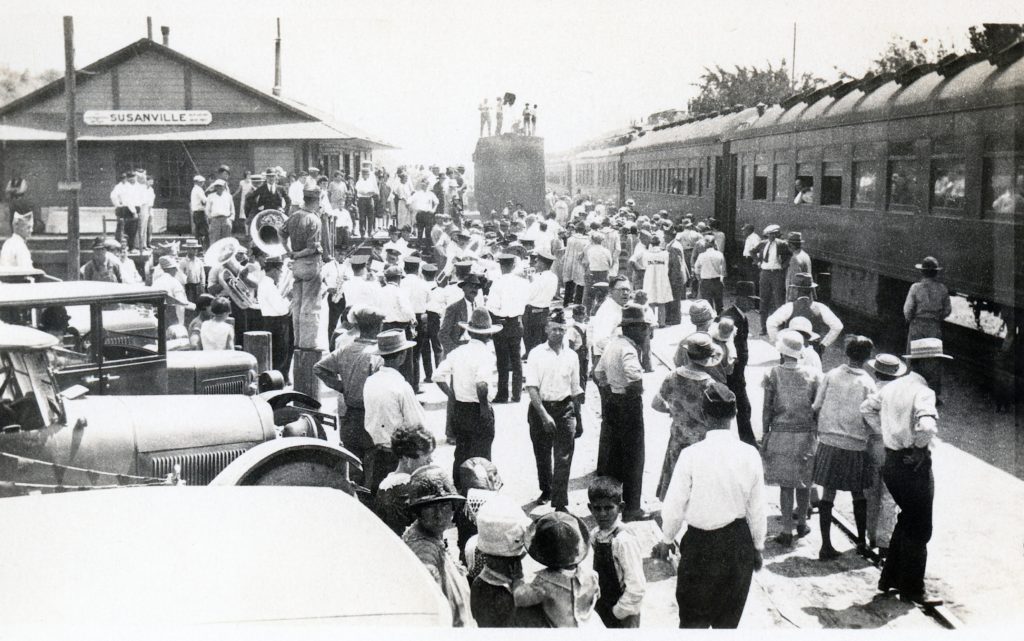
1926 American Legion Convention delegates arriving at the Susanville Depot. Courtesy of Nellygrace Stoll.
Yesterday, the topic was about the chamber of commerce wanting a new Susanville Depot, instead all they got was an addition to the existing depot.
The world was changing rapidly. Between the affordability of the automobile and the construction of highways changed the way the public traveled. The automobile provided freedom to go places whenever a person wanted to do so, and no longer restricted to train schedules. The golden era of passenger train travel was drawing to a close.
The increased use of automobiles and trucks began to take its toll on railroads. In 1933, Southern Pacific railroad officials studied those impacts on the Westwood Branch. To eliminate mail and passenger service it was estimated it would save the railroad $25,000 annually.
On September 29, 1933 a two-day public hearing was held to abandon passenger service. In the late October it was approved by the Interstate Commerce Commission. There was one stipulation. In times when highways were closed by winter storms, the railroad would be obligated to provide passenger service. The last passenger train left Susanville on November 30, 1933.
Susanville Depot, 1929—Hank Martinez
It should be noted, while regular passenger service was discontinued, there were on occasion into the 1950s were exceptions ,made and passengers rode in the caboose.
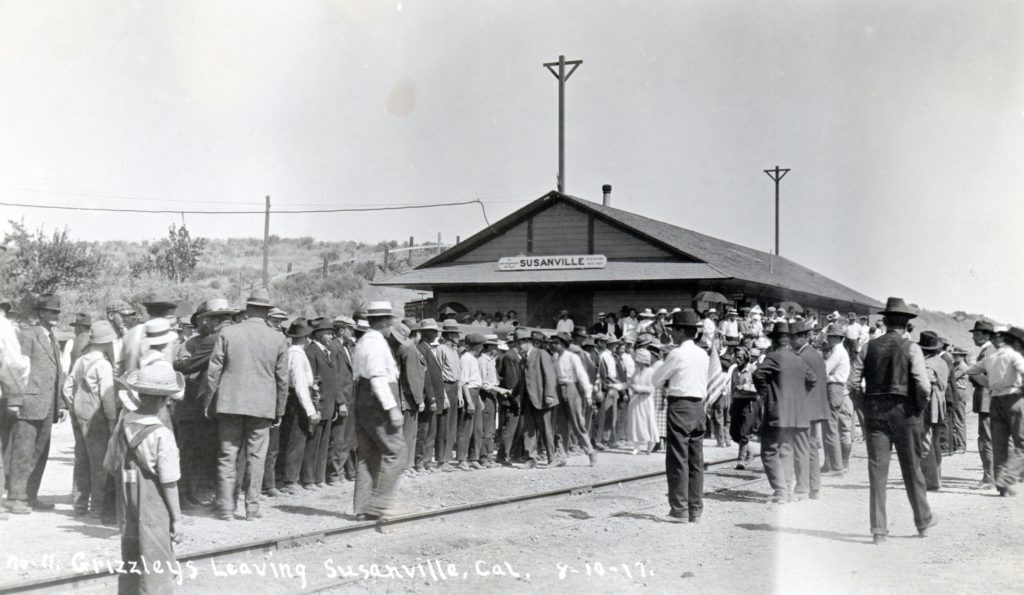
The send off of the first recruits of World War I from Lassen and Modoc Counties at the Susanville Depot. Courtesy of Lola L. Tanner
In February 1926, the Lassen County Chamber of Commerce sent a letter to Southern Pacific officials for their desire for a new depot in Susanville. It was their opinion that they had been short changed since day one. After all, the depots in Litchfield and Westwood were three times the size of Susanville. In their plea, the Chamber wrote:
”Susanville wants a new station and not a makeshift addition to the present one. It is recommended that this new station be of native wood with cedar logs for columns and its construction and architecture be typical of a lumbering community. In other words, the town does not want the stereotypical production of yellow stations which are turned out like so many sausages or tin lizzies. It wants something distinctive and judging by the amount of business in sight, as the cinnamon bear said to the cinnamon bun, ‘I don’t see why we should not have one.’”
The Chamber put forth a strong argument, stating just the growth warranted such. The population had swelled to over 20,000 and prior to the railroad was only 4,000. The Chamber cited how inadequate the current depot in handling freight, citing numerous problems. The Chamber went on:
”Passenger Needs: Passengers require a new and separate passenger station. We believe that such a station should be built with the idea of the rate at which Susanville is growing and adequate for traffic needs not only for the present but for the next five years at least. We believe further that in-so-far as consistent with the general policy of the Southern Pacific, that such a station should be designed to meet the peculiar climatic conditions of the city which in this respect is so radically different than most cities of California.
“We believe these requests are reasonable and feasible and that they are justified by the volume of traffic. We request your earnest and earliest consideration of them.”
A month later, Southern Pacific officials arrived to make an inspection after the receipt of the Chamber’s letter. They took the matter under advisement. Later in the year, they announced they would build an addition to the depot, by extending the depot by 75 feet. It continued with the same buff (yellowish) color typical of Southern Pacific depots. If it was of any consolation, at least it was not a typical Southern Pacific depot.
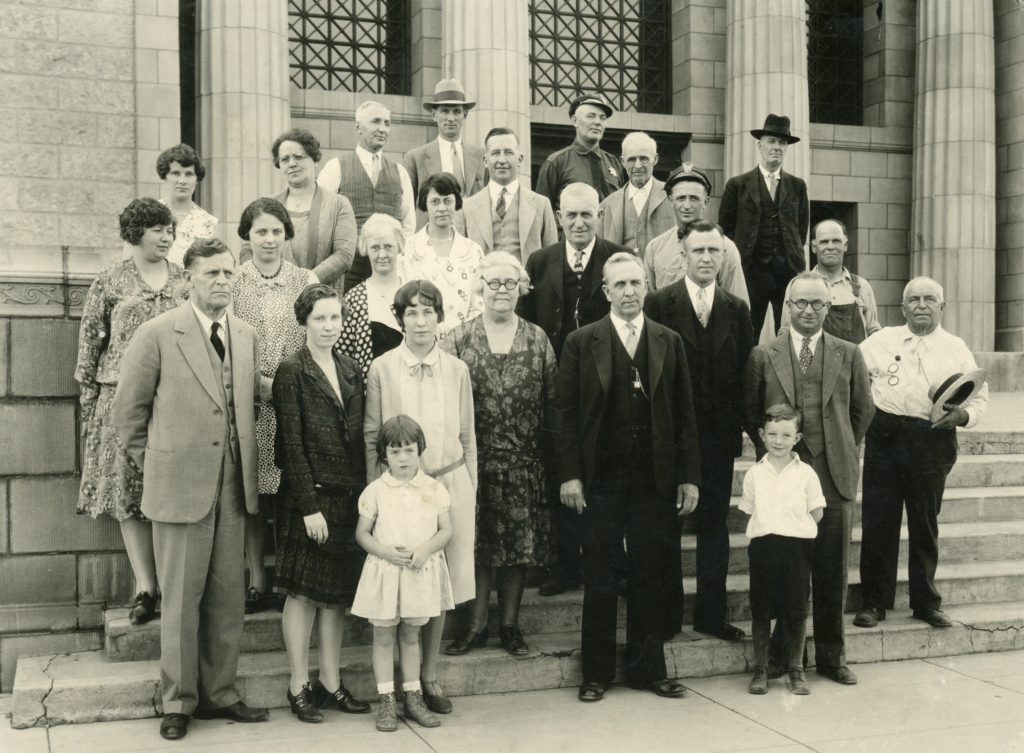
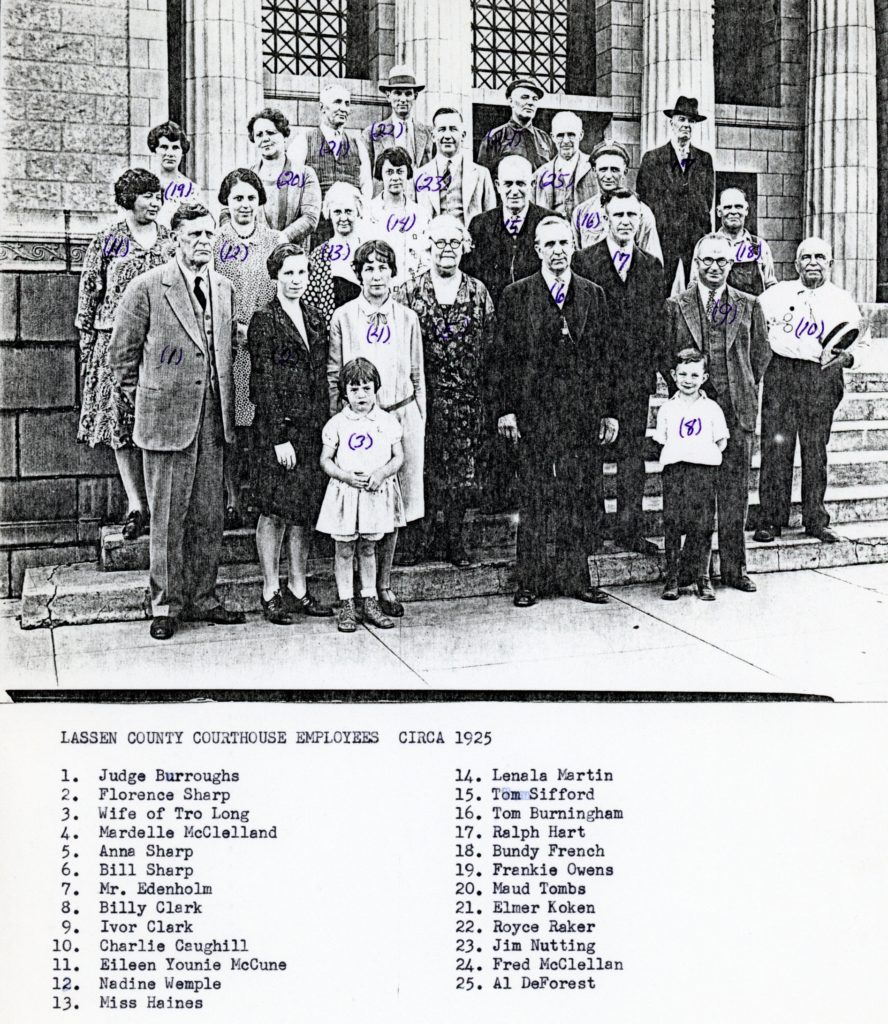
Lassen County Employees, circa 1925–Nadene Wemple. See end of story for identifications
At the April 1926 meeting of the Lassen County Chamber of Commerce they held a dinner meeting in which the speakers were the Lassen County Courthouse employees. Two speakers provided some interesting insight.
First was Bill Sharp, the county treasurer as it pertained to county finances. The total annual income was $589,566.02, of which $385,000 came from county taxes. As to expenditures, schools (251,217) and roads (159,000) consumed the most at a whopping total $410,247). County salaries came in at third at $41,208 followed the hospital and indigent at $28,213.93).
M.D. Collins, county farm bureau agent, spoke on timber conservation and fires. Of note, Collins stated that were 185,000 acres burned over. This would mean, he said, enough timber to build a new house and barn on every farm in four counties of Northern California.
During the 1930s, between bark beetle infestation and a long term drought witnessed a large number of snag (dead) trees on Fruit Growers Lassen Operation. Then came along World War II, which created new challenges due to employee shortages. Yet, it is those kind of conditions where creativity comes to the forefront.
Even after the conclusion of World War II in 1945, there were still labor issues. Since the late 1920s, Fruit Growers, as well many lumber companies turned to machines to do the work more efficiently thus cutting down on labor at the same time.
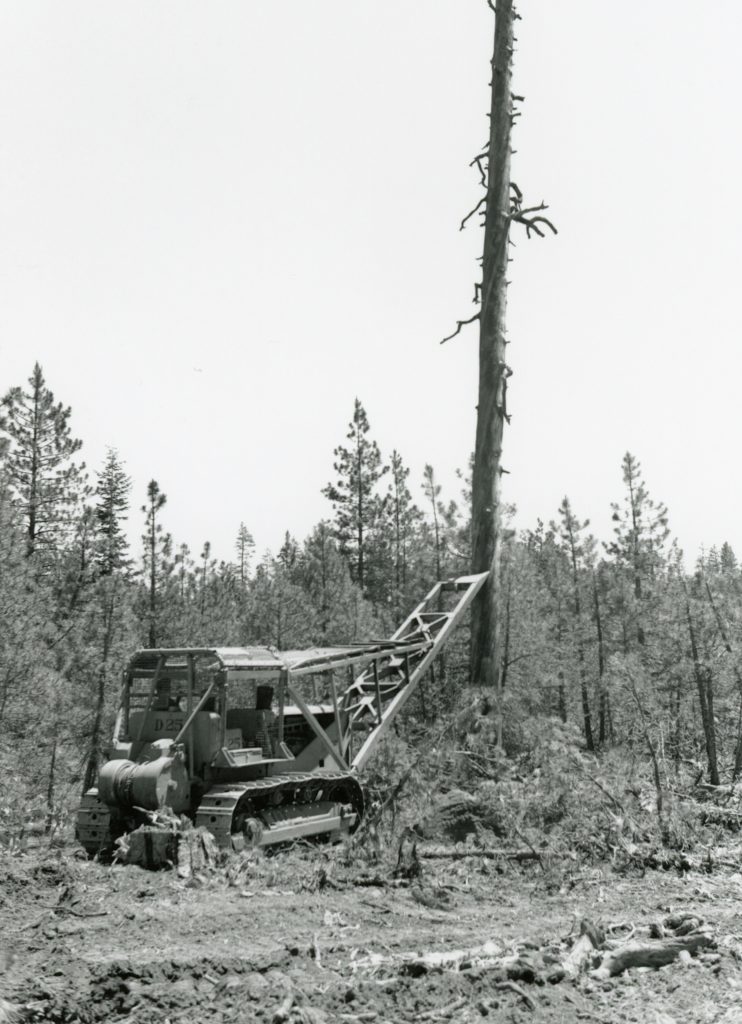
In 1945, with Fruit Growers acquisition of Westwood from the Red River, did have some perks. The machine shop there employed some very talented people, who over years with creative talents improvised equipment best suited for the company’s needs. Their task to design and modify a caterpillar tractor that could knock down a snag tree—a snag pusher. The major advantage was it eliminated timber fallers from doing the job.
In its first year of operation Fruit Growers reported that 6,929 snags were felled by the snag pusher. How long the snag pusher was used, the record does not indicate.
Main Street looking west towards the intersection of Weatherlow, 1937–Margaret Purdy
In the fall of 1926, Susanville installed stop signs at the intersection of Main and Weatherlow Streets, citing safety concerns and to control speeding somewhat. It was by and large ignored. That was going to change. City Police Chief, Lannie Long made it known that beginning on November 21, it would be enforced and tickets issued.
Motorists for the most part obliged and those who did not yield to a full stop were initially given a warning. However old habits are hard to break, and soon motorists started going back to their old ways and and breezing through the stop signs. A crack down had begun and tickets issued. During the week of December 16, 1926 nineteen tickets were issued for failure to stop, including well known local attorney Hardin “Finn” Barry. The fine $5.00. By spring motorists were generally in compliance, and tickets became less frequent.
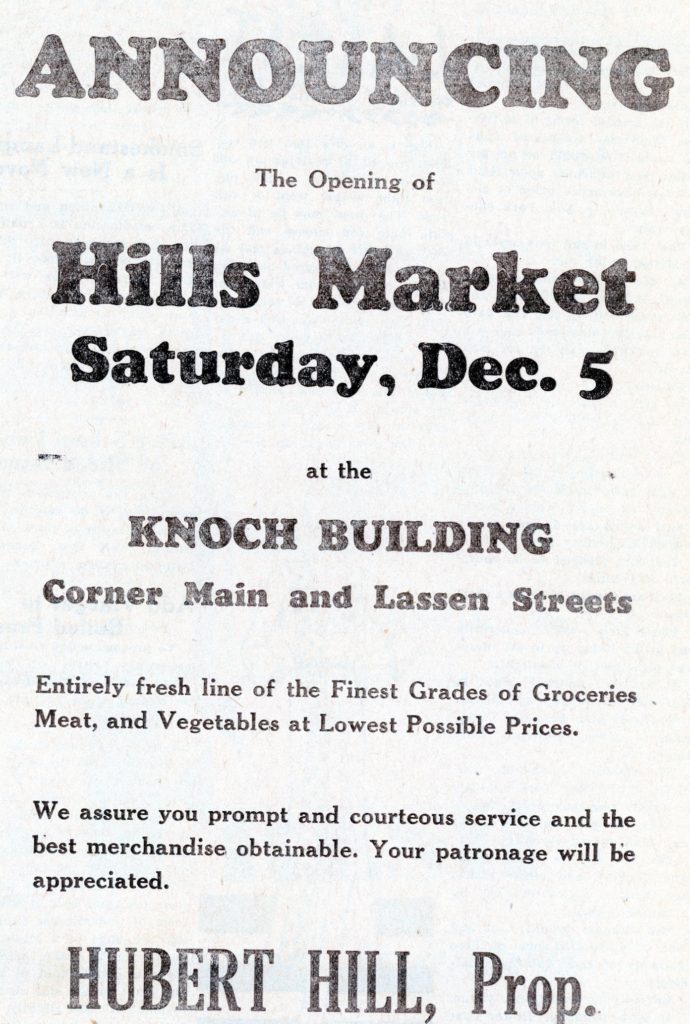
This is to correct a major blunder on my part. It was on December 5, 1931, when Hubert Hill opened Hills Market in the Knoch Building, and was a very popular grocery store for decades to come. What I omitted was his wife, Mildred Long Hill. When Hubert passed away in 1946, Mildred carried on with the business. She passed away in 1967, I am not sure who took over the ownership. There seems to be some confusion over the latter. Stay tuned, while I research this.
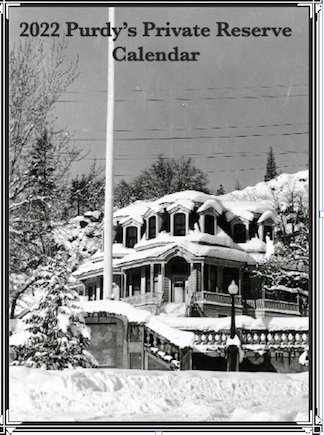
This calendar is unique in a different kind of way. Four of the photographs featured I purchased on Ebay. One of the most unique is that of Homer Lake taken in 1918. Where the photographer took the photograph was impressive. As usual it is an interesting collection of historical photographs of the region.
One has three options to purchase calendars:
1) Locally, you can purchase them at Margie’s Book Nook.
2) You can purchase direct online by clicking here
3) You can also email me to place your order, and it will be sent with an invoice.