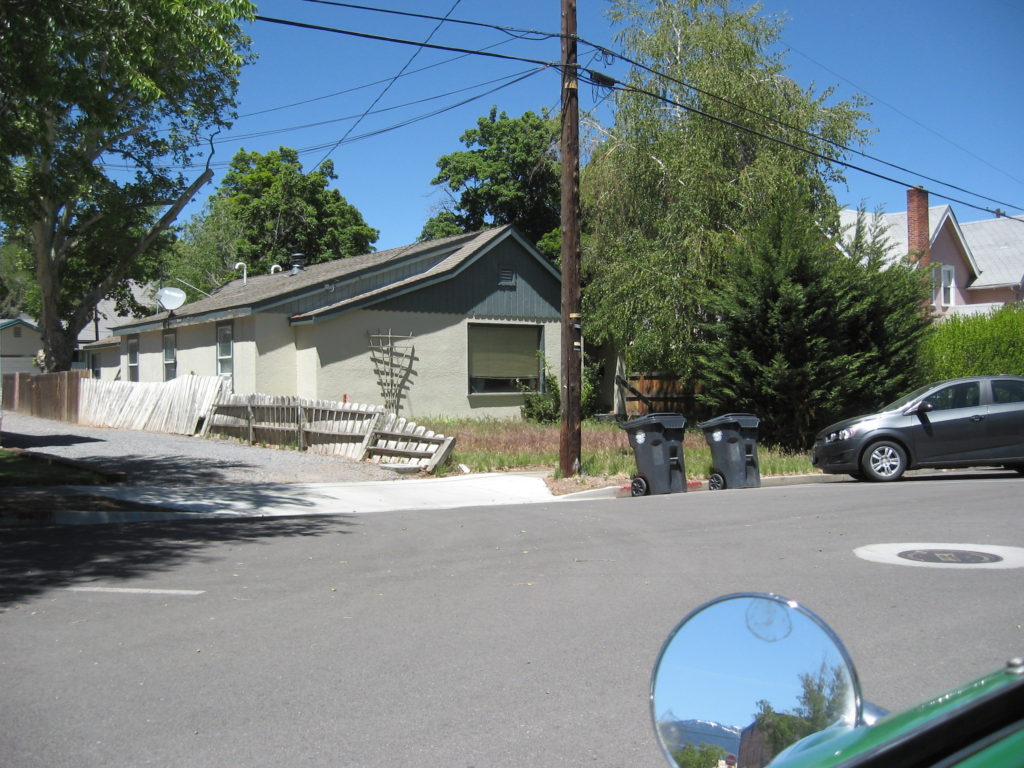
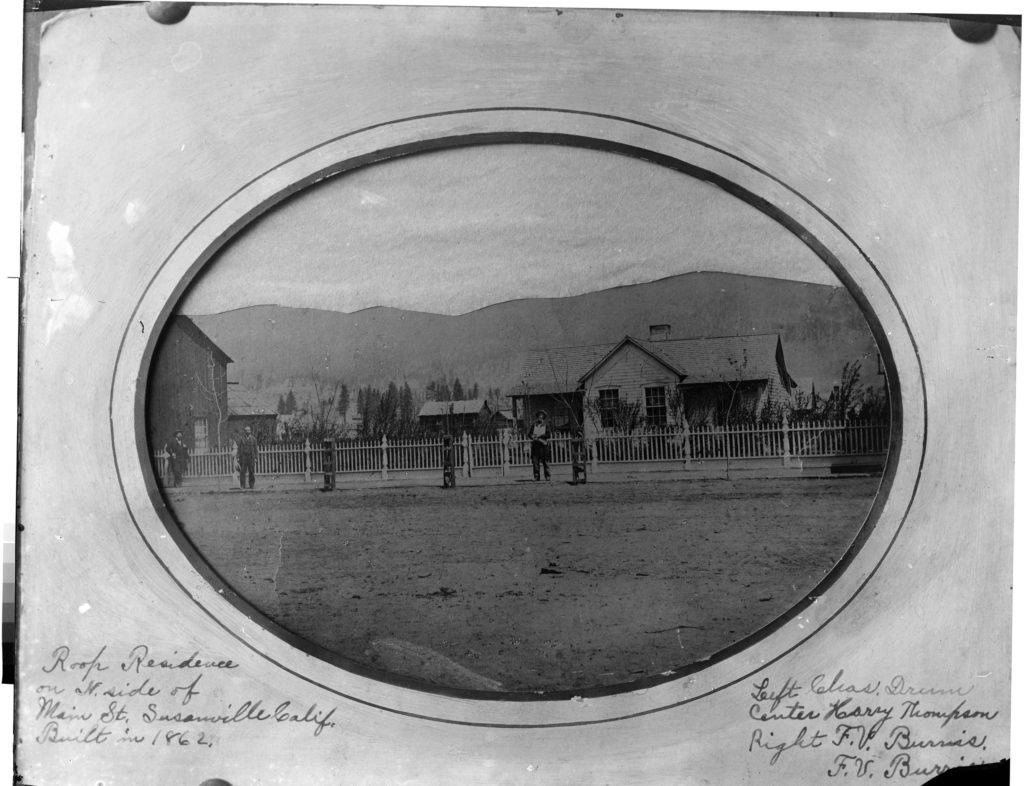
In 1862, Harry Thompson who operated the local stone quarry in Susanville purchased three lots on the north side of Main Street between Lassen and Gay Streets from Isaac Roop. Shortly, thereafter he built a house there. The following year he defaulted on the payments to Roop and Roop took possession of the house and moved in. He would reside there until his death in 1869. Later his daughter and son-in-law, Alex and Susan Arnold resided with him. The Arnolds remained there until 1885 when they sold the house, and built a new home on Weatherlow Street. The Roop house was then moved to its present location at 140 North Lassen Street where it remains to this day. In 1935, Ardell Torrey completely renovated the house.
The house as it originally appeared on Main Street—Eastman Collections, UC Davis
In 1853, Congress passed an Act granting the State of California school lands, in effort to support public education. Every Section 16 and 36 in every Township was granted to the State of California as school sections. These properties did not require a federal land patent to be acquired, just simple fee to the State. It is interesting that 19 California counties were exempt. During the early years, the State sold these lands to prospective buyers at $1.25 per acre. When school lands are sold today, those funds are deposited into the State Teacher’s Retirement Fund. In Lassen County, there remains a high concentration of school lands in the eastern portion of the Honey Lake Valley.
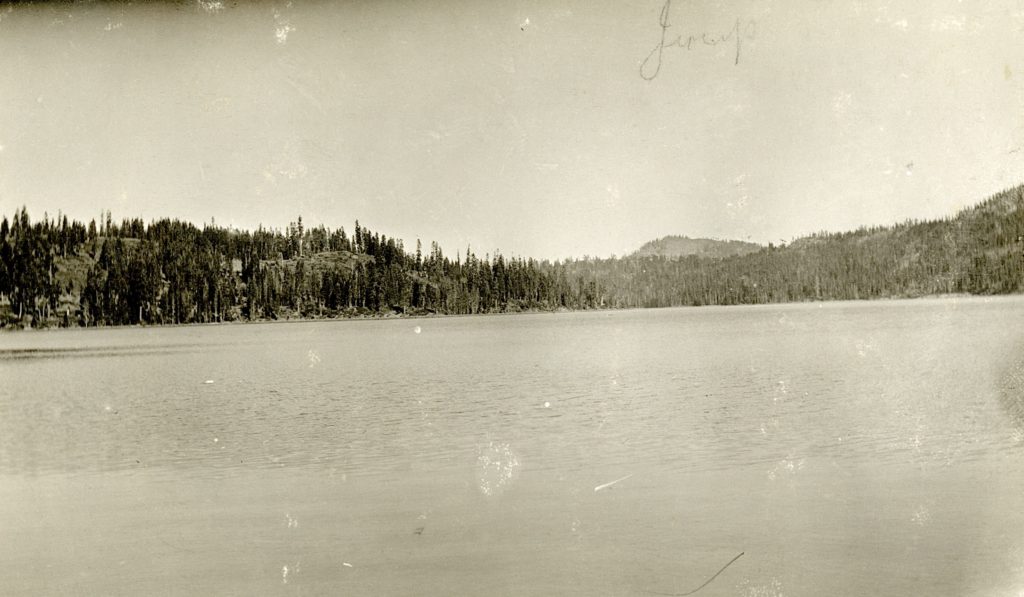
Juniper Lake, located in Lassen Volcanic National Park fell under the jurisdiction of the State as a school land section. In 1892, San Francisco resident, J.P. Frenna purchased 475 acres that included Juniper Lake from the State for $1.25 per acre.
The May 1907 meeting of the Lassen County Board of Supervisors was a lively one. The hot topic was a new county jail and courthouse. The board received numerous petitions from throughout the county. One common thread that residents was for better roads. Many thought the county should be investing in a rock crusher and replacing wooden bridges with steel. There was, of course, resentment from the public who resided far Susanville over the cost of the newly established Lassen County High School.
The petitions from Bieber and Standish had another odd twist. Both petitions urged the board that the county seat be relocated. It was their opinion that Standish be made the county seat on the grounds it was more centrally located. The board took no action on these topics. In addition, it would be some time before the board would even bring up the topic of a new jail and courthouse.
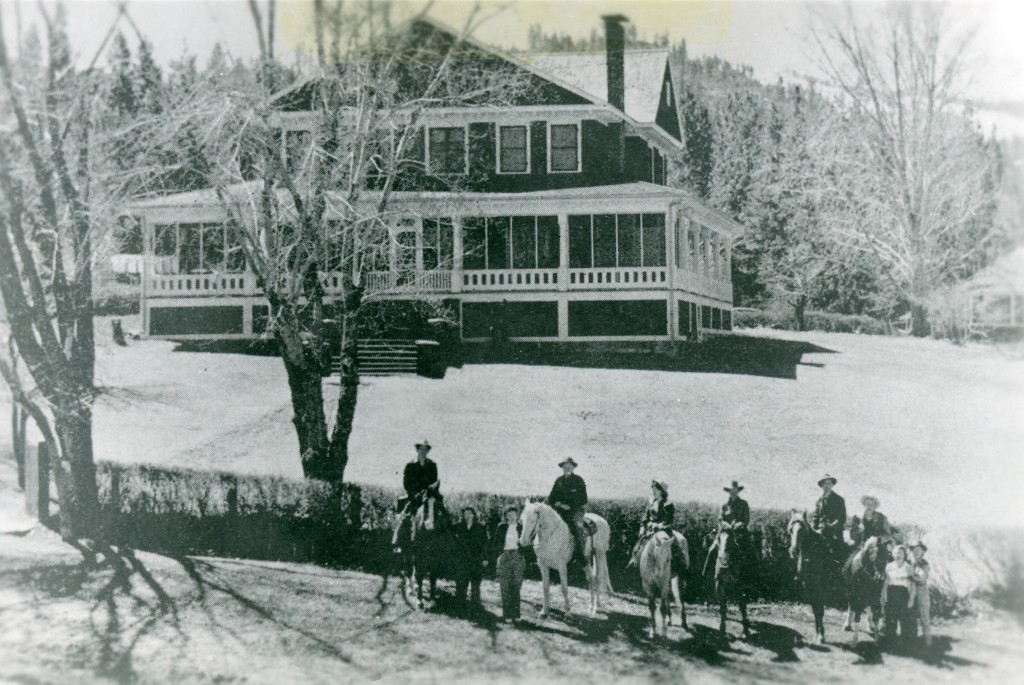
The Wingfield property as it appeared in the 1950s.
George Wingfield’s original summer home had many reincarnations. In 1946, three Carson City investors acquired the property eight miles south of Susanville and known to many as Ellena’s Mountain Meadow Ranch. They incorporated as the Diamond Mountain Guest Ranch. They envisioned transforming it into another New Mexico Vermejo Club or Colorado’s Rio Blanco Ranch.
J.E. “Jack” Hauskins was hired as manager/promoter. It was their original intent to offer 150 one-acre homesites on the property under a 49-year lease agreement. The first 50 sites were offered at $2,000 each, approximately $25,000 today, with an annual fee of $20 for maintenance. They also proposed to build an elaborate clubhouse just east of the original Wingfield home, where numerous events would be held.
However, in the spring of 1947, the future of the guest ranch was in jeopardy. At the time, Hauskins was arrested for embezzlement. In addition, he was accused of not paying employees. In late May, the criminal charges were dropped, but guest ranch never recovered from its tarnished image.
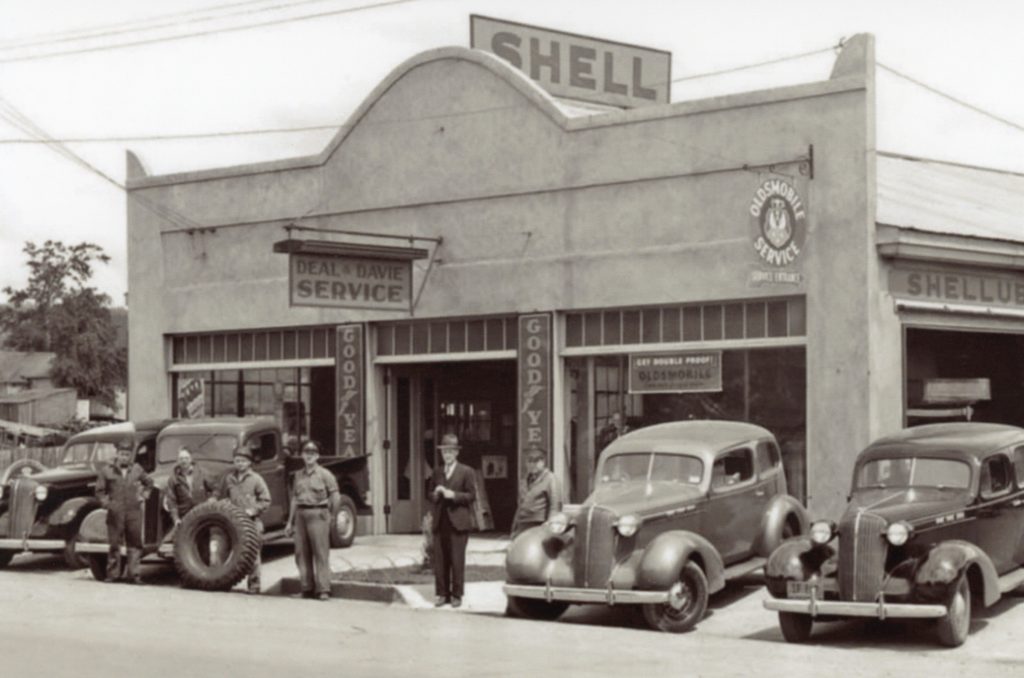
Deal & Davie dealership, the longest lasting of the auto row.
In the mid-1920s a nucleus of what would become Susanville’s Automotive Row took place. Two significant developments took place in 1925/26 with the construction of two car dealerships at the intersection of Main and Weatherlow Streets. On the northwest corner was Smith’s Chevrolet. Kitty corner, or the southeast corner of Main and Weatherlow was Ramsey Auto Sales, a General Motors dealership . Next facing Weatherlow was Menth’s Auto Service. Kitty corner to that a gas station, which out of the four is the only one that exists. Just below Ramsey Auto Sales was Wiencke’s garage, which was an Overland dealership.* Across the street and down a bit near the Veteran’s Memorial building was Susanville Motors, a Packard dealership. In 1931, Fred Deal purchased Susanville Motors from Felix Polin & Son and later brought in Lester Davie to form Deal & Davie.
*Overland would be best known for its Willy’s Jeep.
Where the buffalo and elk roam at Wingfield Ranch. Courtesy of Lola L. Tanner
On September 23, 1912 J.S. Hunter the head of California State Fish & Game Commission paid a visit to local game warden Frank Cady. Hunter had been a frequent visitor of Lassen County to inspect different aspects of wildlife. He informed Cady that he thought that the commission should plant a herd of elk in Lassen County. Hunter stated that government preserves had an abundant supply of elk and thought they would thrive in this region. In addition, Hunter recommended the planting of pheasants.
While the state never introduced elk to Lassen County, George Wingfield brought in elk and buffalo at his ranch at the the base of Diamond Mountain. After Wingfield sold his ranch, the buffalo were taken to Reno. In time, the elk roamed the region with reports that the last one killed about 1940 on nearby Bald Mountain.
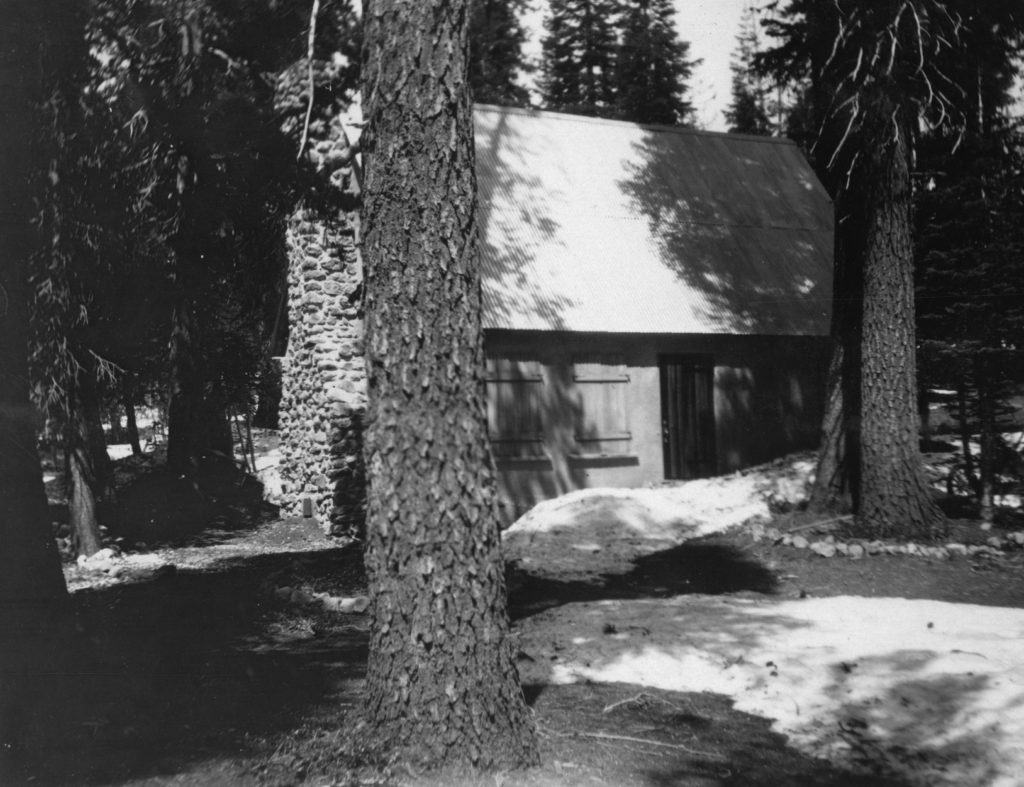
Judge Ben Curler’s cabin at Juniper Lake. Curler a Susanville resident was the park’s first magistrate.—National Park Service
Recently, there was an inquiry about the privately owned cabins at Juniper Lake inside Lassen Volcanic National Park that were destroyed by the Dixie Fire. For those not aware, there were eight cabins, seven which were destroyed.
When the park was created in 1916, inside its boundaries were numerous privately owned properties, that the park would spend decades to purchase. Even Manzanita Lake was not only privately owned it was not even inside the original park boundary, but that is another story.
In 1917, C.P. and Cora Snell created a subdivision at Juniper Lake that contained 1500 lots. While lots were sold, only a a few individuals built cabins. This was due in part, that the lake’s high elevation, the summer season was relatively short, typically June to early September and a rough road did not help matters.
After years of stalled negotiations with the Snells, the park in 1955 filed a condemnation for their unsold lots and their Juniper Lake Resort. It went fairly smooth. In 1959, the park filed a another condemnation suit against the owners of the unimproved lots. While the owners protested, eventually the park prevailed. So the only lots left at Juniper Lake were those with cabins, with a goal of a possibility the park would acquire one day. The park had an opportunity to purchase a cabin there, which they did and was used by park personnel and it was one of the cabins destroyed.
This is an interesting postcard I came across. Unfortunately, the postal cancel stamp was uneven, so most of the date does not show. The author, Carolyn, who sent the card to Miss Sophie Schoenheit of San Jose wrote: “I took this scene in Susanville when the snow was five feet deep.”
The snow obliterates most of the building depicted, so I cannot figure out which residence it is/was. However, I wonder if it might be the Taylor/Compton house on North Weatherlow Street. Whatever the case may be, we could use a lot of snowstorms depicted in the photograph, because this area, as well a wide swath of the West really needs this kind of moisture.
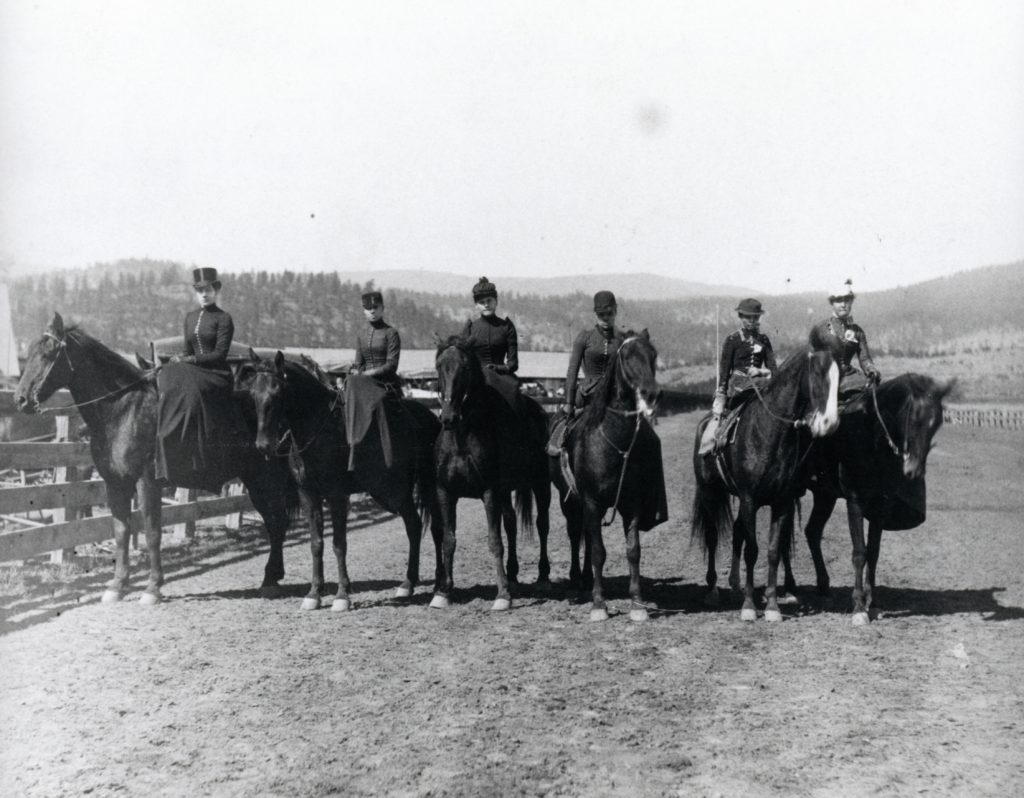
Susanville resident, Med Arnold (1885-1967) recalled the fairs of past, which we explore today. Med wrote: “Every fall we had two-week fair consisting of races, a livestock show and exhibits of all kinds. Many of our local people owned race horses, both runners and harness horses. Other horses were brought in from all parts of the country. There was usually six running races and a couple of harness races each day.
”The mile-track was situated just east of our ranch, and not far from our orchards. The large grandstand, betting ring, restaurant, paddock and stables were on the south side of the track, and the judges stand was on the north side. All of these buildings were situated somewhere in the neighborhood of what is now North Street, but some distance below Memorial Park. I have seen hundreds of dollars in the betting ring, all in gold coins. The present day crop of gamblers are pikers compared to the old-time bettors.”
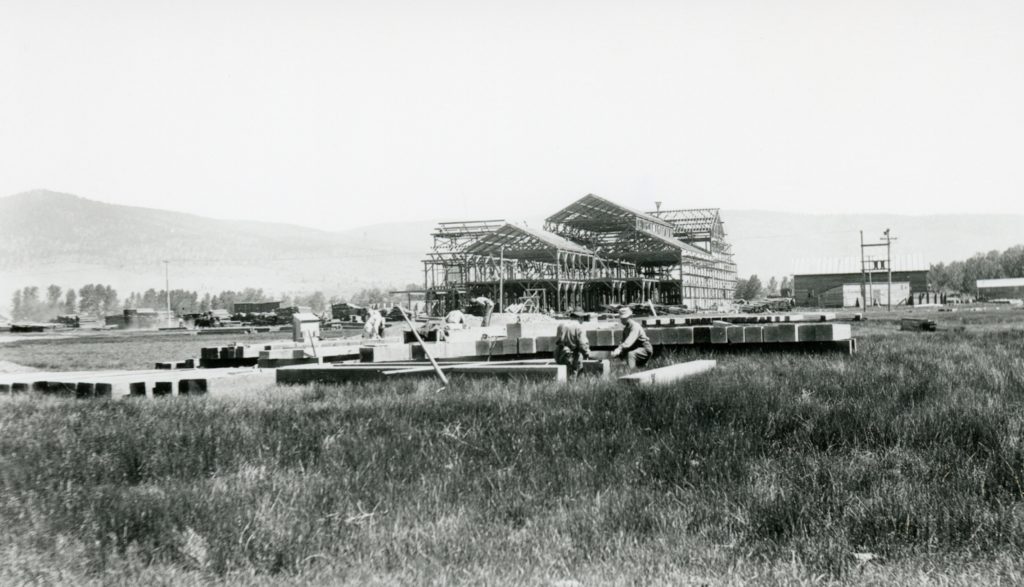
Construction of the FGSBox Factory, Susanville, 1920—Ed Standard
When Fruit Growers Supply Company decided to build a sawmill and box factory in Lassen County, they initially wanted to locate either in or adjacent to their timberlands. Fruit Growers Manager Frank Hutchens consulted with the Lassen National Forest which suggested two sites—Pine Creek, near Bogard Buttes and the Pine Creek estuary at Eagle Lake. There was a third alternative—Susanville.
Susanville’s business community was eager to have Fruit Growers build their mill there. So much so, they offered a cash bonus. A total of $41,130 was pledged by 243 residents if the mill was located At Susanville. Hutchens was impressed. On August 13, 1919 Fruit Growers agreed to the location of the mill at Susanville. In October, a check was for $40,070 was presented to Fruit Growers (a handful of individuals reneged on their pledges.
In 1920 construction began on the mill which with cost over runs exceeded over two million dollars. An additional $245,000 was spent to construct employee housing. When the mill opened on April 16, 1921 they initially employed 1,500 people. The initial monthly payroll exceeded $100,000. That $40,000 investment by the community far exceeded expectations!