Lassen County wanted to oblige, but it had no funds. They deferred to take any action and turned the matter over to the federal immigration officials. J.C. Borden of the Immigration Bureau was brought in to investigate the situation. What he found on his arrival was that of the forty-five applicants only a handful were eligible to receive aid to pay for their return to Mexico. Yet, the issue was also moot, as Borden noted, because all the Mexicans had gone back to work. He informed the Board, should the issue arise again, that under a federal ruling any alien who had been in the United States for three years and becomes indigent can be returned to his native land with the cost borne by the federal government. Continue reading Westwood’s Deportation Continued→
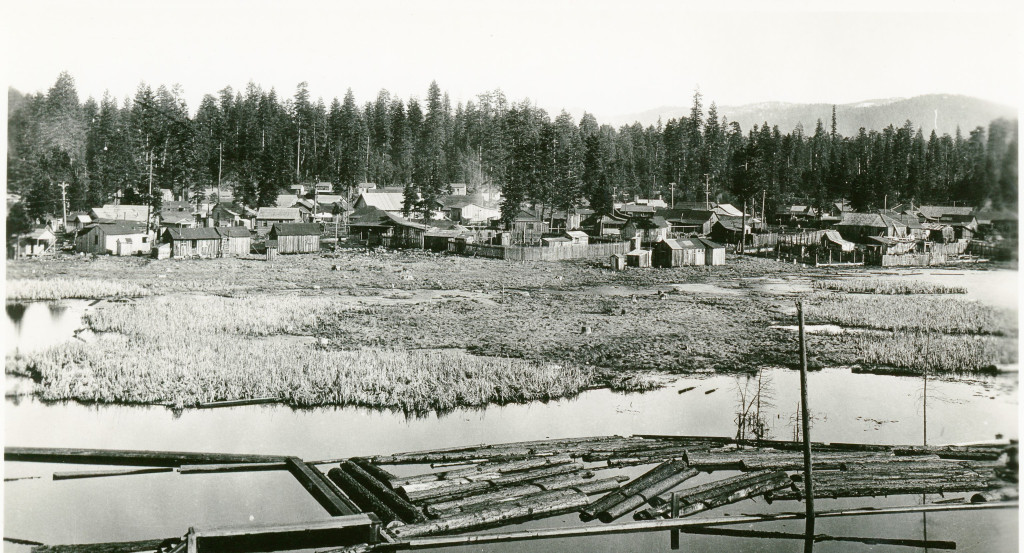
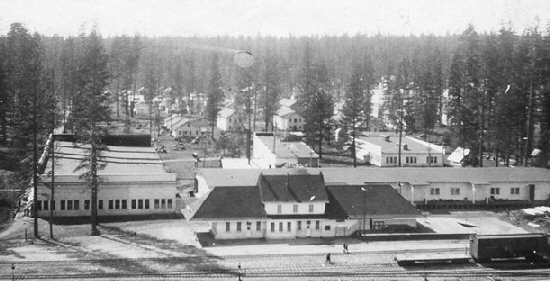
Westwood’s Old Town, home of many of its immigrant workforce. Courtesy of Hank Martinez
One of the more unusual annals in Red River’s history was deportation. Red River hired a large percentage of foreigners whether it be Scandinavians, Italians or Mexicans. By 1929, with the downturn in the lumber market, the company was forced to layoff some of its workers. If they thought that the layoff was temporary, they allowed the affected worker to remain. By 1930, however, Red River sought alternatives, as they could no longer bear the financial burden. Continue reading Westwood’s Deportation of Immmigrants→
In the mid-1920s, Red River had two hydro-plants in operation to generate power. This abundant power supply created an unusual man-made landmark. Red River was able to conserve its sawdust/wood waste pile, which took on a life of its own as it started looking like a small mountain. This created a nice reserve of free fuel that was readily available at any time should there by interruptions from the hydro-plants. To comprehend just how large it was, a Ripley’s “Believe it or Not” column once designated it as the world’s largest waste pile. In 1941 it lost its status to Portland General Electric Company who reported having a 130-foot high pile of sawdust.
Anything of this magnitude created its own hazards. One of the first lessons learned was how to prevent it from spontaneous combustion. A conveyer belt, along with a steam shovel and caterpillar tractor were employed to constantly work on the sawdust pile—whether adding to it or feeding the conveyer belt to the power house. It was not unusual for a worker to get trapped in a sawdust pocket where one could easily die from suffocation. While no fatalities of this nature occurred, there was one death attributed to the sawdust pile. On the morning of January 20, 1925 Alexander Kollinkoff was killed when he was struck by a large piece of frozen sawdust while operating a steam shovel.
Red River also explored other ways to utilize this enormous wood waste pile. When the mill operated at full capacity it produced 400 hundred tons of sawdust and wood chips in a twenty-four period, over half of which was used to fuel the boilers in the powerhouse. In February 1927 Red River installed an interesting piece of machinery, one that manufactured the modern day version of briquettes. This impressive device was capable of compressing a ton of wood waste into briquettes every hour. About a third of the wood waste which it compressed into briquettes could be used for home use, camping or even at the plant itself.
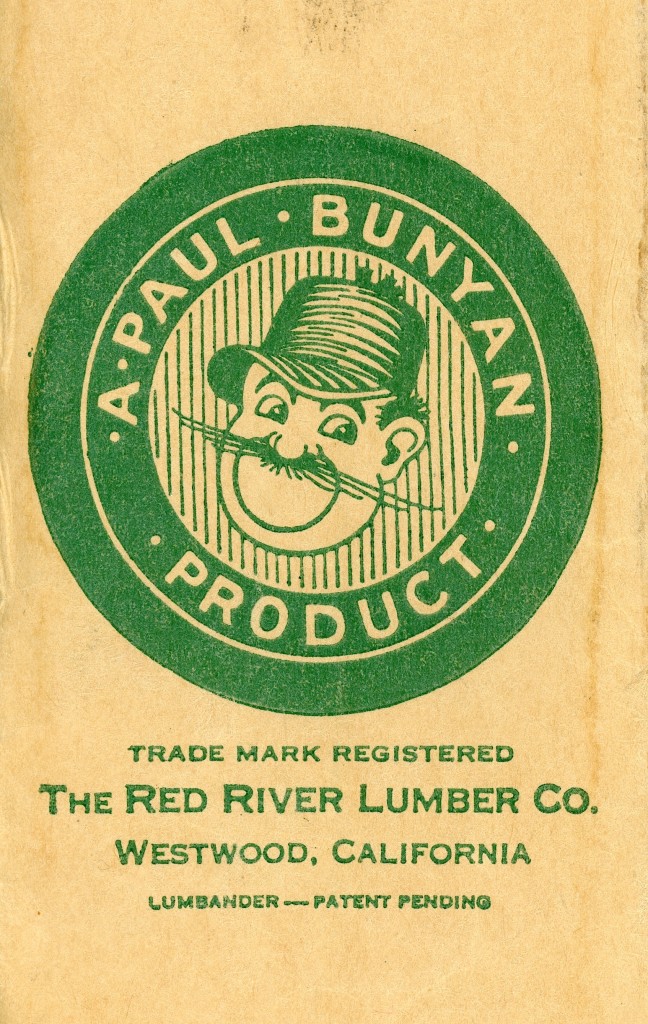
Packaging tape with the Paul Bunyan trademark.Courtesy of John Webb
In the logging camps in Canada and Northeastern United States as folklore would have it, tales of the mythical Paul Bunyan was born. Stories were passed around in the camps, no written account.
In 1900, W. B. “Bill” Laughead, a cousin to T.B. Walker, went to work in Red River Lumber Company’s logging camps at Akeley, Minnesota. There he undertook many jobs starting as a camp chore-cook and ending as a construction engineer. After eight years of working in the woods, he decided to move to Minneapolis working odd jobs and experimented with free-lance advertising work. It was at this time, Laughead drew the first known character drawing of Paul Bunyan, in part of an advertising campaign for Red River’s new California operation. Laughead created the company logo, of a circular design, with his Paul Bunyan’s face, accompanied on the outside with the words Paul Bunyan’s Pine and it became Red River’s registered trademark. The logo was placed on many products and even on its logging trucks. For a short time, Red River even bottled their own soda beverage, with the embossed bottles displaying the trademark. When the company expanded into other operations, they changed it to a Paul Bunyan Product.
In the 1940s, during the dissolution process of Red River, Kenneth Walker continued in the lumber business. In doing so, the trademark was transferred to him, since his own enterprise was the Paul Bunyan Lumber Company.
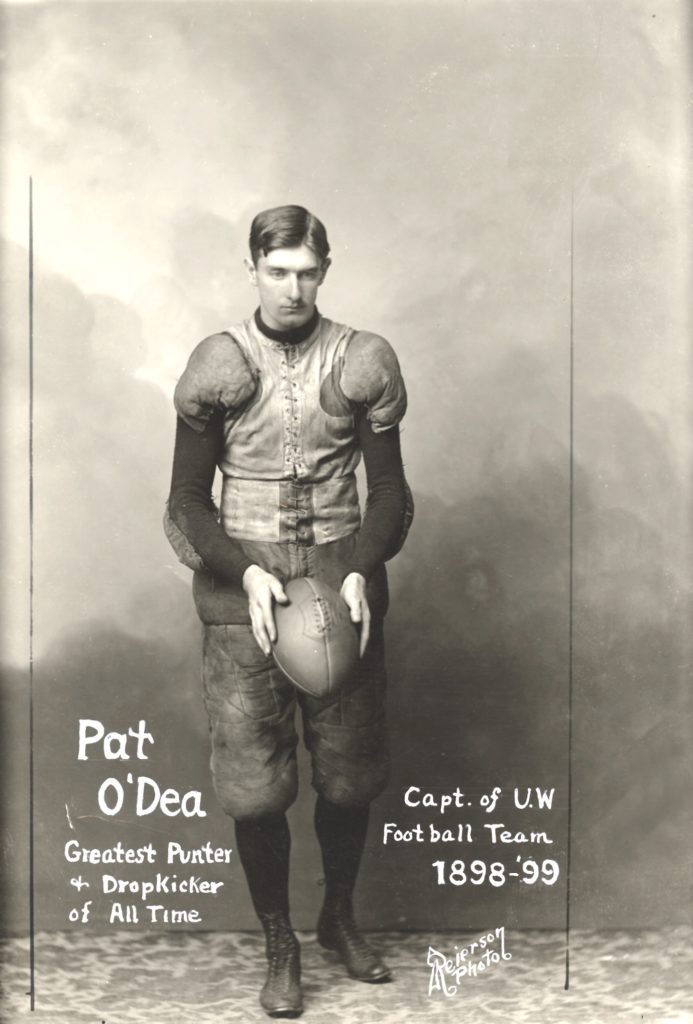
Pat O’Dea, Courtesy of the University of Wisconsin
In 1919, Charles J. Mitchell arrived in Westwood like so many before and after him seeking employment. The Red River Lumber Company had high turnover in its workforce and always had openings. Little did Red River know their new hire was a famous football player. Then again, Mitchell used an alias. After all this was in an era, where few people carried any type of identification, and Social Security numbers were non-existent. Continue reading Pat O’Dea—The Kangaroo Kicker→
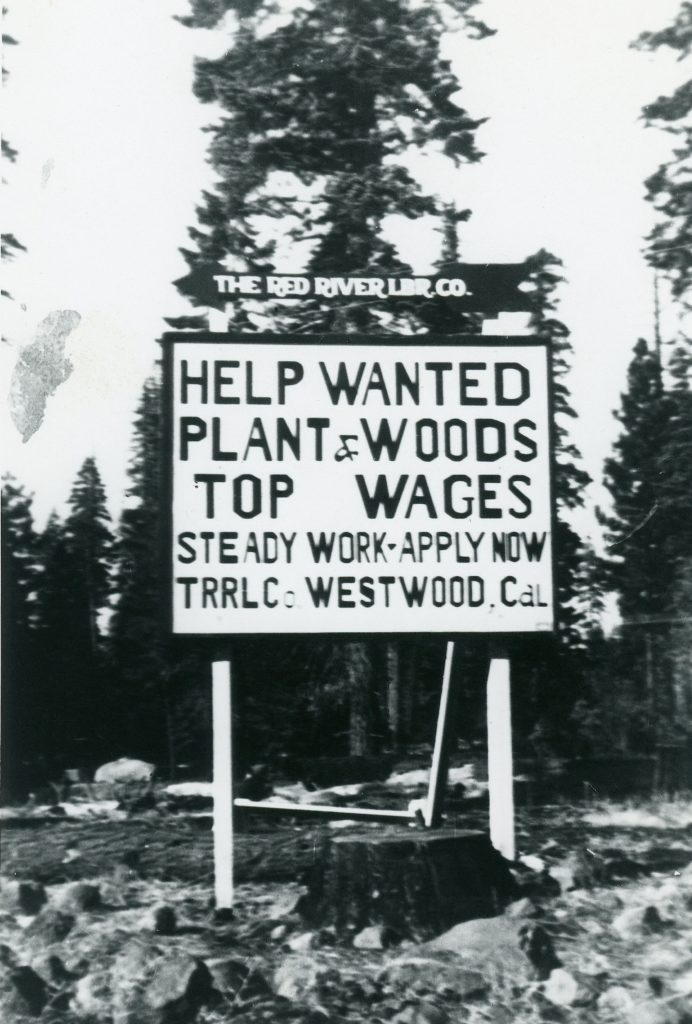
Red River Lumber Company had a large employee turnover.
The labor movement received a big boost during World War I. However, unions lost some momentum after the war as nation went into a recession. Industry on the other hand came up with strategies to counter act the union movement. One of these was the American Plan. The plan had its origins from the labor turmoil of World War I and was first adopted in November 1919 by the metal trades. In time, the Industrial Relation Association of California got behind the movement. It recognized that the model had to be flexible, since there were many variables between industries.
The plan deemed unions a nuisance—a barrier between the employer and the employee. In the simplest of terms, both the employer and employee had to maintain certain obligations. For the employer, one of the critical factors was to design its business wherein the employee was guaranteed steady employment.
In 1921, the Red River Lumber Company adopted the American Plan as a way to stave off the union movement. Actually, during the 1920s Red River’s labor issues were nominal. By the end of the decade, things changed. It was not just from Red River’s own financial turmoil, but the lumber market was headed in a downward
spiral, even before the stock market crash of 1929. Like many lumber operations, Red River was forced to curtail operations. On July 28, 1930, Red River reduced wages by 15% and adopted a five-day week, with an eight hour working day. Red River did make a concession for its employees. It reduced the rents in Westwood accordingly and board at logging camps was reduced to $1.25 a day.
The American Plan at Red River was put to the ultimate test, but circumstances were overwhelming. Red River sought other solutions and company would experience labor turmoils during the 1930s.
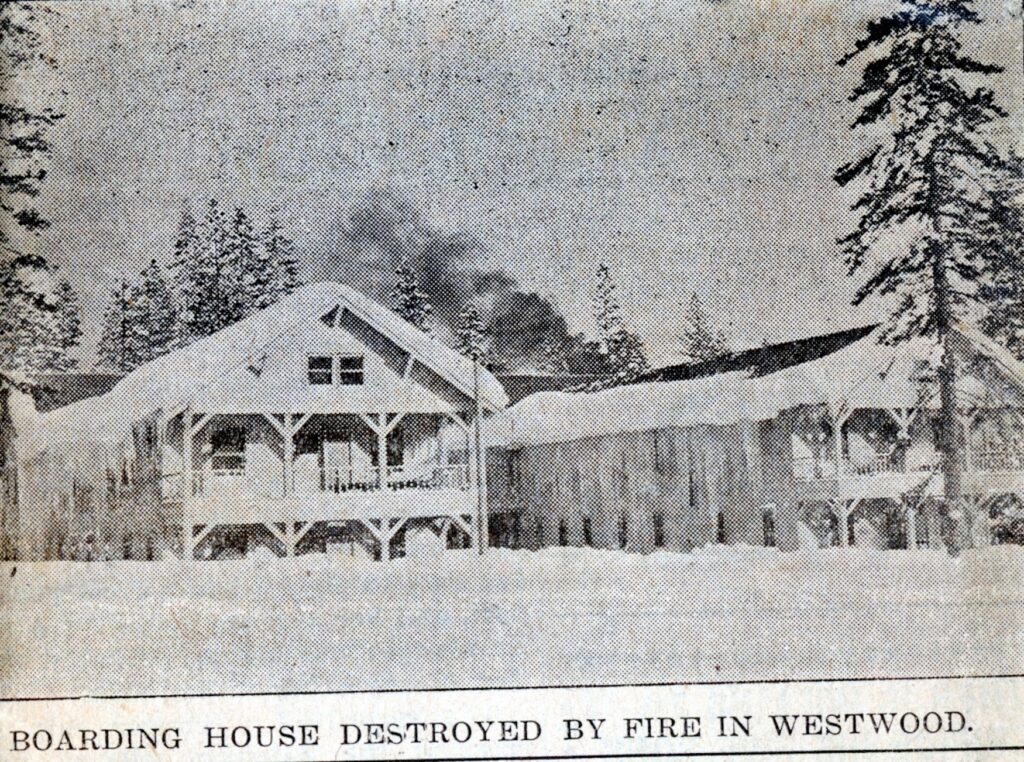
Last Friday, (10/6/23) featured a photograph of Westwood’s Hotel Saville. It confused some readers, as they did not think that the Red River Lumber Company allowed and/or operated hotels in Westwood. Those readers are correct.
Red River, in its own peculiar way, named their boarding houses “hotels.” These facilities housed single men, while houses were reserved for families. The Hotel Saville was built in 1913, and was one of the first rooming houses constructed there for Red River’s employees. It was a substantial structure with 250 rooms. Initially it housed Spaniards. In a bit of trivia, when T.B. Walker visited New York City on financial matters, he always stayed at the Hotel Saville.
On Sunday night, March 30, 1918 a fire broke out on the the lower floor of the Saville. The fire spread quickly and some five hundred men battled the blaze. Every effort was made to contain the fire, for fear it might spread to neighboring Westwood Club and Opera House.
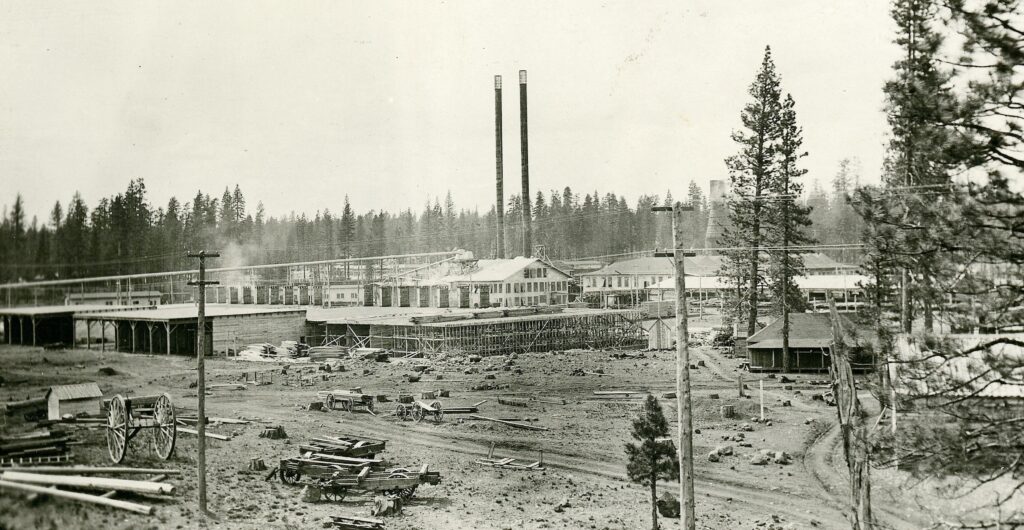
Truth be known in the beginning Red River Lumber Company had three sawmills at Westwood. The first was a portable circular sawmill powered by an old hay threshing machine engine. This mill was assembled in September 1912 and sawed its first piece of lumber on October 1. This mill would provide lumber for construction of Mill B. Mill B would in turn supply lumber for Mill A, the permanent one.
Mill B had a 40,000 board feet daily capacity. The mill was pushed to its limits and it became around the clock operation. Of that output, common grade lumber was utilized to build the town and highest-grade lumber was stored awaiting shipment for when the railroad arrived.
There are discrepancies as to when Mill A was placed into operation. Some accounts have that the first board produced occurred as early as May 1, 1914 and others as August 1. Interestingly, both Mill B (temporary) and Mill A (permanent) were running at the same time. The record is not clear what Red River’s plans were for Mill B. Unfortunately, the issue was resolved when on September 8, 1914, it was destroyed by fire. The fire had originated when sparks ignited the nearby sawdust pile. The fire was fanned by strong winds, which quickly spread to the temporary mill and destroyed it. All efforts were made to contain the fire to the mill, which they succeeded thereby saving the nearby planing mill and lumberyard. While the mill was equipped with automatic sprinklers they malfunctioned during the fire. After the fire, it was discovered there was a piece of wood inside the pipe blocking the flow of water.
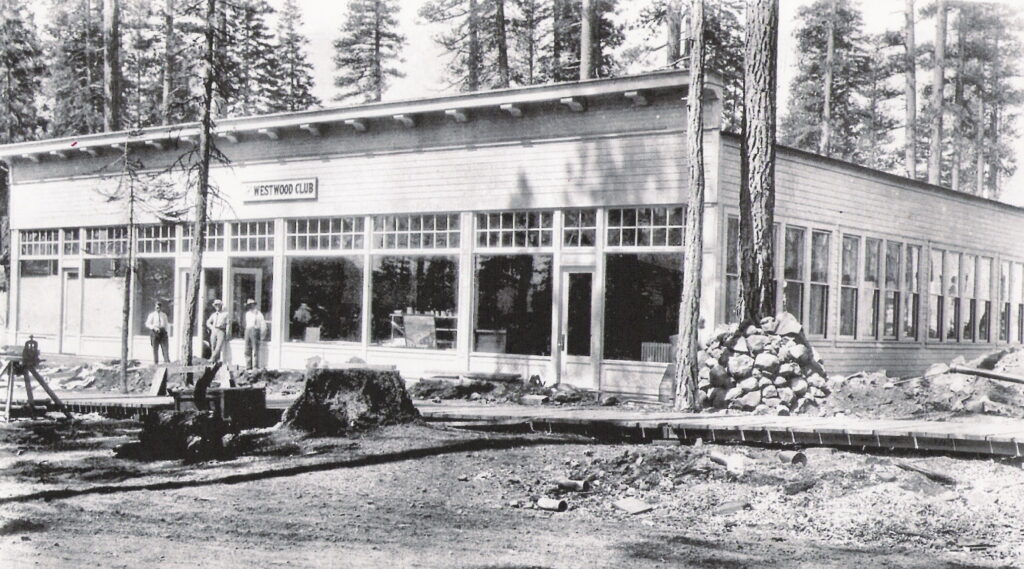
The Westwood Club was one of the first buildings constructed in that community and it was a major social hub—Westwood Museum
In 1935, with the creation of the National Labor Relations Board brought about the collective bargaining between employers and unions, which had a ripple effect in organized labor. During the late 1930s, unions big and small sprung up everywhere. Many a business even with a handful of employees became subject to union membership with a community’s union providing an umbrella for
these workers to join.
H.S. Anderson Company, who leased the Westwood Club, knew the
situation very well. On March 13, 1940, the Bartenders and Culinary
Workers Union No. 654-A went on strike, protesting the firing of
fry-cook Bill Knighton. They desired a closed shop with H.S. Anderson as their working agreement was set to expire in April. When the union signs were removed from inside the Club, this caused a general exodus of the patrons. Four waitresses—Margaret Miller, Vivian Buffo, Donna Weber, Ramson Bingham—for a brief time formed a picket line outside the Club, until the manager of the Westwood Club announced it was closed, for how long no one knew. The displaced customers found relief at Pland-Evans lunch counter on Ash Street, while the Westwood Rotary Club moved their meetings to Tunison’s at Goodrich.
A month later negotiators were brought in with little success. It
took several more weeks before a compromise was reached. On May 4,1940, the eight-week strike ended, the longest in Westwood’ history, with a Union Shop Agreement that affected the thirty workers at the Westwood Club.
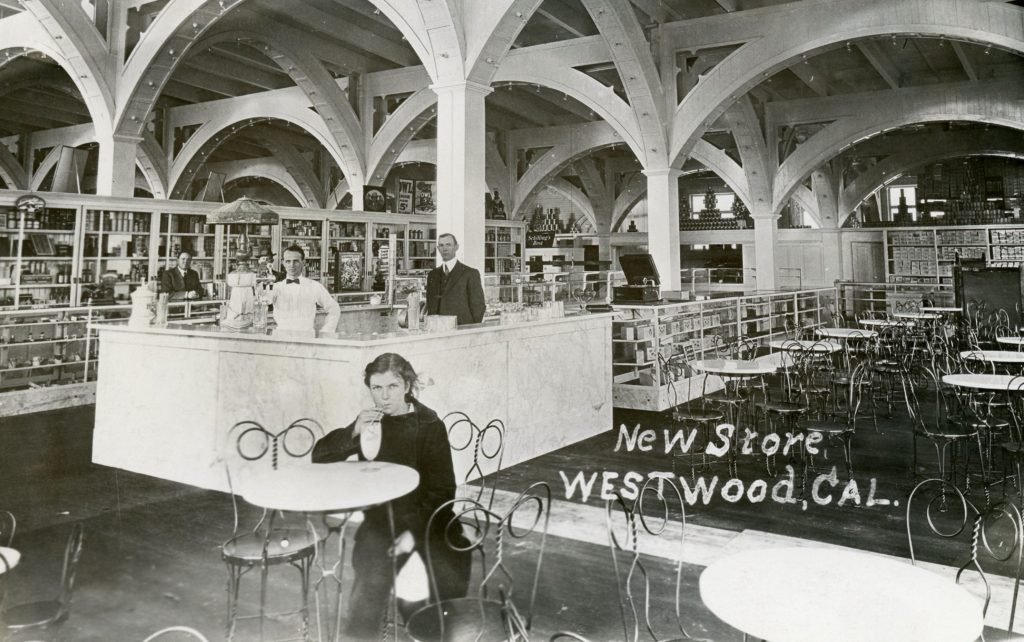
The soda fountain in the Big Store. Westwood, circa 1917
Awhile back I wrote about Frona Colburn’s’ 1922 book The Kingship of Mount Lassen. As promised from her book, is her account of Westwood.
”Like a trip on the magic carpet is the transformation wrought at Westwood, a model town in Plumas County, set in the heart of a virgin pine forest skirting the southern base of Lassen Peak. All about one clean, sweet smell of newly cut pines, and the whole atmosphere is one of humming activity among an intelligent and contented populace. The five thousand inhabitants live in modern homes in a natural forest park. An eye for the beautiful has left the big white pines standing wherever possible, even along the graded streets, and the approach roadways leading into and out of town.
“It was the author’s good fortune to arrive at Westwood at noon, hot, thirsty and covered with volcanic dust. Imagine the surprise and joy of finding an up-to-the-minute department store—large, airy and cool—where a delicious crushed pineapple ice cream soda all but saved one’s life. And the price, fifteen cents! This drink was served with all the daintiness of a metropolitan soda fountain, by a chap in white coat and apron spotlessly clean, and with manners to correspond.
Westwood has just ‘growed up’ in the heart of the woods, sixty miles from Nowhere, and is the last word in a logging camp. What gave it impetus? The constructive imagination of its founders.
Westwood, 1915. Courtesy of Leona F. Byars
“It is the pride and glory of the Walker family to have a nearly a perfect plant as it is possible to create and this desire includes evrything connected with the industry of lumbering. The whole atmosphere of Westwood is one of work. No loafers are permitted to stay long enough to breed dissensions. Every person bears his or her share of the work to be done, consequently there are no paupers and no destitution. Nor is there a shack in the town.
”Westwood baseball teams are not only natty in appearance but they can and play ball. Like the neatly-uniformed band they are an inspiration to all the surrounding countryside. Westwood musicians are in demand wherever good music has an appreciative hearing. The men at the head of the Red River Lumber Company not only know how to live themselves, but are willing that others may share in benefits derived from an intelligent, constructive attitude toward a big problem—that of pioneering in and out-of-the-way neck of the woods. The situation at Westwood would have delighted the soul of Peter Lassen, who was something of a sawmill man himself, and had a true woodsman’s love of trees.
“The Red River Lumber Company gives the following as their attitude toward the industry:
”It is our hope, by forestry practice, to so conserve the trees spite of our cutting (the largest of its kind) the actual amount of timber will never grow less but will remain forever a permanent thing of beauty, a field of labor and a source of supply.”