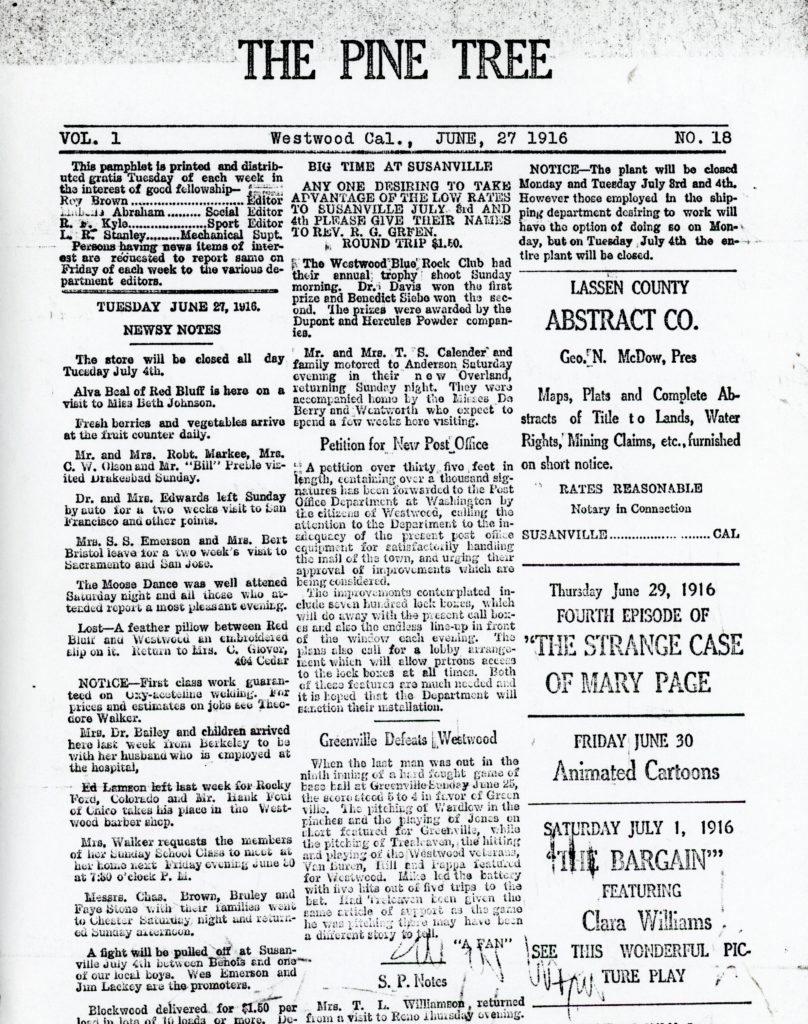
A portion of the front page, and only known copy that was found in the T.B. Walker papers at the Minnesota Historical Society. As a reminder, you can click to enlarge the image.
On March 21, 1916, Westwood’s first newspaper The Pine Tree made its debut. It was a weekly paper that was distributed for free. Leon R. Stanley who was in charge of production, had a background with newspapers in Modoc County. Very little is known about the paper and when it ceased publication.
On August 17, 1917, The Westwood Independent succeeded The Pine Tree. This paper under the helm of G.B. Morrow, who also served as the justice of the peace remained in operation for three years. Stanley again was in the forefront when The Westwood Sugar Pine which eventually became known was Sugar Pine Press succeeded The Westwood Independent.
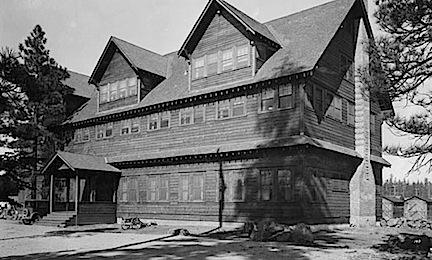
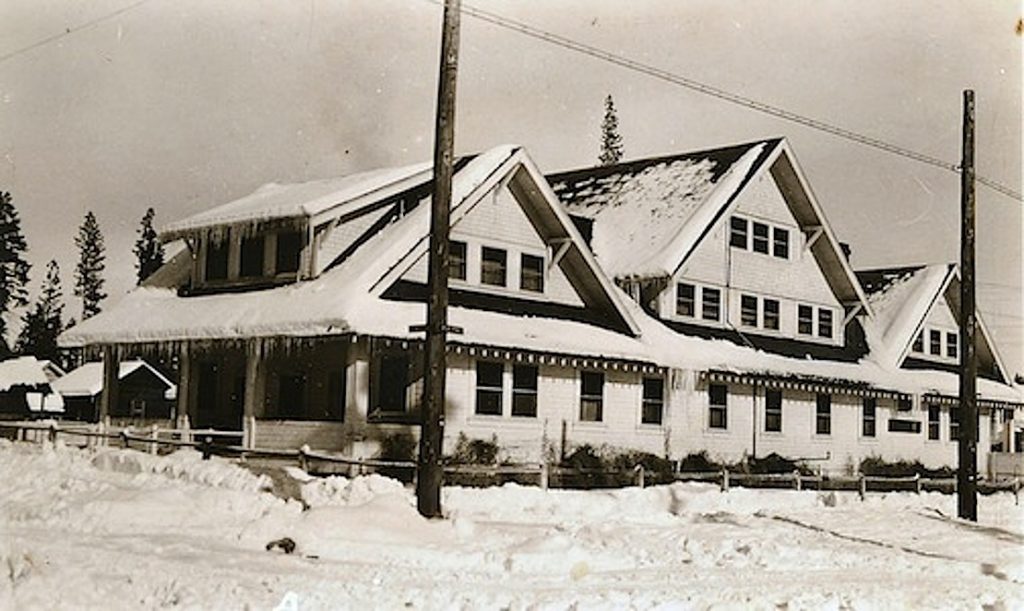
The American Legion Hall was one of Westwood’s tallest buildings.
On July 15, 1918, Westwood resident Clyde A. McKea died in combat in France, making him the first casualty from Lassen County of World War I. In the fall of 1919 a new national veterans organization was formed—The American Legion. Continue reading Westwood’s American Legion Hall→
In January the region was hit a big snowstorm and cold temperatures. Over four feet of snow fell in Susanville, and to get an idea how cold a storm system it was, Sacramento had three inches of snow. The Susanville residents took the storm in stride, as they had been used to such storms every year since 1907. What they would not be prepared for, was this was the last major snowstorm for the next twenty-one years.
When spring arrived, the big news was Leon Bly announced to the world his Eagle Lake project. He assured everyone this time it would be different than the previous twenty attempts. In addition, to Bly the other big news was the first work on a state highway that would connect Red Bluff and Susanville, though it take until 1929 before it was completed.
The Fourth of July was a big celebration that the town had not had for a couple of years. In 1914 and 1915, Westwood was the host to celebrate the nation’s birthday. This time it was Susanville to be the host, and a good time was had by all. By this time a good nature rivalry between the two communities had developed and in the wild, wacky baseball game, Westwood beat Susanville 10-4.
In the fall, Jules Alexander launched a campaign for the preservation of Peter Lassen’s grave, which a campaign fund soon began to erect a new monument. It would take nearly year, but in the fall of 1917, a new monument was installed and dedicated in conjunction with the dedication of the new Lassen County Courthouse.
Just as the year had begun, it ended in much the same way. On Christmas Day Susanville was coated with four inches of snow.
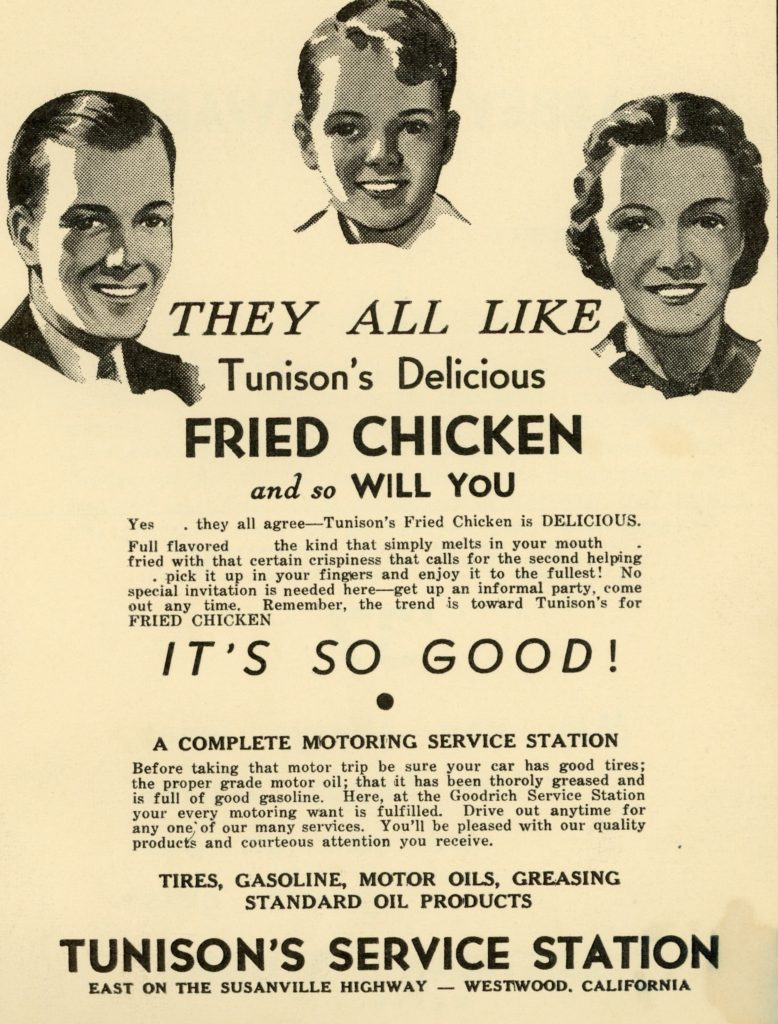
Tunison’s advertisement in the 1937 Westwood Chipmunk
In the mid-1930s, Bill and Jeanette Tunison established very popular bar, restaurant and gas station five miles east of Westwood near Goodrich Creek. Tunison, it should be noted had been a Westwood resident since 1916. The establishment became very popular in a short order, known for its good food and hospitality. As Marian Hull Herrick recalled, “People would call ahead to see if they serving were Jeanette’s Rum pie that night. People raved about the fried chicken and biscuits. Jeanette confided in me that they were made with Bisquick.”
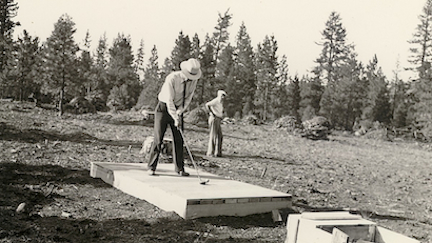
One would not normally associate the sport of golf in a community composed mainly of lumberjacks and sawmill workers like Westwood. However by 1920, the golfing phenomenon swept through Northern California and this lumber town was no exception.
The “divot diggers” as they were affectionaly known then took a little longer to take hold at Westwood. By the early 1920s, Susanville could boast three golf courses, albeit crude by modern day standards. Even Chester, then just a mere hamlet, had a golf course.
As early as 1921, Westwood’s golfing enthusiasts began the debate to establish a golf course. Yet, they just could not generate enough momentum to pull it off. This all changed in 1929 when Westwood’s golfing community organized a club. Those original duffers consisted of Ross Morehouse, Gene Huggins, Bob Pullman, F.W. Koerner, F.M. Jayne, Bill Corbett, Dan Taylor and C.C. Baptie. Continue reading The Westwood Golf Course→
In 1913, when the Red River Lumber Company was building its company town, the Great Western Power was in the midst constructing its Big Meadows dam to create nearby Lake Almanor. Great Western Power did have a resident physician, namely Dr. Fred J. Davis to provide medical care. Red River routinely sought his services. By the fall of 1913, Dr. Davis accepted employment with Red River and remained with the company until 1939 when he moved to Susanville and opened a private practice. Continue reading Westwood Hospital→
The Red River Lumber Company was headquartered in Minneapolis, Minnesota. With its westward expansion to California and the establishment of its company town there, required extensive communications back and forth. For a historian, it was wonderful due to the paper trail. What is truly amazing is how much has been preserved at the Minnesota Historical Society.
The various members of the Walker family, the owners of Red River, were prolific letter writers. Fletcher Walker, who was the resident manager at Westwood had to write in great detail about the conditions in California, since everything operated so differently than in Minnesota.
The letters, of course, also contained happenings around Westwood. Whether it was the political scene, or what their competitors were doing. With that in mind, I share a letter that Fletcher wrote to his father, T.B. Walker, exactly one hundred years to the date. You will note the letter is addressed to T.B. Walker in New York and not Minnesota. T.B. Walker then was spending a lot of time in New York wheeling and dealing as part of a re-finance bond sale for the Westwood operations.
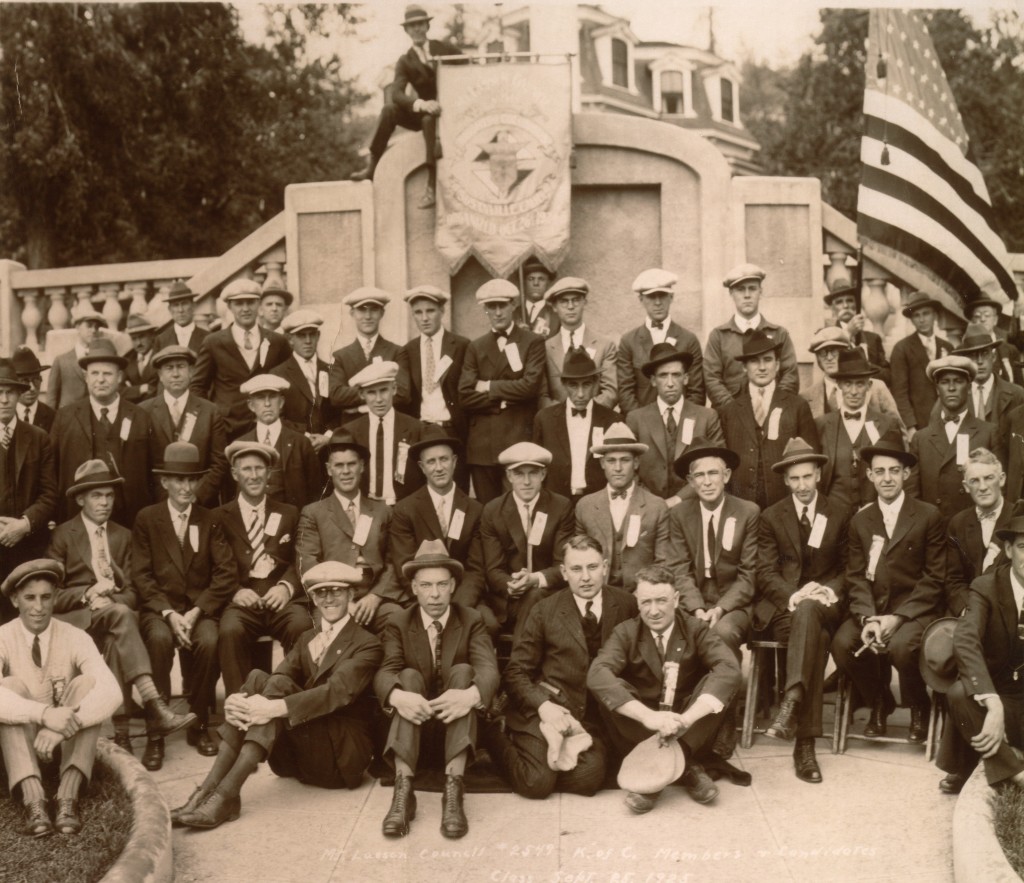
A portion of the local Knights of Columbus assembled at the Elk’s Lodge, 1924. Courtesy of Jean Kern
Susanville’s first catholic organization the Knights of Columbus was formed in the same year as the Susanville Elk’s Lodge and the Susanville Country Club. It was busy period in the town’s history. Continue reading Susanville – Knights of Columbus→
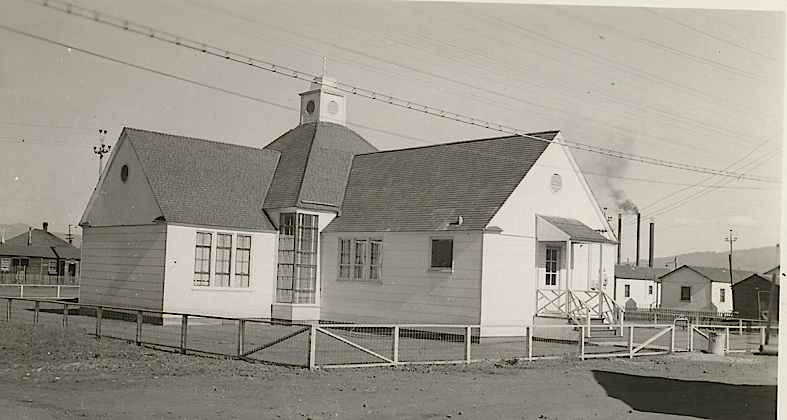
Church of the Latter Day Saints, Westwood, June 14, 1943
On March 9, 1940 the Church of the Latter Day Saints held groundbreaking ceremonies on corner of Ash and Fifth Streets, in Westwood. This was the last house of worship to be constructed under Red River Lumber Company’s tenure at Westwood.
The church was designed Caldwell and Richards, Los Angeles architects. After World War I, the LDS Church began to implement standardized plans. This particular church was the first to use this particular layout. The $9,000 church was built by volunteer labor and completed in four months.
In 1986, its congregation had grown, wherein they bought property in nearby Clear Creek and built a new church. In 1991, their old our church was acquired by Our Lady of Snows Catholic Church which they converted into a parish hall. However, with their new Lake Almanor church, it will be just a matter of time when this is placed on the market, and only time will dictate its fate.
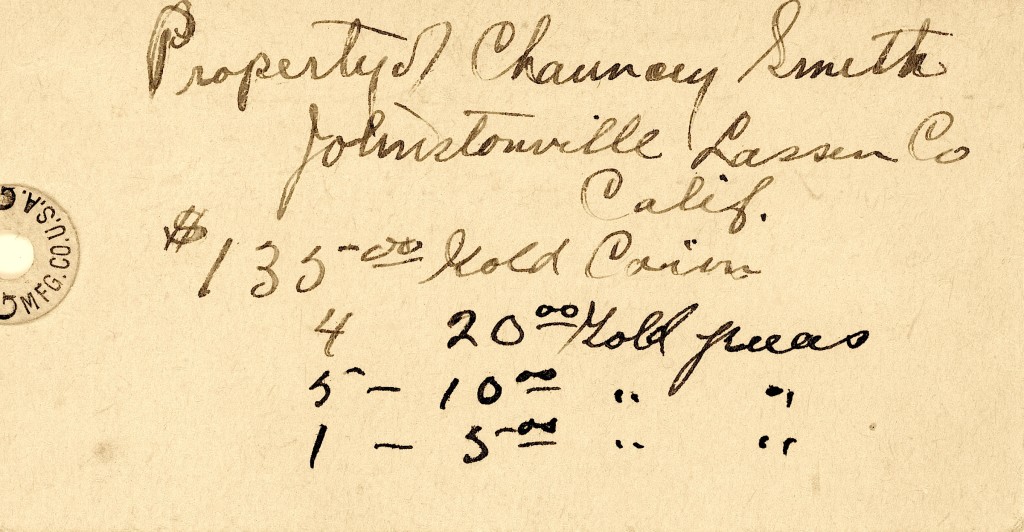
Receipt of one of cans of money found that Chauncey Smith buried.
From time to time, someone will approach me about buried treasures. Some stories have been embellished over the years, especially that of Harry Gordier’s gold and the Holden Dick Mine.
Then there are the lesser known tales, which are actually true,and not folklore. In the book Untold Stories, I relate the story of Chauncey Smith, since only a portion of his hidden cache of money was ever found. There is, of course, the great Westwood bank robbery, that to this day the money has never been recovered. In August, 1926 a portion of Red River’s monthly payroll shipment consisting of $45,000 never made it Westwood from the Reno bank. One theory was the money was stashed along the mountainside between Doyle and Milford. In June 1927, Red River thought they had found thief, in one A.A. Bruce who formerly worked for the railway express offices in Reno and Westwood. Bruce was arrested and his Reno home searched. However, when a preliminary hearing was held in Susanville, Bruce was released from custody as there was insufficient evidence to charge him with the crime. No one was ever charged, and the money never found.