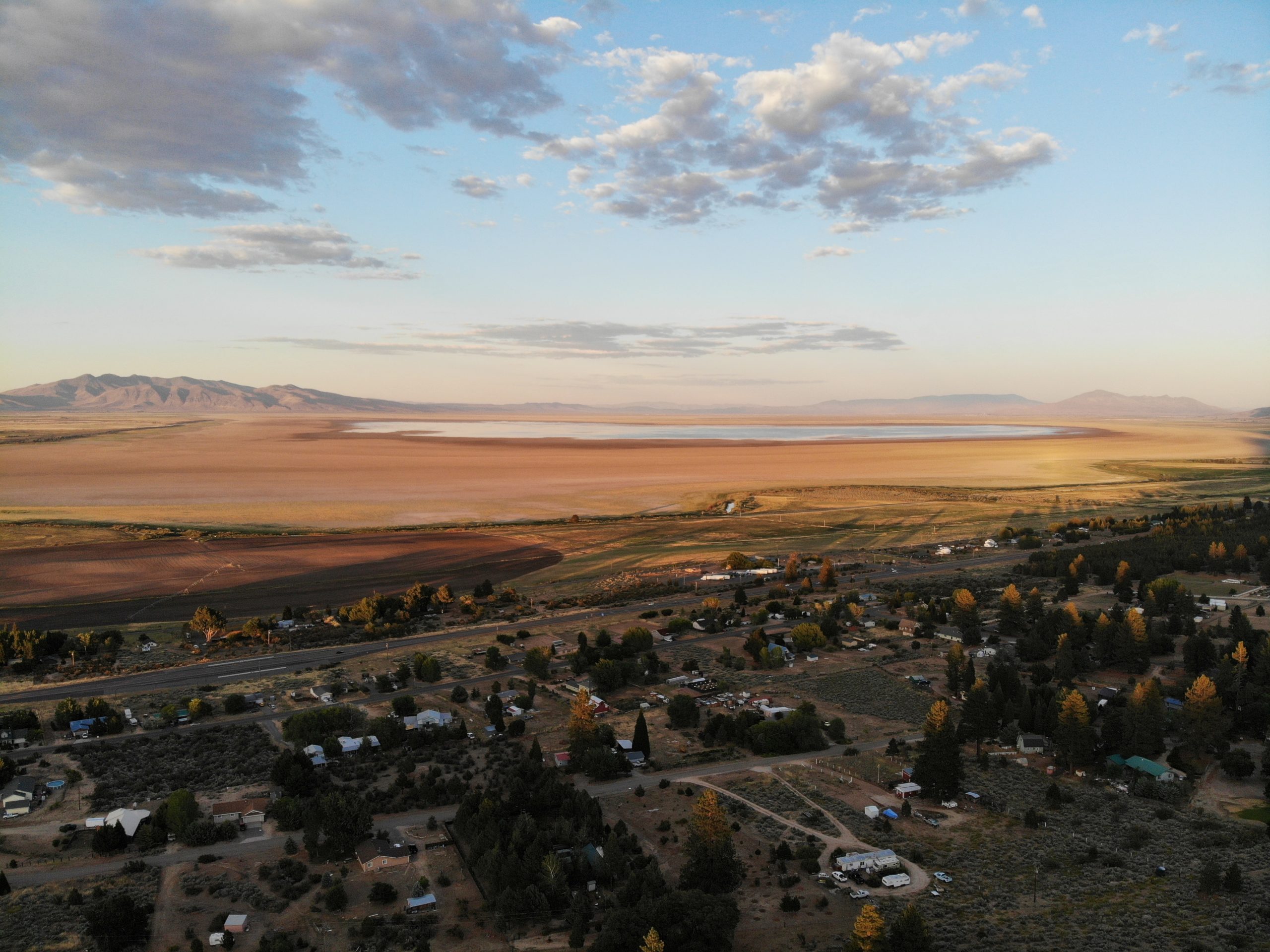
On August 29, 1903 it was reported that Honey Lake had entirely dried up. Since the Anglo settlement of the valley in the 1850s, it was an unusual occurrence. It should be noted that area received abundant winter precipitation. The years from 1907 to 1916 was an extremely wet cycle. In 1911, Litchfield founder, B.F. Gibson proclaimed the lake was so high that it might be necessary in the future to build a canal at the east end of the valley to Astor Pass. and the excess water would then flow to Pyramid Lake at that point. It would not be necessary as beginning in 1917 the region would experience a twenty-year drought in which Honey Lake remained dry all those years.
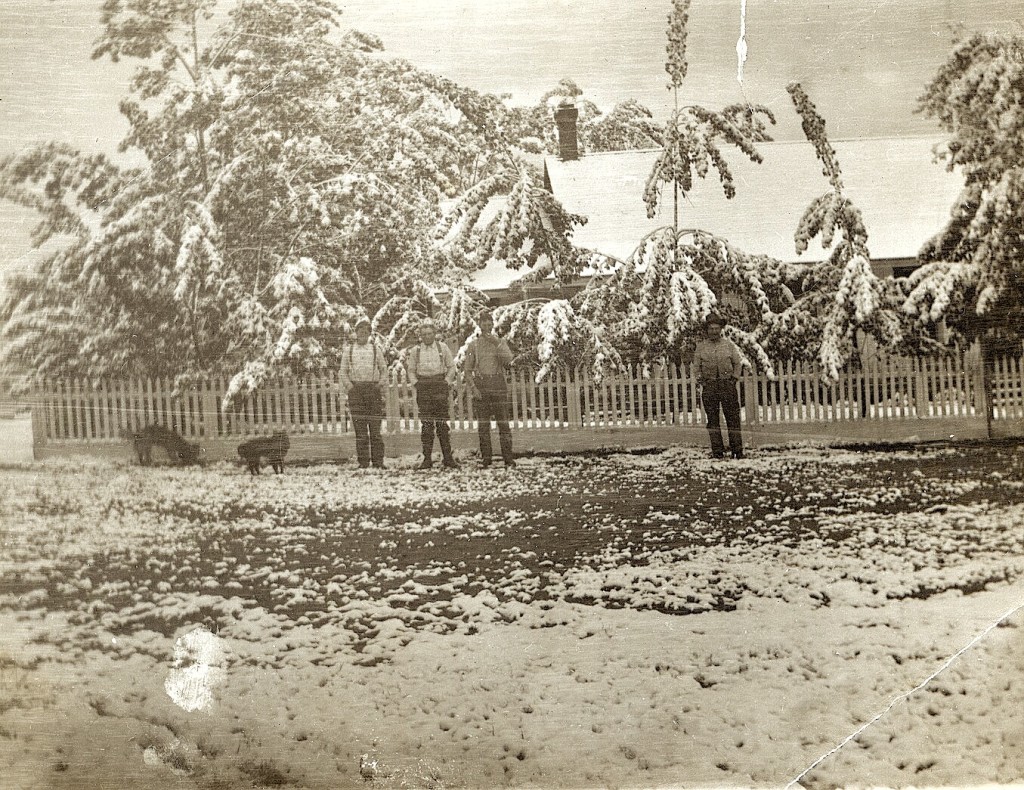
With the first day of summer approaching, I thought I would share this picture of Constantia taken on June 21, 1907. Unfortunately, I do not possess any other documentation and no reference made in the newspaper, other that it was unseasonably cold. I went through my various notes of Phil Hall, who provided me with the photograph, I failed to take note.. His parents at that time resided at Constantia. However, anyone who has resided around these parts for any length of time, have experienced numerous strange weather events. In a related matter, Claude Wemple told me in a 1978 interview that Milford received four inches of snow on July 4, 1902.
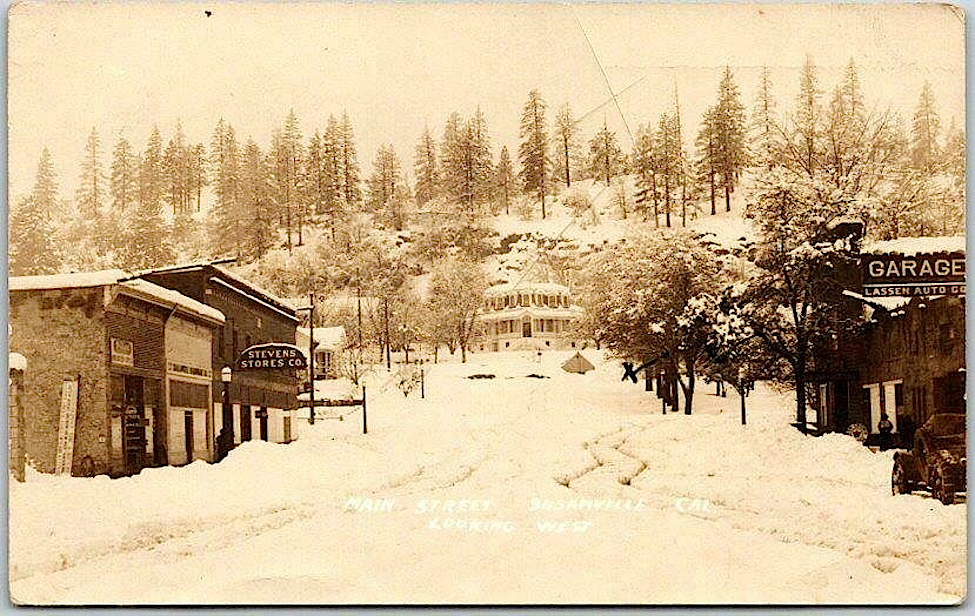
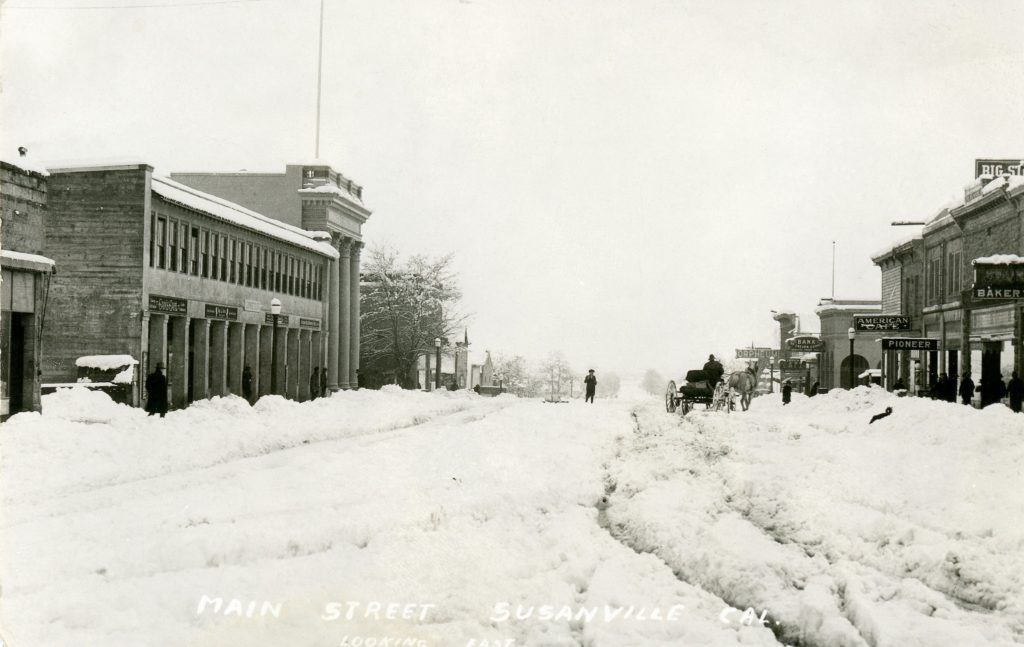
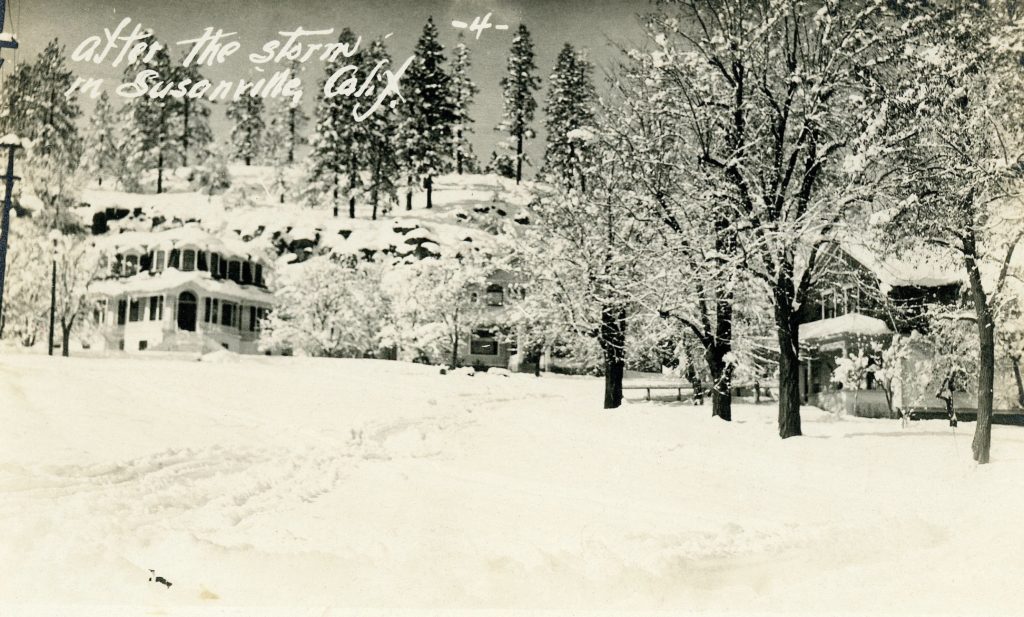
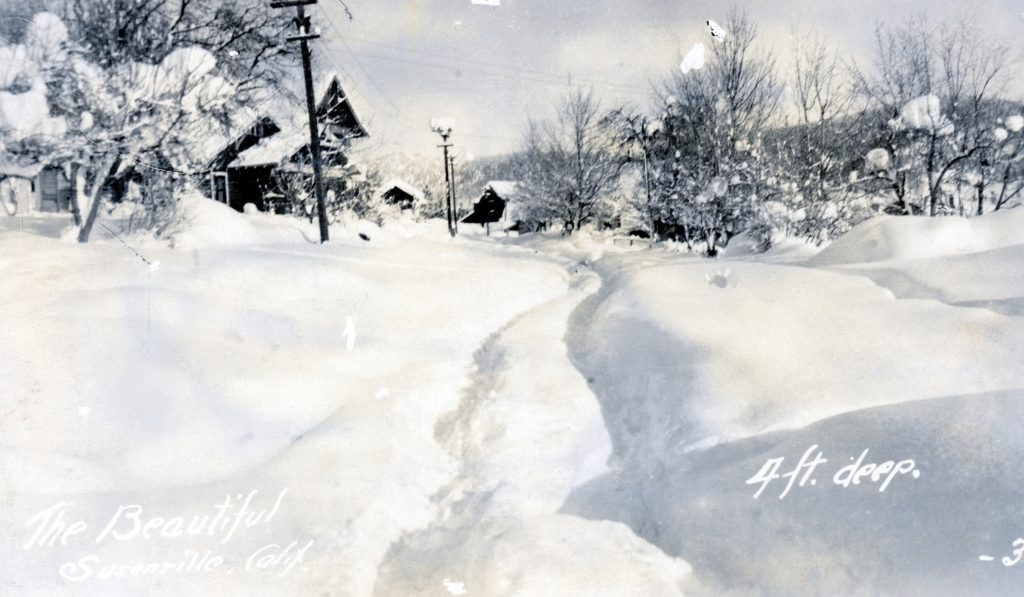
While January usually witnesses some of the largest snowstorms of the season, February can pack a wallop. In mid-February 1922 was a classic example. A snowstorm hit region dumping seven feet of snow at Westwood Junction, five feet at Westwood and four feet at Susanville. It was a heavy wet snow that caused numerous problems, especially with power outages and travel.
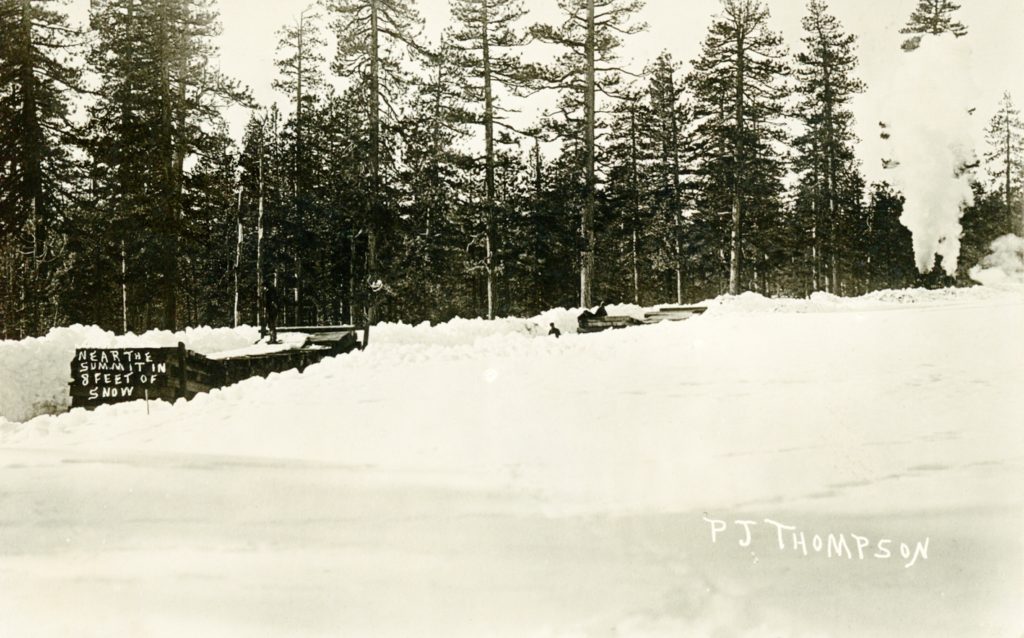
Approaching the summit of the Fernley & Lassen Railroad in 8 feet of snow, February, 1914—B.R. Zimmerman Collection
It was a very wet and snowy January 1914 in the Lassen region. There was so much snow on the ground, the ground hog, could not even make it to the surface, even if it wanted to see his shadow or not.
In January 1914 Susanville had received nine inches of rain, along with 93 inches of snow. The total precipitation for the month was 18.27 inches.
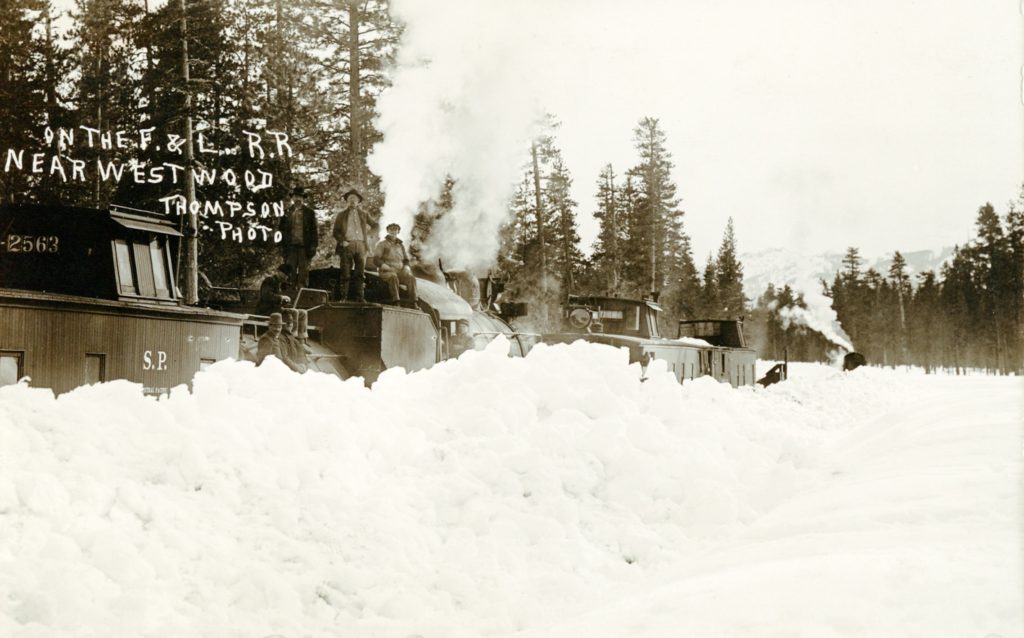
Approaching Westwood, the final destination, February 1914–B.R. Zimmerman Collection
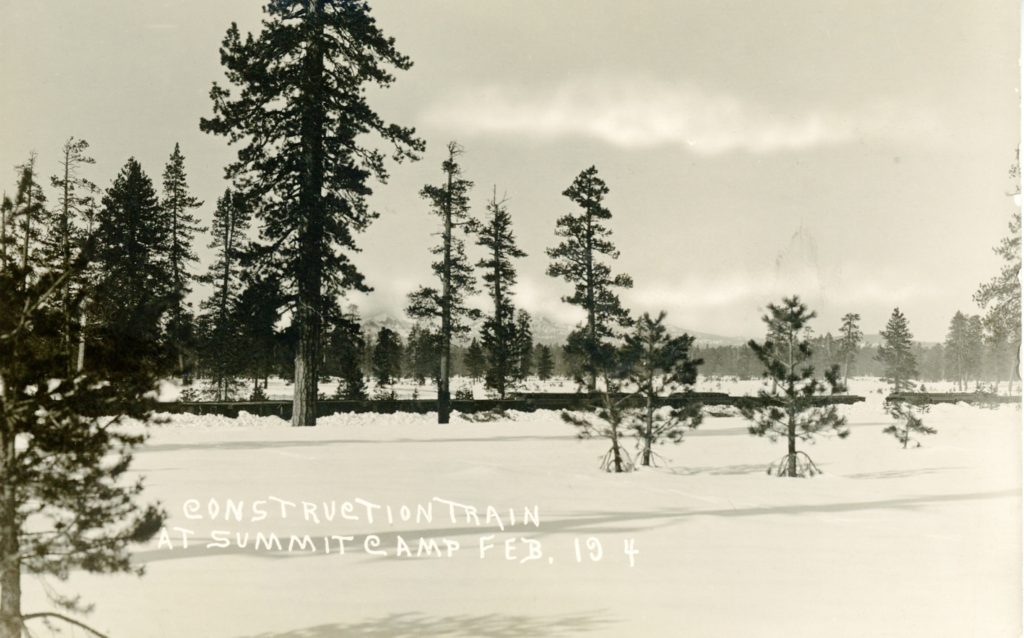
This is a good day as any to showcase these photographs of the construction of the Fernley & Lassen Railroad between Susanville and Westwood during that time. The snow depths in early February 1914, ranged from 8 to 10 feet.
In February 2012, a classified ad appeared in the Lassen County Times that a person had a small trunk of old photographs of the region. I called the number and it took several attempts. An elderly gentleman answered and said the trunk was found in an old barn in Richmond, Contra Costa County. It took several months before the trunk was shipped to me. It was twice the size, I was told, and when I examined the contents, which were photographs of the B.R. Zimmerman family, long time Susanville residents, I was thrilled. I did end up paying about $70 for the cost of sipping and it was worth every penny.
With the initial construction of Westwood in 1913, Fletcher Walker, Red River Lumber Company’s Resident Manager referred to the new community as the “City of Trees”. At that time, an order was issued not cut down any trees than necessary, just enough to clear building sites and streets. As one visitor to Westwood in 1913 noted, “The cottages are being built right among the pine trees, and the only clearance is where the trees have been cut to make way for the streets. The trees are so close together that one can only see a few houses at a time. Hence it is a city among the pines.”
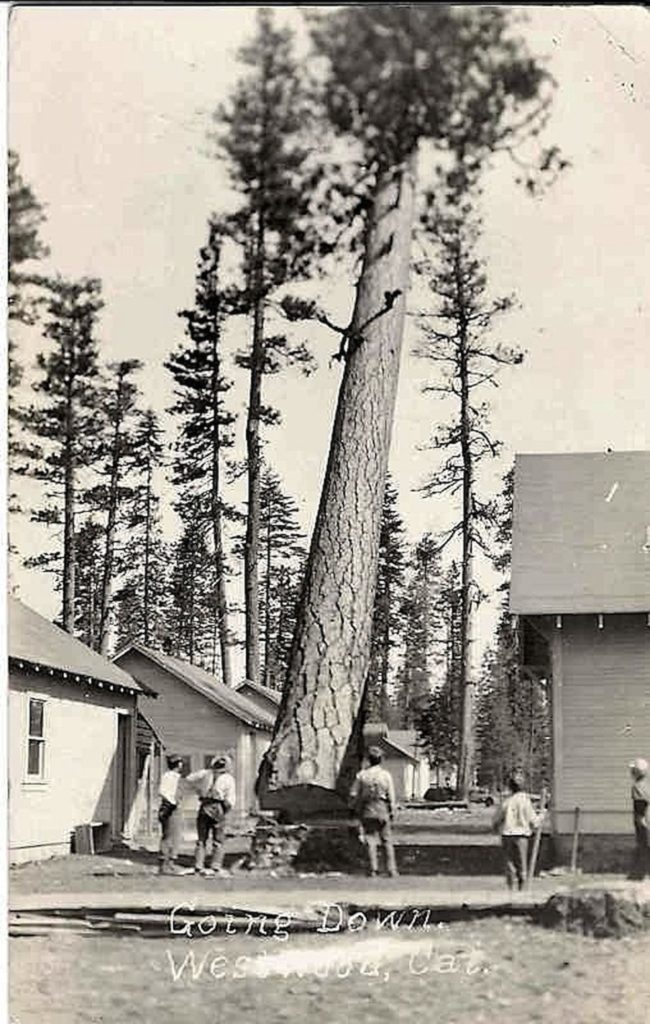
No one was aware that the lofty pines would present a hazard until January 25,1914. The stormy weather began shortly after midnight and from all appearances was no different than any other storm the residents had endured. This all changed shortly before eleven o’clock in the morning. A ferocious windstorm struck the community. The gale force winds, while only lasting about five
minutes, wreaked havoc on Westwood and rattled the nerves of its
inhabitants. Over one hundred lofty pine trees snapped like kindling. One tree crashed on the roof of the cookhouse whose occupants were preparing the noon meal. A ten-room cottage under construction fell victim as well when a tree crashed into it, the force so great it tossed one of the carpenters into a snow bank. Several other cottages were destroyed, but luckily there were no other injuries. At two o’clock in the afternoon the residents gathered en mass at the Opera House to discuss what happened. A committee of three was selected to confer with Red River management to request all standing trees be removed immediately, as they felt threatened by them. So serious was their plea, should the company take no action many would quit and move elsewhere. Red River obliged and next morning removed a number of trees that they deemed posed a hazard.
While in the past I have noted the January 1916 snowstorm, followed by a very cold spell. For the record here are the statistics for that month observed at the Susanville station.
North Pine Street, January 1916. Courtesy of Dolores Gasperoni
The average maximum temperature was 35 degrees and the average low of 12. On January 23, the record high for the month was 50 degrees and on January 30 saw a record low of -14 below zero. It was a snowy month with 104 inches and on January 2 the greatest amount of snow in one day was 32 inches.
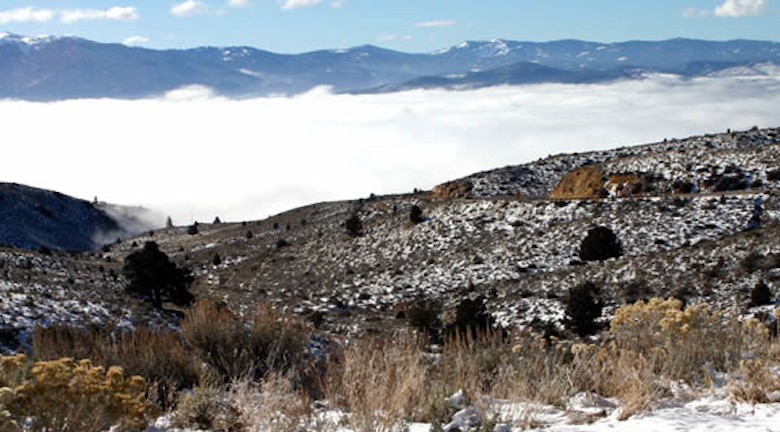
The latest storms residual moisture and lack of wind is the perfect combination for a pogonip, also known as a freezing fog. . A true pogonip is when the fog freezes coating everything with ice crystals. The name is from the Native American community when translated means white death, due to the number of Indians who would contract pneumonia from this weather condition.
There are varying types of pogonips. The most common form is when the high pressure holds down the cloud inversion. Thus, in many instances, one only has to travel a few hundred feet above the valley floor to bask in the sunshine. The pogonip season usually runs through December and January. The longest recorded duration, locally, lasted for six weeks in the winter of 1859-60.
On a final note, the National Weather Service states that there is a storm front headed our way tomorrow. There should be enough winds to break up the inversion, and may be we will see a little sun shine in the afternoon.
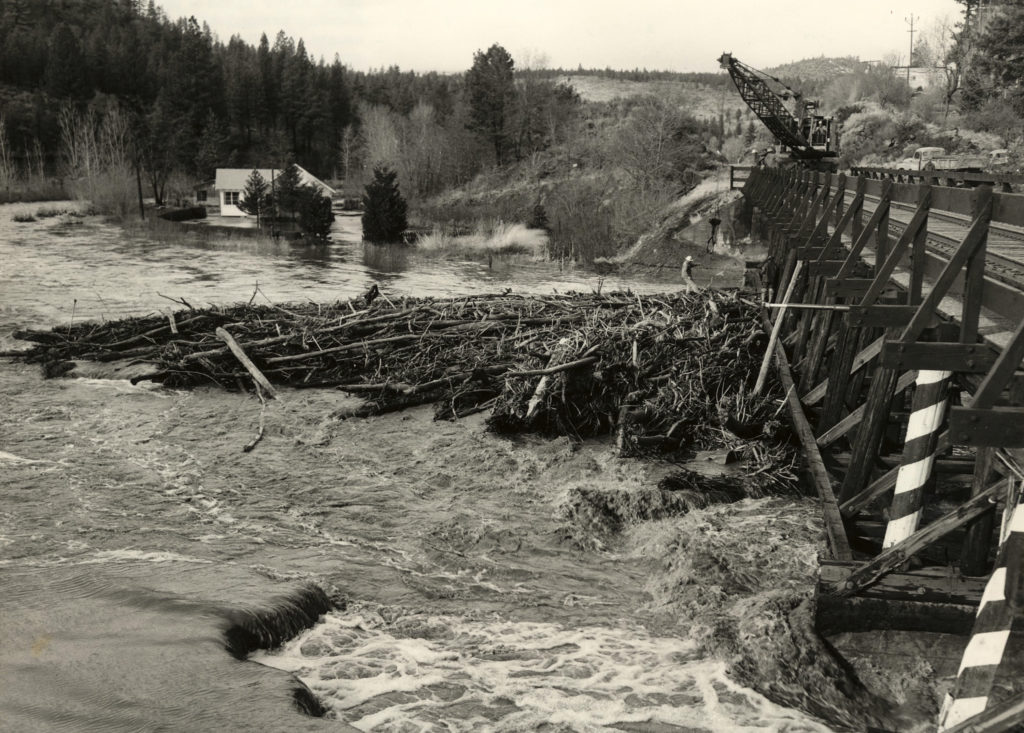
Southern Pacific’s railroad trestle at South Lassen Street, December 1955.
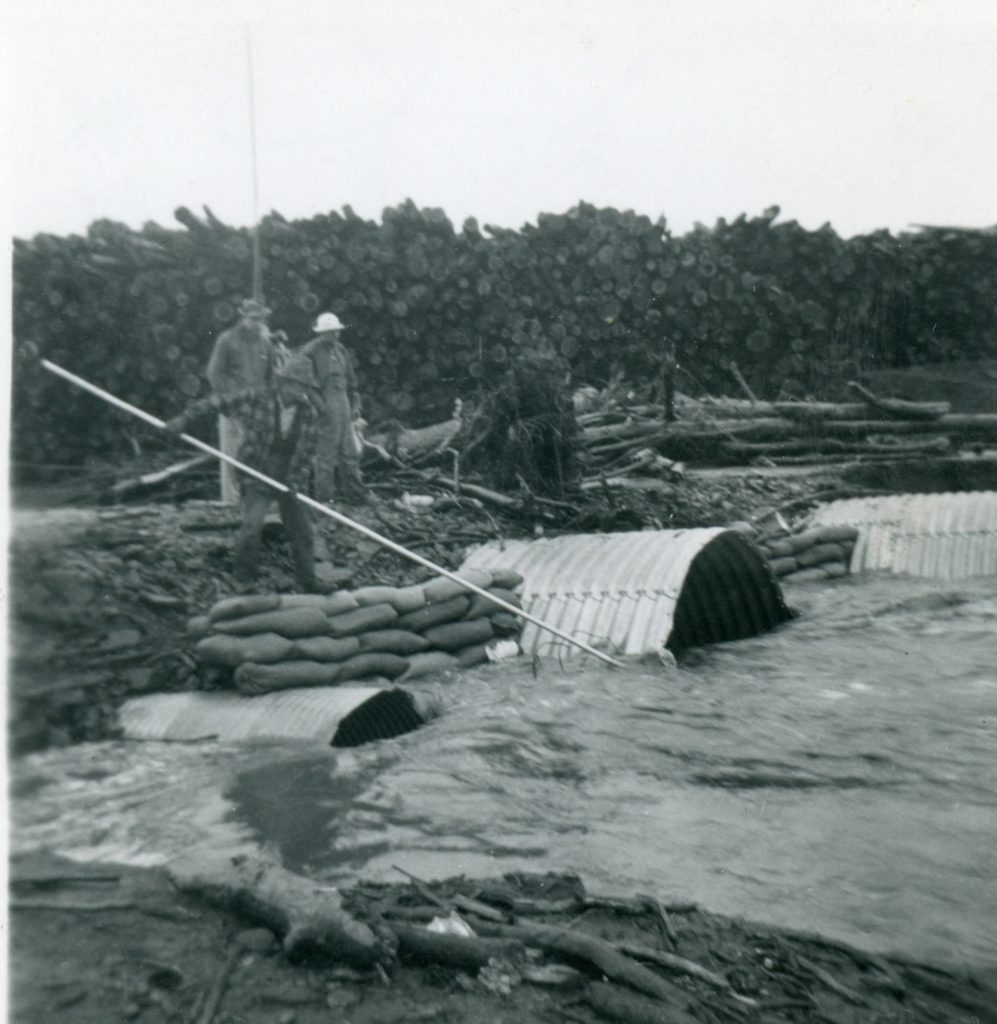
The floods of December 1955, locally and throughout California was a notable event to say the least. It began with warm rains on December 15th and by December 20th, 4.41 inches had fallen in Susanville. The snow elevation remained high, and on December 20th there was 21 inches of snow on Fredonyer summit. The rain continued turning the Susan River into a raging menace. Conditions worsened as the river brought assorted debris with the floodwaters. The debris became a major obstruction when it collided with the Southern Pacific’s railroad trestle at Susanville’s Lassen Street. On December 23rd Marvin D. Coltran, a member of Southern Pacific’s bridge gang fell into the water there. Efforts were made to reach him, but the river’s swift current swept him away.
Riverside Drive, Susanville, December 1955
Relief from the rains arrived in the form of snow on December 28, when four inches fell in Susanville. In December 13.03 inches of rainfall was recorded in Susanville.
Gallatin Beach and Peak, 1916. Courtesy of Wyn Wachhorst
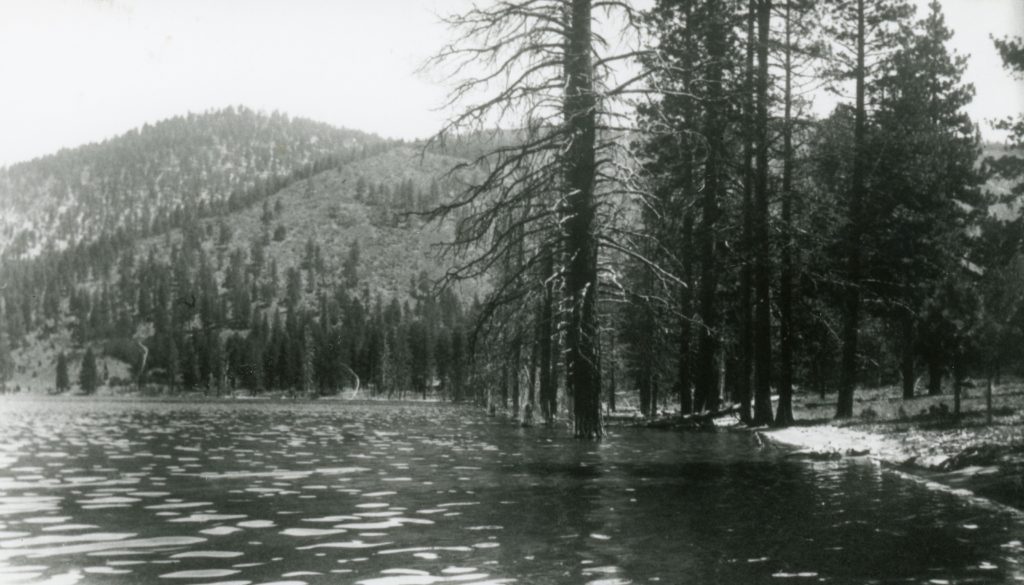
This was part of the headline statement featured in the Lassen Mail of November 20, 1931 when it was reported that the water level of Eagle Lake had reached its lowest level, yet. The newspaper stated from the lake’s highest point had now dropped by twenty-six feet. That over a ten year period the lake had dropped two and half feet each year. The paper blamed the unusually light winter precipitation that was cause of the drop. It went on to state that in normal times the spring run off into the lake varied from two to five feet. Had this occurred, according to their opinion, that was sufficient amount of water to cover from the effects of evaporation and the water drawn from irrigation.
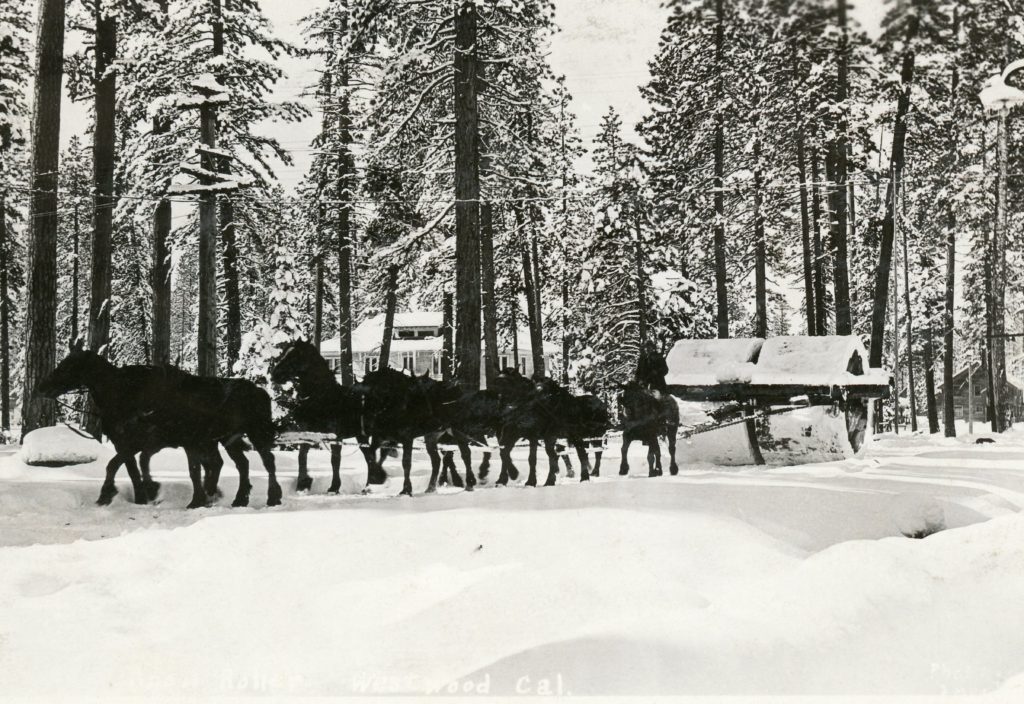
Red River’s snow roller in action. Courtesy of Calvin Sharp
Any weather prognosticators out there? Meteorologically speaking December 1 marks the first day of winter. The winter of 1915-16 was brutal. Snowfall was heavy throughout the region, and it was unusually wet. One storm in January dumped over four feet in Susanville. It was necessary for the Southern Pacific Railroad to bring in a rotary snow plow to keep the rail line open between Susanville and Westwood. In Westwood, Red River came up with a contraption they called a snow roller to compress the snow. Once all the snowstorms subsided in early January, it turned bitter cold with long periods of below zero temperatures. Because of the water content in snow, Red River officials dubbed the condition as “Blue Snow.”