In today’s hipster vernacular the “in” word is repurposed. In days of yore before we became a disposal society not much was discarded. When Lassen County was in the midst of building a new courthouse in 1916-17, the county deemed the old courthouse as surplus property.
In November 1916, the county advertised for bids for the sale of the old courthouse in anticipation of moving into the new facility. Plenty of people inspected the building. The county did not know when the building would be available. In January 1917, the county received two bids for the structure, but they were rejected. The county decided to hold an auction, in fact two.
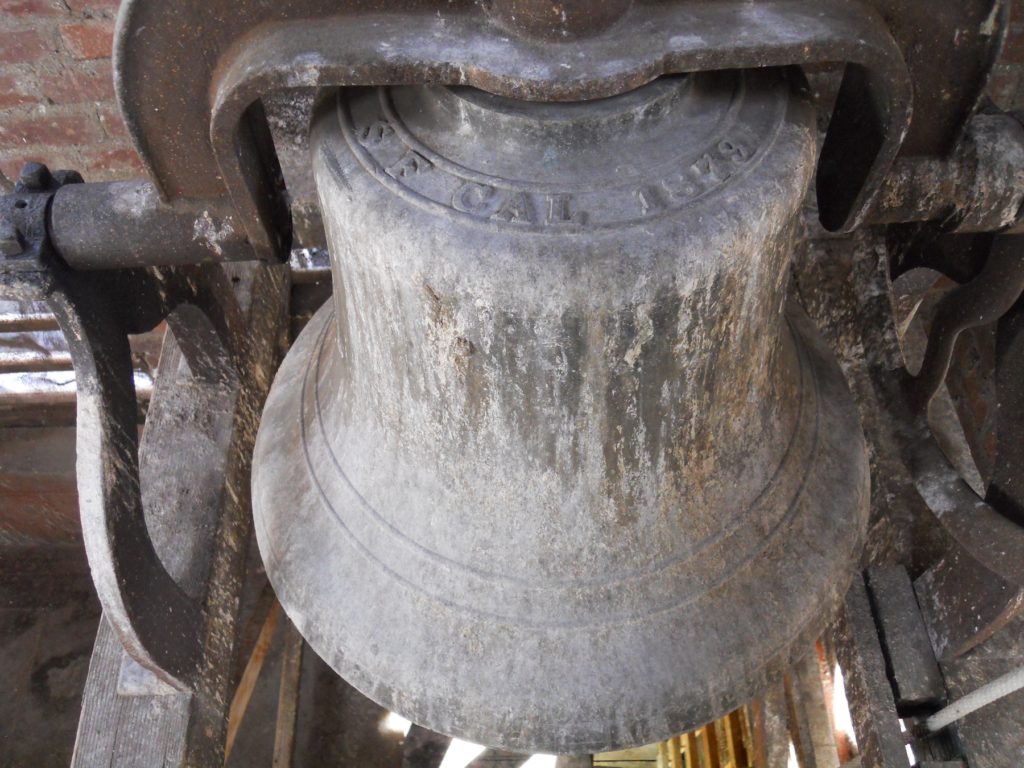
The Methodist Church bell, 2017 Courtesy of Martin Balding
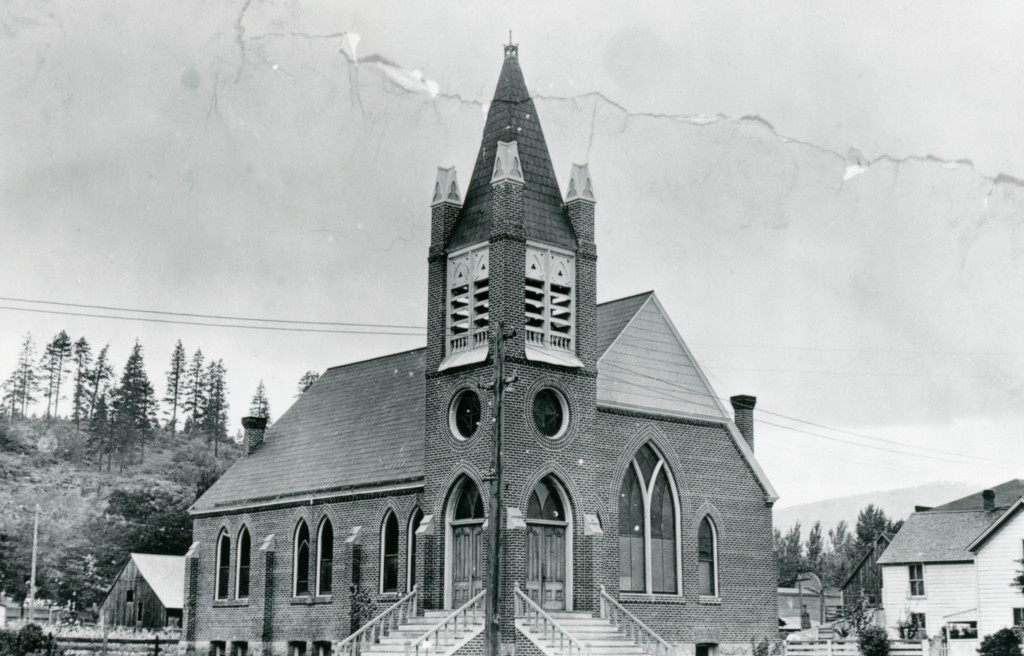
The first one held was on April 11, 1917. It included the bell from the old courthouse that used to call court into session. It was purchased by Rev. J.H. Westervelt of the Methodist Church. The church was destroyed in a 1915 fire, and they needed a replacement bell.
The installation of the bell was chronicled in the Lassen Advocate of October 19, 1917: “The bell purchased last spring for the Methodist Church was placed in the tower of the edifice last week and for the first time in many a day ‘the sound of the church-going bell’ of this the oldest church in town, brought against its hearers the indescribable feeling of Sabbath peace and quiet that means so much to village life the world over.”
It should be noted, the bell is still used to this day to call the faithful to worship. I can attest that the bell has a wonderful tone.
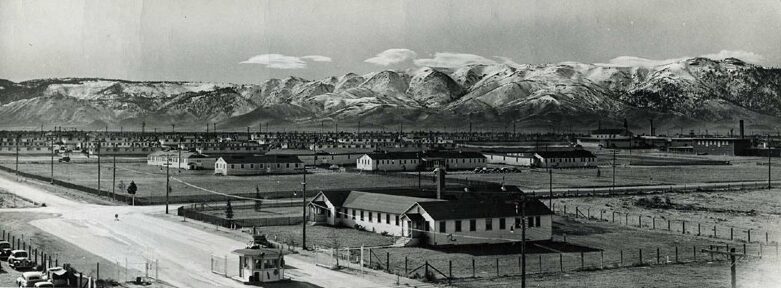
On January 26, 1942, U.S. Representative Harry L. Englebright announced that the War Department had approved the establishment of the Sierra Ordnance Depot. It would be located at Hackstaff, forty miles southeast of Susanville. Hackstaff was a very small station on the Western Pacific Railroad. The ordnance depot, on the other hand, would cover an estimated 25,000 acres sagebrush lands on the eastern side of the Honey Lake Valley. Englebright informed Susanville residents that $20 million had been approved to construct the depot. It would involve the construction of some 1,000 “igloos” for ammunition storage, besides the facilities associated with the depot. Construction would begin immediately.
It was projected that as many as 5,000 people could be involved with the initial construction and operations. A new infrastructure would have to be constructed to accommodate this huge influx of population. Susanvile and the Honey Lake Valley would be heavily impacted by this development, with such issues as housing, schools and roads. The initial reaction was mixed, though Susanville’s business community was more supportive of the project than the agricultural community.
At the February 9, 1942 Susanville City Council meeting, Jack Hill of the Shell Oil Company, informed them of expected problems with the construction of the depot. He said that Susanville would be the initial employment headquarters. The city would shortly be flooded with people seeing employment. Since time was f the essence, Hill suggested that icy become involved in established tent and trailor courts to handle the increase population. After all, with building supplies in demand, this would provide an alternative housing method. Hill warned both the city and county to be prepared for the criminal element, i.e., camp followers found at such construction projects. He said, “You are going to have a very high percentage of non-desirable people arriving with those whose livelihood is made in every conceivable means outside the law. You can combat them if the community is prepared to stop them before they get started. The fastest and easiest way to stop them is to make their activities unprofitable.”
To prepare for the criminal element, a group of local law enforcement officials-the County Sheriff, District Attorney and Chief of Police, paid a visit to Hermiston, Oregon, where a munitions depot had recently been established. Hill was 100 percent correct in his warning. In June 1942, the crime wave swept Susanville and the environs of the Honey Lake Valley. During June 1941, there had had been 31 arrests inside the city. A year later, it has escalated to 103 for the same period. The majority of these offenses were for drunk and disorderly conduct. On one day, June 27, 1942, a record sixteen people were booked into the city jail-a facility that had only 400 square feet of room to house inmates! Over at the county jail just blocks away the situation was just as grim. One alternative solution to alleviate overcrowding the two jails was from the implementation of a special fee. If one had the extra cash, he could pay a fine three times of the existing fine and would not be incarcerated, though it only pertained to misdemeanor offenses.
The intersection of Main and Gay Streets, Susanville, 1878
In 1880, Edward W. Hayden, a newspaper man arrived in Susanville, and worked for the Lassen Advocate. He would eventually own the newspaper in 1892 and sold it 1921. In 1927, he wrote some memoirs about what Susanville was like in 1880. There were two observations that peaked my interest. One was the water tank on Main Street, that there is very little documentation. The other has me befuddle and may be readers can assist. My interpretation according to Hayden was that there was a bandstand on Inspiration Point. At that time, the locals just called it the bluff and it was not named Inspiration until 1918.
Hayden wrote: “In the center of the intersection of Main and Gay Streets was a water tank four feet high about as wide and eight or ten feet long., a lofty flag pole at is western end. [The flag pole was erected in 1861 by Union sympathizers.]
“Two private residences were in the space between Roop and Pine Streets and the space occupied by the Elk’s Home was vacant. There was a rudely constructed stairway leading up to the bluff to a band stand high above the town.”
If you reside in northwest Susanville and you turn on the water faucet for drink of water, its source Bagwell Springs. That is good thing, as it is pure spring water. It was not until 1935, that it was tapped for domestic water supply.
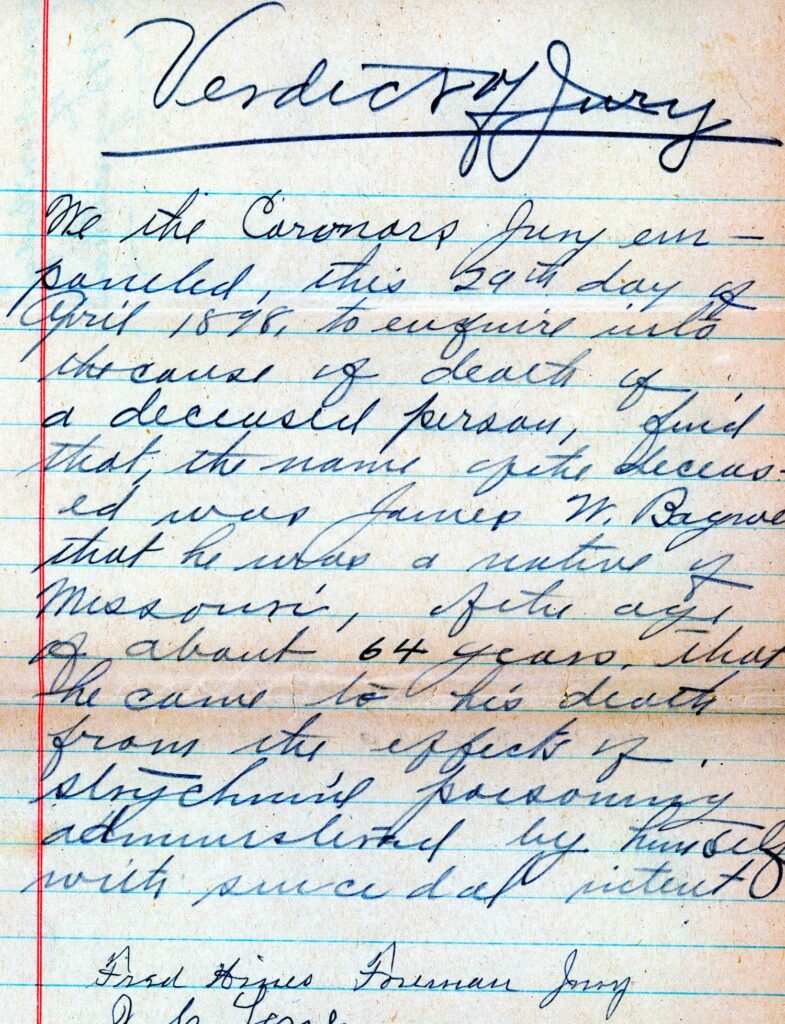
So who was Bagwell that is spring named, which is located north of Susanville Ranch Park, one may ponder.A native of Missouri, James Washington Bagwell (1835-1898) came to Lassen County in 1871. He eventually settled on a 160-acre homestead, north of Susanville, and a portion is now Susanville Ranch Park. Bagwell made a living working odd jobs, primarily selling firewood. In 1893, he sold his homestead for $300. Bagwell moved into Susanville where he was employed as the Lassen Courthouse janitor, earning $20 a month, until his death in 1898. He committed suicide from an overdose of strychnine. Bagwell was known for his interesting wit. In one instance he spoke of the stray horses grazing on the Courthouse lawn, “They got to go, if they continue to browse much longer, they will be applying admission to the bar.”
On a final note, it was not until 1901 when W.B. Long claimed rights to this spring that he designated as Bagwell.
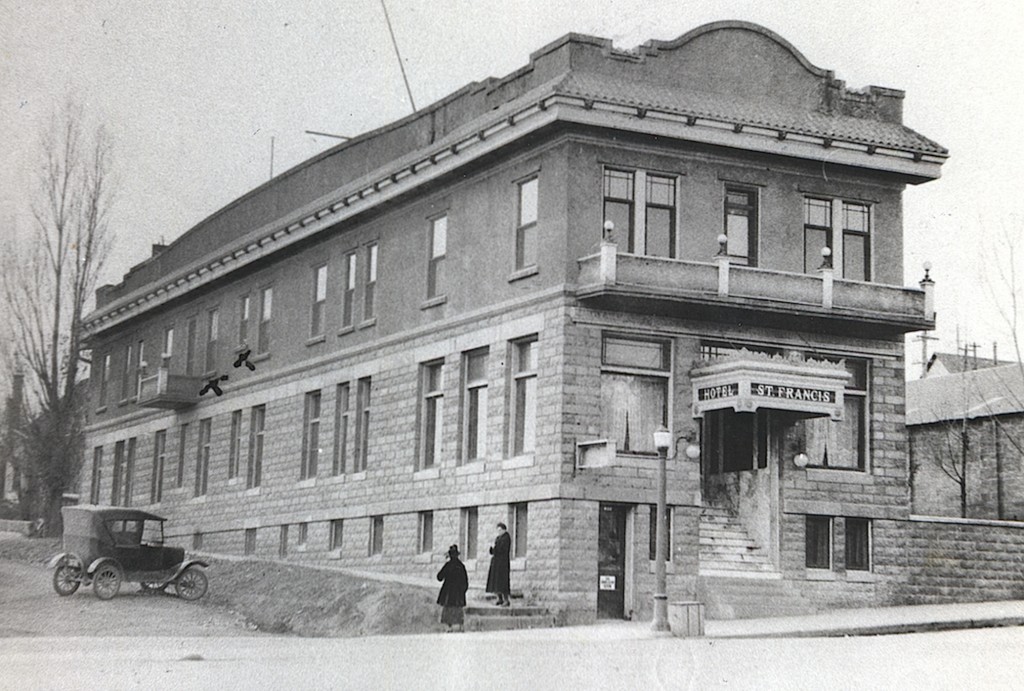
St. Francis Hotel, circa 1919. Courtesy of Art Almeda
For years, before the St. Francis was shuttered, the Round Up Room, the hotel’s bar, was a popular gathering place. When St. Francis opened it was denied a liquor license to operate a bar.
In the spring of 1914, St. Francis Hotel opened. Gus Steinhauser was hired as the manager. He applied for a liquor license from the City of Susanville. It did not go well. At the City of Council meeting of April 28, 1914, it was the first item on the agenda. Councilman Emerson made the motion to deny the license. Councilman Rankin seconded it and the application was denied.
The protest began. First was Isaac Knoch, followed by Steinhauser. Bot the gentleman stated a hotel bar was not your typical saloon. Steinhauser stated it would not pay him to open a dining room if he could not serve guests wines or liquors with the diner’s meals. It was an exercise in futility. At the conclusion, Councilman Rankin suggested to amend the liquor license ordinance to be limited to seven, and when those licenses lapsed, they could not be renewed. Eventually, the St. Francis prevailed and the liquor license issued.
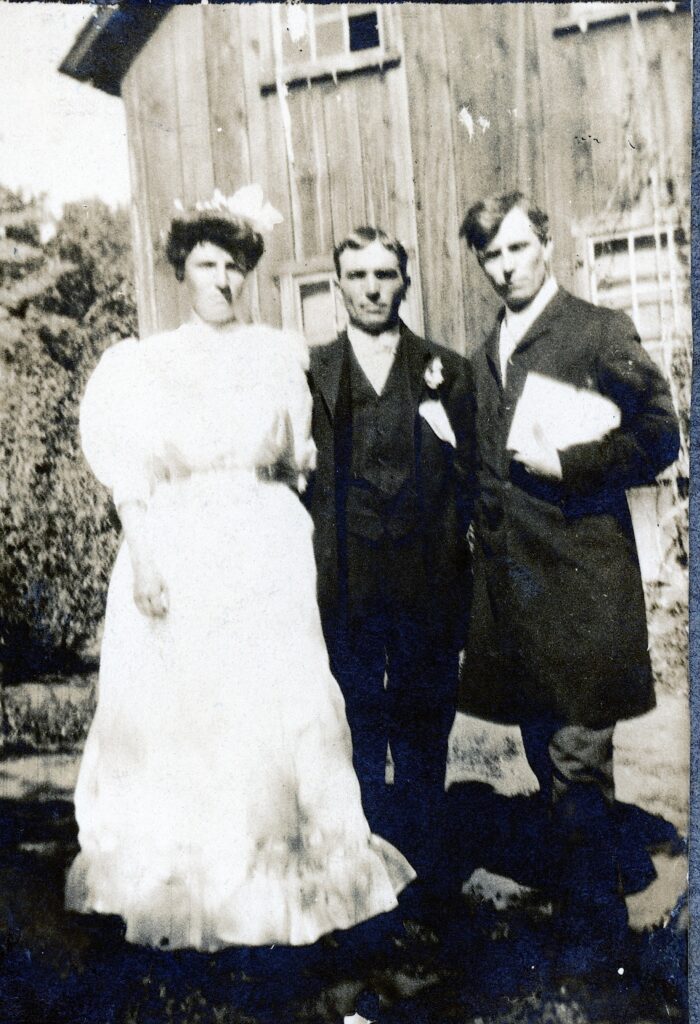
David and Theda (Williams) Fritter wedding portrait 1906.
Some years back, I received an unexpected call from the Eagle Lake Ranger District, Lassen National Forest. There are petroglyphs on the west side of Eagle Lake that are on the forest service land. Over century ago, two Eagle Lake residents, Dave Fritter and Charles Spalding etched their names along side of the petroglyphs. The forest service wanted who those two individuals were. I obliged.
There are petroglyphs on the east side of Eagle Lake. Personally, I have not observed them, but I have never done due diligence to locate them.
Closer to home, i.e. Susanville there are a handful of petroglyphs. Most on private property, but one site is owned by the City of Susanville.
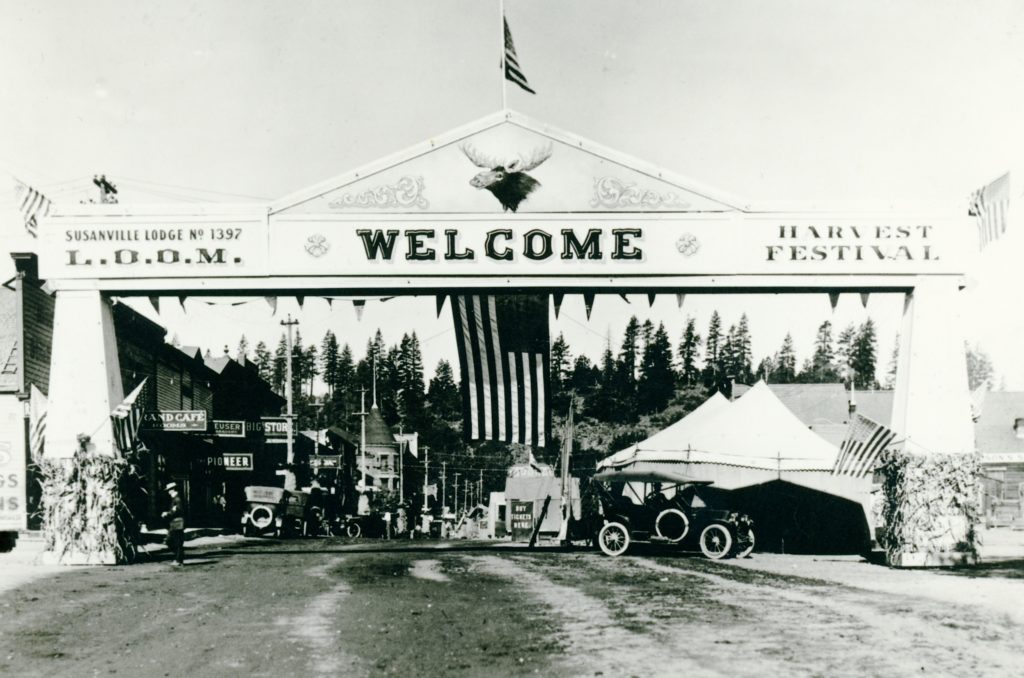
The arch was a temporary affair, and a windstorm two weeks later, blew it over.
Those who reside or have resided on the east slope of the Sierra Nevada know all too well that they are prone windstorms. Some areas worse than others.
On September 18, 1914, a particularly strong windstorm hit the region. One account reported that dust from Susanville’s Main Street was so bad, that occasionally one could not see buildings on other side of the street! Numerous reports of damage to Susanville businesses were reported, chief among them was large plate glass window that was recently installed in the Del Mar Building was shattered. Just over two weeks ago the local Moose Lodge sponsored a Harvest Festival and placed an arch at the intersection of Main and Gay. It was toppled.
Trees were uprooted and damage to fruit crops was extensive. A.H. Taylor, whose apple orchard on North Westherlow Street was a victim. He estimated 100 boxes worth of apples were blown off his trees.
On April 16, 1921, a grand celebration was held in Susanville for the Fruit Growers Supply Company new mill that was placed into the operation. In evening, a banquet was held for an assorted of company officials and local dignitaries. Fruit Growers General Manager Frank Hutchens stated how the Lassen would be operated. Fruit Growers would conduct selected tree harvesting, whereby 30 percent of the merchantable trees would remain as seed trees. Fruit Growers and the Lassen National Forest Service were working on a selective harvest plan that would allow to operation to continue in perpetuity. They estimated it would take between fifty to sixty years to log their holdings. By that time, the original logged areas would be ready for the second harvest of mature trees which again would take between fifty and sixty years to harvest, and the cycle could continue.
C.E. Emerson, a local merchant and rancher, told the crowd of his reforestation experience locally. Emerson recalled as a child, forty years ago, he helpd plant a tract of pine trees on the family ranch just south of Susanville on Diamond Mountain. Those seedlings, he said, had become a fine stand of pine timber, many of which were 22 to 24 inches in diameter.
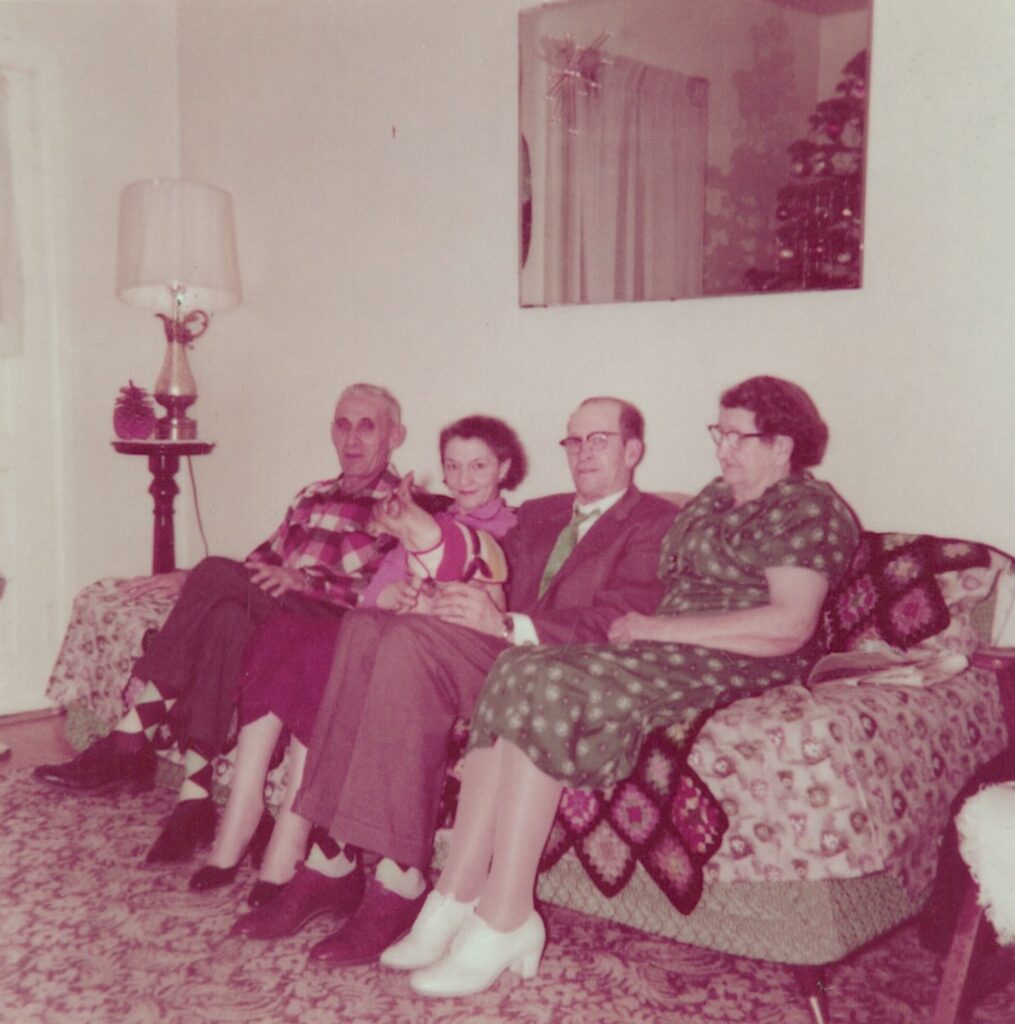
Left to Right: Ira Purdy, Kate Potter, Sam Potter, and Ruth “Ma” Potter, December 1957-Courtesy of Riki Jo Potter.
Last Friday, we explored Potter’s Maternity Home.I just happened to come across the other day a photograph that included Susanville’s best known midwife, Ruth “Ma” Potter.
On Sunday, April 20, 1924 the first Easter Sunrise Service were held in Susanville. Preparations began two weeks earlier for the non-demonitial service. Inspiration Point was the selected location. The event was organized by the Ladies Auxiliary of the American Legion. The women were ambitious. They persuaded the Lassen Lumber & Box Company to donate the materials and labor to construct a cross on the point at no cost. They employed the same maneuver with the Lassen Electric Company who adorned the cross with light bulbs. A week prior to service, in the evenings the cross was lit up and seen for miles around.
At five a.m. Easter Sunday some 300 people attended the service under very chilly conditions. The invocations were done by Father McCarthy (Catholic), Rev. Price (Methodist), Rev. Rowe (Baptist) and Captain Diez of the Salvation Army.