Tag Archives: Susanville

Easter Sunday

Susanville’s Methodist Church, circa 1896. Courtesy of Philip S. Hall

It being Easter Sunday, I thought it would only be appropriate to provide some of the early history of religion in our region. The Methodist Church had a profound influence on the Honey Lake Valley. In 1860, this church held their first service in Susanville. By 1905, there were Methodist Churches in Janesville, Johnstonville, Standish and, of course, Susanville, more than any other denomination. 

Sacred Heart Altar
The altar at Sacred Heart Church, circa 1911

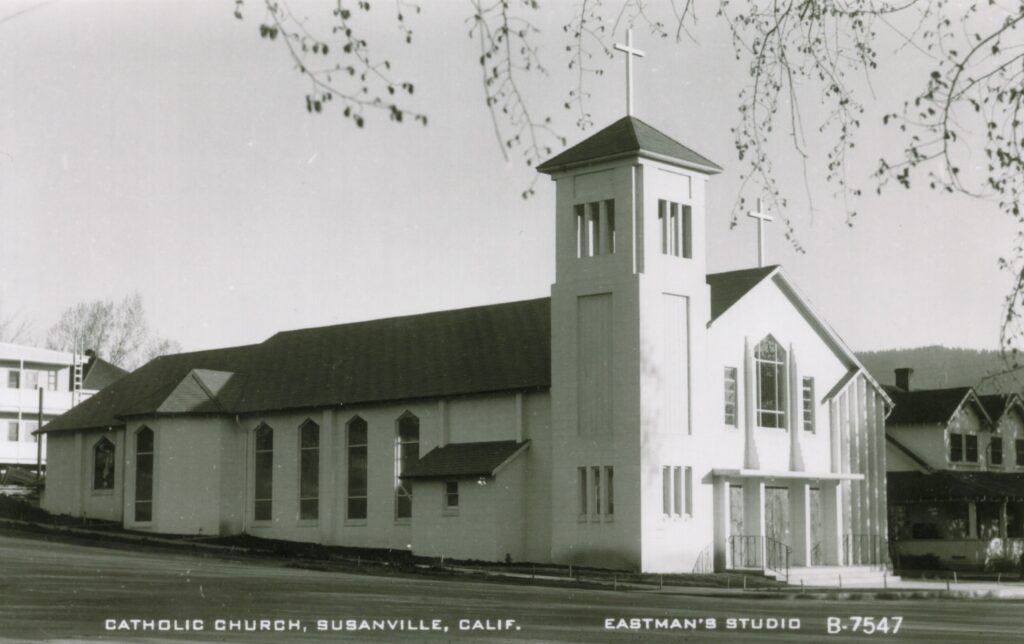
The Roman Catholics first made its appearance in 1868, holding Mass at the home of Ned Mulroney a short distance south of Susanville, near Gold Run. The Catholic population in the region was small, so in many instances they may only see a priest one or two times a year. In 1892, they built their first church on Richmond Road. In 1909, it was moved to the site of the present church on Nevada Union Streets.

Other religious affiliations slowly made their presence known such as the Church of Latter Day Saints who first made their presence in Big Valley in the 1880s, before slowly drifting south towards Susanville. The Baptists, Lutherans, Presbyterians and others followd suit.

Tim

P.S. – Still in search of a  home.


Eagle Lake Lumber Company Fire

June 13, 1965 – Hank Martinez

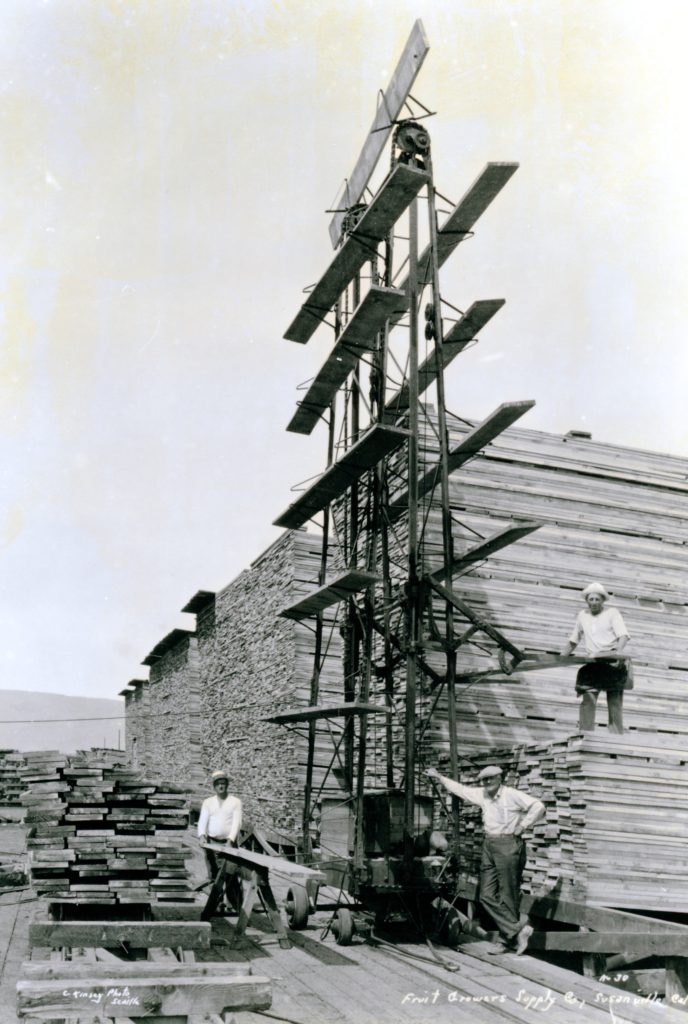
After Fruit Growers Supply Company closed their Susanville mill,it initially appeared that it would be sold to a liquidation firm. Fruit Growers had been in negotiations with Crook & Emmerson to sale them the mill, but negotiations stalled. Finally on June 12, 1963 they reached an agreement and the mill and adjoining residential section was sold to Crook & Emmerson for $875,000.

June 13, 1965 —Hank Martinez

Crook & Emmerson’s new enterprise was known as the Eagle Lake Lumber Company. All went well until the early morning hours of June 13, 1965 when a fire broke out in the planing mill. The sprinkler system there was inoperable as the structure was being renovated. By the time the fire department arrived, it was too late, as a large portion of the plant was engulfed in flames. After three hours, the fire destroyed the planing mill, the dry kilns, the abandoned box factory and an estimated five to six million board feet of finished lumber. The estimated loss was between $5 to $6 million.

The aftermath—FGSCo.

It should be noted that Eagle Lake Lumber Company evolved into Sierra Pacific Industries.

Support

P.S. – Still in search of a  home.


The Courthouse Auction

The Methodist Church bell, 2017 Courtesy of Martin Balding

Yesterday, we explored that in February 1917 the county accepted the newly constructed courthouse as complete. There were still matters to contend with the existing courthouse. The county hired Younie & Buckwalter, auctioneers to dispose of the old courthouse and its furnishings. The auction was held on April 21, 1917. Of course, the majority items sold one would expect such as desks, chairs, etc. There was a particular item that caught my attention a bird cage that sold for seventy-five cents. There is one relic that survives to this day and is functioning-the bell. Susanville Methodist minister Rev. Westervelt purchased the courthouse bell for $12.50. On Sunday mornings at 10:30 the bell is to put into action calling the faithful church. Back to the auction, the total proceeds from the auction was $266.05. The cost of advertising and the auctioneers commission was forty dollars.

Tim


Susanville Creamery Company

The creamery building and later Model Laundry, at 435 N. Roop Street, April 1938–Betty B. Deal

On March 5, 1903, Jules Alexander, John Borrette, Isaac Knoch, Sol Nathan and John Spalding formed the Susanville Creamery Company.  It should be noted that these individuals were prominent Susanville merchants. By the end of the month, the newly formed company hired Herman Enhorning and Charles Odette to construct a creamery at the end of Roop Street, near Piute Creek for $1,925. By July the new creamery was in operation, W.T. Mitchell was at helm, he had previously managed to the Diamond Mountain Creamery.. There were problems. There were too many creameries in the area-the others being located at Johnstonville, Spoonville and Standish. Equally important, there was not enough dairy cattle and labor to support all four. In 1911, the Susanville Creamery shut down. It would later re-open and by 1916 it was permanently closed. Continue reading Susanville Creamery Company

The Big Snow of 1952

Main Street, Susanville, 1952.

The big snow made its debut on January 12, 1952. Three days later Susanville was covered with a blanket of five feet of snow. On the other side the mountain, at Westwood eight feet had fallen. The storm was followed by unusually strong gusty winds. Not only did the winds disrupt electric power but drifting snow created highway blockades. These drifts ranged between seven and nine feet. They. were no match for regular snow removal equipment. Clearing them necessitated use of rotary snowplows. While they were efficient, it was a slow process. To clear a single highway lane of thirteen miles between Chester and Westwood took the rotary plow three days, working around the clock.

Elks Lodge, Susanville, 1952

The “big snow” showed how much life had changed. The residents were no longer self sufficient like the pioneers before them. Many relied grocery stores. After three days of the highway blockade, the grocery stores were depleted of their stock. In Susanville. a shipment of yeast was dropped by plane for the Sunrise Bakery so there would be a supply bread. Officials at Westwood and Chester made arrangements for an air drop of food and medical supplies. It was cancelled on January 18th, when the snowplows made it to Mineral. There a convoy of trucks laden with food, fuel and other supplies made its way along the one-lane highway. While the worst over, traffic was limited to emergency vehicles until two lanes were cleared. On January 31st balmy temperatures arrived in Susanville, with a morning low of 42 and a daytime high of 50.

Support

The Harvest Festival Arch

The Harvest Festival Arch, 1914

While we have explored the Harvest Festival of 1914, this post is with the emphasis about the arch constructed during the festivities. As noted, the four day event was a sponsored the local Moose Lodge. It is interesting to note that it coincided with California’s Admission Day, September 9.

The arch was a temporary affair, and a windstorm two weeks later, blew it over.

Some community arches, like Reno, were to be permanent. This was not case of the Moose Lodge arch located at Main and Gay Streets. The lodge duly noted that its arch was a temporary, but no one knew when it was to be dismantled. Mother Nature intervened. On September 18, 1914, a particularly strong windstorm hit the region. It did considerable damage and toppled the arch.

Tim

Keep Susanville Clean

The citation to clean up the Lassen County Courthouse grounds

When the town was incorporated in 1900, the major impetus was for fire protection. One concern was that citizens would either pile up rubbish at the nearest vacant lot or in the alternative to avoid the city’s wrath and possible fine, one could easily find a convenient location outside the confines of the city limits.This in itself poised a fire risk, but also health hazard.

It was not until 1920 that a city dump was created. On March 20, 1921, the City awarded a franchise to Frank Gerig, who offered twice weekly garbage collection at a monthly fee of fifty cents per address.

Tim

Sterno & Prohibition

Richmond Road store-keeper. A. Farris and his monthly report of sale of canned heat..

Sterno was developed around 1900 for use in catering to keep chafing dishes warm. The product sold in little cans received the nickname of “canned heat.” It was popular with soldiers during World War I to heat their meals.

Then came along Prohibition. One of the ingredients of canned heat is methyl alcohol, than can be deadly if ingested. This did not stop individuals straining canned heat with a cheesecloth to extract the alcohol. It was not only a nation wide crisis, but a local one as well. In March 1926 the deaths of John Murphy and Pete Nelson were attributed to the consumption of canned heat. It took local officials over a year to curb the usage of this product. In the fall of 1927 both the City of Susanville and the County of Lassen passed ordinances requiring that dealers of canned heat obtain a special license to sell it. The license cost dealers $50 per quarter. It was presumed that by making the special license so high, it would eliminate the product from the shelves. It worked and canned heat was no long a problem locally.

Subscribe