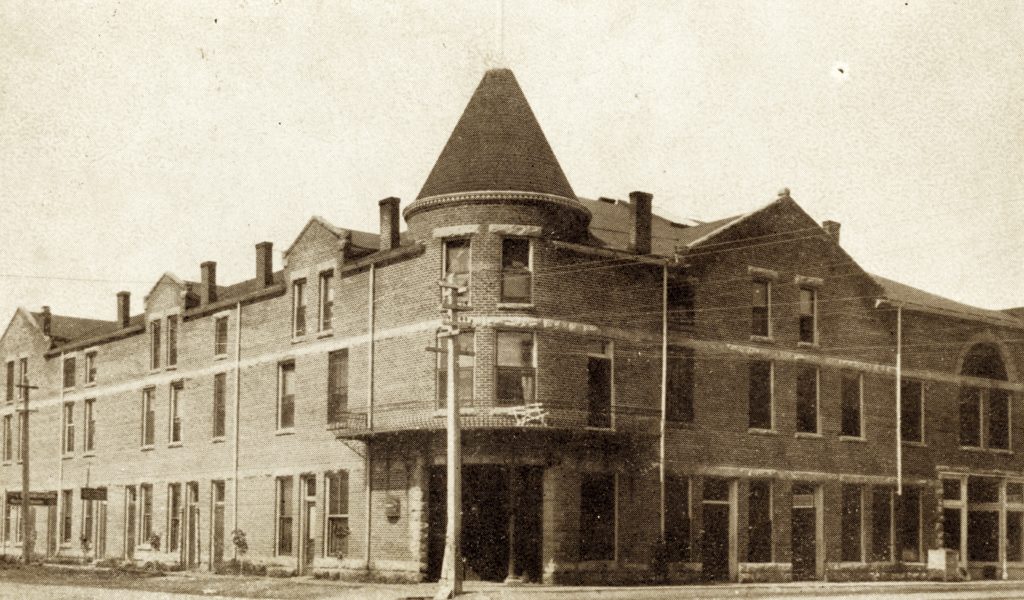
The Emerson Hotel located at Main & Lassen Streets, the current site of the Hotel Mt. Lassen. Completed in 1901, destroyed by fire in1915.
If you thought $540 for the Lassen County Farm Bureau cookbook was tad expensive, well I was recently alerted about another much more pricey one. The latest involves Emerson family memorabilia, specifically that of May Spencer Emerson (1867-1955). The package includes a woman’s dress, necklace, purse and two historic invitations. One of those invites is for the 1901 dedication of the Emerson Hotel. Asking price $900.
Other people are involved in hopes to purchase said items for the Lassen Museum. This is one of those instances I go into a retreat mode, it has all the features of a sticky wicket drama–something I avoid.
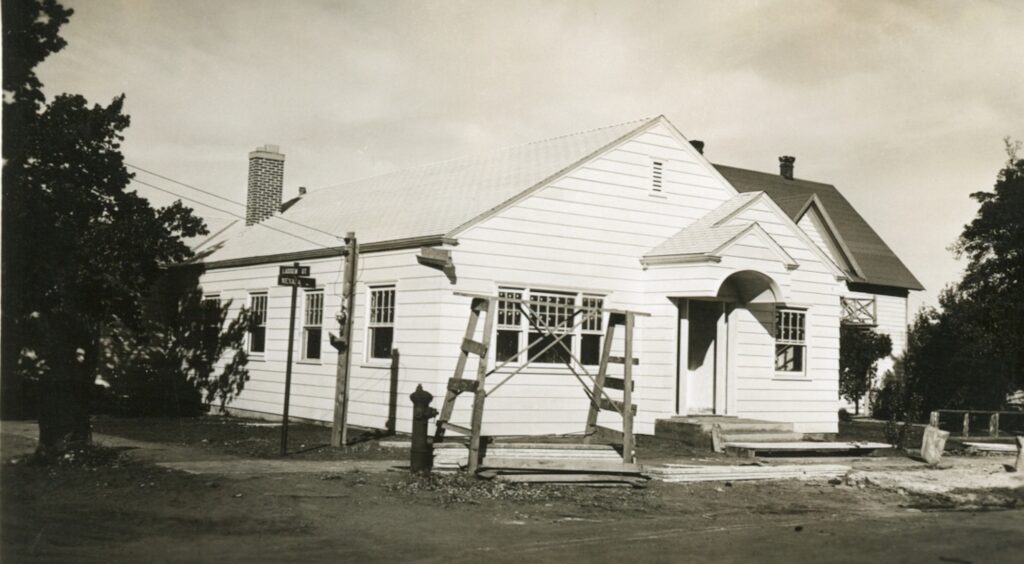
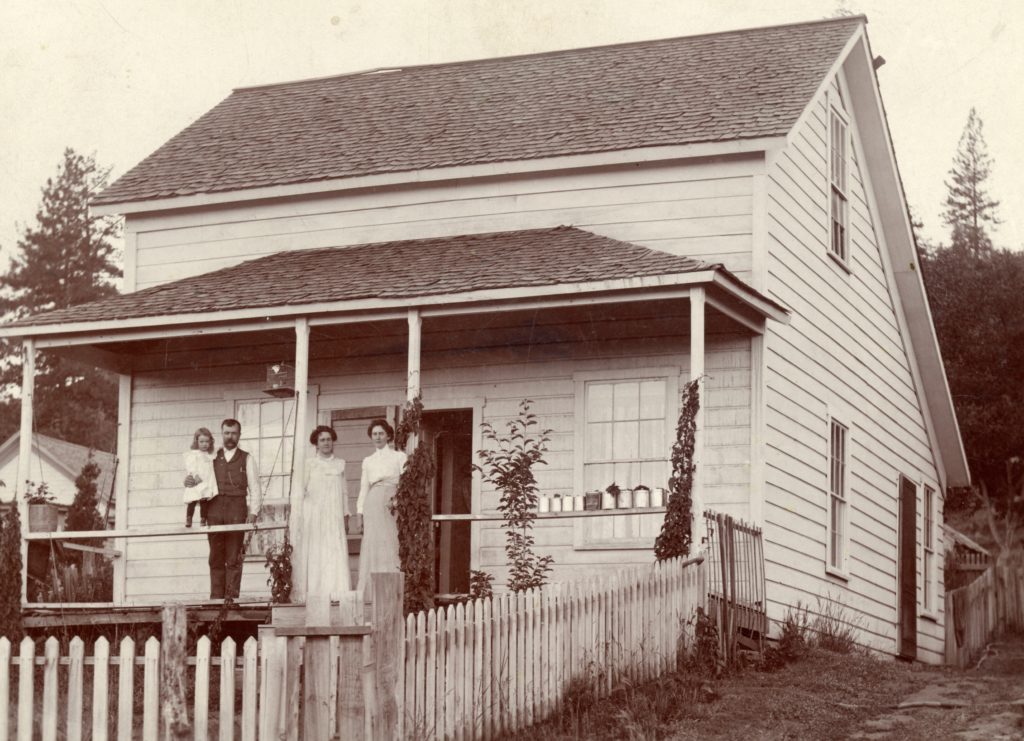
701 Nevada Street, Susanville, October 7, 1939–H. Frodsham photograph
In 1912, the Great Western Power Company was in the midst of the construction of Nevis Dam to create Lake Almanor. The company hired Dr. Fred J. Davis to provide medical care for the construction workers. In September 1913, Red River Lumber Company hired Dr. Davis to provide medical care to its newly constructed company town of Westwood. Dr. Davis would remain in charge of the Westwood Hospital until 1939. Dr. Davis, along with son, Dr. Fred J. Davis, Jr., moved to Susanville to open their private practice. At 701 Nevada Street, Susanville they had an office constructed. In 1965 Dr. Davis Sr. retired. In 1974, Dr. Fred J. Davis Jr. retired and he sold the office to Dr. Jay Beams. In 2022. Beams closed the office, which now sits vacant.
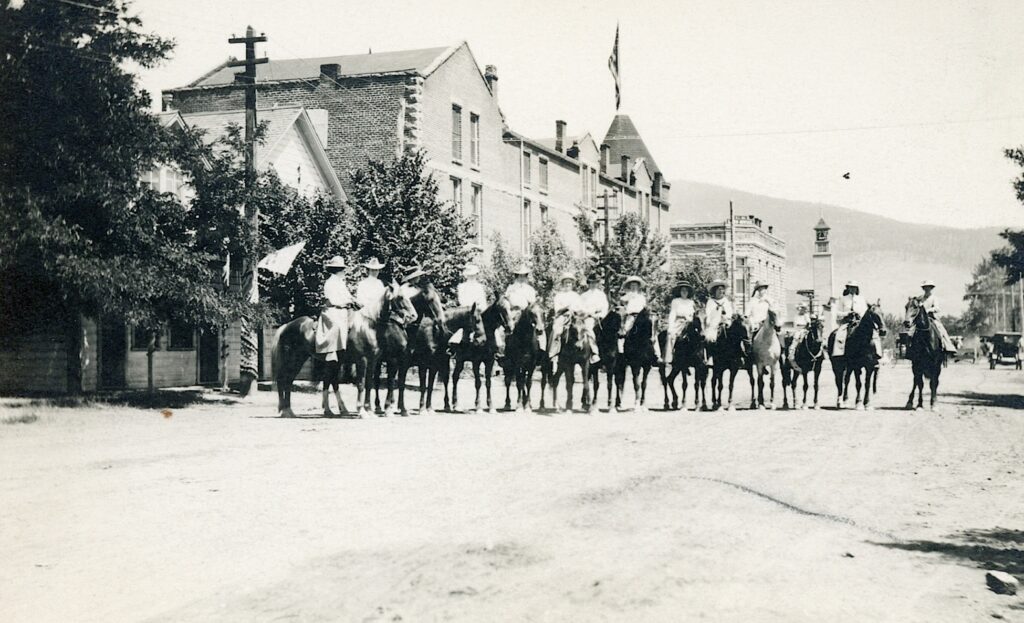
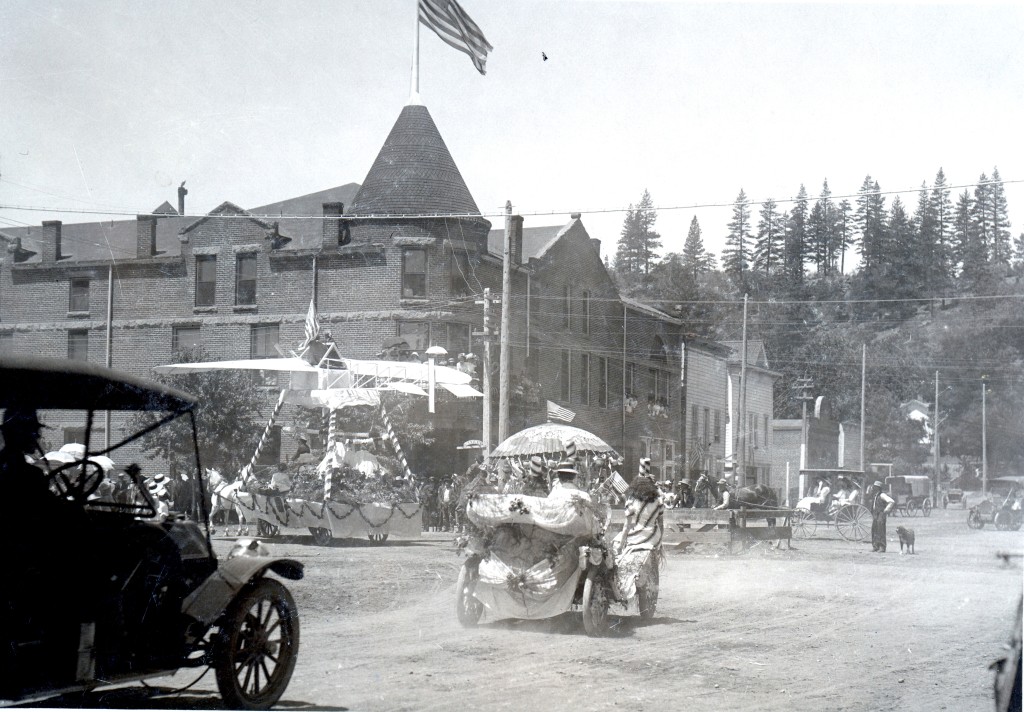
Here is a bit of worthless trivia about the early 1900s 4th of July parade route in Susanville. It was a short one. Entrants gathered at the corner of Cottage and South Gay Streets. From there the parade proceeded north on Gay and then turned left onto Main Street. Then the parade went one block west to Lassen Street, where the route took a left onto Lassen Street, which concluded at the intersection of Lassen and Cottage Street, basically a nearly one block loop.
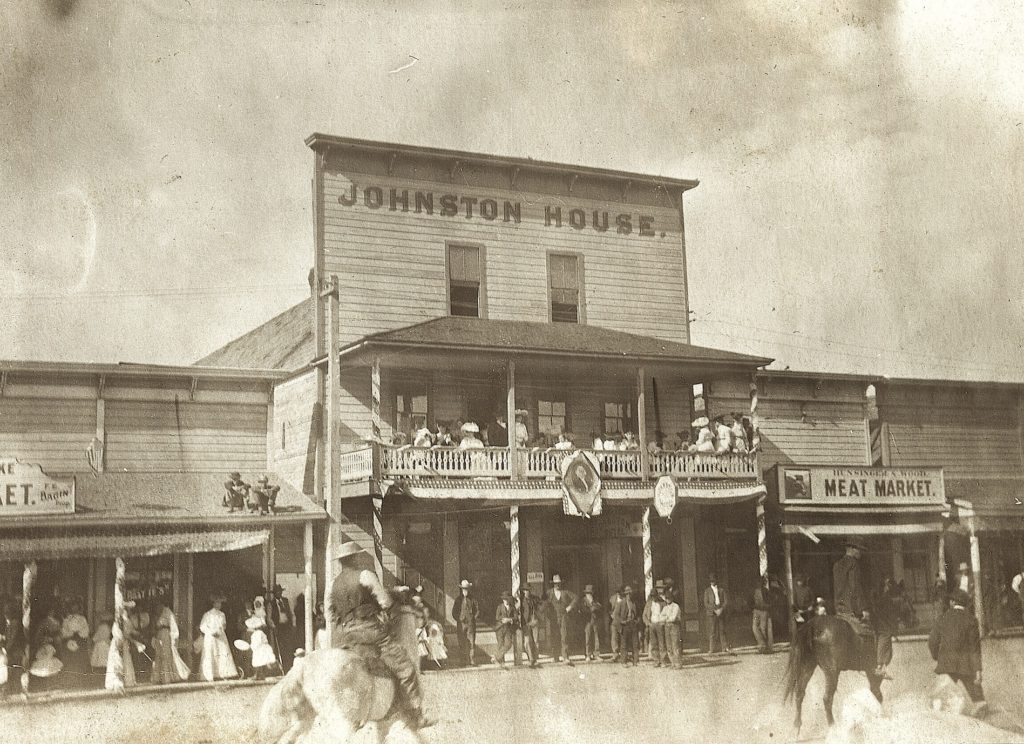
The Johnston House, July 4, 1909. Courtesy of Betty Barry Deal
Tim
P.S. Any one who is a long time reader, know that I a firm believer on a ban of fireworks. This is an excerpt from yesterday’s New York Times:
Fireworks sparked 916 wildfires in the state in 2021, the most recent year for which full data is available, and those fires caused more than $3.2 million in property damage, according to CalFire. The year before that, in the state’s worst fire season on record, fireworks caused more than 2,000 fires and $8 million in property damage, along with injuries to 11 people and one death.
It is not just a California phenomenon. A study published last year in the journal PLoS One found that more than 11,000 wildfires nationwide were caused by fireworks between 1980 and 2016 — and that two-thirds of those blazes occurred in the two-week period around July 4.
In fact, more fires began on July 4 than on any other day of the year, it found.
4th of July 1912, Susanville. Courtesy of Lola L. Tanner
Note: This is a perennial post, because it has merit and in my opinion they should be banned permanently.
he following appeared in the New York Times, July 3, 2024 “Fireworks sparked 916 wildfires in the state in 2021, the most recent year for which full data is available, and those fires caused more than $3.2 million in property damage, according to CalFire. The year before that, in the state’s worst fire season on record, fireworks caused more than 2,000 fires and $8 million in property damage, along with injuries to 11 people and one death.
“It is not just a California phenomenon. A study published last year in the journal PLoS One found that more than 11,000 wildfires nationwide were caused by fireworks between 1980 and 2016 — and that two-thirds of those blazes occurred in the two-week period around July 4.
“In fact, more fires began on July 4 than on any other day of the year, it found.”
In Susanville’s early years as an incorporated city, it was remarkable what the council did. One of their actions, I still support today, and that is the prohibition of fireworks. The first time they banned fireworks was in 1906, following the aftermath of the San Francisco earthquake and fire. It was also a nod to the insurance companies who suffered tremendous loss from that event. It was their belief, as well as many other communities, that this preventive measure would reduce the risk of fires.
In 1912, the City once again banned fireworks. The Lassen Advocate applauded the city and wrote: 21 June 1912 – “No Fireworks on the Fourth. We desire to congratulate our Board of Town Trustees on their action in placing the ban on all kinds of fireworks on July 2, 3, and 4. This action has been taken by large and progressive cities for years past, and we are greatly pleased to note that the smaller places are falling into line. Fireworks do no good and may do a world of harm. Fires may be started that will blot out blocks of cities or towns; little boys and girls all over the United States have lost fingers, hands eyes and in many instances, their lives from the dangerous pinwheel and firecrackers. Let them yell all they will, let them spend their money for ice cream, candy—anything on earth but the fireworks.”
In 1916, the Monticola Club appeared before the Susanville City Council asking for a ban of fireworks for the 4th of July. Their answer was no. The council assured that the utmost care would be done, but they were not going to deprive children of the festivities. In 1926, due to the tinder dry conditions, the City banned fireworks for fire, health and safety reasons.
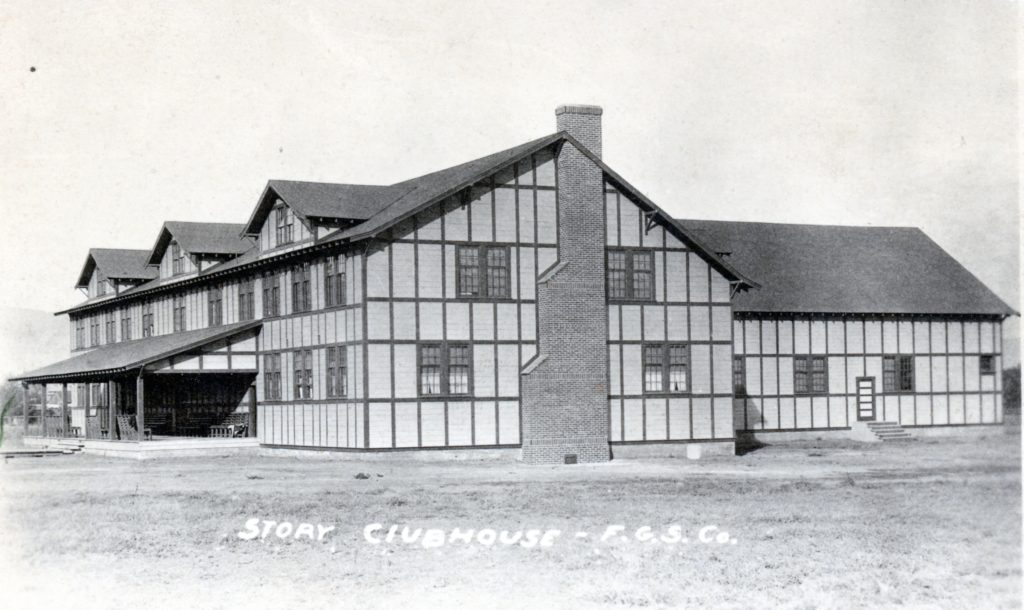
When Fruit Growers Supply Company accidentally became owner of a sawmill and town at Hilt, Sisikiyou, County, it was a major learning curve. One lesson they learned early on, you treat your employees well and they in turn do the same for company. Recreation amenities for Fruit Growers employees was deemed essential. By offering such, the company recouped its investment by reduced employee turnover.
In 1922, Fruit Growers constructed a three-story recreational facility known as the Story Club. In July 1924, on the on the north side of the Story Club and adjacent to Riverside Drive they built a public park complete with a children’s playground, the first in Susanville. When the Story Club was destroyed by fire in 1944, the company decided not to rebuild since there were a variety of recreational outlets in Susanville. However, not to let the vacant space go to waste, they expanded the park.
In 1963, Fruit Growers sold its mill properties, which included the park, to Eagle Lake Lumber Company. Prior to the sale, the City of Susanville, agreed to take care of the park’s maintenance, since the public had use when it was created. In 1976, A.A. “Red” Emmerson, president of Sierra Pacific Industries, of which the Eagle Lumber Company was a division, offered the park to the City for $23,000. It had recently been appraised at $45,000. The City accepted the offer and by end of the year the deal consummated.
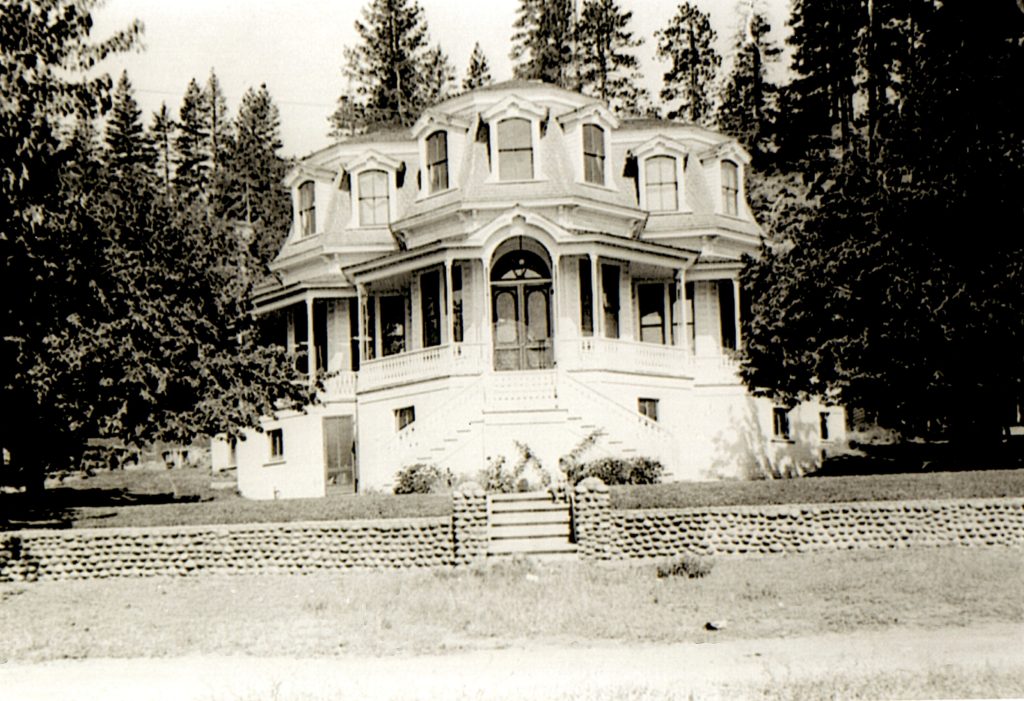
The Swain residence, before it became the Elks Lodge, 1913–Frances Swain
For nearly the first eighty years of the building’s existence it was street level. So what happened? A major change came in 1922 when Highway 36 was constructed it would enter Susanville on South Pine Street. Prior to this highway one left town via North Pine Street.
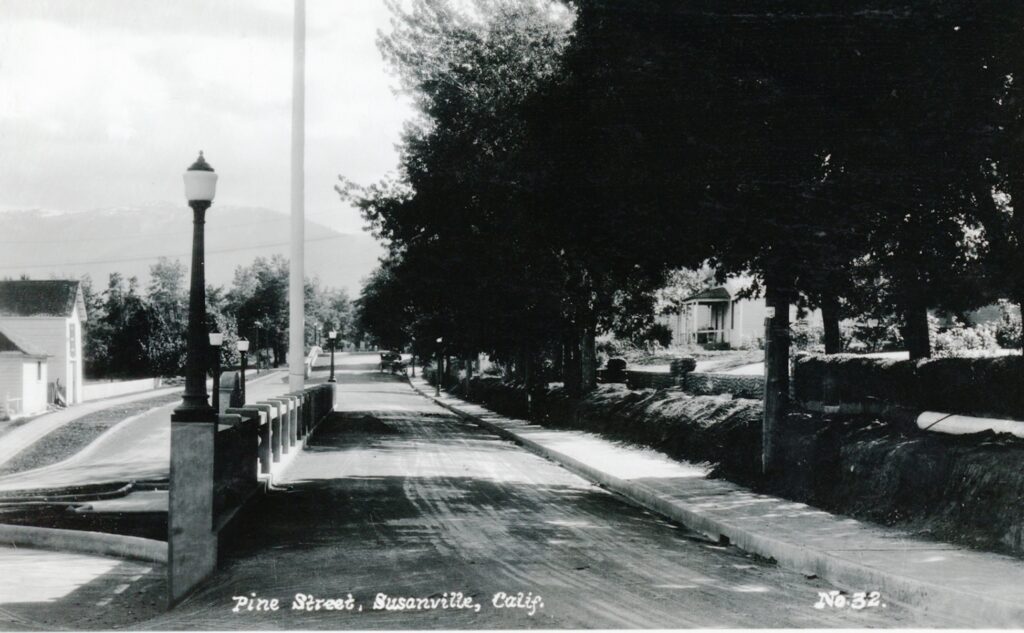
Pine Street, 1921
In 1965/66 the California Division of Highways did a 8.3 mile highway realignment from Susanville to Willard Creek. The curve near the Elks Lodge saw a drastic change. The retaining wall was removed thus lowering that segment of Pine Street below the Elks Lodge. to what is today. One of the other dramatic change was a new bridge span over the Susan River at Devil’s Corral.
Pine Street, 1922–Hazel Moller
On a trivial note, when Lake Lahontan covered the Honey Lake Valley, the property of the Elks Lodge would have been lake front.
Main Street, Susanville, October 1924—Boyd Benham/Connie Boomer
Of course, editorials have a hint of bias. This particular one that was published in the Lassen Advocate in 1924 caught my attention. While truthful, its also misleading. Newspapers then were great civic boosters and promoted their locale. Susanville was still in its boomtown heyday, but to some outside the region was still known of its Wild West atmosphere of saloons and bawdy antics. While the Advocate’s editorial provided the appearance, that it getting things under control, and it looked good on paper, the reality was a different story.
There was Susanville proper as in the city limits, which was relatively small. The southern boundary was Susan River, eastern Weatherlow Street, northern Piute Creek and western Inspiration Point. The greater Susanville region as a much larger territory. While the editorial proclaims how Susanville is cleaning up after bootleggers proper those bootleg operations outside the city limits continued as usual. The three main areas was Rooster Hill (Indian Heights), Milwood and the area around the Susanville depot. This territory was under the jurisdiction of the county to enforce. Some times they did and some times not. Some county officials thought that prohibition since it was a federal offense, and it was up to federal officials to enforce it. Anyhow, here is the editorial.
Lassen Advocate, 20 February 1924 – Enforcement in Susanville. Not only the bootleggers of Susanville, but the consuming public at large is beginning to feel the pinch of an honest endeavor to stop illicit in traffic in Susanville.
Taylor Clement who has been on night duty relieving the regular nightwatchman has been giving the bootleggers a run for the money at night and they have been complaining. He makes his regular rounds every 15 to 20 minutes and has kept bartenders and proprietors busy by dumping their liquor. And he does not make his calls at any stated times. They never know when he is coming. A few nights ago, he through h is actions forced the proprietor of a Gay Street establishment to close. Later in the evening espying three men under the grammar school hill he threw his light on the same three men that had left the Gay Street resort. They broke a bottle that they had with them.
Between Marshall Lannie Long in the day time and Taylor Clement at night the bootleggers are between the devil and the deep. Even some of the heavy consumers are complaining that they can not buy a drink as often as they used to.
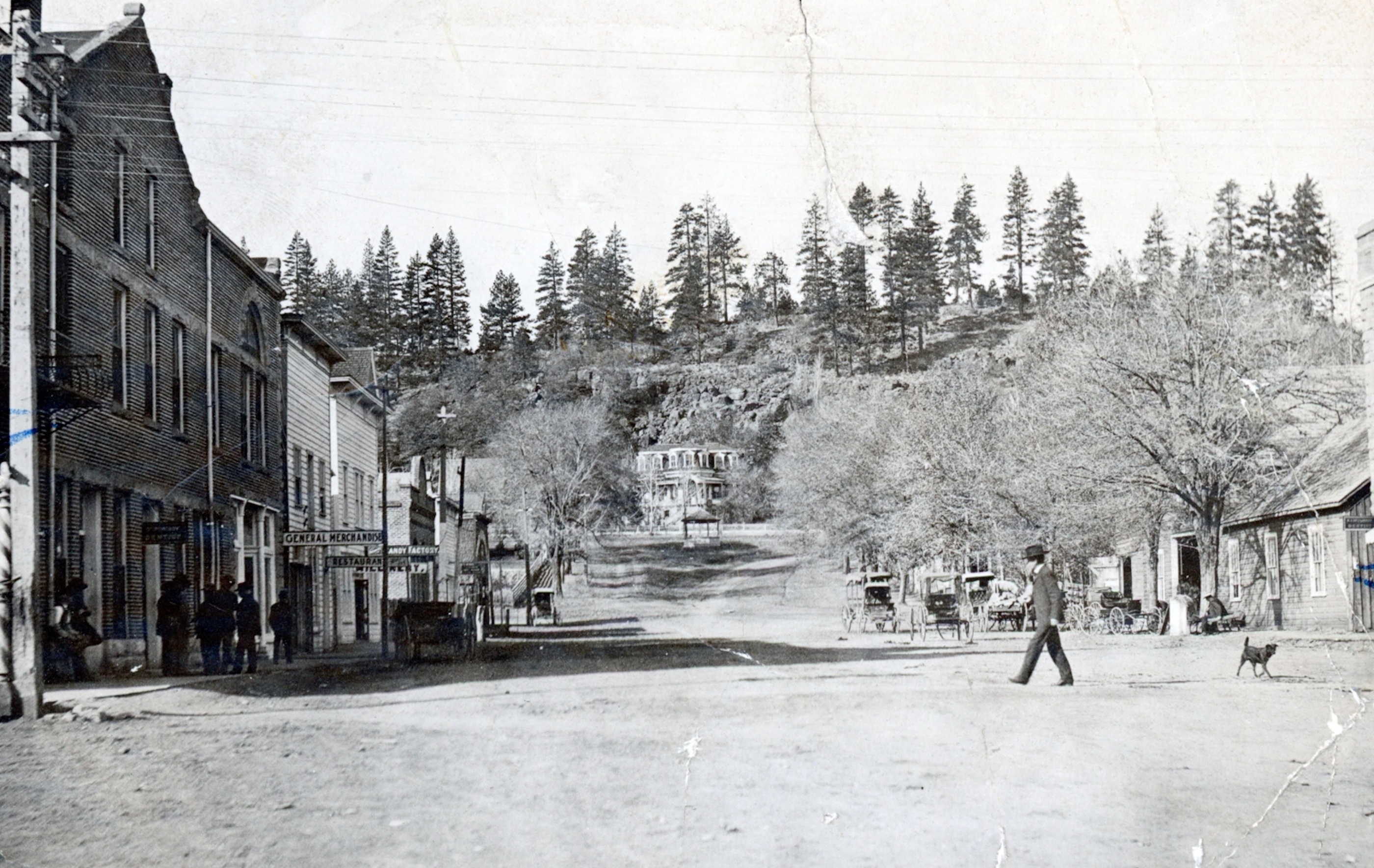
Looking west on Main Street, at Lassen, 1906. You can see the bandstand in the background. By the way, the gentleman crossing the street is Dr. W.E. Dozier. Photograph courtesy of Betty Barry Deal
Awhile back we explored the origins of the triangle at the west end of Susanville’s Main Street. For a refresher, you can read about it here.In the coming weeks we will explore how this intersection evolved over the years.
The 500 block of Main Street was criticized by many of its unkept appearance, with sagebrush creating a median. The Mountain Echo Band had an idea to change the scruffy landscape. In September 1902, an octagonal bandstand was constructed there and even adorned with electrical lights. On September 14, 1902, the bandstand was dedicated by the Mountain Echo Band with their first concert. Two weeks later it was focal point of a royal pageant during one of the infrequent county fairs. A few years later the Mountain Echo Band disbanded and the bandstand fell into disrepair. By 1906, one observer said the relic had become eyesore on the community. In 1908, it was torn down.
500 Block, Main Street, Susanville, 1911—C.R. Caudle Collection
Up Next: For nearly 80 years, the prominent Elks Lodge was street level.
For several years prior to 1912, the Pioneer had a biergarten next door. Courtesy of Philip S. Hall
In past, we have explored how instead of demolishing buildings, the buildings were moved to another location. In 1920, W.H. Tuttle purchased the Pioneer Saloon (722 Main Street, Susanville). Tuttle wanted to replace the wooden structure with a new two-story fireproof one.
The late George McDow, who was ten years old at the that time recalled the event of moving the structure: “We kids watched with great interest as they pulled the old wooden structure into Main Street with a horse-powered winch. Turning the building around one-quarter turn, they led it down Main Street hill on planks and rollers by means of the winch anchored at the top of the hill. On reaching the bottom of the hill between Union and Weatherlow Streets, it was turned back the quarter turn to its original position and moved backwards onto a vacant lot, where it still stands.”
In 2024, the building is still there, albeit in an altered state. The location is 924 Main Street.
B.R. Zimmerman residence, 45 South Pine Street, circa 1890. Courtesy of B.R. Zimmerman Collection
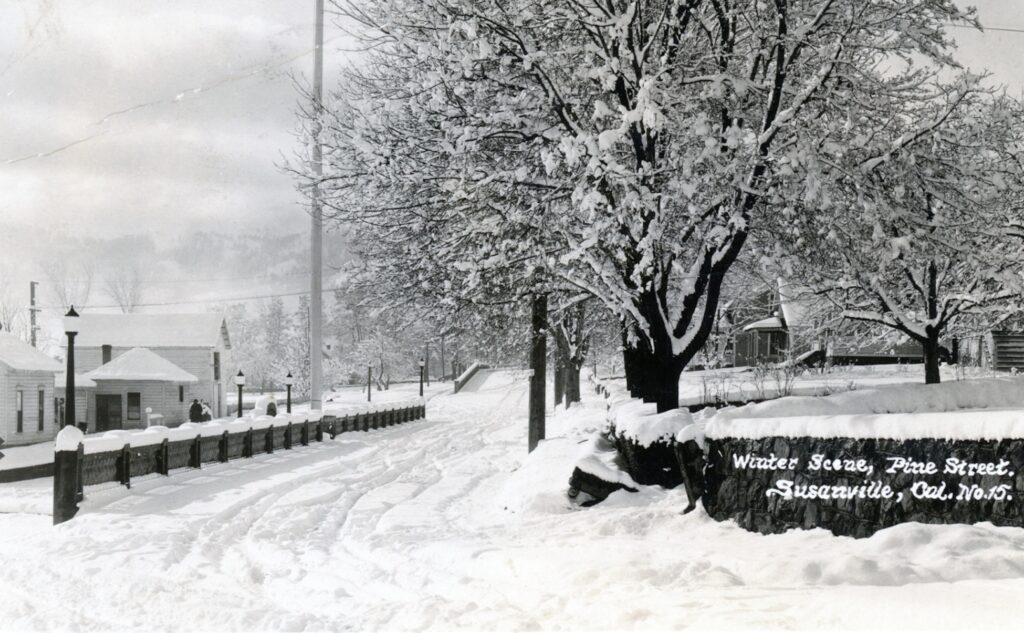
One of Susanville’s original streets, when the town was surveyed in 1863, it was the most western street. So named for the pine trees that are on the western edge of town. An odd thing about Pine Street, it initially went from Main south to the Susanville Cemetery. What is known as North Pine Street did not come into existence for a number years, and even then it only extended to North Street. For years it was known as Prattville Road, and this was route out of town, and the next town then in existence was Prattville, which the original town no longer exists as it demolished to make way for Lake Almanor in 1914.
North Pine Street, January 1916. Courtesy of Dolores Gasperoni
Beginning in 1922, the street underwent substantial changes when it intersected with Highway36 and more on that shortly.