By 1900, Standish Colony was not developing the way the founders envisioned. However, Buntingville merchant, Mike Phillips, from across the valley saw potential at Standish. He closed up shop there and moved to Standish.
Phillips first order of business was to open a store at Standish. Then he became the principal figure to organize the Standish Creamery. That was followed by building the town’s first hotel. When Phillips was at Buntingville he established a newspaper Buntingville Breezes. In 1903, he made an unsuccessful attempt to establish a newspaper at Standish.
In 1904, for reasons unknown, he sold his Standish properties. A.E. & Harriet Torrey bought the hotel. It should be noted that Harriet was Standish first postmaster. The creamery and store was sold to Susanville businessman Charles Emerson. Phillips relocated to Reno Nevada and never heard from again.
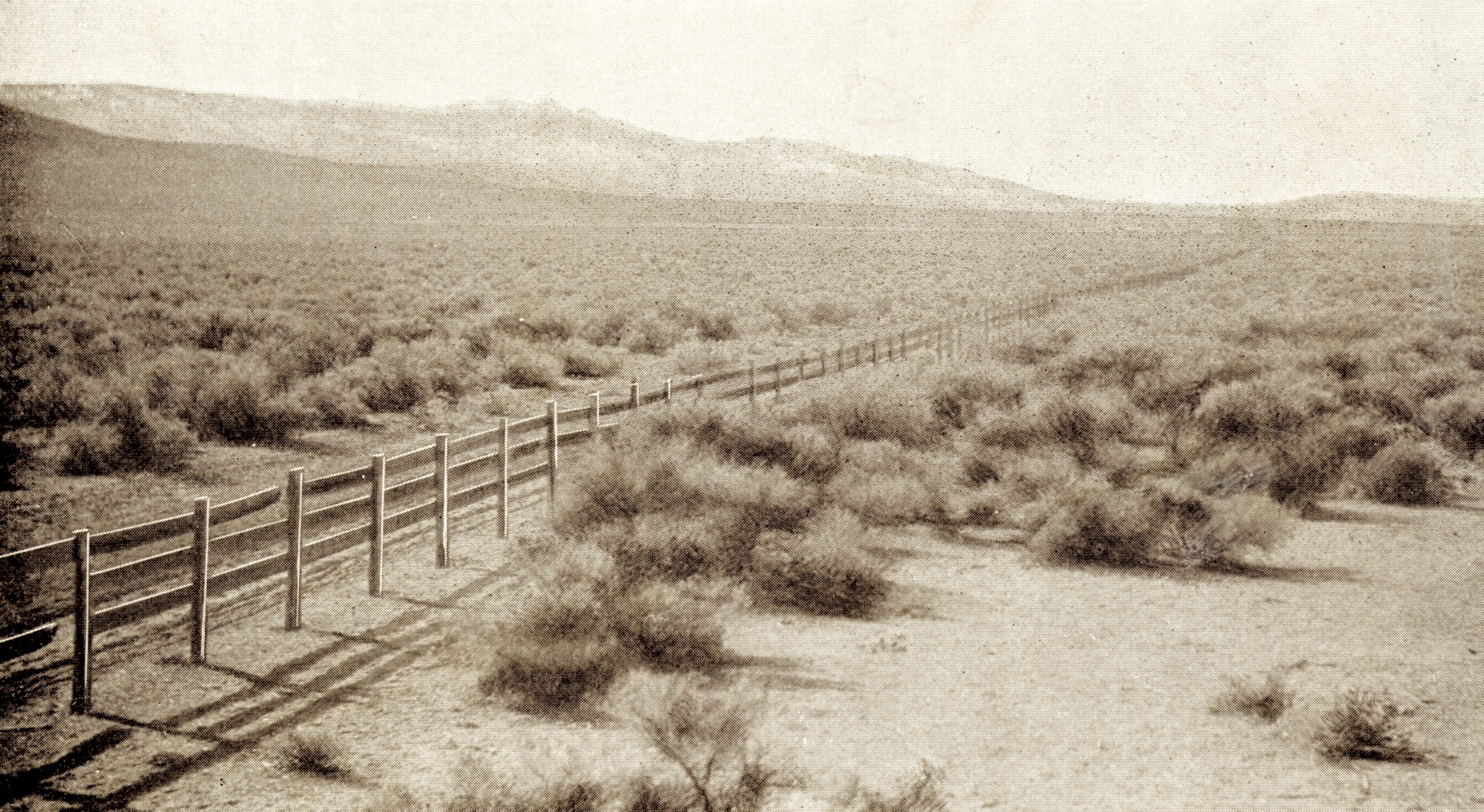
The Standish townsite prior to clearing the sagerbrush, January 1898
A lot of planning went into Standish Colony, and the selection of the townsite was no exception. Some of the initial work in late 1897, early 1898 was conducted by H.R.T. Coffin and Tom Barham. They had a vague idea where it might be located. Their task was to poll the area residents about a prohibition clause that would be included in the deeds. It was simple that no intoxicating liquors be manufactured or sold, and if a person violated the clause the property would revert back to the Associated Colonies.
It was Albert Halen, the civil engineer for the colony to make the final decision for the location. He selected a 240-acre site, where the Susanville-Datura stage line dissected through the middle of the townsite—known today as U.S. Highway 395 North. On February 5,1898 various members of the Standish Colony gathered at the future townsite. William E. Smythe, one of the founders of the Associated Colonies did the ceremonial cutting the sagebrush there.
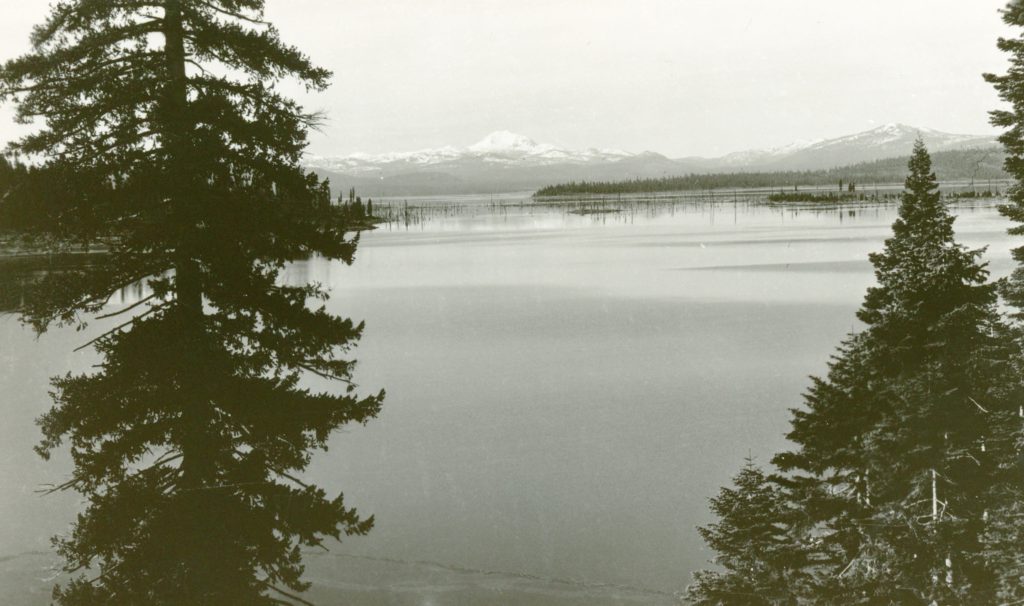
In June 1898, the Associated Colonies published a small booklet “The Standish Colony in the Highlands of California. It contained this description: “The village site of Standish is located on high ground and enjoys fine, natural drainage. The sagebrush has been cleared and the streets and parks laid out in accordance with the beautiful Plymouth plan. The Colony homes will command views of splendid mountain pictures in all directions—to the east, beyond the blue sheen of Honey Lake, the towering Hot Springs Mountains,; to the north, brown heights of Shafer’s Peak and the picturesque defile which Willow Creek flows down to the valley and lake; to the south, Diamond Mountain and its sisters clothed in dark forests crowned with snow; to the west, the higher Sierras with that great Sentinel of the north—Lassen Butte—holding eternal vigil over the Sacramento Valley, on one side, and Honey Lake Valley, on the other.”
In 1891, William E. Smythe was involved with the National Irrigation Congress, which opened doors to him. Smythe’s interest was irrigation/reclamation issues of the American West. He then formed the Associated Colonies as a venue to promote his vision. This colony movement was based a lot on the Puritanical beliefs of New England. In 1895, they founded a colony at New Plymouth, Idaho.
Smythe was intrigued with the Honey Lake Valley and its many failed irrigation projects. In 1897, he planned for a colony there to be known as Standish. He was even able to secure Edward Purser’s Susan River Irrigation System, which included the reservoirs of McCoy, Hog and Leavitt. It would be an interesting experiment that we will explore in future installments.
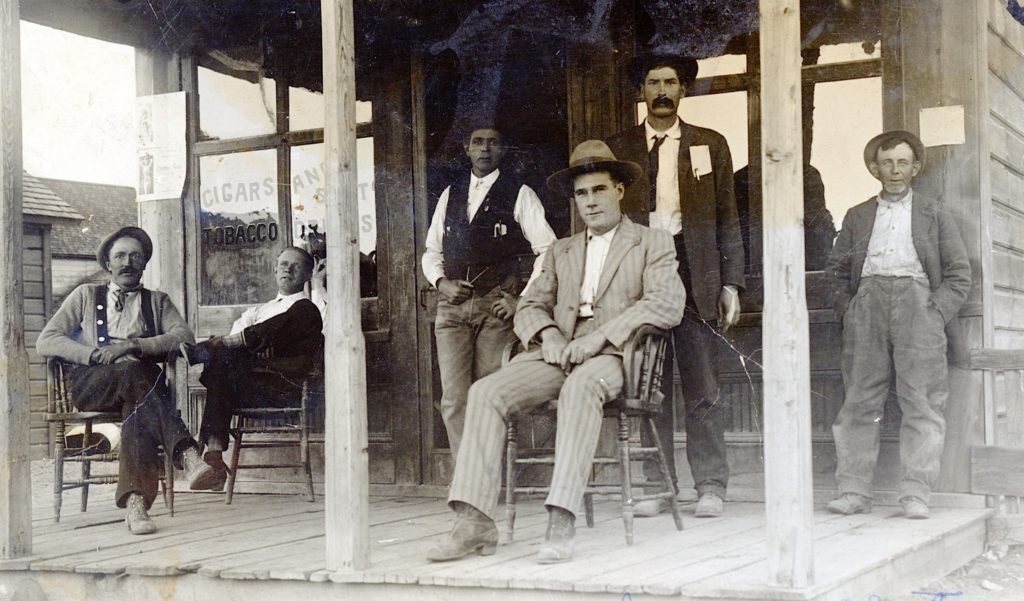
Dobyns Saloon—L-R Seated, Leslie Cottingham, Garfield Vogt, Roy Hopkins—Standing L-R Unknown, Unknown, Shorty Roe, 1907–Betty Barry Deal
During the planning stages of the Standish Colony in 1897, numerous issues were addressed. One, it would be a “dry” town and deeds would include a covenant restricting the use, sale or manufacture of intoxicating liquor. However, things changed quickly, after the initial construction of the town of Standish. The organizers of the Standish Colony were beset with numerous problems, and financially struggled. In 1901, the Standish Colony went bankrupt, a major milestone for the fledging town. No longer under tight control from the town’s founders, Standish went into a boomtown stage.
There were other changes on the horizon. A part of the old Wild West era was coming to end, in which one could randomly open a saloon. Lassen County adopted an ordinance, that to operate a saloon one had to apply for a county liquor license.
In December 1906, Susanville resident, Henry C. Dobyns submitted the necessary paper work to Lassen County for a liquor permit to operate a saloon in Standish. Among the documents included was. petition signed by 15 registered voters of Standish. At the January 2, 1907 Lassen County Board of Supervisors meeting they approved Dobyns license. By the end of the month Dobyn’s “Tipton Saloon” was opened for business in Standish.
There was a lot of resentment in the Standish community having a saloon. It was just a matter of time before things got ugly. On September 5, 1907 James Wood and N.B. Elledge filed a complaint with the county board of supervisors that Dobyns was not in compliance. They cited that not only underaged children of 18 had been served alcohol, but also allowed to loiter there. Then there was the issue of selling alcohol to Indians, who then became inebriated and causing havoc in the community. On September 21, 1907 a hearing was held with testimony from ten Standish residents about how the business was conducted in a disorderly and indecent manner. After all was said and done, the board revoke Dobyn’s license and gave him to the end of the month to close the saloon.
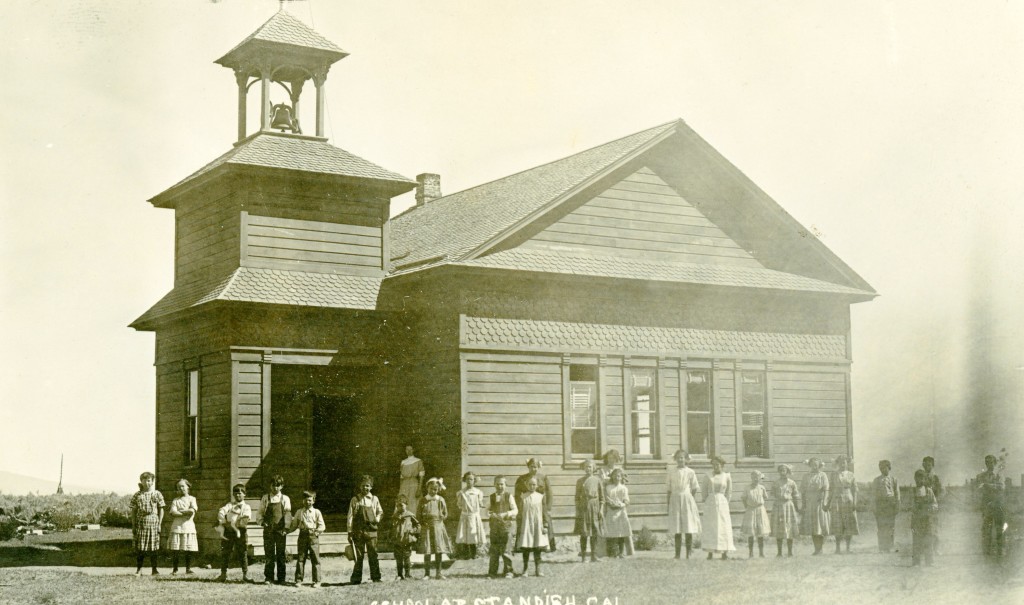
Standish School, 1911. Courtesy of Esther McClelland
Yesterday, we explored how Westwood was slow in building a church. Over the mountain at Standish it had a church early on, but did not have a school. However, there were two nearby schools—Bridgeport on Chappuis Lane and Honey Lake at the intersection of Alexander and Lambert Lanes. On December 30, 1905, eleven Standish residents, who had a combined total of 22 school age children petitioned to form a new school district from territory served by Honey Lake School. It was granted.
Standish School, to the far left, teacher Miss Esther Pierce, 1911—Esther McClelland
On Saturday, June 2, 1906 a school bond election for $1,300 was held. All ten voters approved it. That summer the Wilbur Brothers constructed the school. The brothers also built Honey Lake and Missouri Bend schools, each with a distinctive bell tower. In 1950, Honey Lake School was annexed to Standish, due to a lack of students. On July 1, 1951 the residents of Bridgeport, Soldier Bridge and Standish School Districts approved to consolidate and form the Shaffer Unified School District. The Standish School was subsequently closed and torn down in 1967.
In August of 1911, fourteen men in the Standish area gathered to form the Standish Promotion Bureau. It was a very short lived organization. Their one and only goal was to convince the Southern Pacific officials to have their Fernely & Lassen Branch line be built through Standish. This was an uphill battle since the railroad line had already been surveyed to the north of Standish. The bureau had a slate of officers towit: E.F. Koken, President; B.F. Gibson, Vice President; E.H. Doyle, Treasurer and J.H. Elledge, Treasurer.
Things did not go well and in the spring of 1912, things unraveled. Instead of convincing railroad officials to change their mind, Gibson suggested to the bureau that they should move Standish to his ranch where the rail line would be built. Needless to say it was not a pleasant meeting. Gibson resigned. Add insult to injury, when word emerged that Gibson was working with Los Angeles promoter, B.E. Jackson on a proposed townsite on the Gibson property, when the bureau organized. There was no reason to continue with their mission, the bureau disbanded.
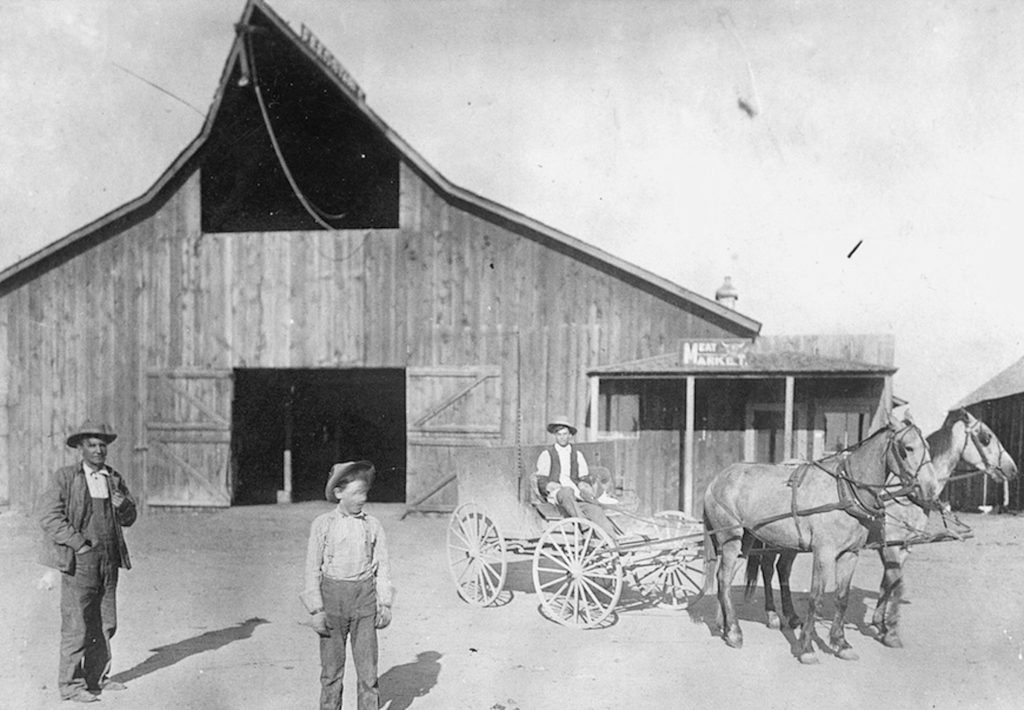
Standish Livery Stable and Meat Market, 1909. Left to Right: Todd Hemler, Bill Kennedy and Fred Hansen. Courtesy of Vivian Hansen.
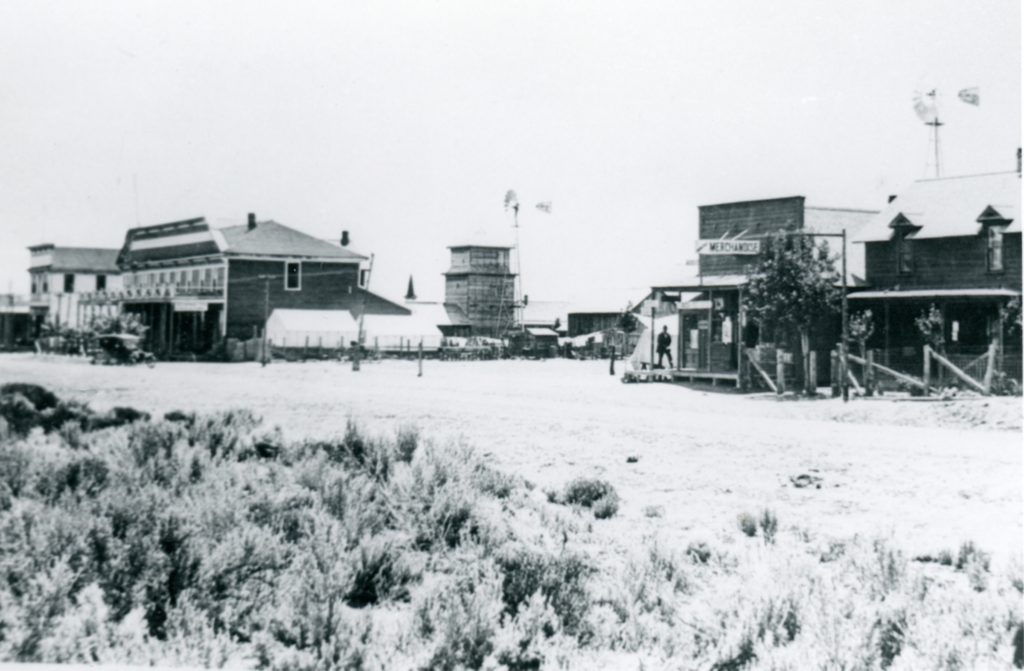
In 1904, George Short (brother-in-law to James Mapes) established the Standish Livery Stable on Milford Street (A-3). In 1906, he built an addition which became the home of the Standish Meat Market. Both the livery stable and meat market were leased to various individuals such as Fred Hansen, Todd Hemler and Floyd Bass. In 1912, Fred Hansen moved the meat market to a new location. In 1913, Louis A. Kline purchased the livery stable. Kline at the same time leased the Wrede Hotel located to the north of the stable.
On November 18, 1913 the Standish Livery Stable was destroyed by fire, and for a time threatened the entire town. The fire started in the harness shop, the former site of the meat market. It was later learned the harness maker, went on a drunken spree, returned to the shop knocked over an oil stove, and passed out. When the building was engulfed in flames, it was discovered the nameless harness maker was inside and volunteers dragged him out.
Most of the contents of the livery stable was saved except for forty tons to hay. The harness shop and its contents was a total loss. Kline only had partial insurance on the building in the amount of $400 and did not rebuild.
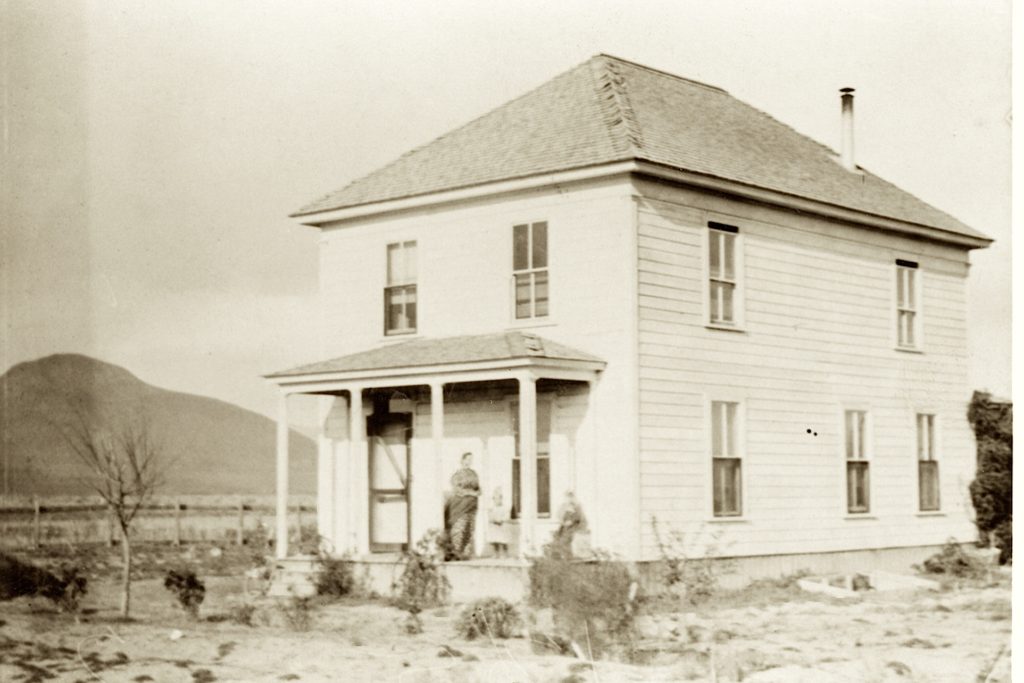
Architecture is one of my many interests. Personally, much of today’s building designs are rather bland, whether commercial or residential. Today, we examine the Mattison house, which originally was not a stand out.
In 1879, Otto Ranker came to Susanville from Oroville to operate a blacksmith shop. In 1884, he located what was referred to as four corners, about two miles east of present day Standish. Like many homesteaders before and after him, he first lived in a small three room cabin. As needed, another room would be added, and so forth. In the early 1890s, he had a second story built that consisted of four bedrooms. In 1900, he moved to Chico for health reasons, but rented his ranch..
Mattison House, near Standish
In 1906, Ranker sold the property to Fred Mattison. Shortly afterwards Mattison had the house remodeled. Mattison died in 1926, but his wife’s family continued to occupy the property. In the early 1950s, during a cold winter the pipes froze. Hal Story crawled underneath the house with a blow torch to thaw the pipes. Instead, of thawing the pipes, he caught the house on fire and the residence destroyed.
Tuesday’s are a wild card day, some times there is a post and some times not. For newer readers, when I started this site back in 2015, I did a daily post seven days a week. After five years, I scaled back to six days. However, I wanted to make sure something went on this Tuesday, to monitor the issue with the host sever.
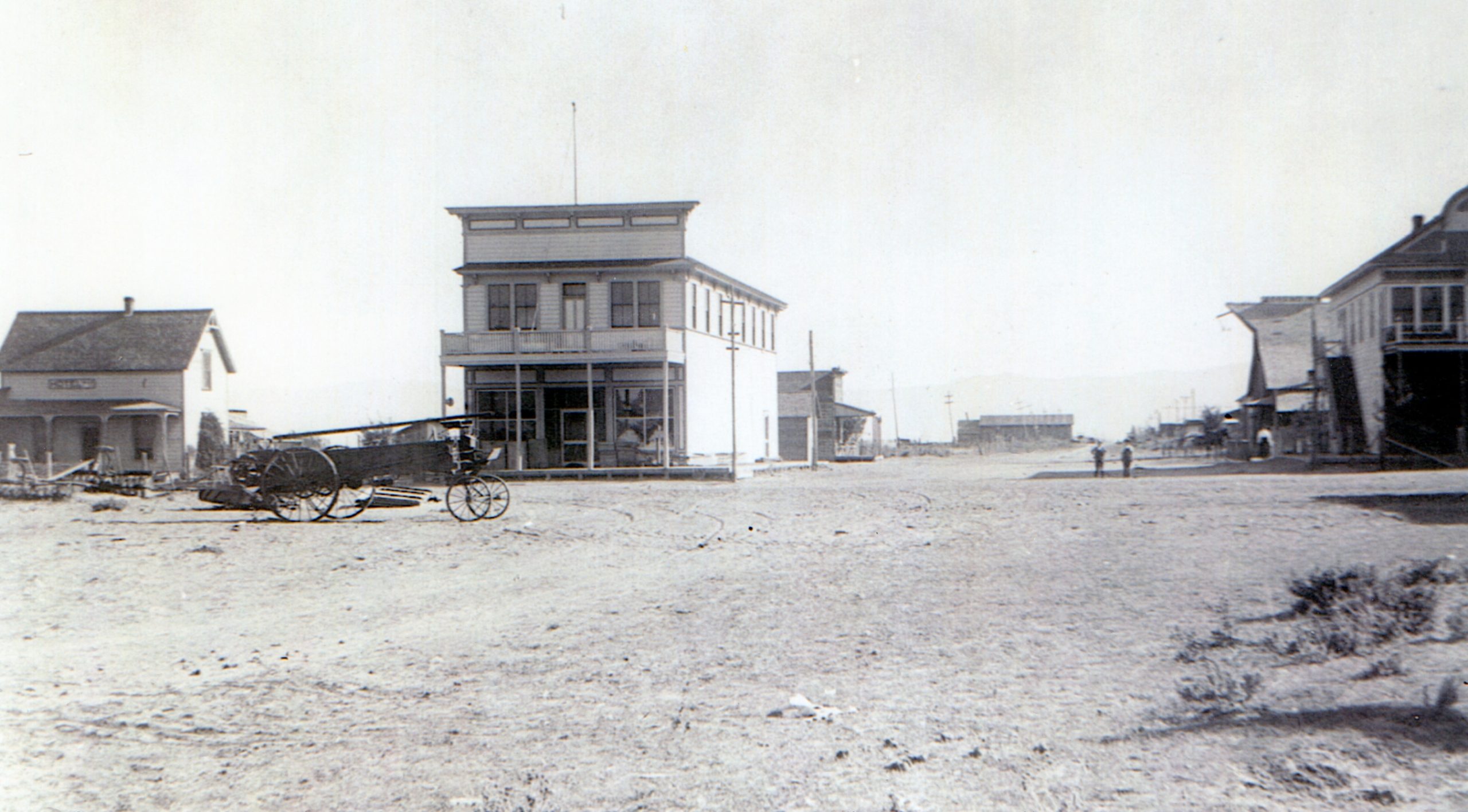
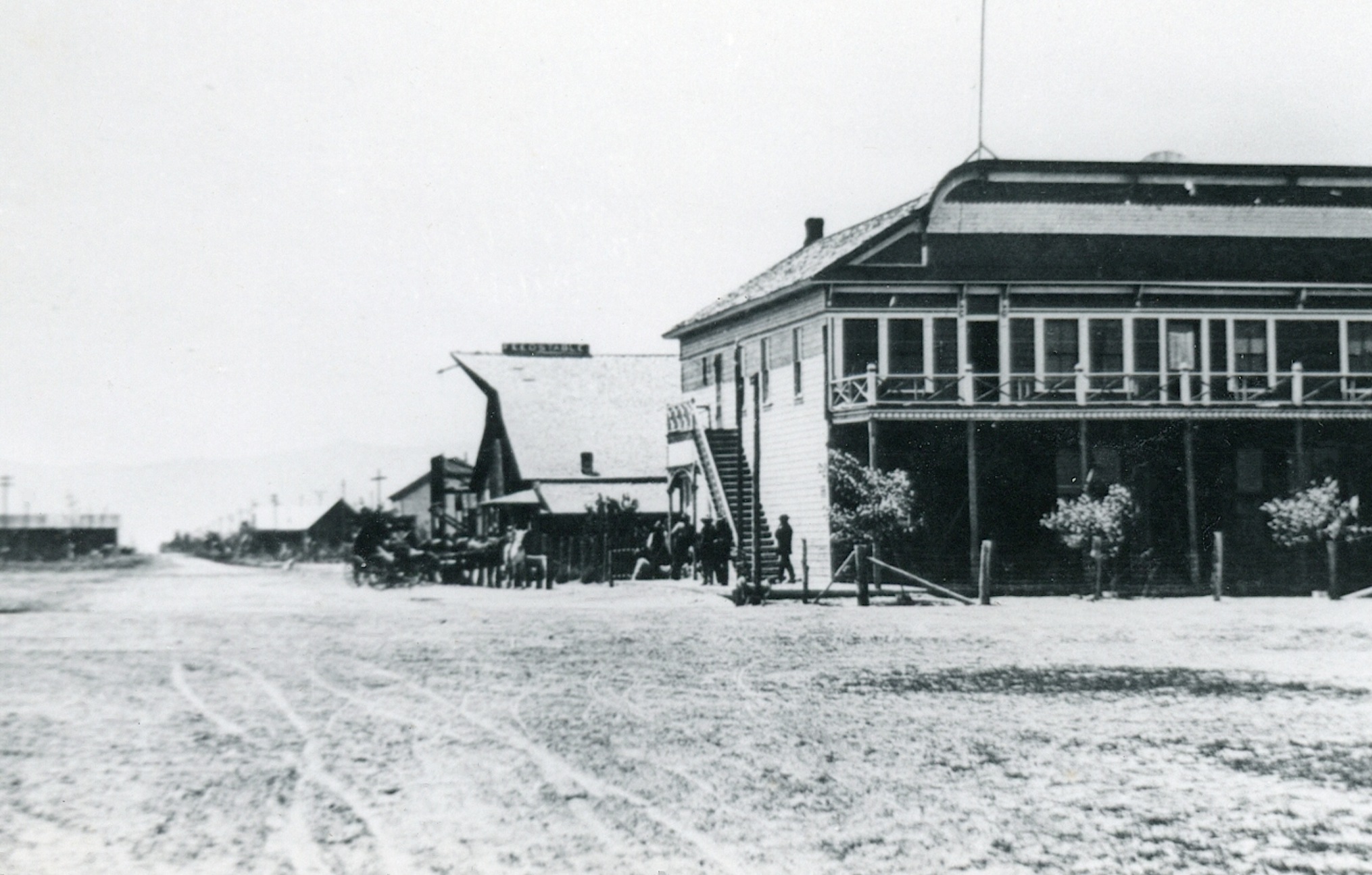
The above photograph is Milford Street, Standish looking west, known today at the Standish-Buntingville Road or County Road A-3. The building to the right was the Wrede Hotel. It is now replaced with gas pumps at the Wayside.
Note: This originally appeared on January 8, 2018, so it might be familiar to some. For some odd reason in August 2021 it garnered a lot of attention from first an internet search and then spread on social media. While seasoned subscribers may recall it, there are new ones who may find it of interest.
From time to time discussions have been held whether the cloud seeding in the Lake Almanor Basin area by Pacific Gas & Electric Company affects the areas to the east. In 1979, Lassen County officials thought the cloud seeding was part of the drought problem in southern Lassen County. In October 1979, Henry LaPlante of PG&E stated that the company has been treating selected storm systems for more than 25 years. He said the intent of the seeding was to increase the high elevation snowpack. Furthermore, LaPlante wrote, “There is no scientific evidence which indicates that cloud seeding activities in our Almanor area reduces the amount of precipitation in any other area.”