In 1911 the Fall River Valley High School was formed in eastern Shasta County. However, that school’s boundary extended into Lassen County, most notably the Pittville section. Prior to the Fall River school that area was in the jurisdiction of the Lassen County High School. Lassen County erroneously taxed those that served by the newly formed school. In 1912, Lassen County Auditor George Bailey addressed the Lassen County Board of Supervisors of the issue. He asked the board for permission to send out tax rebate checks to those affected-some 86 individuals. The total amount came to $483.01. The smallest amount was fourteen cents to Charlie Young and the largest was $112.00 to Thomas B. Walker.
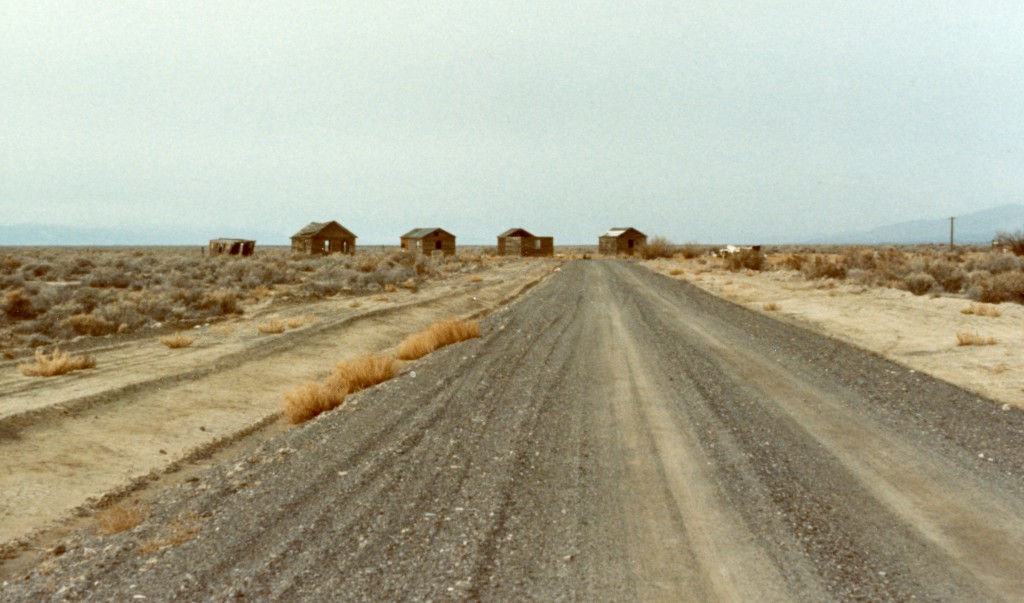
Established in 1887, it was originally located at the Bonham Ranch in the Smoke Creek Desert. The school closed in 1919 for lack of students.
Flanigan, 1976, courtesy of Christopher Moody
In 1929, it was resurrected at Flanigan in the Honey Lake Valley. It closed on June 20, 1969 and at that time it was the only remaining one-room school in Washoe County. Standish resident Ed Bass purchased the school and moved it to his property.
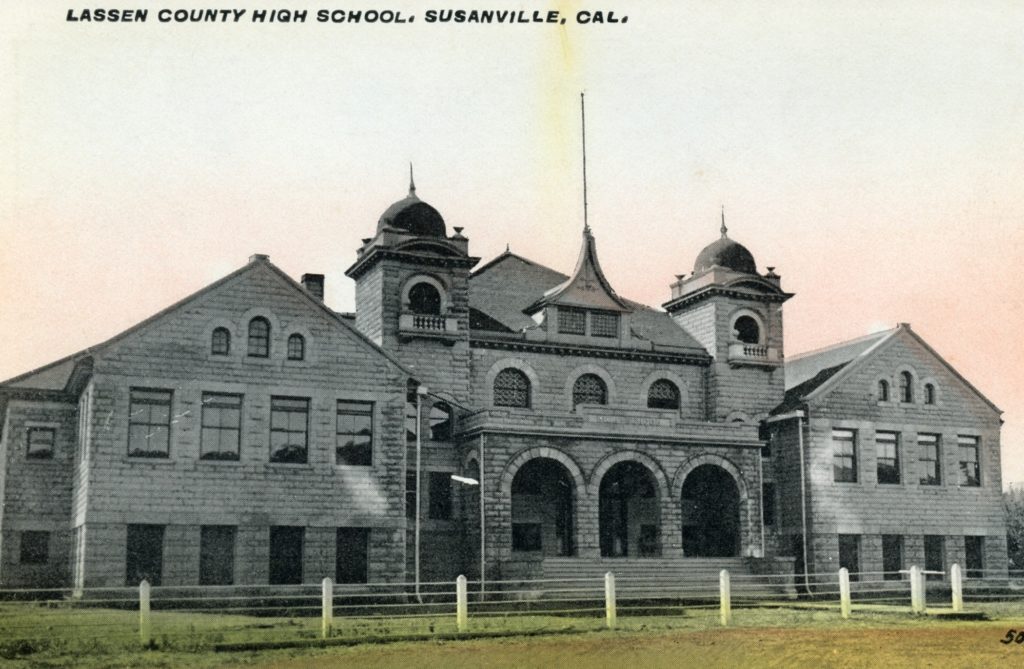
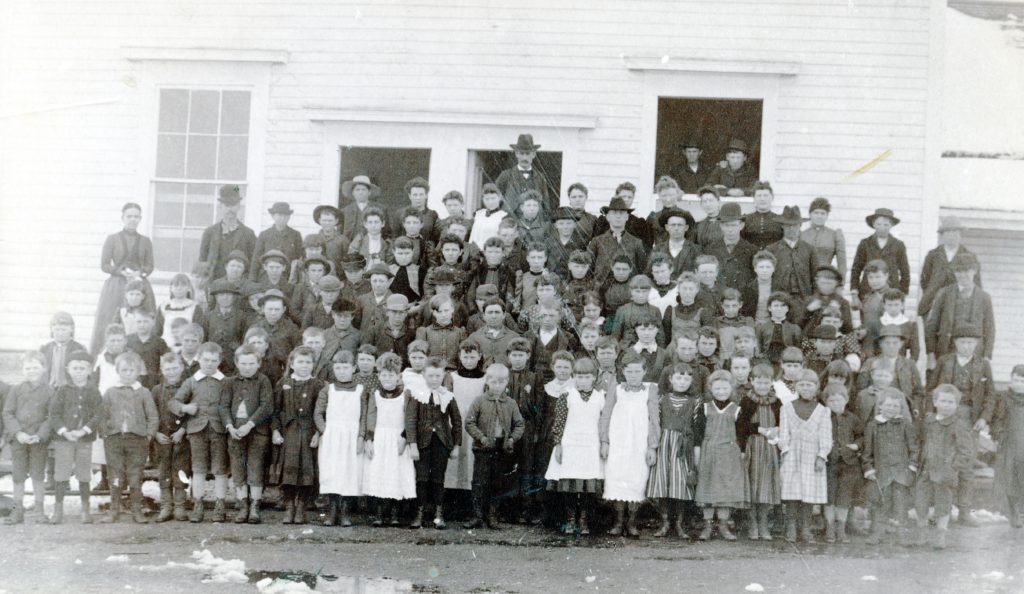
The Susanville Grammar School, early 1890s. Courtesy of Juen Chappuis.
The Susanville School District, technically is the oldest, since it was established in 1863, before Lassen County was created in 1864. The first school was located on Cottage Street, and the site it still used for educational purposes. However, I have heard that the property might be for sale in the not so distant future.
In 1873, a new school house was built to replace the existing one. Time and an increased of school age population had taken its toll on the structure. Eight years later an addition was made.
By early 1899, the Susanville School District agreed to go the voters for a bond measure to replace the current school building. Some stated the building was an actual disgrace to the community. Another opinion voiced “It was poorly constructed, old, dingy and dilapidated, there is no longer any possible justification for its continued use. On June 2, 1899, the voters of approved the $12,500 bond measure to build a new two-story brick schoolhouse by a vote of 84 to 19.
The Susanville Grammar School, nee Washington, as it appeared in 1948.
One would think with the bonds past, it would be all systems to go. The State required that the school district to hold a special meeting as to a future school site. Several meetings were held. When the trustees next meeting it was to be vote on, but there was no quorum. It was not until late December when the issue was settled. It was decided to build on the current site. The school grounds would have to be enlarged and the trustees voted to purchase the adjoining vacat lot. In March 1900, that the contract to build the new school was awarded to Reno contractor, C.E. Clough. In 1948, that building was condemned
Hayden Hill School, 1894. Courtesy of Del & Diane Poole
Providing service’s to Lassen County’s largest mining community had its challenges. There were, of course, the boom and bust cycles, so its population was always in state of fluctuation. Due to its elevation and harsh winter conditions, many residents sought refuge elsewhere in the winter months.
Hayden Hill School, 1918. B. Dorsey Collection
Those factors influenced educational opportunities at Hayden Hill. In 1872, Perry Edris opened a private school on the Hill. It was not until 1878 that the public school was created. The school opened in the fall of 1878, with Ida Spalding as the teacher of fifteen students. The school remained in operation until 1925, when it closed for lack of students.
On June 1, 1931, the Board of Supervisors offered the schoolhouse for sale. Fred Bunselmeier and Lloyd Walsh purchased the two-story building for approximately $125.
The July, Ask Tim post only generated two inquiries. May be it is so-called dog days of summer. Here is the first question and I am working on the next, stay tuned.
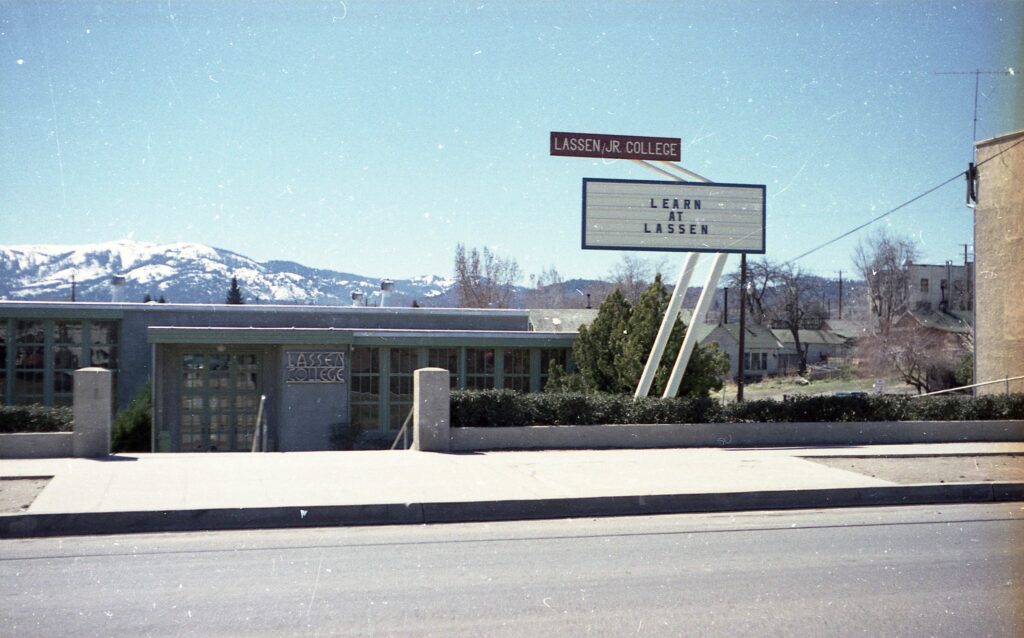
Lassen College Graduation Photographs. Were there any pictures taken of the last Jr, college graduation in the quonset-hut on the Lassen High School property?
It has been my experience that historical documents and photographs of Lassen College’ are rarer than the proverbial “hen’s teeth.” It should be noted that I served on the Lassen College board from 2011-2020. Towards the end of my tenure, it was relayed to me by college personnel that there was secret cache of old college annuals and photographs that had been discovered. I was not privileged to examine those records. In May of this year marked the 100th anniversary of the college’s founding, but the administration ignored this historic milestone. If anything surfaces, I will let everyone know.
It is only fitting to the end series on Lassen College’s history during its centennial that to acknowledge Glenn Wemple’s contribution to that institution For those not familiar Glenn served on Lassen College board from 1957 to 1987. It should be noted when he was first elected he was as trustee of Lassen Union High School, that oversaw Lassen Junior College. In 1965 the college separated from the high school, and Glenn was one of transition that he became a college trustee.
In 2012, Wingspan Press published Glenn’ memoirs IRemember Lassen College. It is a candid account how Lassen College came to be. Unfortunately, I am not sure of its availability. Margie’s Book Nook in Susanville kept in stock, so one might inquire with the store as to the status.
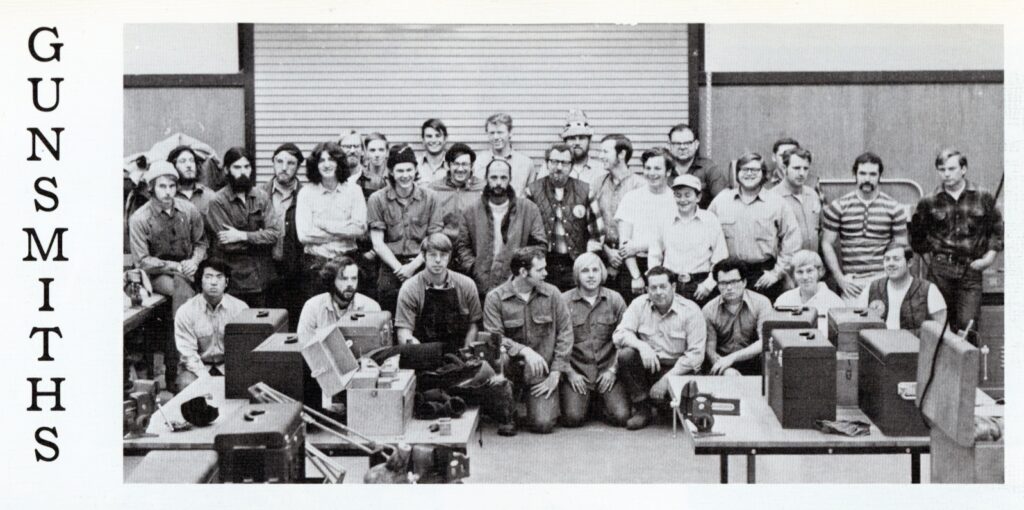
Lassen College Yearbook, 1973-Courtesy of Jim Chapman
Lassen Community College’s Gunsmithing Program is the oldest program of its kind in the nation.
The following is from the Lassen Advocate of 5 September 1946 providing a glimpse of the humble origins of the program.
“The only gunsmithing course being offered in a college or trade school in the United States is being given this year at Lassen Junior College.
“While the market for fine guns has multiplied in this country, old time master gunsmiths have declined in numbers, Charles W. Frost, gunsmithing instructor, explained. Improved roads into wilderness areas, shortened work weeks, longer vacations and wider familiarity with firearms from service in the armed forces were reasons given by Frost for increasing opportunities for skilled gunsmiths.
“The genial middle aged German, Swiss or Belgian gunsmiths so familiar to sportsmen of almost every fair-sized town a generation ago have, for the most part, passed on,” Frost pointed out. These old gunsmiths, who had become master crafstmen through a seven-year apprenticeship n Europe guarded the secrets of their craft so closely that not more than a handful of young men of their day learned it from them.
“Frost was one of these fortunate few learning to be a master craftsman under Fred Muhl, an old-school gunsmith in Bloomington, Ill. For 15 years before coming to Susanville a year ago, he operated his own gunsmithing shop in Arcadia and Eureka on the coast. He also taught musketry at Humboldt State Teachers College.
“This is not a tinker’s course,” Frost said, “It’s not just to teach repair of second hand guns.” The two-year course, with a third year optional, will prepare graduates to build fine rifles.
“For example, Model 6 Winchester rifles, selling for about $45, will bring from $200 to $400 when thoroughly rebuilt by a master gunsmith, according to Frost. He said such fine guns don’t attempt to compete with production-line factory models, which is another reason for only students with serious craftsmen ambitions to sign up for the course.
“Today there are probably less than a score of master gunsmiths west of Salt Lake City. “All of this seems to indicate,” he said, “that there is an assured future for any young man with the intelligence and determination to complete the course outlined.”
“Harland Fritts of Susanville is beginning his second year of gunsmithing at Lassen Junior College. He admitted it was a tough course. “It’s a wide open field,” he said. “And I like the work.”
Three other students have signed up to start the course this year.
“The two-year college course covers all phases of gunsmithing but barrel making and custom stock making, with correlated academic background courses about half time in mathematics, science and English. The additional year of graduate work includes barrel making, stock making, engraving and metallurgy.
“Trade courses in gunsmithing curriculum are mechanical drawing, precision woodwork, including pattern making; machine shop; soldering, brazing and welding; firearms’ history, design and construction; ammunition, including catrridge-case and bullet design, ballistics; sights, iron and optical fitting, chambering, turning, straightening and finishing of barrels.
“Academic background courses include geometry, physics, chemistry, English, accounting, typing and free-hand drawing.”
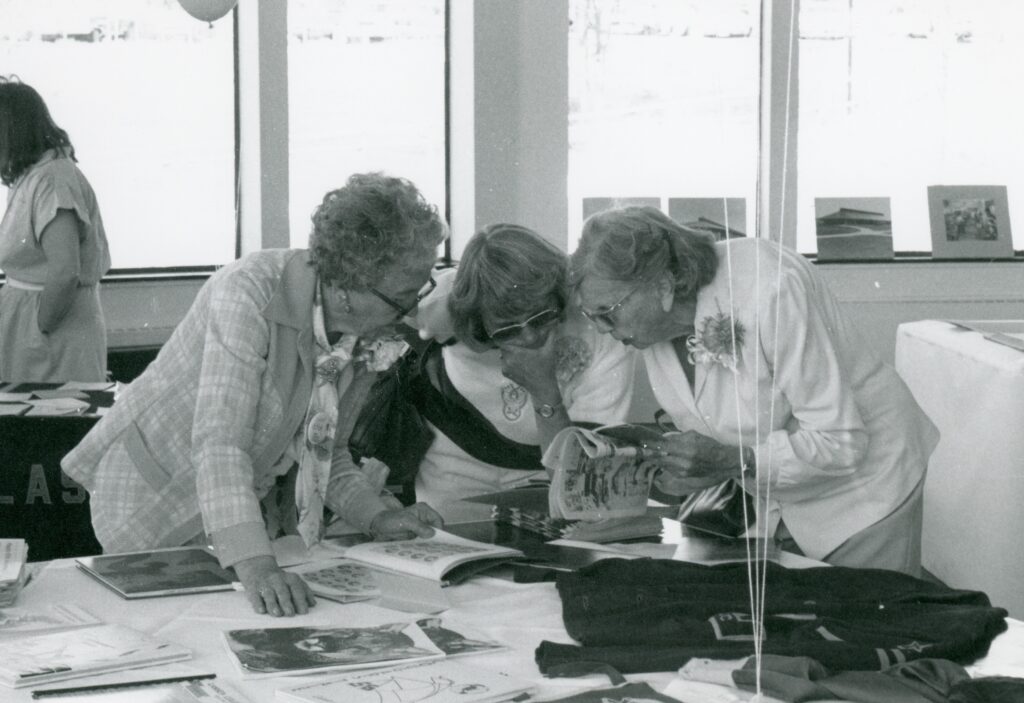
Lef to Right: Olive Murrer, Sally Finefrock and Hilda Bennett at the Lassen College 70th anniversary.. Thank you Linda Kennedy
While Lassen College has been celebrating its centennial this month, this evening will mark its 98th commencent. The college’s centennial gradation and its commencement will occur in 2027. Of note, my Aunt Olive Farwell Murrer was a member of the College Class of 1927. Her sister, Hilda Farwell Bennett a member of the College Class of 1928.
On a personal note, I served on the Lassen College Board Trustees for ten years. Graduation was a special and joyful occasion. As trustee its a wonderful moment, not just to the student’s hard work paying off, but as trustee with the hard work behind scenes made its extremely worthwhile.
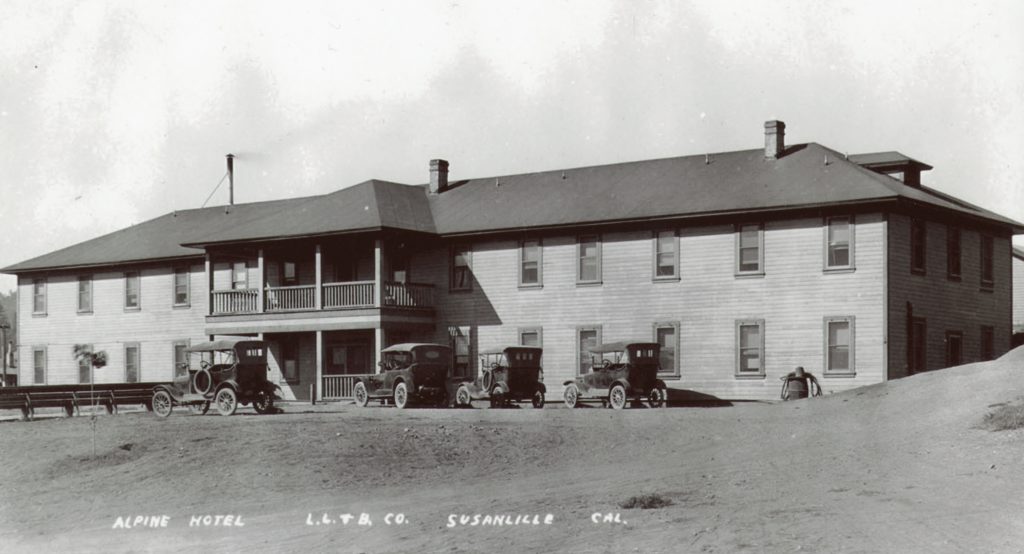
Alpine Hotel was a dormitory for the employees of the Lassen Lumber & Box Company and later served as a dormitory for Lassen College’s early forestry students.
Once upon a time, Lassen College had a very popular forestry program. This was back in the day, with three large lumber mills in Susanville, another one in Westwood, along with the Lassen National Forest provided a lot of job opportunities. It was because of these factors that there was need for some vocational training in this field, and especially for the community. Continue reading Lassen College’s Forestry Program→
In 1910, A.J. Matthews arrived in Susanville as part of a small group of men to form a local telephone company. They would be successful. In 1915, Mathews married native daughter Lena Cahlan and would be life-long resident of Susanville. Mathews was a firm believer in civic engagement. He was involved in so many different activities on the local and state level.
Mathews also served on the Lassen Union High School/Lassen Junior College Board—the two were intertwined until the college separated in 1965.
In January 1935, Mathews addressed the Susanville Rotary Club concerning the schools reorganization plans, specifically that of the college. Mathews stated, “We should capitalize on the fact we have the only junior college in northern California north of Chico.”
Later in 1935, the college board of trustees, met with Mr. J.C. Beswick from the State Department of Education, in charge of Trade and Industrial Education. It was met with enthusiasm by all parties, including the lumber mills and related fields. On September 19, 1935, a Technical Institute course in forestry at Lassen College was offered, with Gale M. Whitchurch in charge. Initially, enrollments fluctuated between 12 and 23. It was a major turning point in the college’s history that attracted students from around the state to attend Lassen and of a necessity for the college to thrive would have to offer courses to attract students from out of the region.