Tag Archives: Red River Lumber Company

Westwood Junction

Westwood Junction

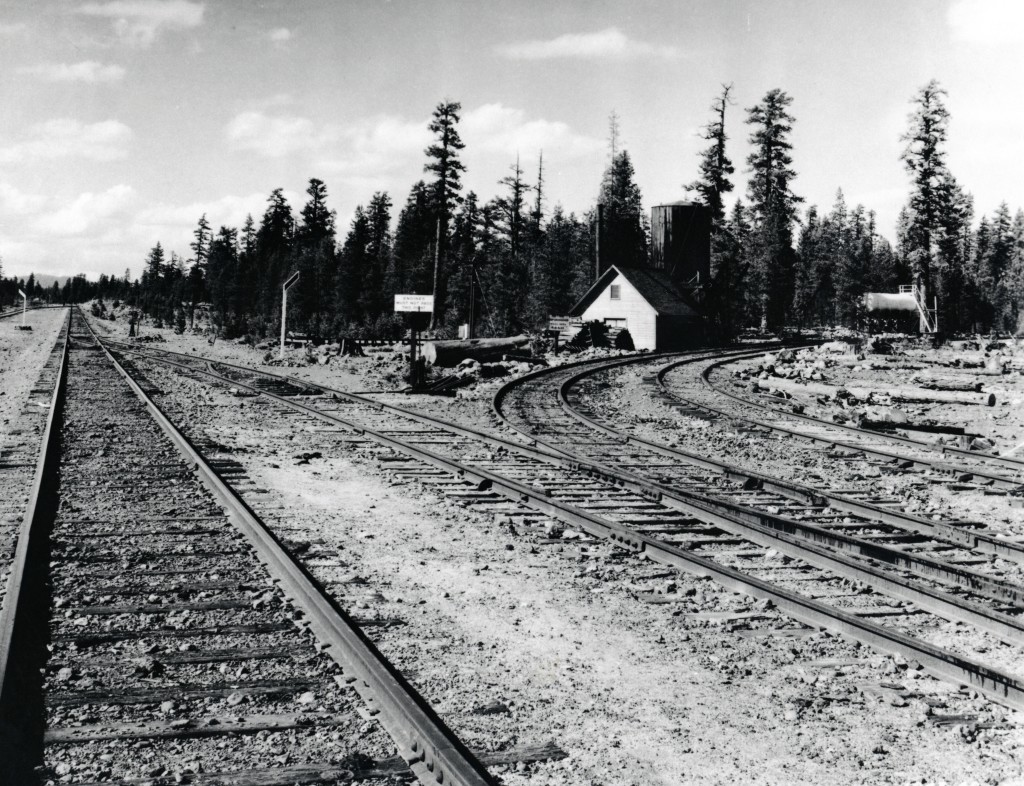
Westwood Junction was that of the Fernley & Lassen branch of the Southern Pacific, built by an agreement with the Red River Lumber Company.  At this point the railroad constructed a spur line to the south of the newly created town of Westwood. The Southern Pacific’s  goal was to extend the line north to Klamath Falls, Oregon. It was after all, the Red River Lumber Company’s intent to build several mills, the next one scheduled for near Lookout. By 1917, the Southern Pacific was anxious to extend the line north, but Red River was not ready. The mammoth mill at Westwood was more than it could handle. In the meantime, the Southern Pacific was nervous that its competitor the Western Pacific might extend a branch to Westwood and siphon off traffic, since Southern Pacific’s five-year agreement with Red River which the railroad had all inclusive freight deal was about to expire.

Then came along World War I and that changed everyone’s plan. When the war ended, the nation went into a severe recession, so expansion was off the table for many. . In the meantime, the Southern Pacific focused on the troubled Nevada-California-Oregon Railroad, as an alternative route north to Oregon, which it eventually did.

This site, it should be noted,  also served as a junction for the railroad logging operations of the Fruit Growers Supply Company and the Lassen Lumber & Box Company.

It is never too late, subscribe.

Westwood’s Deportation Continued

Westwood, 1931

Lassen  County wanted to oblige, but it had no funds. They deferred to take any action and turned the matter over to the federal immigration officials. J.C. Borden of the Immigration Bureau was brought in to investigate the situation. What he found on his arrival was that of the forty-five applicants only a handful were eligible to receive aid to pay for their return to Mexico. Yet, the issue was also moot, as Borden noted, because all the Mexicans had gone back to work. He informed the Board, should the issue arise again, that under a federal ruling any alien who had been in the United States for three years and becomes indigent can be returned to his native land with the cost borne by the federal government. Continue reading Westwood’s Deportation Continued

Westwood’s Deportation of Immmigrants

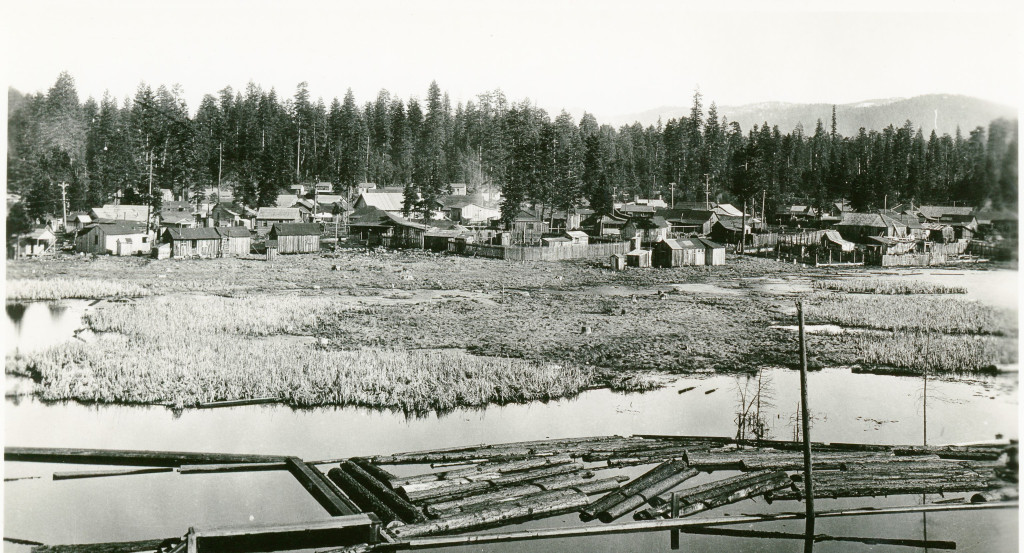
Westwood’s Old Town, home of many of its immigrant workforce. Courtesy of Hank Martinez

One of the more unusual annals in Red River’s history was deportation. Red River hired a large percentage of foreigners whether it be Scandinavians, Italians or Mexicans. By 1929, with the downturn in the lumber market, the company was forced to layoff some of its workers. If they thought that the layoff was temporary, they allowed the affected worker to remain. By 1930, however, Red River sought alternatives, as they could no longer bear the financial burden. Continue reading Westwood’s Deportation of Immmigrants

Westwood Saw Dust Pile

sawdust 1 purdy

In the mid-1920s, Red River had two hydro-plants in operation to generate power. This abundant power supply created an unusual man-made landmark. Red River was able to conserve its sawdust/wood waste pile, which took on a life of its own as it started looking like a small mountain. This created a nice reserve of free fuel that was readily available at any time should there by interruptions from the hydro-plants. To comprehend just how large it was, a Ripley’s “Believe it or Not” column once designated it as the world’s largest waste pile. In 1941 it lost its status to Portland General Electric Company who reported having a 130-foot high pile of sawdust.

Anything of this magnitude created its own hazards. One of the first lessons learned was how to prevent it from spontaneous combustion. A conveyer belt, along with a steam shovel and caterpillar tractor were employed to constantly work on the sawdust pile—whether adding to it or feeding the conveyer belt to the power house. It was not unusual for a worker to get trapped in a sawdust pocket where one could easily die from suffocation. While no fatalities of this nature occurred, there was one death attributed to the sawdust pile. On the morning of January 20, 1925 Alexander Kollinkoff was killed when he was struck by a large piece of frozen sawdust while operating a steam shovel.

Red River also explored other ways to utilize this enormous wood waste pile. When the mill operated at full capacity it produced 400 hundred tons of sawdust and wood chips in a twenty-four period, over half of which was used to fuel the boilers in the powerhouse. In February 1927 Red River installed an interesting piece of machinery, one that manufactured the modern day version of briquettes. This impressive device was capable of compressing a ton of wood waste into briquettes every hour. About a third of the wood waste which it compressed into briquettes could be used for home use, camping or even at the plant itself.

Felion Sawdust

The Paul Bunyan Trademark

Packaging tape with the Paul Bunyan trademark.
Packaging tape with the Paul Bunyan trademark.Courtesy of John Webb

In the logging camps in Canada and Northeastern United States as folklore would have it, tales of the mythical Paul Bunyan was born. Stories were passed around in the camps, no written account.

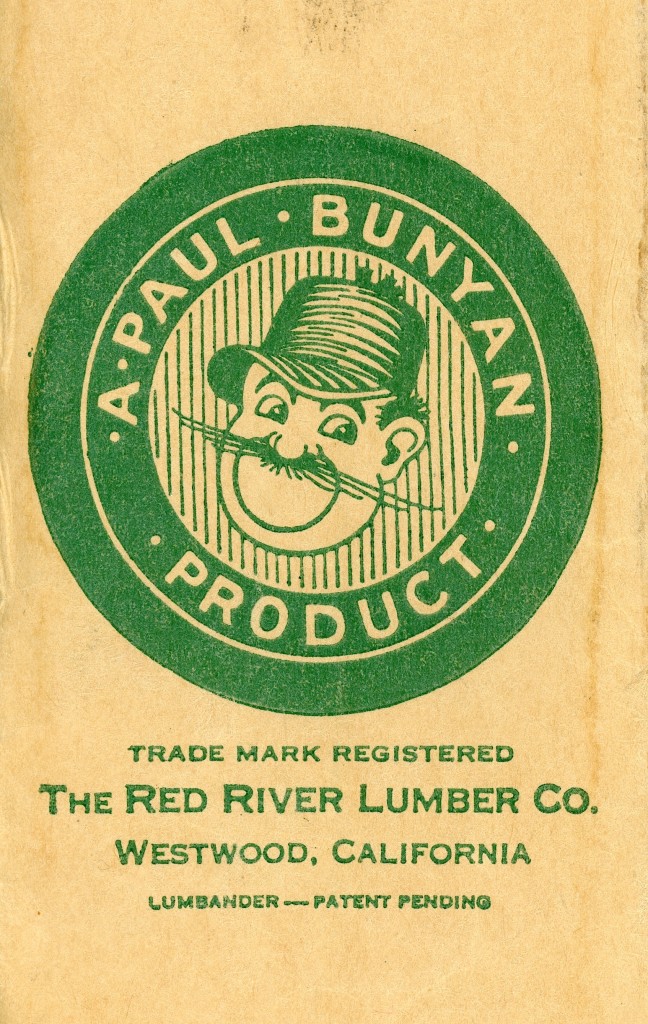
In 1900, W. B. “Bill” Laughead, a cousin to T.B. Walker, went to work in Red River Lumber Company’s logging camps at Akeley, Minnesota.  There he undertook many jobs starting as a camp chore-cook and ending as a construction engineer. After eight years of working in the woods, he decided to move to Minneapolis working odd jobs and experimented with free-lance advertising work. It was at this time, Laughead drew the first known character drawing of Paul Bunyan, in part of an advertising campaign for Red River’s new California operation.   Laughead created the company logo, of a circular design, with his Paul Bunyan’s face, accompanied on the outside with the words Paul Bunyan’s Pine and it became Red River’s registered trademark. The logo was placed on many products and even on its logging trucks. For a short time, Red River even bottled their own soda beverage, with the embossed bottles displaying the trademark. When the company expanded into other operations, they changed it to a Paul Bunyan Product.

In the 1940s, during the dissolution process of Red River, Kenneth Walker continued in the lumber business. In doing so, the trademark was transferred to him, since his own enterprise was the Paul Bunyan Lumber Company.

Never miss a story, click here.

Pat O’Dea—The Kangaroo Kicker

Pat O’Dea, Courtesy of the University of Wisconsin

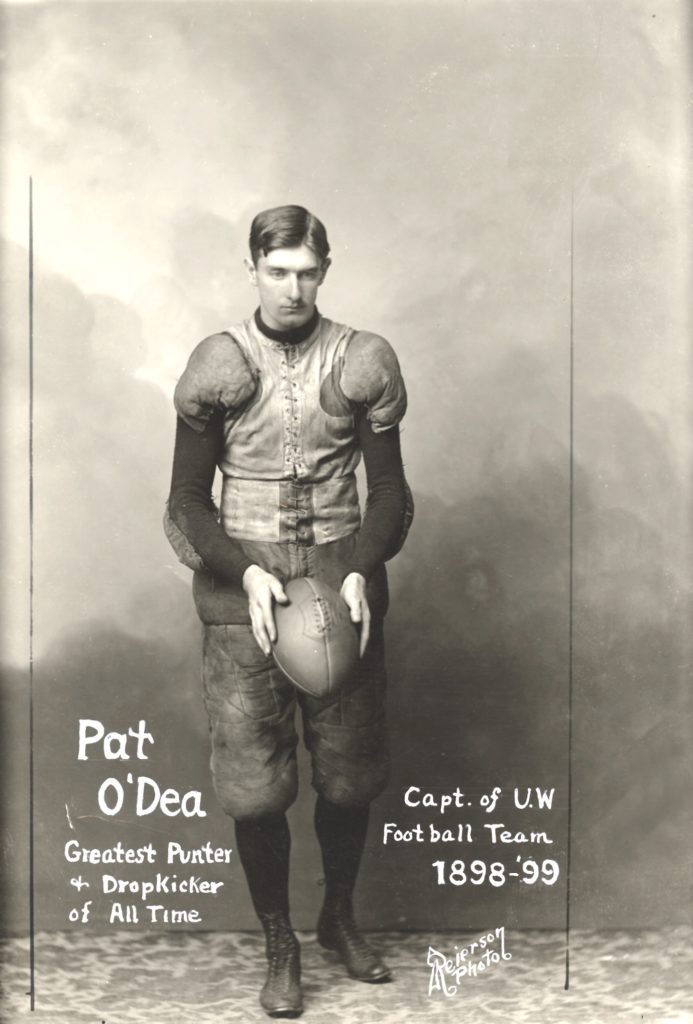
In 1919, Charles J. Mitchell arrived in Westwood like so many before and after him seeking employment. The Red River Lumber Company had high turnover in its workforce and always had openings. Little did Red River know their new hire was a famous football player. Then again, Mitchell used an alias. After all this was in an era, where few people carried any type of identification, and Social Security numbers were non-existent. Continue reading Pat O’Dea—The Kangaroo Kicker

The American Plan

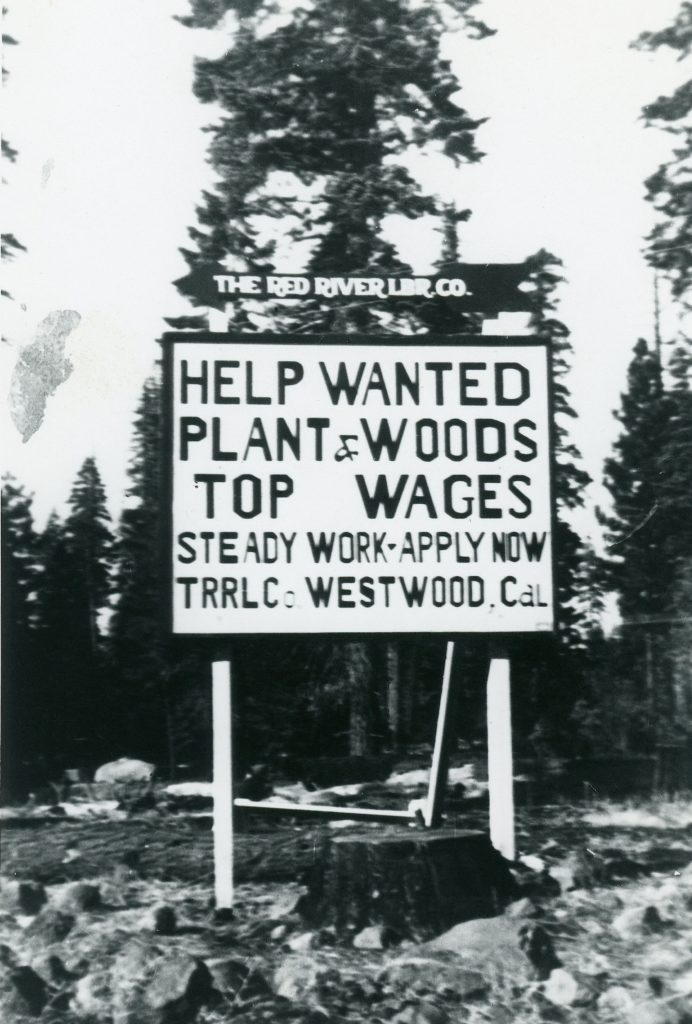
Red River Lumber Company had a large employee turnover.

The labor movement received a big boost during World War I. However, unions lost some momentum after the war as nation went into a recession. Industry on the other hand came up with strategies to counter act the union movement. One of these was the American Plan. The plan had its origins from the labor turmoil of World War I and was first adopted in November 1919 by the metal trades. In time, the Industrial Relation Association of California got behind the movement. It recognized that the model had to be flexible, since there were many variables between industries.

The plan deemed unions a nuisance—a barrier between the employer and the employee. In the simplest of terms, both the employer and employee had to maintain certain obligations. For the employer, one of the critical factors was to design its business wherein the employee was guaranteed steady employment.

In 1921, the Red River Lumber Company adopted the American Plan as a way to stave off the union movement. Actually, during the 1920s Red River’s labor issues were nominal. By the end of the decade, things changed. It was not just from Red River’s own financial turmoil, but the lumber market was headed in a downward
spiral, even before the stock market crash of 1929. Like many lumber operations, Red River was forced to curtail operations.  On July 28, 1930, Red River reduced wages by 15% and adopted a five-day week, with an eight hour working day. Red River did make a concession for its employees. It reduced the rents in Westwood accordingly and board at logging camps was reduced to $1.25 a day.

The American Plan at Red River was put to the ultimate test, but circumstances were overwhelming. Red River sought other solutions and company would experience labor turmoils during the 1930s.

Donate

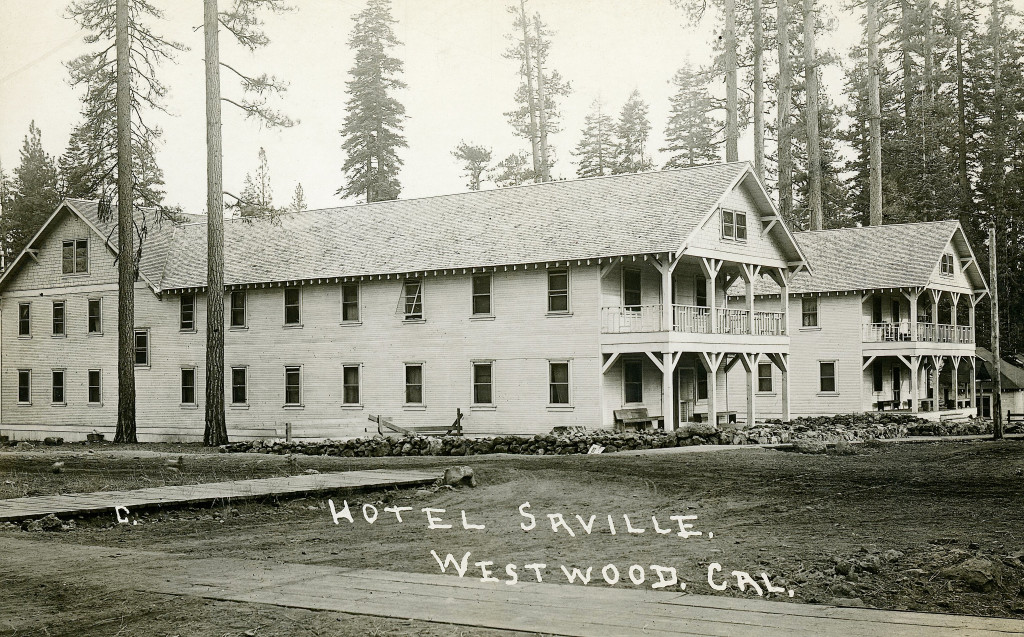
Hotel Saville Explained

Westwood Independent, April 2, 1918

Last Friday, (10/6/23) featured a photograph of Westwood’s Hotel Saville. It confused some readers, as they did not think that the Red River Lumber Company allowed and/or operated hotels in Westwood. Those readers are correct.

Red River, in its own peculiar way, named their boarding houses “hotels.” These facilities housed single men, while houses were reserved for families. The Hotel Saville was built in 1913, and was one of the first rooming houses constructed there for Red River’s employees. It was a substantial structure with 250 rooms. Initially it housed Spaniards. In a bit of trivia, when T.B. Walker visited New York City on financial matters, he always stayed at the Hotel Saville.

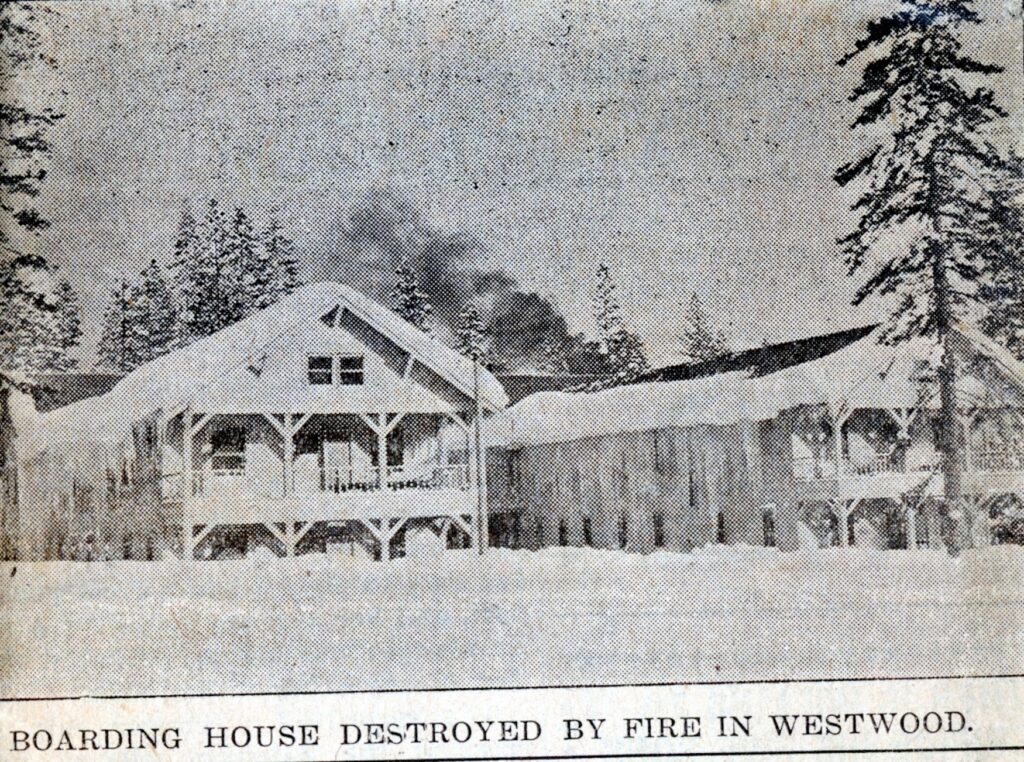
On Sunday night, March 30, 1918 a fire broke out on the the lower floor of the Saville.  The fire spread quickly and some five hundred men battled the blaze. Every effort was made to contain the fire, for fear it might spread to neighboring Westwood Club and Opera House.

Tim

California’s Workmen’s Compensation Act of 1913

Westwood Hospital

In 1911, the California Legislature implemented a voluntary Workmen’s Compensation Act. It failed way short of its goals. In 1913, the introduced a new version, but this time it was mandatory. It initially affected large manufacturers. In yesterday’s column, T.B. Walker was not pleased with this legislation and with the construction of Westwood underway, there was no way to avoid it.

Companies had two options: 1) They could make payments to the State which set up a special account or 2) They could self insure.

Red River Lumber Company went the self-insured route. Each month one-dollar was deducted from employee’s salaries. This money would fund the Westwood Hospital. For employees it was a good deal. In turn, they received full medical coverage, and even for not work related injuries. As far as I am aware Red River continued with the self-insured route until they sold Westwood in 1944.

When Fruit Growers Supply arrived on the scene they, too, opted for self-insured, just as they did at Hilt. In 1942, Fruit Growers opted out of self-insured and money collected from employees were sent to the State. This was not so good for employees, because their insurance covered only accidents on the job. One of the side effects was hospital at Hilt was closed, but converted into a first aid clinic.

Support by subscribing.

California Politics, 1913

Hotel Saville
Hotel Saville, Westwood, circa 1914

When T.B. Walker was scouting his westward expansion of the Red River Lumber Company he examined all angles. Two important topics were politics and taxes. He was not fond of California politics, but then again he did not like Minnesota taxes.

In Walker’s opinion he though  California had an anti-business stance, and he was concerned about future legislation impacting on Red River’s profit. In a 1913, letter to his son, Willis Walker, T.B. made reference to the passage of legislation concerning
workmen’s compensation and providing medical benefits. T.B. wrote:” There is a very unsatisfactory labor liability law that seems to be more drastic than has been passed in any legislature.  I am aware that the prejudice against business in California has got so far along that it is but little use of make any defense or efforts at protection of our legal rights and proper treatment.”

In summation, T.B. declared: “The California Legislature is a sly,
reckless gang of socialists, and have succeeded in completely
deceiving the people through which they can make successful war
against capital and enterprise”

Tomorrow: The California Workmen’s Compensation Act of 1913

Support by subscribing.