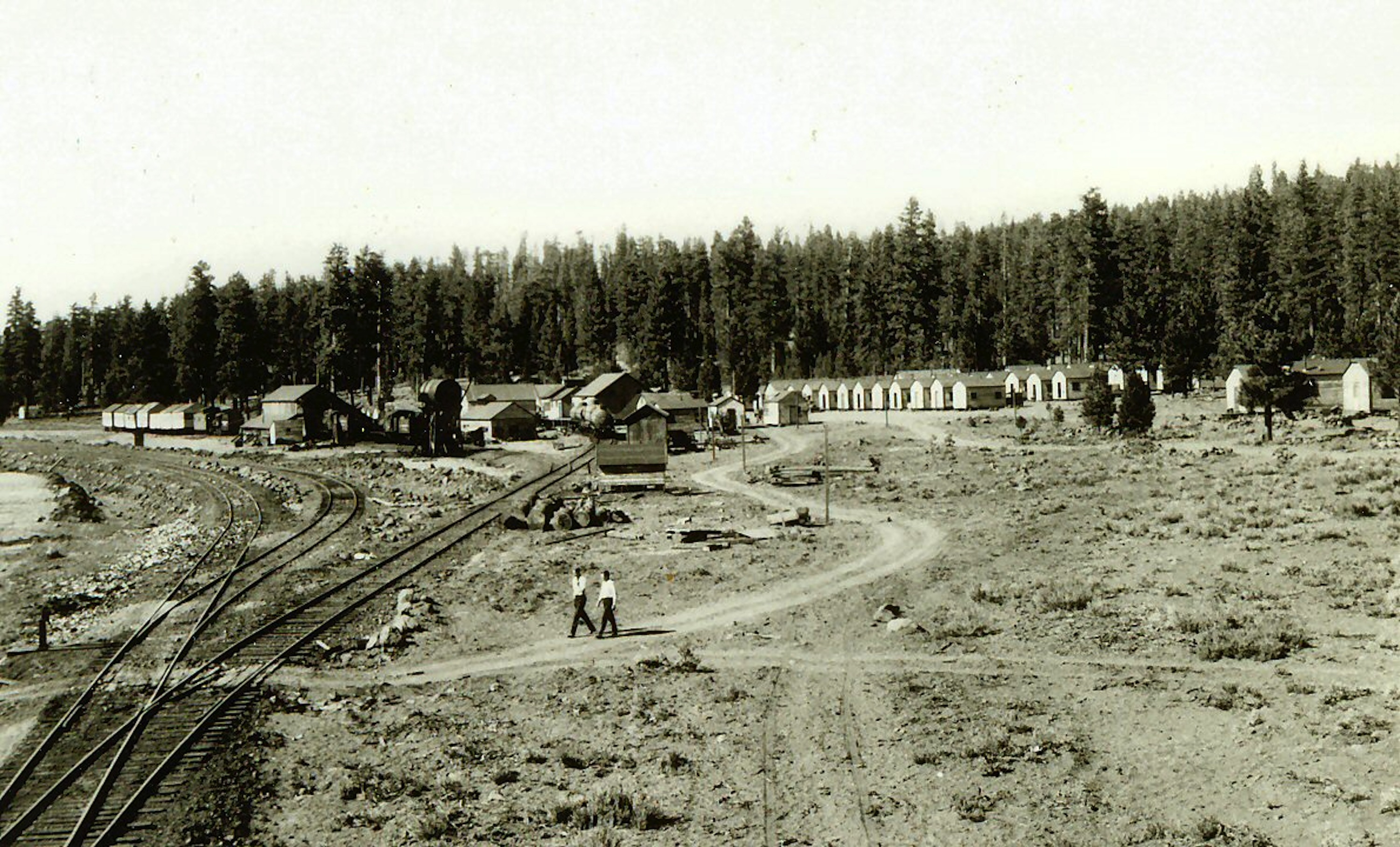
Hat Creek Powerhouse No. 1, 1921. Courtesy of Lola L. Tanner
The Red River Lumber Company operated many enterprises and it still as an influence concerning electricity to many residents of the region. From time to time when the Susanville area has a power outage, many times there will be a reference to the Hat Creek line. So you may ponder how did Hat Creek come to be? Continue reading Hat Creek Power→
In 1865, John C. Wright located on the abandoned homestead of Thomas Pearson, who had perished in a snowstorm on New Years Day 1865. Wright as known locally was Coyote Jack, and hence the name of Jacks Valley. In 1869, he left for parts unknown. By 1880, this had become a crossroads for travelers as five different roads converged in the valley. Frank Fluery took advantage of the opportunity provided by this unique junction and established a saloon. In 1884, as one of Fluery’s patrons noted: “. . . for ten cents he will give you enough to make you happy to cause you to forget all your trials, troubles and tribulations for a time.” In 1889, Fluery sold to A. J. Conklin who operated the saloon for a number of years. In 1907, Conklin ventured into the lumber business and built a sawmill that had a daily capacity of 15,000 board feet. In 1920, Conklin sold the sawmill to William Johnson. Johnson operated the mill for three years and then sold to the Red River Lumber Company who immediately closed it. In August 1926, a forest fire ravaged the region that encompassed some 20,000 acres. The following year, the Red River Lumber Company established logging Camp 70 to salvage the burnt timber. This was one of that Company’s earliest truck logging camps. While those enterprises have long since faded into oblivion, a cement water trough remains and is still a recognized feature to travelers. In 1913, Thomas Hill and the County of Lassen constructed the water trough. For early motorists, it was a wonderful blessing, a source of water for overheated automobiles making the trip up Antelope Grade. For the next 80 years it was popular stop to drink the water and take a break, though it appears the water line has been disconnected. The trough is located ten miles north of Susanville on Highway 139. To learn more about other places throughout Lassen County see the Lassen County Almanac.
Red River operated numerous logging camps from 1913 through 1944 when it sold to Fruit Growers. The camps were assigned numbers, though in no particular order. The majority of the camps were short lived and only had a span of one to maybe three years. One of the more interesting camps was Camp 33, but referred to as Town Camp, as it was located less than a mile west of Westwood. What made it unique was that Red River’s company town of Westwood would experience from time to time a housing shortage for its employees. On occasion, this camp was used to house mill workers instead of loggers.
In 1861, Carlton Goodrich settled at Mountain Meadows and would become one of the largest property owners there, as his ranch totaled over 7,000 acres. He located his ranch house just west where the highway crosses Goodrich Creek, approximately across from where the old chimney stands. It became known as Mountain House and was a popular stop for weary travelers. In April 1875, Sylvester Daniels paid Goodrich a visit while touring the region and wrote, “I love these mountain folks. No aristocracy among them.” When Goodrich died in 1886, due to estate issues and the subsequent sale to John Crouch, the popular establishment closed. When the Red River Lumber Company established its Westwood operation, they transformed the old Goodrich ranch into a dairy.
When the Red River Lumber Company established its company town of Westwood in 1913, it had to provide numerous amenities due to its remote location at the time. It was necessary to not only attract employees, but to retain them, as the lumber industry experienced a high turn over rate in labor. The Westwood Club was one of several facilities designed to meet the recreational needs of its employees. It included a restaurant, lunch counter, soda fountain, cigar and newsstand, barbershop, reading room and a billiard room.
Westwood Club, 1920
On early Friday morning, March 31, 1944 a fire broke out in the Westwood Club though the cause, was never determined. Within twenty minutes the whole building was engulfed in flames. The heat so intense, that Nick Kannier’s automobile which was parked in front of building, burst into flames. Even neighboring buildings from across the street were smoking, on the verge of spontaneous combustion, which with quick action by the fire department prevented the same.
The J.R. Bartlett Company were the concessionaire of the Westwood Club, which included the clubhouse, cafe, pool hall, bar and lounge. There were four other tenants in the building—Ehorn’s Pharmacy, Quitman’s Apparel, Westwood Market and Kilpatric’s Used Furniture department. Estimated loss for all parties was placed at $125,000.
Having spent a good portion of my youth working in the woods with my father, Leroy W. Purdy, this topic comes naturally to me. In addition, I have authored several books on the topic, such as the Fruit Growers Supply Company and the Red River Lumber Company. Over the years I have gathered considerable material on not only those companies, but the smaller mills that existed prior to these large lumber outfits. In a future post, I will explore the 1907 logging bonanza of the Honey Lake Valley region. It was the first major exportation of lumber, as prior to that date, must lumber produced was for local consumption. Believe or not Honey Lake played an important role and finished lumber was shipped across the lake from near Buntingville to Amedee for shipment on the NCO Railroad. Stay tuned.