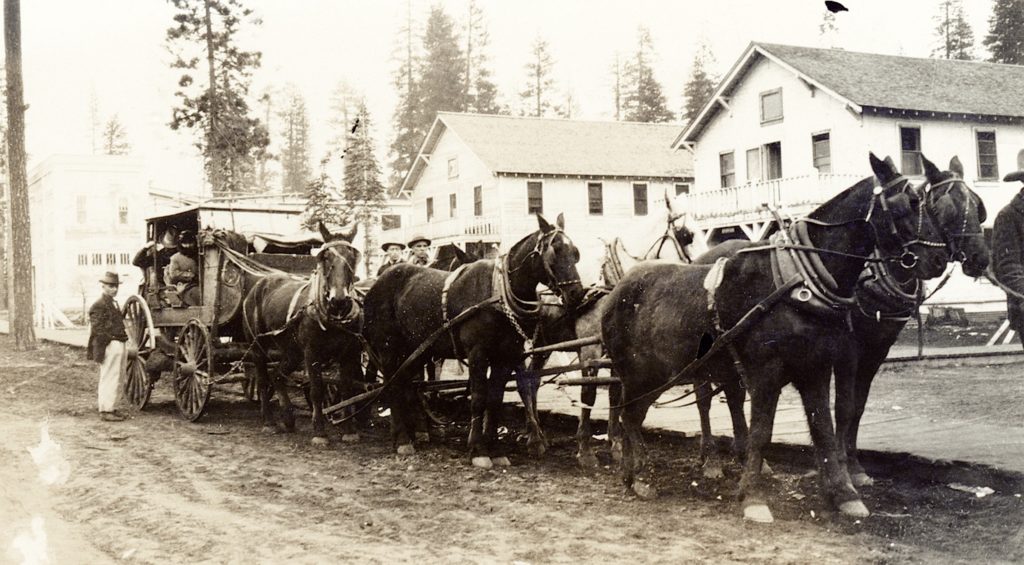
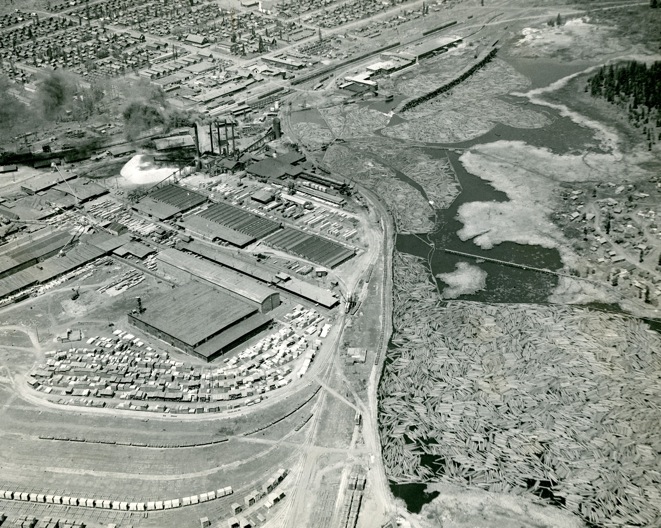
The old fashioned iconic symbol of the American West, the stagecoach would soon suddenly disappear during the time Red River constructed its company town of Westwood, that took an initial two year to build from 1912-14. It was truly a remarkable era with the automobile overtaking the horse and buggy era. Westwood evoked the modern era. A new town with electricity, sewer system and a department store, that would take decades for the neighboring communities to implement such “modern day conveniences.”
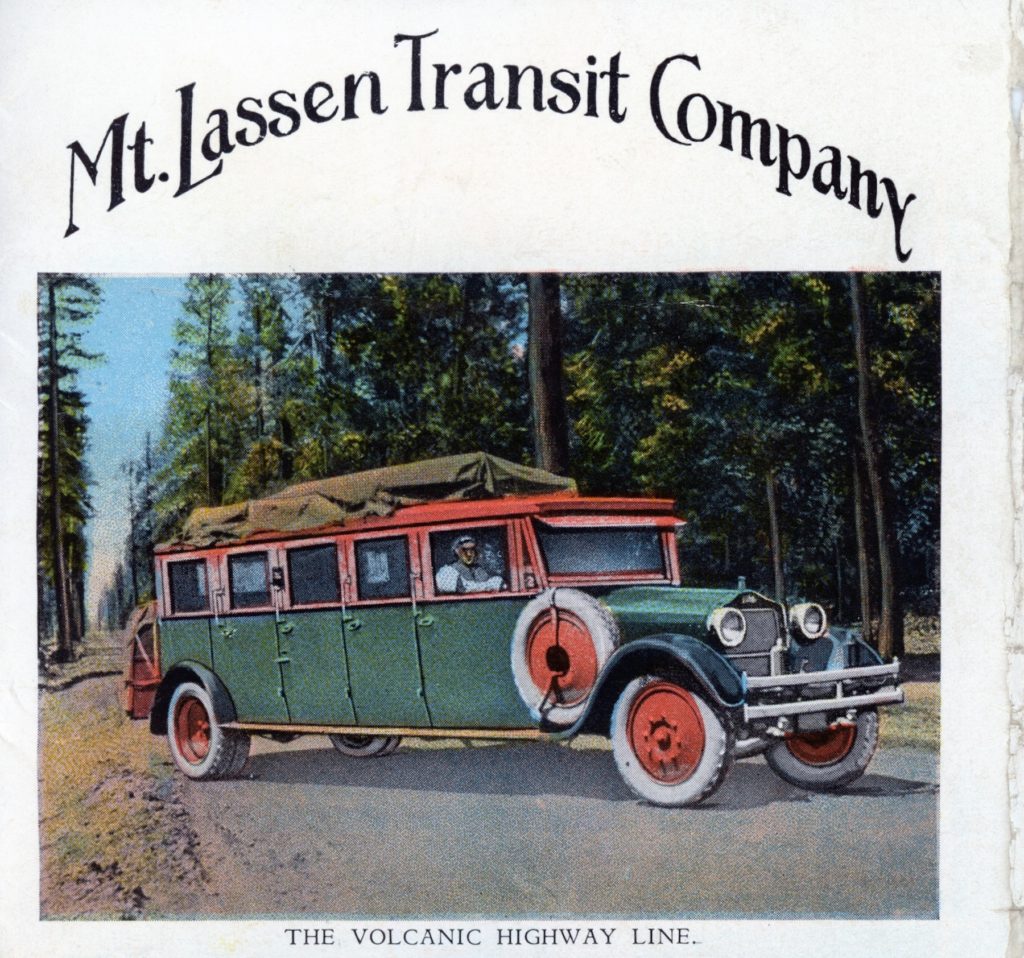
A year after the above photograph was taken, the horse drawn stagecoach was replaced with the “auto-stage” a large touring car. In 1916, the voters of California passed a $16 million bond measure to begin the construction of a state highway system.
Brochure of the Mt. Lassen Transit Company, Red Bluff, circa 1920. Courtesy of Margaret A. Purdy
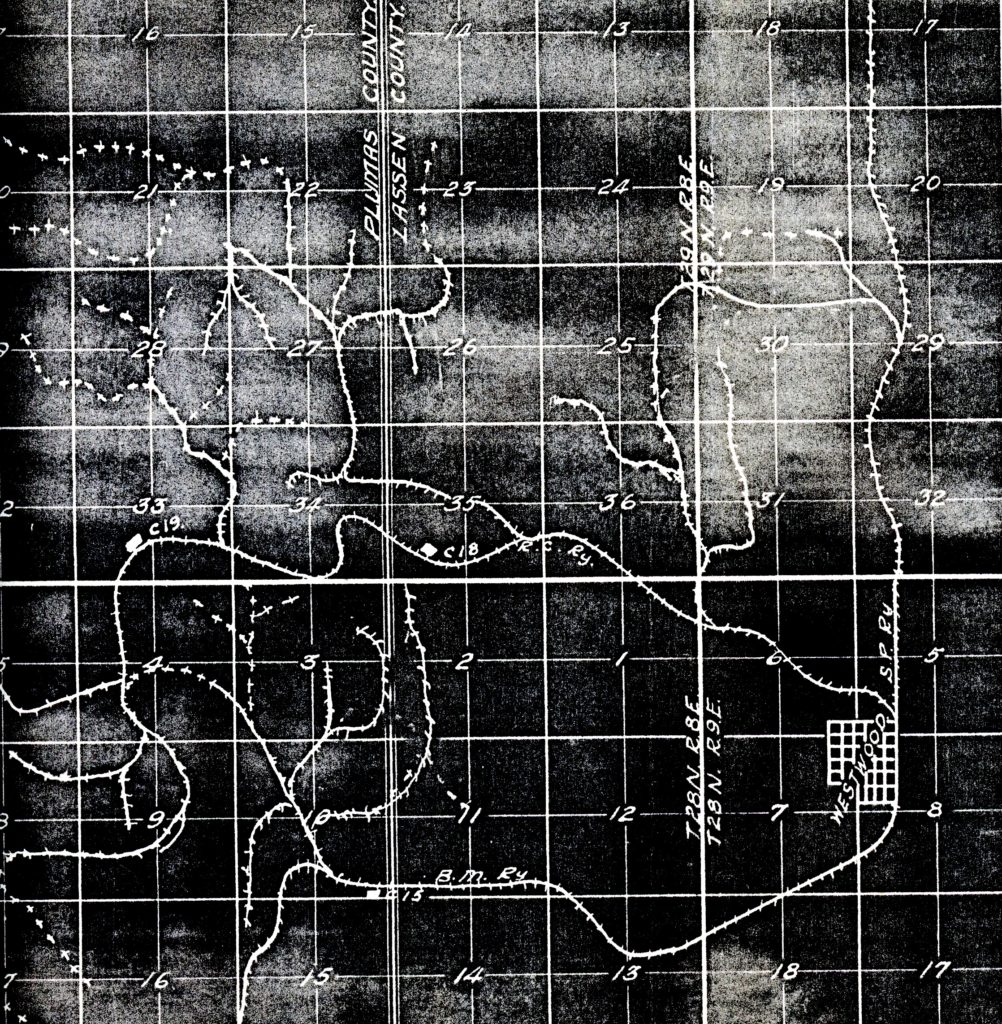
This map was recorded in official records of Lassen County indicating where Red River would log in 1917.
The 1917 logging season for the Red River Lumber Company was somewhat different than previous years. After all, it should be duly noted the majority of its logging was focused on its contract with the Great Western Power Company to log and clear Big Meadows of timber to make way for its new reservoir Lake Almanor.
Now with that obligation out of the way, Red River began logging its timber just adjacent to Westwood. Red River planned to increase its output by logging 150 million board feet in 1917 versus that of 137 million the previous year. This, of course, reflected the demand for lumber with wars ravaging Europe and elsewhere. This undertaking required operating five logging camps and building some twenty-five miles of railroad spur lines.
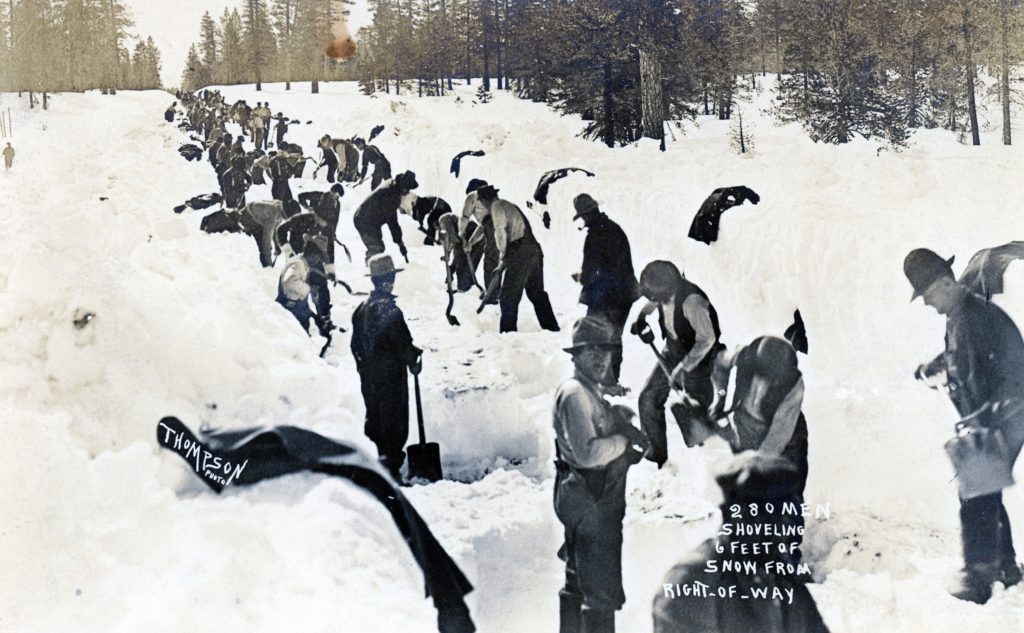
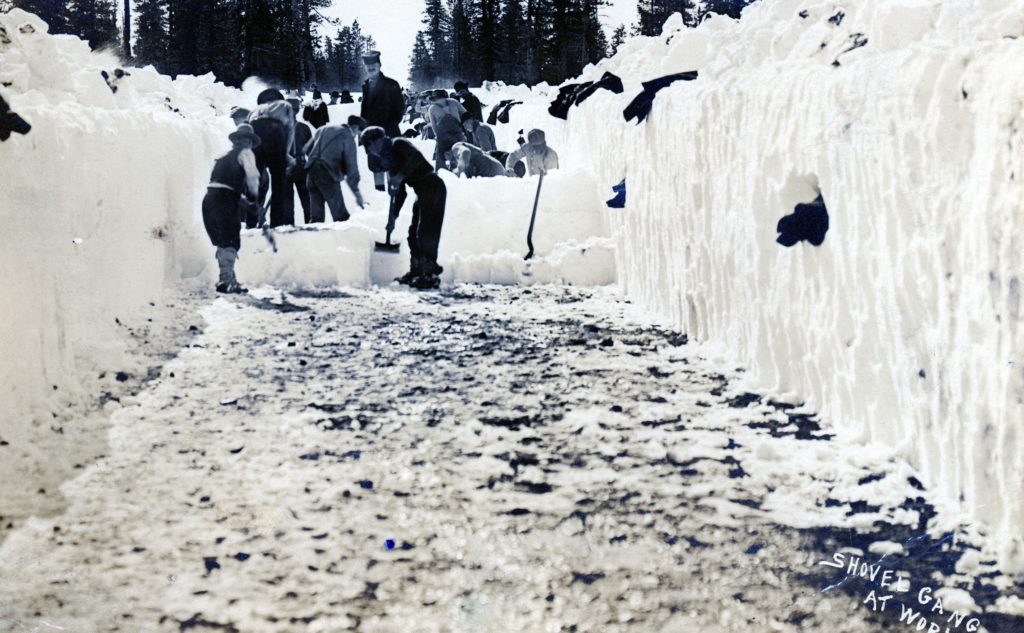
Snow Shovelers clearing the right-of-way in six feet of snow, January, 1914—B.R. Zimmerman Collection
On January 29, 1912, the Red River Lumber Company and the Southern Pacific Railroad entered into an agreement for the construction of the Fernley & Lassen Railroad. Time was essential, with completion date of two years. Red River already had a contractual obligation with Great Western Power Company to remove the timber from Big Meadows, which would be flooded to create Lake Almanor in 1914..
The line would extend from Fernley, Nevada to a point west of Susanville to be named Westwood Junction. At that point a nine-mile spur would be built south to the soon to be company town of Westwood.
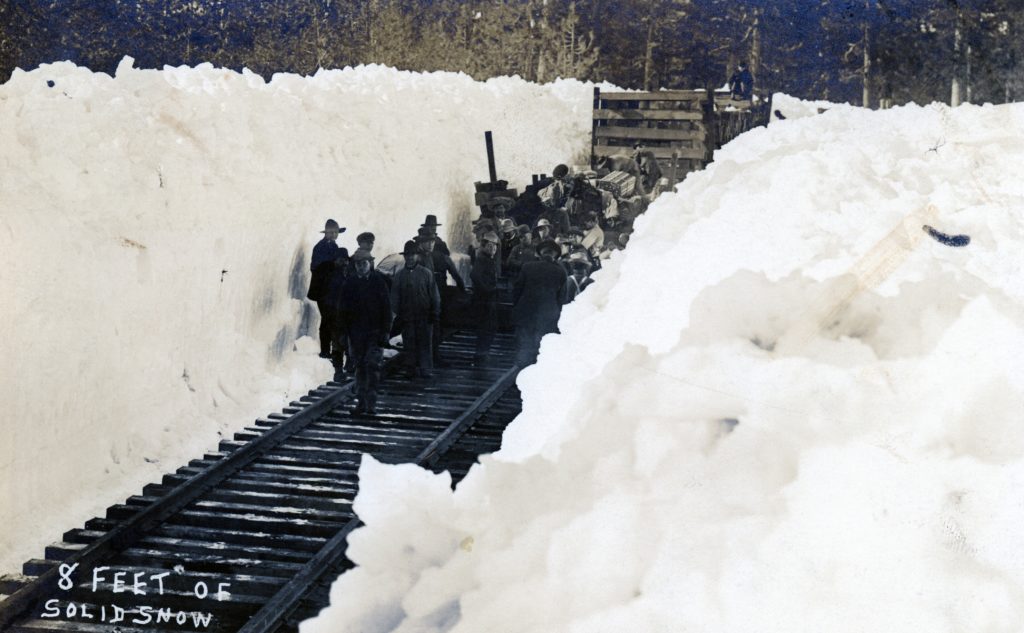
A daunting snow removal task on the Fernley & Lassen Railroad, west of Susanville.—-B.R. Zimmerman Collection
By the fall of 1913, the tracks had reached Susanville. The most formidable task was the Susan River Canyon, wherein the Southern Pacific put 1,000 men to work to meet the January 1914 deadline. However, Mother Nature had a mind of her own, and lashed a series of record breaking storms. Even with eight feet of snow in Susanville during January 1914, was not a deterrent for the construction. Though due to the unusual circumstances Red River and Southern Pacific agreed upon a two-month extension to the deadline.
Construction of the Fernley & Lassen Railroad, west of Susanville, January 1914. Courtesy of B.R. Zimmerman Collection
On February 21, 1914 the rails reached their destination to Westwood. It would not be until fall when all work was completed such as ballast and sidings.
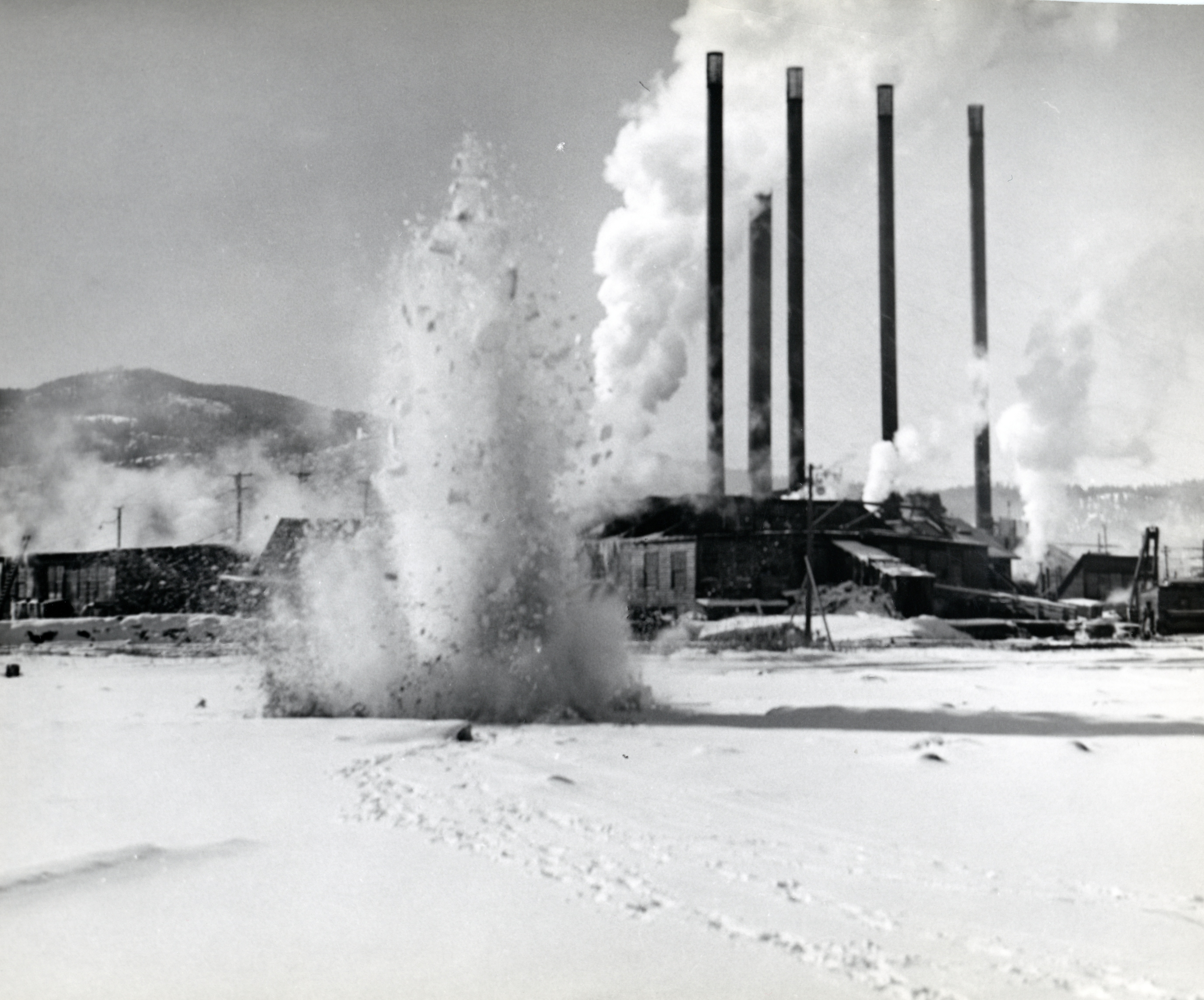
Dynamiting the Westwood millpond, January 27, 1949. Courtesy of Fruit Growers Supply Company
It has been some time since this region has experienced prolonged sub zero temperatures, which is fine with me. When it does get that cold things happen. In January 1949, the temperatures plummeted to nearly thirty degrees below zero at Westwood. The millpond froze. When the Red River Lumber Company designed the facility, they placed piping from the powerhouse that forced steam air directly into the millpond near the sawmill. This system was no match for Mother Nature. To keep the mill operating it was necessary to use dynamite to blast loose the logs in the millpond. Continue reading How Cold?→
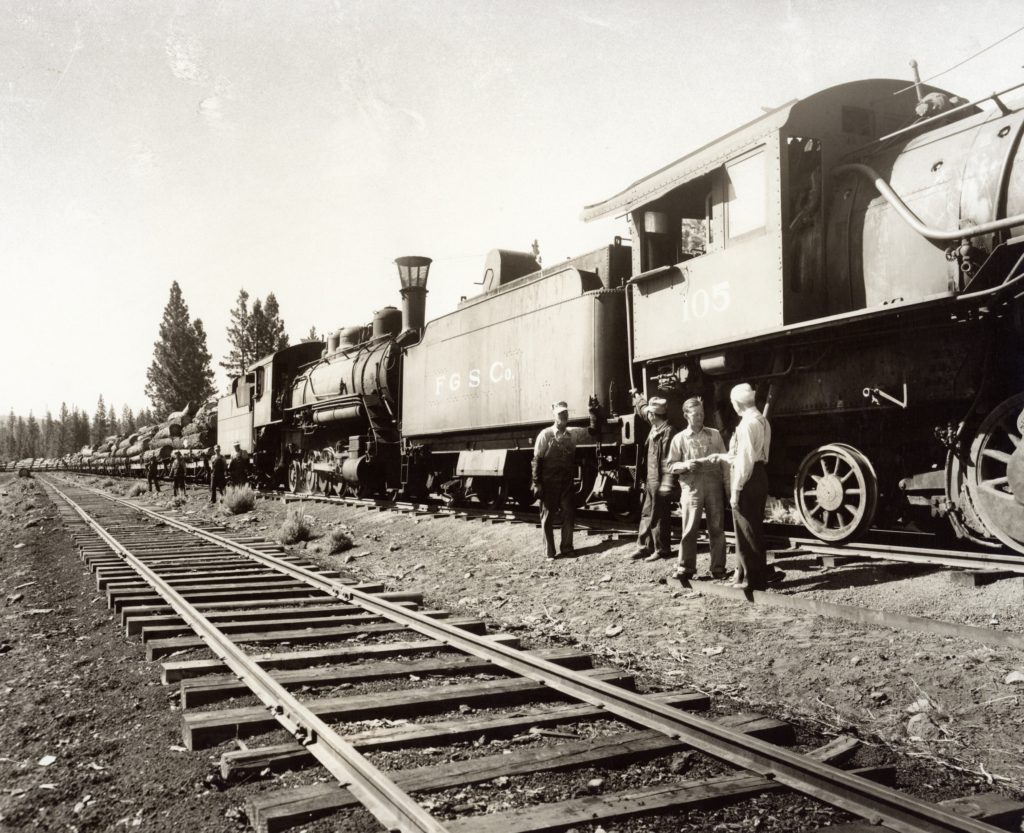
Fruit Growers Locomotive No. 105 at Halls Flat, 1946.
In 1940, with the Red River Lumber Company making plans to log north of Westwood in the Poison Lake and Blacks Mountain region further discussions were held as to construct a railroad line to Burney to harvest their extensive Burney Tract that contained two billion board feet of merchantable timber. An initial railroad survey was conducted with a starting point at Poison Lake. The major barrier was that of Hat Creek Rim. It was determined to follow the rim and slowly make a descent at Cassel and then onward to Burney. It was estimated it would cost one million dollars to construct the line. Fletcher Walker, the resident manager of Westwood was eager to build and wrote, “We would increase the Veneer Plant output and get good logs to operate it and this alone would more than pay for the cost to build the railroad.” However, no one else in the Red River family shared Fletcher’s railroad proposal. In 1941, Red River made the decision to sale Westwood and the Burney Tract.
In 1944, after intense negotiations, Fruit Growers Supply Company purchased Westwood and the Burney Tract. They, too, contemplated to build a railroad line similar to the one proposed by Red River. As late as 1951, Fruit Growers still considered the option of a railroad to Burney. Yet, changes were occurring rapidly with the conversion to cardboard boxes, that forced Fruit Growers to reconsider its future plans, as the needed for wooden boxes to ship citrus would eventually be eliminated.
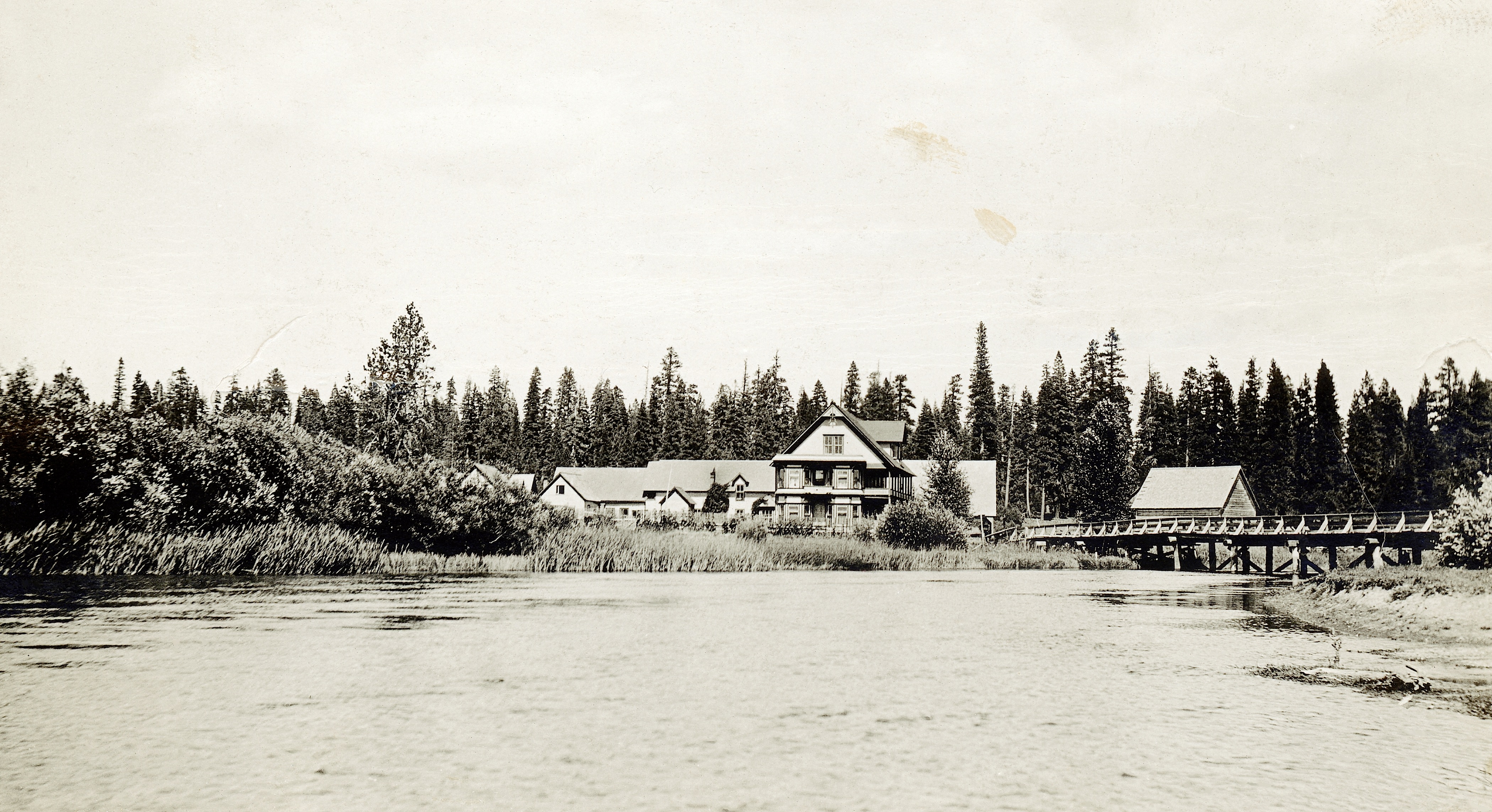
Bunnell’s Resort, Big Meadows. Courtesy of Philip S. Hall
While my Red River series covers a tremendous amount of material on the Red River Lumber Company, there were some topics that were not addressed. In 1938, the topic of controlled burns was being discussed, as the company had done it in its earliest years until Clinton Walker’s departure in 1913. Below is an excerpt of a 1938 memo Clinton wrote to the Board and the experience of a control burn at Lake Almanor.
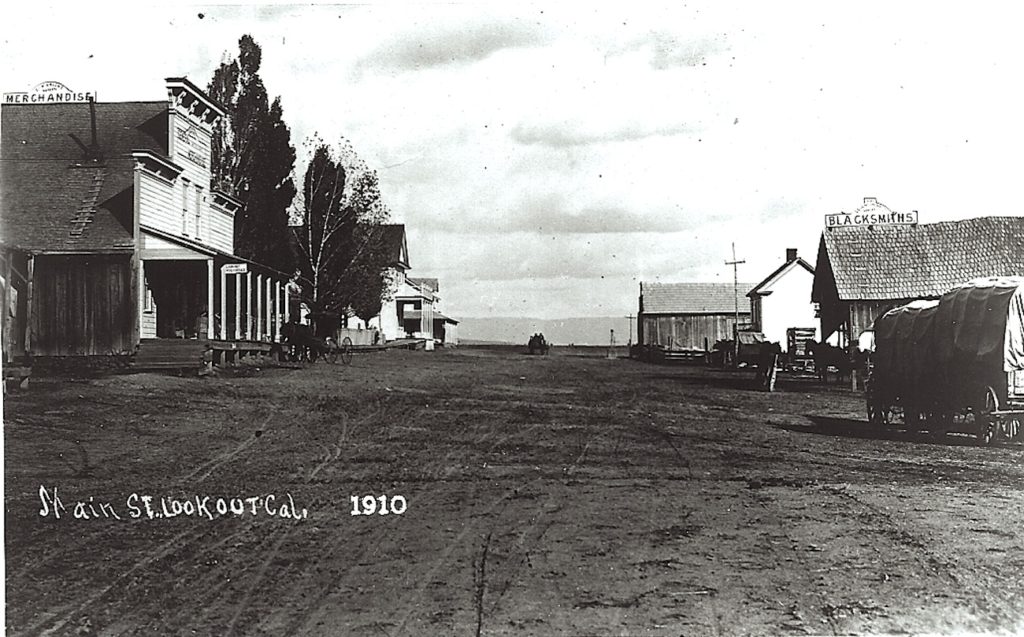
Located approximately eight miles north of Bieber, in the northwest portion of Big Valley, Lookout is best known for the Leventon Blacksmith Shop and the Lookout Lynchings. However, unbeknownst, to the community back in 1916-1917, there were some major plans to transform it into a major lumber manufacturing center.
It all began back in 1912 when the Red River Lumber Company and the Southern Pacific Railroad entered into an agreement to the build the Fernley & Lassen Railroad. At Westwood Junction, the Southern Pacific built a spur line south to Red River’s newly constructed company town of Westwood.
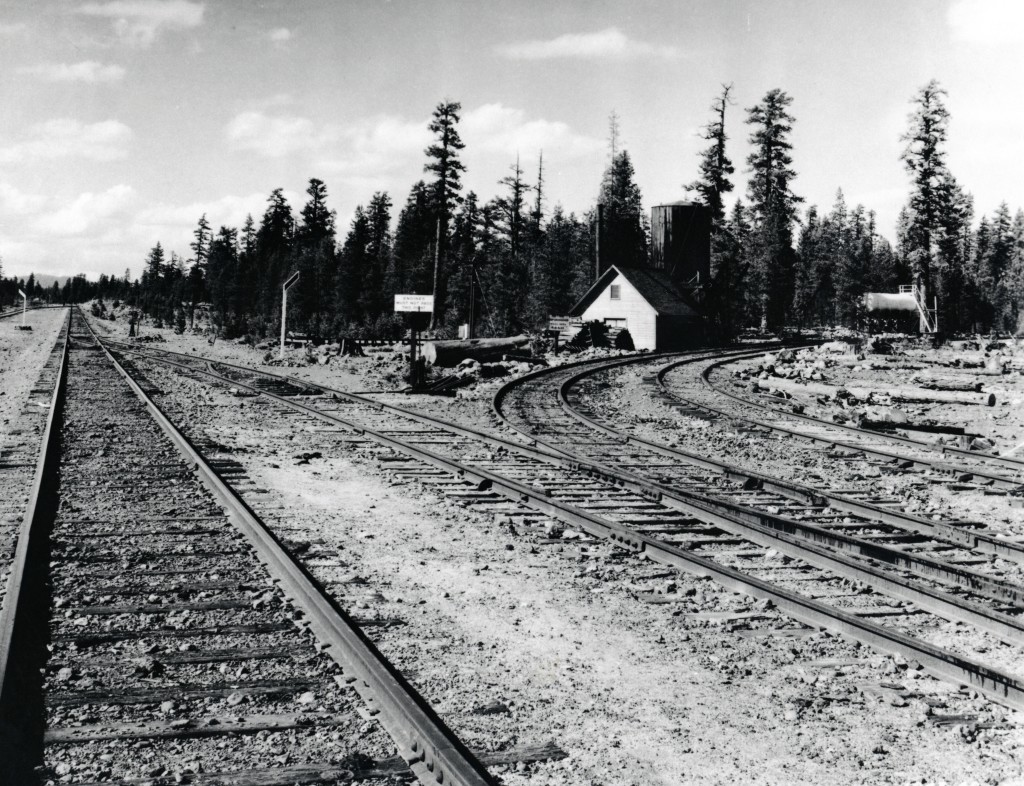
Westwood Junction
It was Southern Pacific’s intent to extend the line north to Klamath Falls, Oregon. In 1916, Southern Pacific was eager to begin construction of the line to the north. Southern Pacific prodded Red River about its future plans to establish a second mill north to log its Whitehorse Tract in Siskiyou County. Red River somewhat obliged and in the summer of 1917 company officials traveled north to inspect future mill sites.
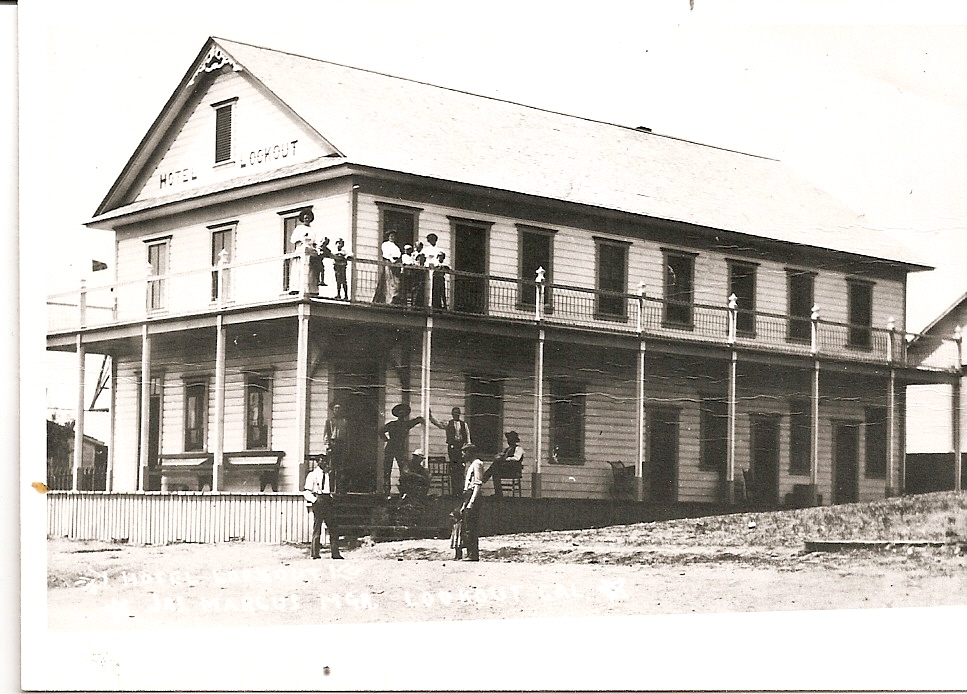
Hotel Lookout—-Beth Coppedge Walls
They found Lookout to be favorable. They were pleased with the cheap land prices, but also more important the weather. Lookout was much drier than Westwood. However, with the world conflicts Red River was not prepared to make any commitment to build a second mill. At the conclusion of World War I the economy was not conducive to proceed with such an endeavor and the plans for Lookout were tabled.
Spread the word, and encourage a friend to subscribe
By 1930, the nation’s lumber market had suffered big time not only with the economy teetering but supply flooded the market where there was no demand. In the Lassen region, this was a new experience as everyone had been accustomed to the good times. The big three mills had not only scaled back their labor force, but curtailed production. This fueled the rumor mill, and in December 1930, the rumor on the street that the Red River Lumber Company was to permanently shut down its mill. Company officials had to put out the word, that this was utter non-sense. After all, in December there was the usual slow down with the end of logging season, and soon it would be time for annual maintenance of the mill.
On the other, Lassen Lumber & Box Company was in dire financial straits. They closed down Camp Lasco, their logging camp for good and would rely upon logging contractors for their future needs. The company also went through major refinance of all the other departments.
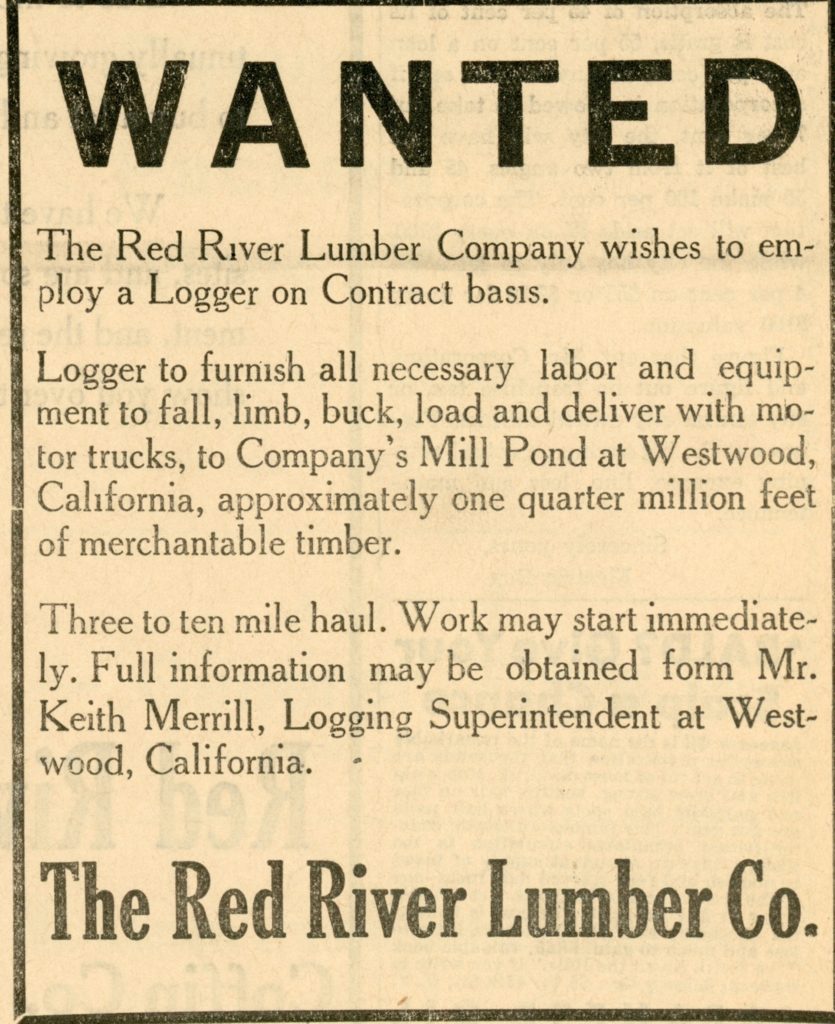
A Red River Lumber Company Ad—-Lassen Mail, October 7, 1935
This is one aspect of logging operations that I have never addressed. It is by the way, a term near and dear to me, as my father was a gyppo logger.
The term originated during World War I from the Industrial Workers of the World (IWW) one of the earliest unions to attempt to organize loggers and sawmill workers. Just exactly how word was coined is not known. The IWW referred to the gypos as strike breakers. Basically, a gyppo logger could be an individual or small company who worked as a independent contractor to log certain tracks for large companies such as Fruit Growers Supply, Red River Lumber Company among others.
Spread the word, and encourage a friend to subscribe
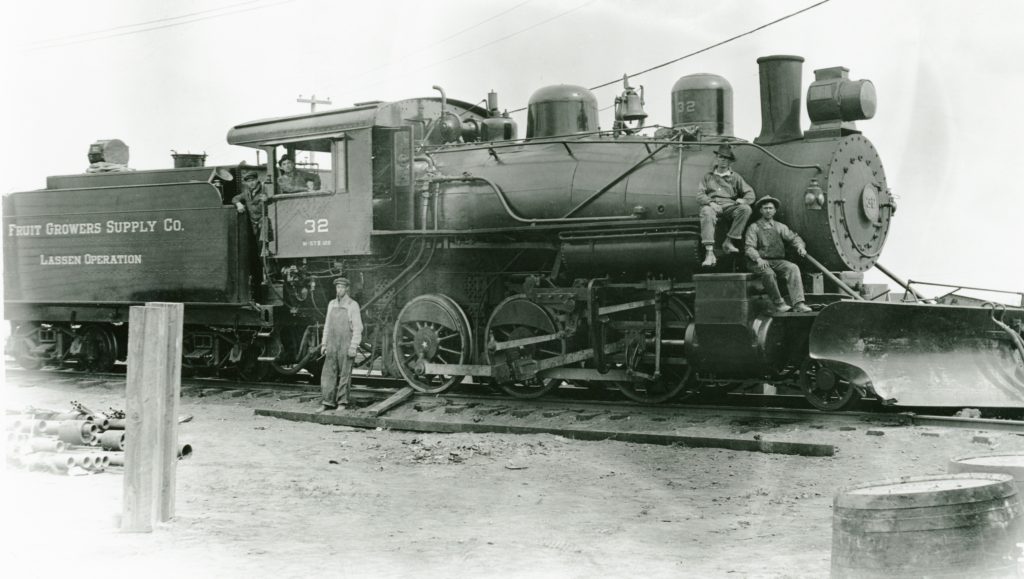
In 1919/20 when Fruit Growers Supply Company established its Susanville operation, they of course needed locomotives for its railroad logging operations west of Eagle Lake. They purchased this Baldwin locomotive from the Ocean Shore Railroad that operated a line along the Pacific Coast from San Francisco to Santa Cruz.* Fruit Growers ownership of the No. 32 was brief and they sold it in 1924 to the Red River Lumber Company. In 1944, Fruit Growers reacquired it when they purchased Red River’s Westwood operation. In 1953 the locomotive was scrapped.
*The Ocean Shore Railroad, was not completed with a gap in the middle.
Spread the word, and encourage a friend to subscribe