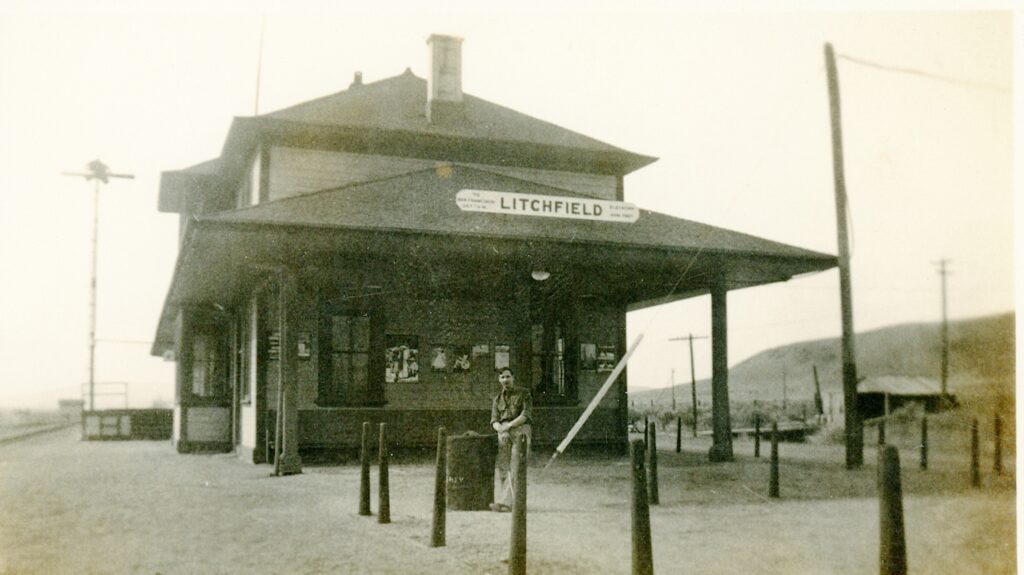
Leona Jackson at Susanville’s SP Depot, 1919–Lola L. Tanner
In 1913-14 when the Fernley & Lassen Railroad was built through a major segment of the Honey Lake Valley, the residents rejoiced. This was especially true for the agricultural community. While there was the NCO railroad, many deemed it expensive and unreliable. There was also other issue, its depots were not conveniently located.
Yet, on the other hand, no one knew what to expect when the Red River Lumber Company established its company town of Westwood. The agricultural community was overwhelmed that it had a large local market, and thanks to the railroad it was easy to get their products to Westwood. The scenario would repeat itself with establishment of the lumber mills—Lassen Lumber & Box Company and Fruit Growers Supply Company—in Susanville. The bottom line, it came as a total surprise that the railroad would create a large local market for local products. The region witnessed an increased local production in the agricultural sector, that allowed for more export of produce by rail.
The Red River Lumber Company at its Westwood operation developed its own fire trains used to fight forest fires. Of course, Red River had its extensive railroad logging network. However, if Red River wanted to access the Southern Pacific’s railroad tracks between Westwood and Susanville there were protocols set by Southern Pacific. In 1936, a Southern Pacific Bulletin stated ”The fire train of the Red River Lumber Company may make the following speeds: Between Mason and Westwood Junction, 35 MPH’ Between Westwood Junction and Susanville, 25 MPH; and through all tunnels, 10 MPH.” I do not know what type of restrictions the Western Pacific imposed.
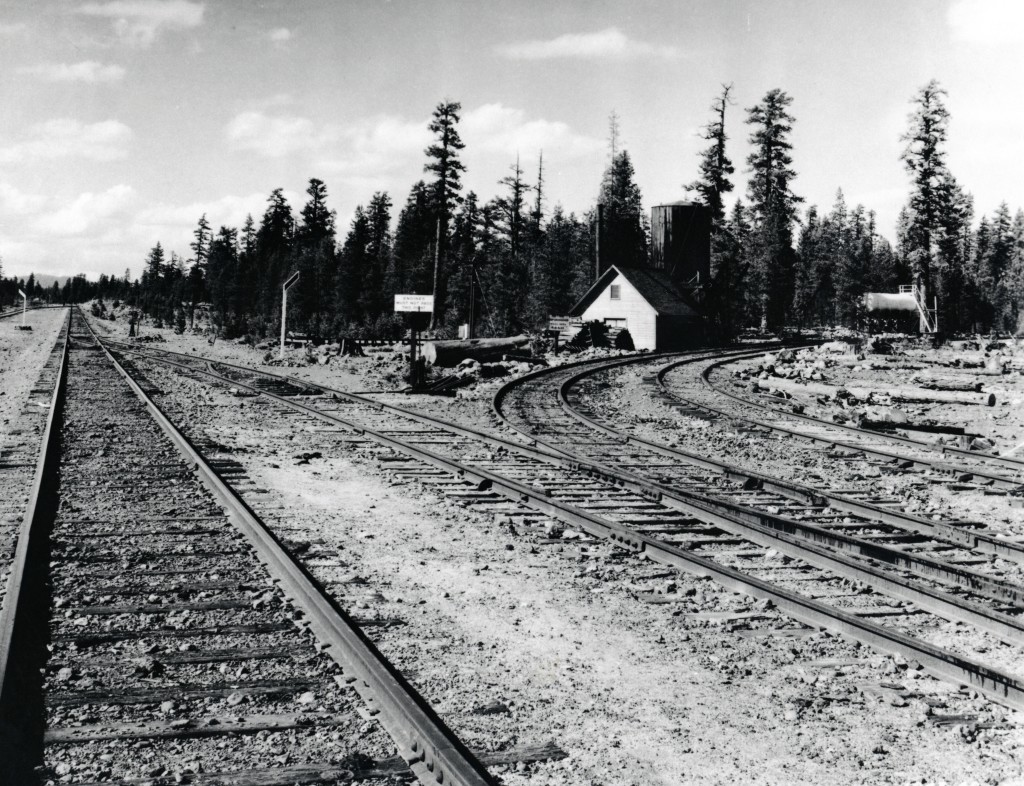
Westwood Junction was that of the Fernley & Lassen branch of the Southern Pacific, built by an agreement with the Red River Lumber Company. At this point the railroad constructed a spur line to the south of the newly created town of Westwood. The Southern Pacific’s goal was to extend the line north to Klamath Falls, Oregon. It was after all, the Red River Lumber Company’s intent to build several mills, the next one scheduled for near Lookout. By 1917, the Southern Pacific was anxious to extend the line north, but Red River was not ready. The mammoth mill at Westwood was more than it could handle. In the meantime, the Southern Pacific was nervous that its competitor the Western Pacific might extend a branch to Westwood and siphon off traffic, since Southern Pacific’s five-year agreement with Red River which the railroad had all inclusive freight deal was about to expire.
Then came along World War I and that changed everyone’s plan. When the war ended, the nation went into a severe recession, so expansion was off the table for many. . In the meantime, the Southern Pacific focused on the troubled Nevada-California-Oregon Railroad, as an alternative route north to Oregon, which it eventually did.
This site, it should be noted, also served as a junction for the railroad logging operations of the Fruit Growers Supply Company and the Lassen Lumber & Box Company.
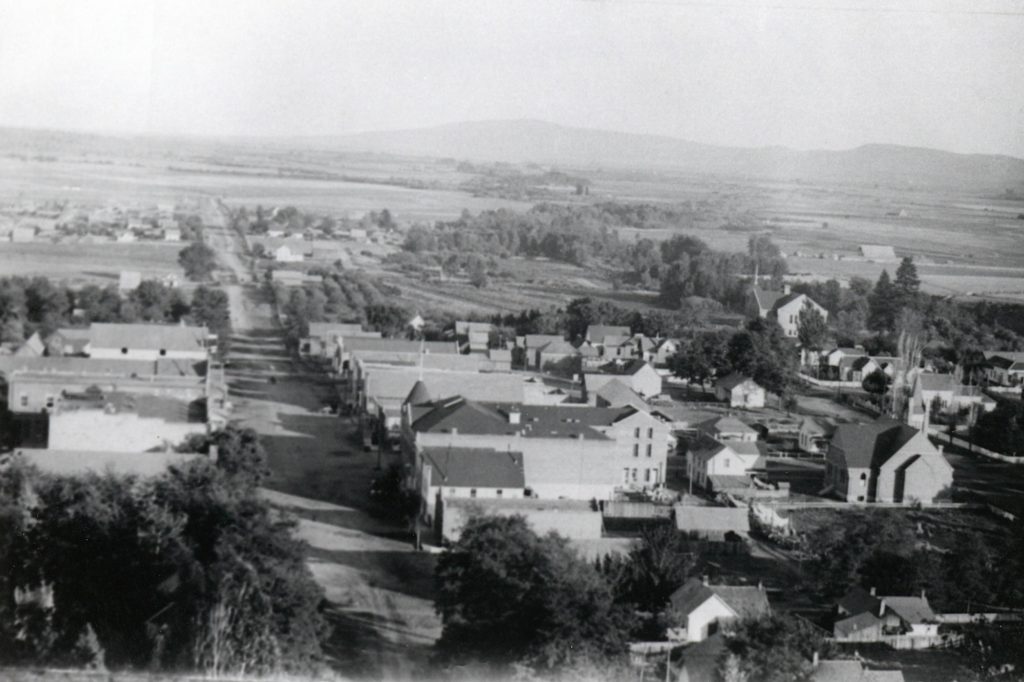
Susanville, 1905. Courtesy of Dick & Helen Harrison
In 1910, with no substantial proof that a railroad was coming to Susanville, some of the powers to be thought the town could use a makeover. In February, the Lassen County Chamber of Commerce thought the town had a image problem. In their opinion, the town’s name should be changed with something of a more cosmopolitan flair. This was, of course, a delicate maneuver, since the town’s matriarch and namesake, Susan Roop Arnold, was still a resident of the community and had been for forty-six years. The Chamber advised her that it did not mean to be disrespectful, but felt changing the City’s name would be in the best interest of the community. The Chamber believed the town was destined to become an important city and that with name of with suffix “ville” carried a stigma, as being associated with a hamlet or village.
The City Trustees listened to Chamber’s proposal. They decided to postpone it until the March meeting. The Trustee’s appointed a committee to provide a propose name change. The group were not very creative and the best they could come up was Lassen. They cited that if the Lassen name was adopted, very few changes would have to be made. Numerous businesses and organizations had already incorporated the name into their respective establishments. The City said no, end of story.
While searching through files concerning railroad passenger service between Keddie and Klamath Falls, I came across the following account, that I thought some might find of interest
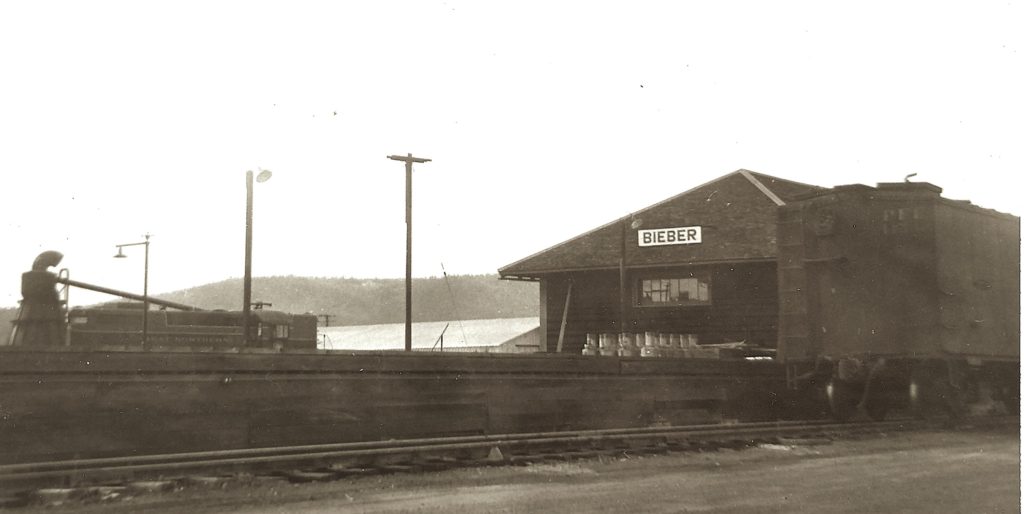
On September 22 and 23, 1934, a special excursion train sponsored by the Plumas County Chamber of Commerce went from Keddie to Klamath Falls. At Bieber, Lizzie Durfee and Ellen Elliott boarded the train to its final destination at Klamath Falls and the following is their published report.
Big Valley Gazette, Bieber, California — 4 October 1934: “This excursion was the first passenger train to leave Big Valley since the dedication of the railroad three years ago. Big Valley waited fifty years for the railroad, but there is no passenger service yet. Of course, there are better roads and the automobile, so we do not miss the train service too much.
“The excursion left Bieber about eleven o’clock Saturday morning. It was a little chilly but the cars were comfortable and the crowd was sociable and friendly.
”A stop was made at Merrill going up and the excursionists listened to a recital of the resources of Tule Lake section that seemed almost incredible. Space does not allow a detailed account but the crops and stock produced for disposal this year totals over $4,000,000. As a souvenir of the good will of the people of Merrill. each excursionist was presented with a ten pund box of potatoes of the best variety grown in that section.
”Klamath Falls was reached about 3 o’clock and courtesy cars took the visitors around the city and showed them the vantage points, and the growth and expected development of that busy bit little city.
”The banquet that evening was a pleasant affair where everybody visited with his neighbor on either side of him and across the table. Of course there were speakers of good will and friendliness and the banquet ended with everyone in the best of humor.
”The return home was uneventful and arrived back in Bieber six Sunday evening.”
It should be noted that nearly 200 people participated in the event.
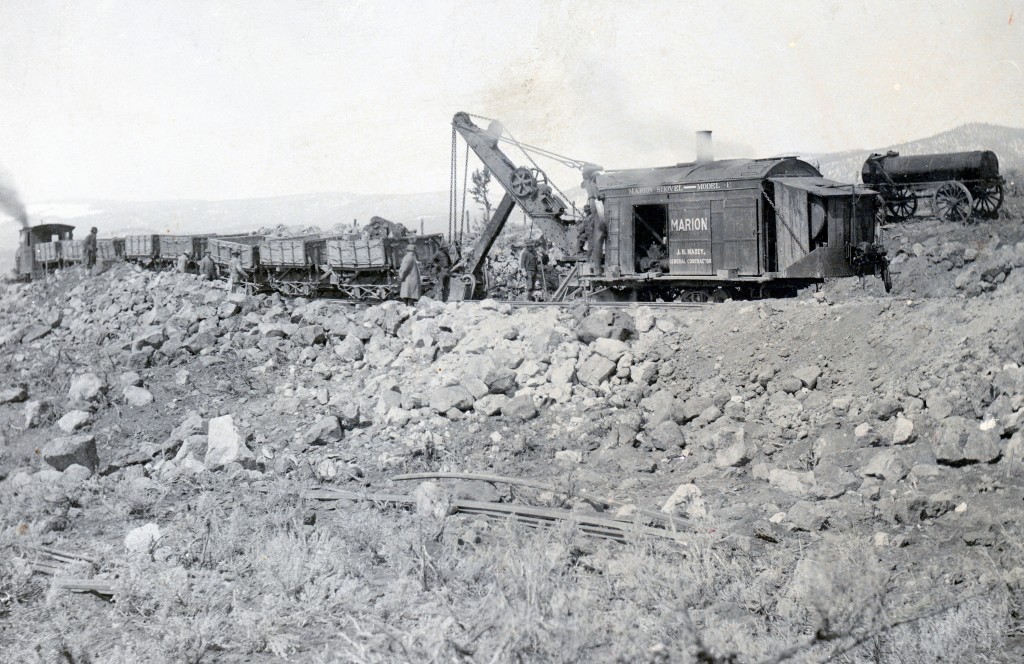
Davis Cut near Susanville of the Fernley & Lassen Railroad, 1912
Thousands of people drive by this landmark, and ,many are probably oblivious. Located a short distance north of Johnstonville on Center Road, is a railroad cut—named Davis. It really is somewhat insignificant as railroad construction goes, but it was the first in the Honey Lake Valley when the Fernley & Lassen Railroad was under construction.
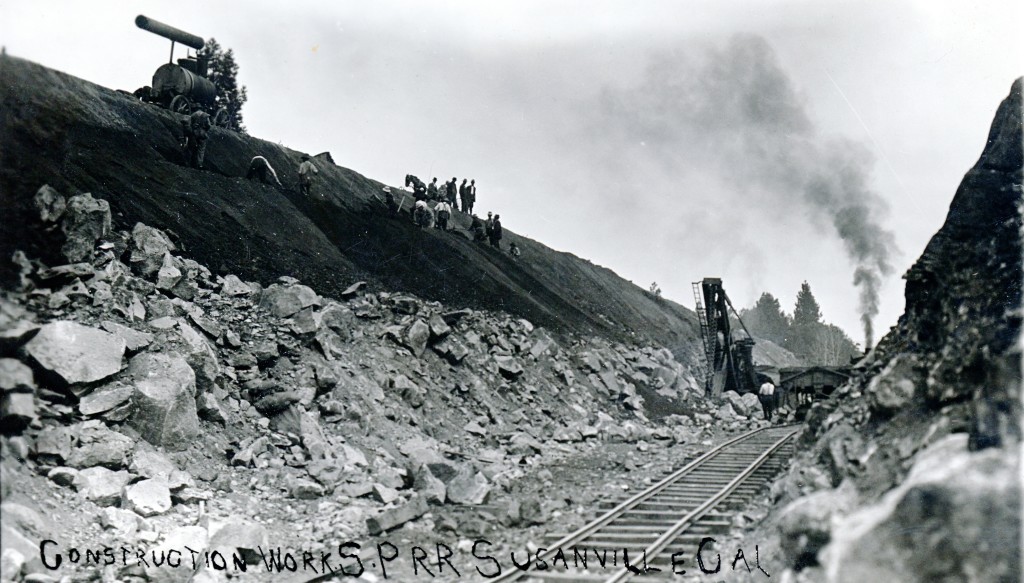
In April 1912, the Southern Pacific Railroad announced construction of the Fernley & Lassen Railroad, and awarded the contract to the Utah Construction Company. That company hired a numbered of sub-contractors, the most prominent of which was J.H. Maxey Construction Company. No time was wasted on construction as there was a deadline to reach Westwood by March 1, 1914. In the fall of 1912, a construction train reached Davis Cut, near Johnstonville. There were several fatalities associated with the construction of the railroad, and one of them occurred at Davis Cut. On April 13, 1913, James Cook, a powderman for the J.H. Maxey Construction Company, was killed there in an explosion to blast the rock.
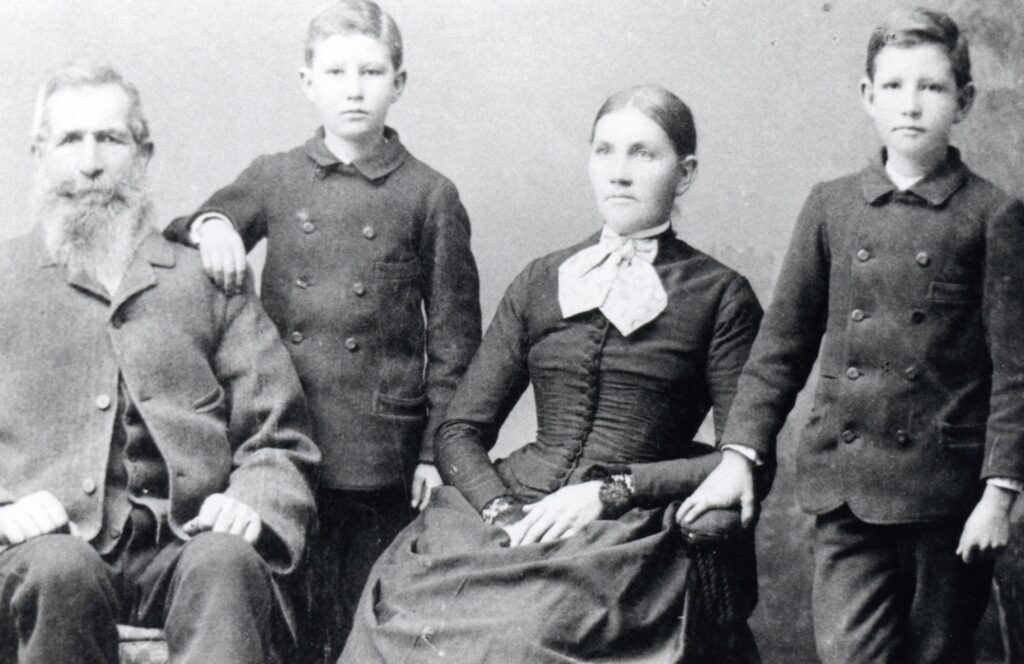
John C. Davis family, circa 1890–Courtesy of Robert and Eulalee Trussell
The cut was so named for the John C. Davis family. Davis, a native of Germany, came to California in 1850. In February 1858, he made his home in the Honey Lake Valley. In 1866, Davis purchased property just north of Johnstonville where he lived until his passing in 1894.
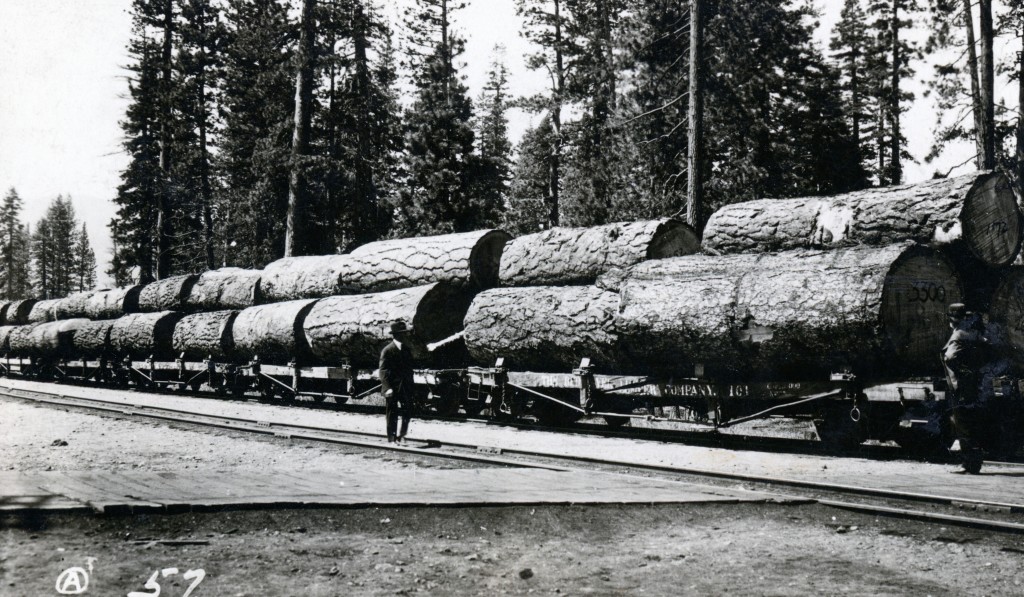
Train load of logs leaving Camp B, FGS Company,1923—Dick & Helen Harrison
For lumber companies back in the day, taking photographic scenes to show case premium logs and/of forest scenes served an unusual purpose that the casual observer would not be aware of. The photographs were used in portfolios to show bondholders, investors and other stakeholders what they were getting for their money.
This particular photograph is very revealing. These are Fruit Growers logs on Red River flat cars. When both Fruit Growers and Red River established their mills, they made agreement with the Southern Pacific Railroad to provide them with rail cars to transport the logs to the mill, saving the companies an expense. Red River found out the hard way that Southern Pacific was not always reliable and eventually purchased their own cars to care of those situation. In this particular instance, Red River was being a good neighbor to Fruit Growers and came to their aid to lend them some cars.
Construction of Miller’s cut near Susanville 1913. B.R. Zimmerman collection
Daily life got crazy in Susanville when the railroad arrived in 1913. Numerous discussions were held to make the town “dry.” It was the belief of some that if there was a ban on alcohol, that it would rid the town of certain elements. The City was not so keen on the other hand, as it received most of its operating revenue from liquor licenses. Continue reading Those Rowdy Camp Followers→
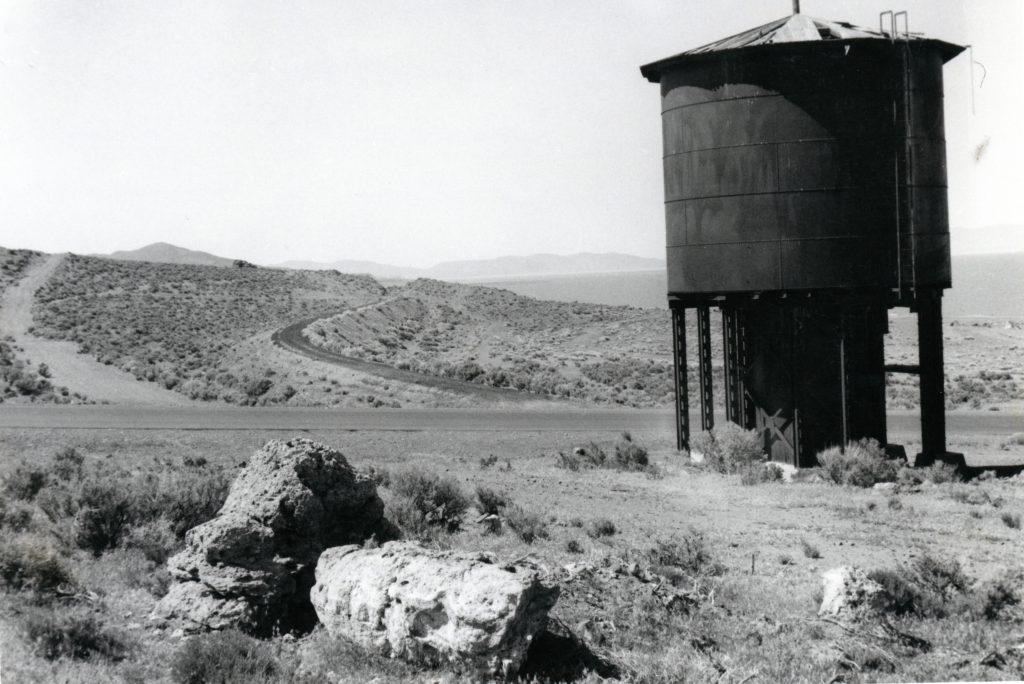
The abandoned line at Pyramid Lake., Nevada Historical Society 1971
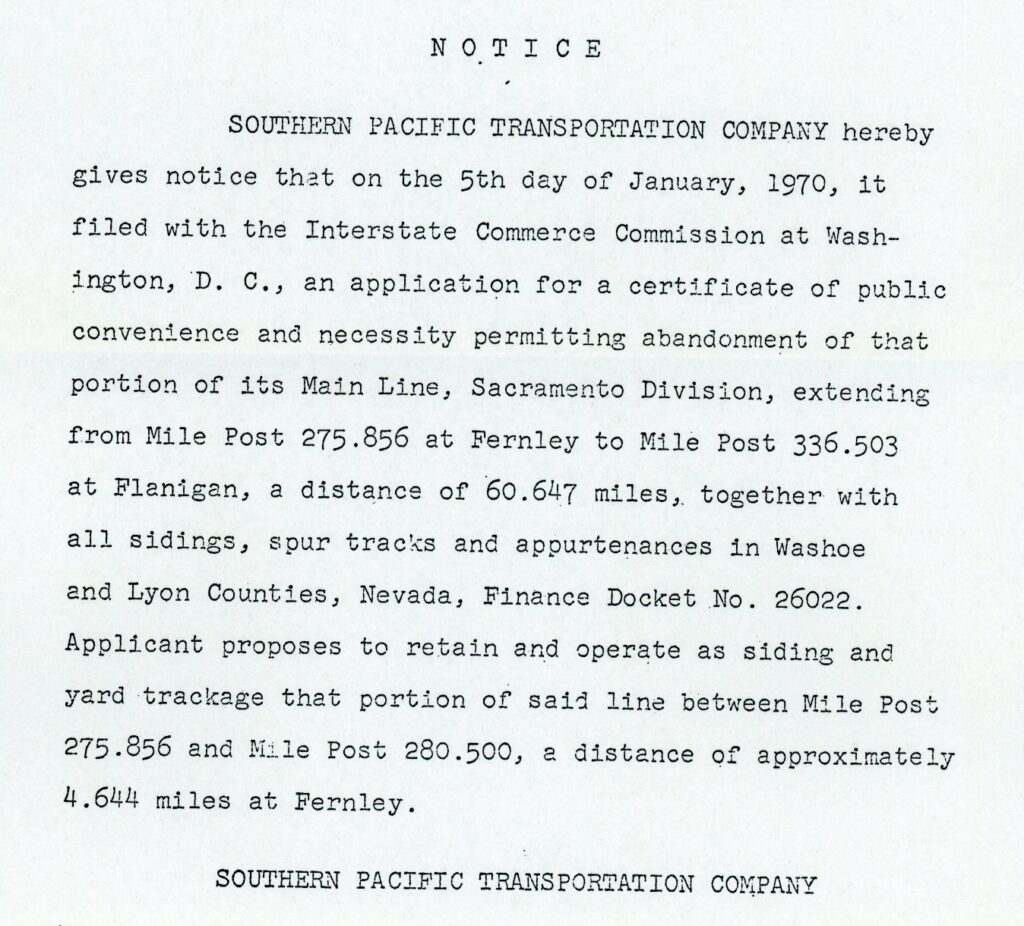
This kind of boggles my mind, that so many railroad historians get something so incredibly wrong. What I am referring to is the abandonment of the Southern Pacific’s Westwood Branch line between Fernley and Flanigan. First we start off with Jack Bowden whose book the Modoc Line states that the 60 mile segment of track was abandoned in 1963. David Myrick places the date of abandonment in 1962. Eric Moody, the author of a book on Flanigan has the date as 1972!
The 1970 abandonment notice—David Martin
John Signor wrote: “The SP line from Flanigan to Fernley continued to support a once-a-week local until it was discontinued in 1966. Work crews began taking up the line south of Flanigan along Pyramid Lake on October 7, 1970.”
David Martin on one of his forays to Flanigan came across notice of abandonment posted on an old pole, which clearly indicates that the segment was indeed abandoned in 1970 and shortly thereafter the tracks removed.