Tag Archives: Railroads

Herlong’s FM Switcher Locomotives

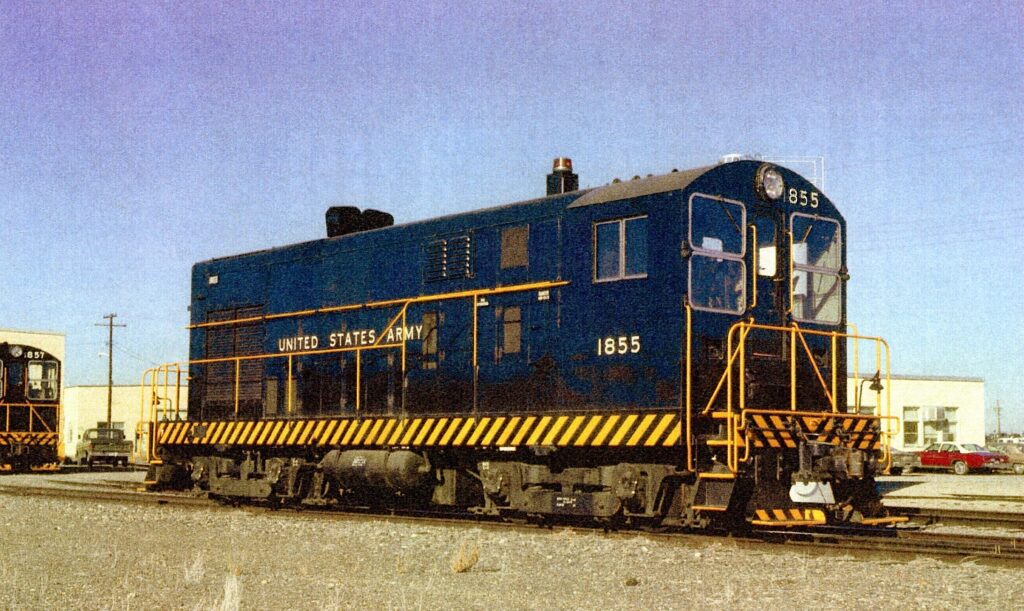
One of three FM locomotives at Sierra Army Depot, 1976-Courtesy of David Lustig, the photographer, published inTrains magazine in October 2024 and David Martin who copied the article and sent it to me.

Note: This is work in progress. It is hoped that when this is posted, some one may come forward with additional information.

The Fairbanks Morse Switcher Locomotives were a rare breed. There were only 336 manufactured between 1950-1961. The Sierra Army Depot, at Herlong, had three. In 1976, the Sierra base railroad operated five days week from 7:30 a.m. to 1:30 p.m. The main purposes were to shuffle cars arriving from the Western Pacific which could range anywhere from two to ninety. I do not know when the depot acquired these locomotives, nor when  they were discontinued by the depot..

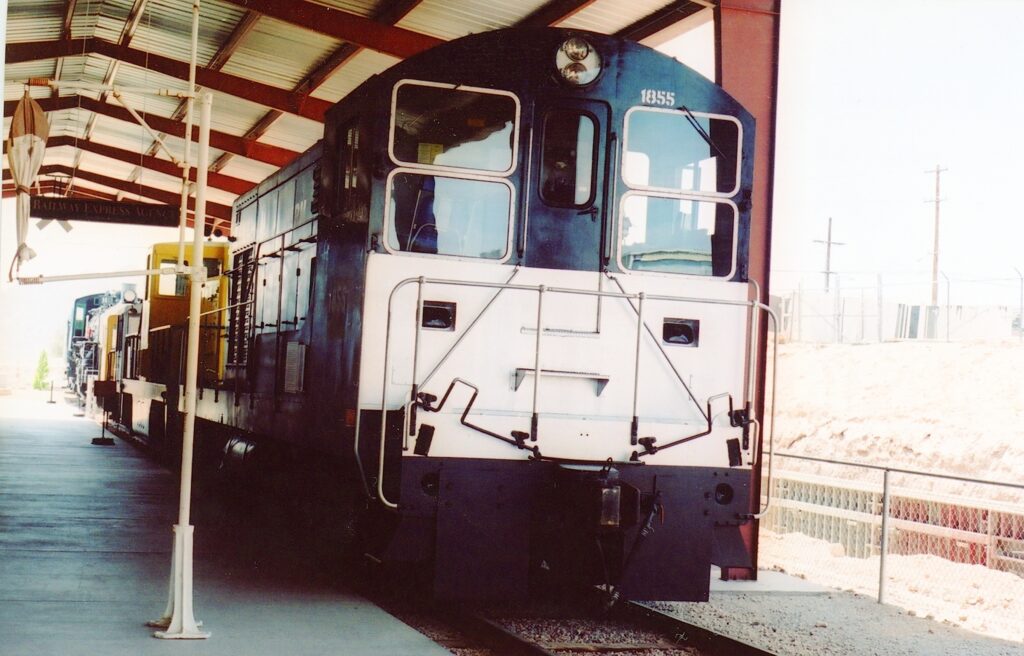
The No. 1855, as seen above is now at the Nevada State Railroad Museum at Boulder City, Nevada. The No. 1857, is part of the collection of the Western Pacific Railroad Museum at nearby Portola, California.

The FM Switcher 1855 now at Nevada State Railroad Museum, Boulder City, Nevada, May 2013. Photograph by David Martin

Hopefully, with this article will flush out other information.

Tim


An Alturas Train Question

The NCO Depot, Alturas, 1921-Jack Bowden

About a week ago Ken O’Connell relayed the following message, and an interesting train question at the conclusion. Hopefully, there are astute readers that  can answer Ken’s question. You may contact him at oconnell@uoregon.edu. Of course, you can always share you reply here, to enlighten us.

Ken wrote; “Recently I’ve been traveling through Alturas each time to drive to Reno to see my sister who is in Care. I have a question regarding the railroad transport in the 1940s and 1950s. My father, Daniel O’Connell, worked for Southern Pacific as an electrician. He would often ride along as several engines would pull a freight train that needed electrical work in one of them. Sometimes he would stay over night at a station in town and return to our home in Oakland, CA the next day.. My mother would say, “Your father will return tomorrow as he is staying in Alturas.”

“I see the hundreds of freight cars on tracks west of town. What role did Alturas play in those years as a station on the trains from the bay area?”

 Tim

A Wendel Map

1924 Wendel Railroad Map

Those rail fans may find this appealing, while others not. On the other hand it is documented for posterity.

Lassen County had to go through unusual hoops with railroad crossings at Wendel. They had to contend with the NCO’s narrow gauge and Southern Pacific’s standard gauge. In 1924, the county wanted to make a road alignment. The Southern Pacific agreed and provided the map above.

Tim

Lassen County – Viewland

In 1985, the Neversweat Chapter #1863, E Clampus Vitus restored the Viewland monument.

Viewland is the low summit between Mud Flat and the Honey Lake Valley. From this vantage point, emigrants in the 1850s, who had finally traversed the Nevada desert, obtained their first view of the Honey Lake Valley and the Sierra Nevada Mountains. The Nevada-California-Oregon Railroad established a station there named Murray, but when the line was broad gauged by the Southern Pacific Railroad it became their Viewland. The siding was important for sheep growers who, after shearing, would haul the wool there to be shipped out by rail.

Spread the word, and encourage a friend to subscribe.

Wendel’s Time To Shine

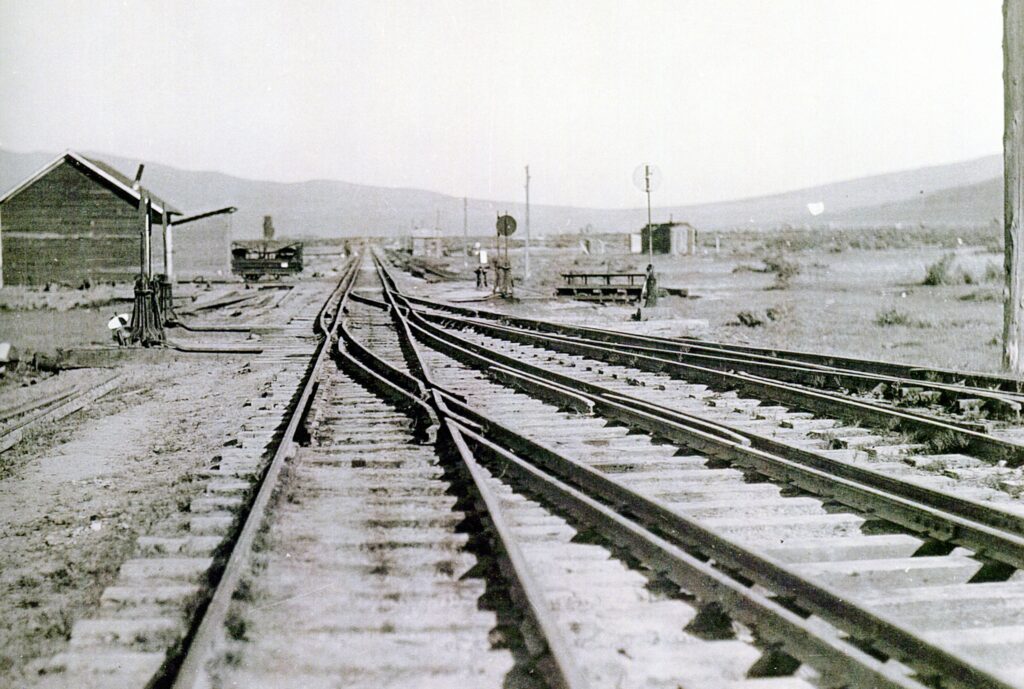
Looking north of Wendell during the change to from narrow to broad gauge.–Jack Bowden

Wendel one of those railroad communities that in early years had an identity crisis. It was first known as Upper Hot Springs to distinguish of Lower Hot Springs five miles to the south. The later became known in Amedee in 1890,, when the Nevada-California-Oregon Railroad (NC0)extended its line there. In 1899 the NC0 extended its line, the small station there originally called Smithon, though general usage was Hot Springs Station. Since it was close proximity to Amedee it was hampered any type development. In 1913 Southern Pacific’s Fernely & Lassen Branch crossed the NCO tracks at Hot Springs with little fanfare. It should noted that in 1915, Wendel designation applied to railroad stations and the post office.

Wendel Store, circa 1925. Courtesy of Alda Riesenman

Changes were on the horizon. In  1922, Wendel became NCO terminus. A couple years later, Southern Pacific purchased beleaguered NCO. Then on July 1, 1927 800 railroad workers descended there  to broad gauge the narrow gauge. For some time, there was hub of activity at Wendel. Then in the fall of 1929 J.E.Faustino recorded the Wendel townsite. Susanville’s Lassen Mail newspaper went on  the Wendel bandwagon during the spring of 1930 and published statement: “Certain people may prefer to scoff at Wendel as a possible metropolis of the plains, but the fact that there is more than sagebrush down there has been proven throughout past two weeks. There is good fortune in Wendel, and farsighted people will soon be watching this place to see what happens.”

To Support, Please Donate or Subscribe 
 

Upcoming Southern Pacific Railroad Convention

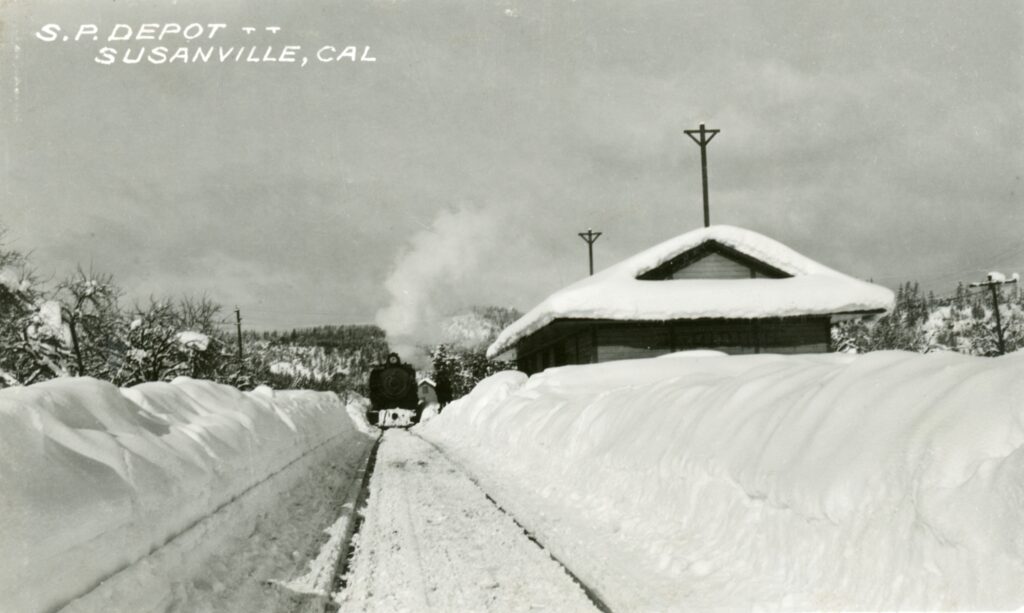
Susanville’s Southern Pacific Depot, 1929—Hank Martinez

While the Southern Pacific no longer exists, it is not forgotten. The Southern Pacific Historical & Technological Society carries on to preserve its history. This year the organization will hold its convention in a railroad community the Southern Pacific made–Sparks, Nevada. It will be held from October 16-19.   To learn more about the event and the registration form you can find the information here.

Yours truly was invited to be a guest speaker, a tremendous honor. Alas, I had to decline. I had the dilemma of scheduling an earlier  presentation of the local Native Daughters of the Golden West. The latter, after nearly nine months since I  received their request will occur on California’s Admission Day (September 9).

Tim

The Doldrums of the Early 1900s

Susanville, 1910

Before there was the Great Depression of the 1930s, there was the 1893 Depression. The recovery from the latter was a slow process. Take for instance, the NCO Railroad remained stalled at Amedee for most of the 1890s. It was not until 1899 that the railroad finally began to extend its line northward to the Madeline Plains.

Standish, 1910–Prentice Holmes

The utopian community of Standish floundered since its beginning in 1897. While company officials stated their goal was to take a slow course, that  proved disastrous. In 1901, Associated Colonies the organizers/promoters of Standish went bankrupt.

On the surface in 1900-1901it looked like was Susanville booming. Four major brick buildings were constructed, but that was partially in response to recovery of a major fire in June 1900 that took a huge chunk of the town’s business district.

One area that looked promising were the proposed railroads. There was the Marysville- Susanville Railway, the Oregon Short Line to name two. While the so-called paper railroads never materialized, they did have surveyors in region, thus adding to speculations.

Tim

Susanville’s Distinct Southern Pacific Depot

Susanville Depot, 1914

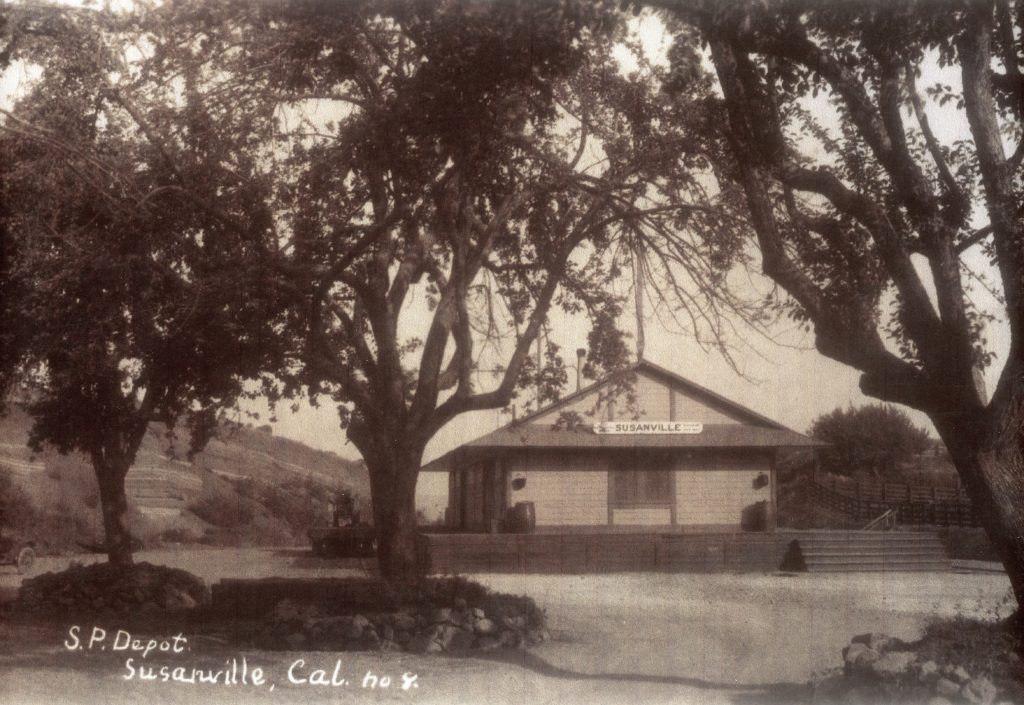
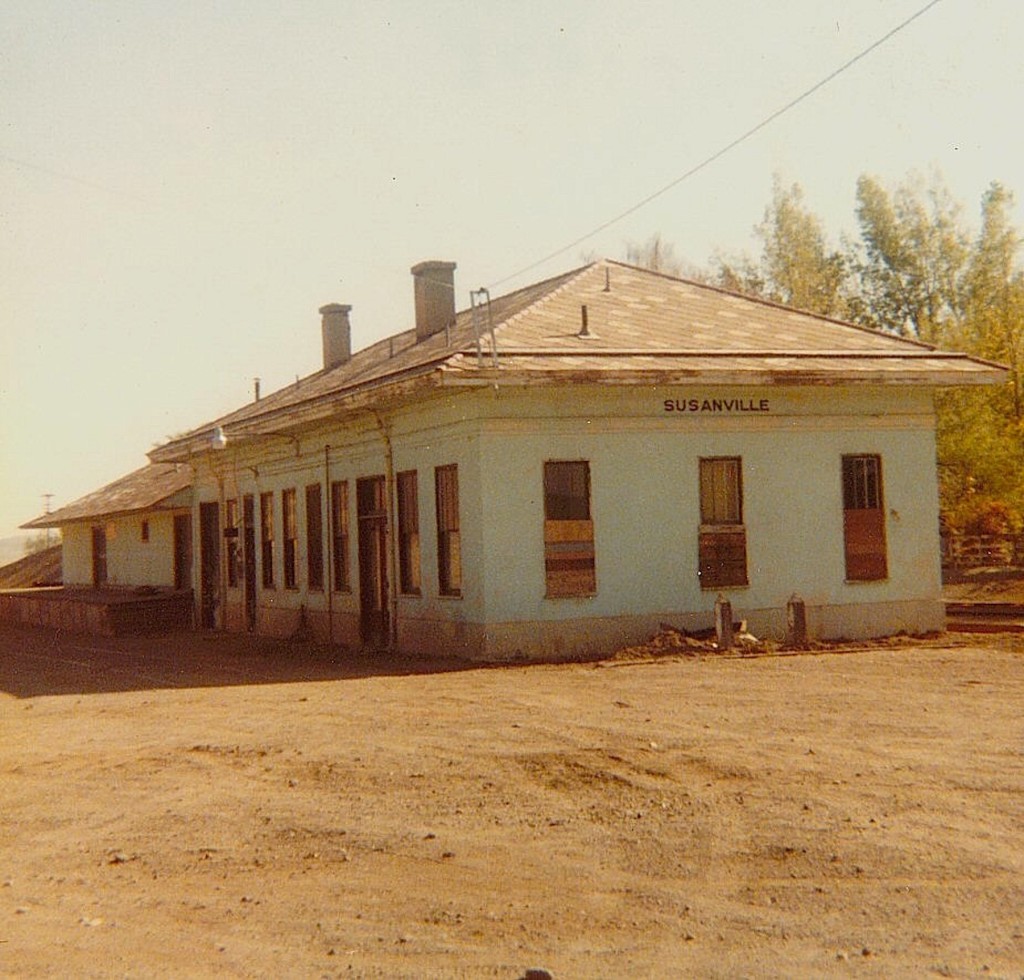
Susanville’s Southern Pacific Railroad Depot on Richmond is unique in many ways. By the time the railroad reached Susanville in 1913, the company had already adopted a set of standard depot building plans.

In 1913, the residents wondered what kind of depot they would have. As far as the Southern Pacific  were concerned it would be a modest structure, since in their opinion, Susanville was a small community that had no industry.  A wooden 26 foot by 62 foot depot was built, being part passenger depot and part frieght shed. It opened to the public on September 14, 1913 with C.B. Morton’s the first depot agent.

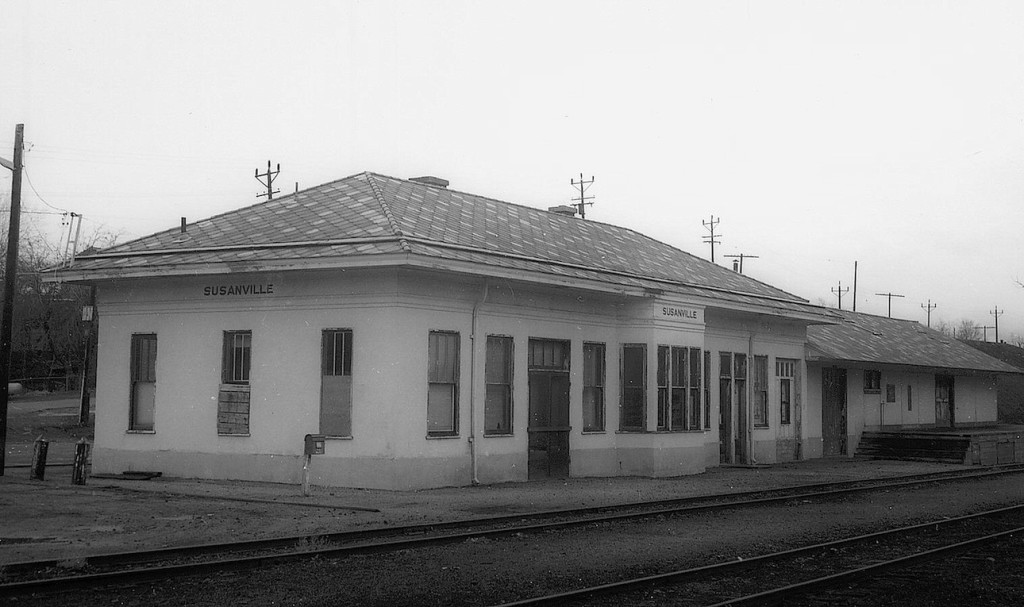
Susanville Depot, 1970.

Times quickly changed and by 1921 Susanville boasted two large lumber mills—Fruit Growers Supply Company and Lassen Lumber & Box Company. The original depot was no longer able to meet the needs. In 1927, the Southern Pacific constructed a 75-foot addition and unlike other depots its exterior was stuccoed.

Depot 78
Susanville Depot, September 1978.

Times were rapidly changing, especially with the State of California’s ambitious highway construction plan. As automobile travel became the preferred mode of transportation, travel by train declined. In 1933, rail passenger service at Susanville was eliminated. In 1979, Southern Pacific closed the depot.

To Support Donate or Subscribe

The Local Benefits of the Iron Horse

Leona Jackson at Susanville’s SP Depot, 1919–Lola L. Tanner

In 1913-14 when the Fernley & Lassen Railroad was built through a major segment of the Honey Lake Valley, the residents rejoiced. This was especially true for the agricultural community. While there was the NCO railroad, many deemed it expensive and unreliable. There was also other issue, its depots were not conveniently located.

Yet, on the other hand, no one knew what to expect when the Red River Lumber Company established its company town of Westwood. The agricultural community was overwhelmed that it had a large local market, and thanks to the railroad it was easy to get their products to Westwood. The scenario would repeat itself with establishment of the lumber mills—Lassen Lumber & Box Company and Fruit Growers Supply Company—in Susanville. The bottom line, it came as a total surprise that the railroad would create a large local market for local products. The region witnessed an increased local production in the agricultural sector, that allowed for more export of produce by rail.

Subscribe

Fire Train Restrictions

fire train
Red River’s fire train, courtesy of Doug Luff

The Red River Lumber Company at its Westwood operation developed its own fire trains used to fight forest fires. Of course, Red River had its extensive railroad logging network. However, if Red River wanted to access the Southern Pacific’s railroad tracks between Westwood and Susanville there were protocols set by Southern Pacific. In 1936, a Southern Pacific Bulletin stated ”The fire train of the Red River Lumber Company may make the following speeds: Between Mason and Westwood Junction, 35 MPH’ Between Westwood Junction and Susanville, 25 MPH; and through all tunnels, 10 MPH.” I do not know what type of restrictions the Western Pacific imposed.

Tim