Tag Archives: Politics

The making of Maud Tombs

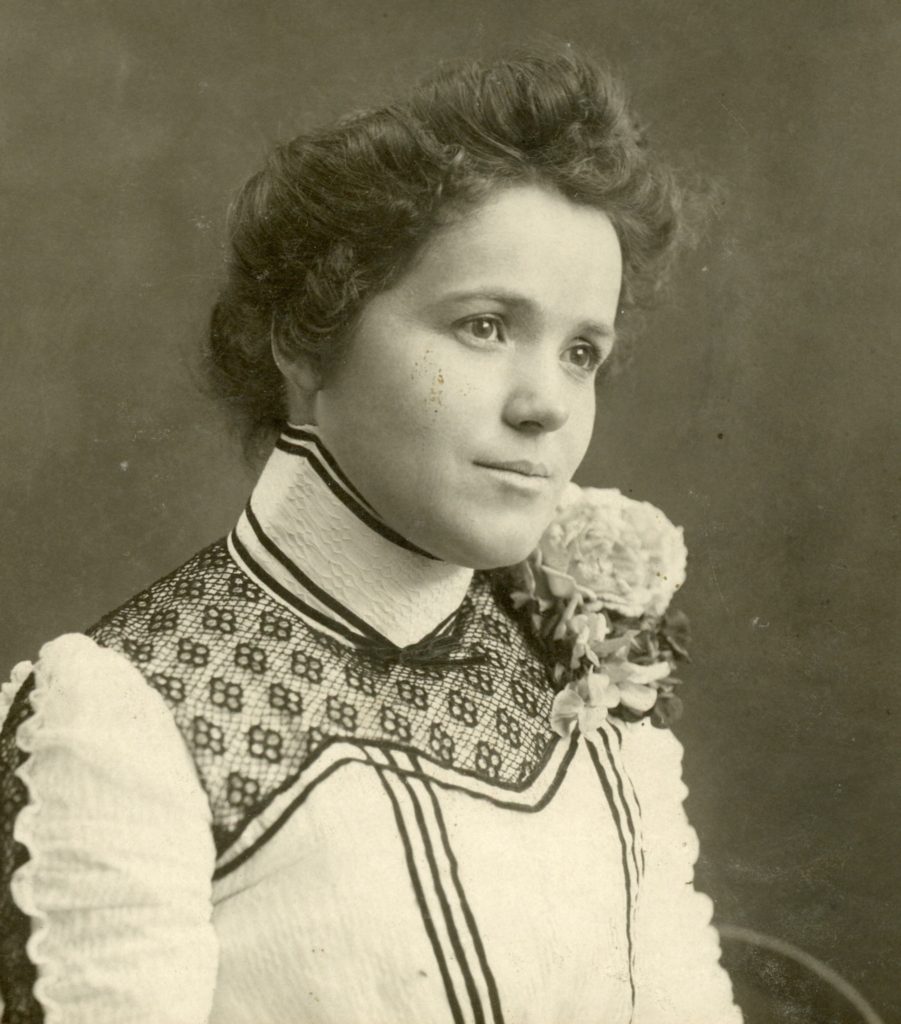
Maud Tombs, 1900. B.R.Zimerman Collection

In 2017 when I conducted the Lassen County Courthouse Centennial Cemetery Tour I wanted to include the grave of Lassen County Clerk Maud Tombs. I was prudent in the grave selection, because I had no idea what the attendance would be. If it was large, which it was, I wanted the selected graves easily accessible and eliminate as much possible potential hazardous features such as grave copings. Maud’s unfortunately did not fit into the easy accessible category.

Maud Edna Long was born on May 2, 1875, in Susanville, the eldest of ten children of John and Margaret Long. By the time she was born, her family already had an influence in the region’s history. The town of Longville in Humbug Valley, Plumas County, was named for her grandfather, William B. Long back in 1861.

On August 3, 1897, Maud married George L. Tomb. He was a native of New York and came to Susanville in 1890, no doubt influenced by the Pardee family, relatives of his. In 1898, George entered the politcal arena and ran for Lassen County Clerk and won. In 1902, he ran for a second term and was elected. Going for a third term, the voters rejected him and he was replaced by George Bassett. For whatever reasons, in early 1907, George sold his furniture/undertaking business and moved his wife Maud, and two daughters, Nadene and Gladys to Red Bluff. It did not take long for Maud to discover her husband’s dark side, a gambling problem. Before 1907 concluded Maud left him and returned to Susanville with their two daughters. Upon her return there was a distinct little name change in her last name, an “s” was added and she was now Maud Tombs.

In 1918, Maud decided to run for Lassen County Clerk against the incumbent George Bassett who had defeated her husband. Joining her on the ballot was Robert Kyle of Westwood and Elmer Winchell of Standish. The primary held on August 27 showed it was a race between Bassett with 73 votes and Maud with 66, the other two candidates combined only garnered 25 votes. The general election was a close race, and a problematic one on reaching out to the voters due to the outbreak of the Spanish influenza. Maud won the election with 991 votes with Bassett trailing at 976. Maud would go on to be elected seven more times. In 1951, she was succeeded by her daughter Nadene Wemple who would serve four terms as Lassen County Clerk.

Two final notes. Maud was the first woman elected to a county wide office. Secondly, for over a century a woman has always been elected county clerk.

Never miss a story, click here to subscribe.
Cardenas v. Red River Lumber Co.

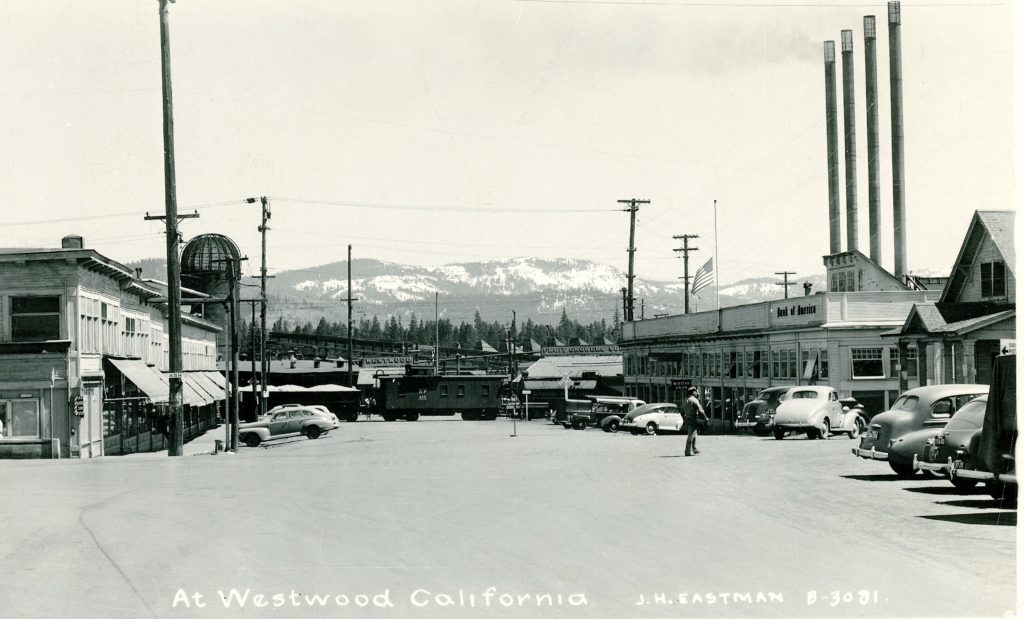
Westwood, circa 1940.

In many respects the case of Manuel Cardenas versus the Red River Lumber Company appeared to be like so many others before seeking damages from injuries sustained. In 1936, Cardenas sued Red River for $50,000 from loss of his right eye due to an attack by him by Deputy Constable David Bohannon, a Red River employee. Thomas C. Ryan, a San Francisco attorney who represented Cardenas stated at the opening of the trial “Red River owns and controls Westwood.” Many folks thought that way, but feared publicly to say it. The Susanville business community had a code name for Red River—the Red octopus. It was a reference Red River’s tenactles were everywhere in Lassen County. Anyhow, Red River’s attorney, Hardin “Finn” Barry of Susanville retorted, “Every commercial business is operated by private business.” This was a recent event, as part of a reorganization of the company. Had this event occurred ten years ago, Ryan’s words would ring true. In the end, Cardenas was awarded $3,000.

Subscribe

Milwood and the Annexation Issue

L.D. McDow Residence. Courtesy of George McDow, Jr.

It would take nearly a half century for Susanville, as a municipality, before it was able to expand its boundaries. Of course, politics played a pivotal role and the city’s most formible opponet was the Red River Lumber Company which owned the Milwood Tract east of the city limits.

Annexation efforts tried and failed with Red River’s influence. In the summer of 1928, the residence of J.A. Metz, who lived in the original McDow home in the Milwood Tract was destroyed by fire. Since it was outside the city limits there was no fire protection in Milwood and adjoining subdivisions. The fire prompted a petition drive for annexation. It was met with opposition and they were able to stop the movement in its tracts.

In 1930, an annexation campaign was resurrected. A committee was appointed to investigate the many issues and report back to a public meeting scheduled for March 10. It was decided to take a poll in the Halltown and Milwood Districts to obtain the residents’ pulse on the measure. For the proponents it was not good news. The initial poll showed 156 against annexation to 47 for it. End of discussion and remained that way for nearly a decade.

Never miss a story, click here to subscribe.
Toad Town No More

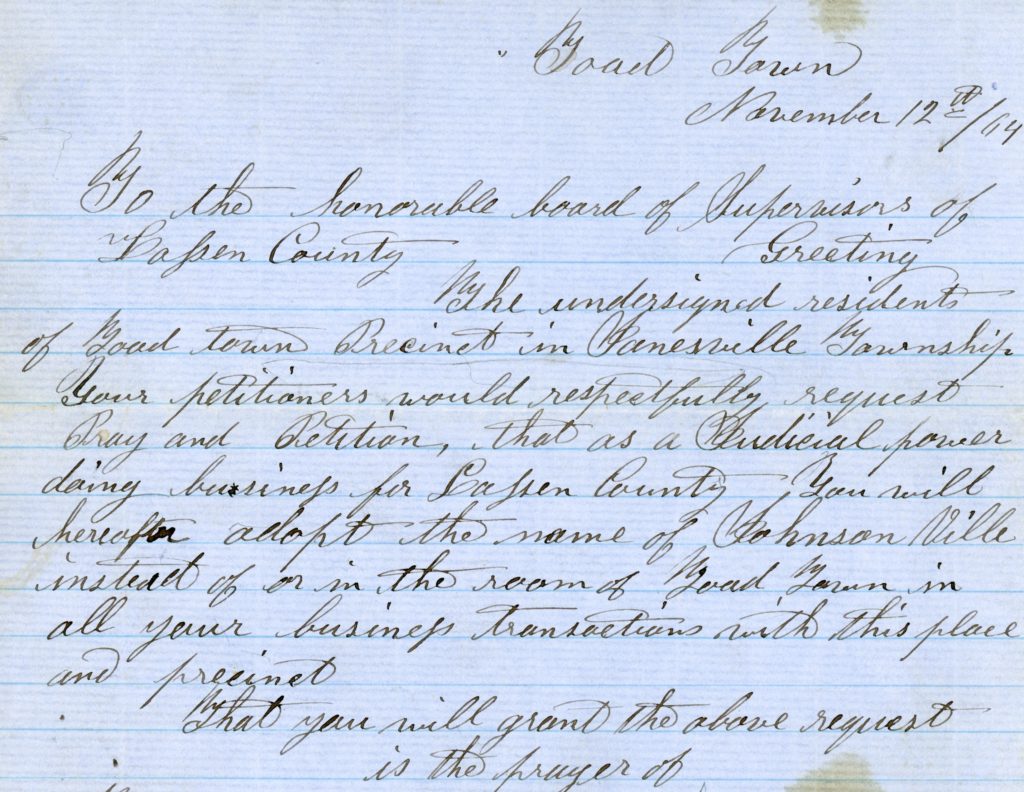
The November 12, 1864 petition.

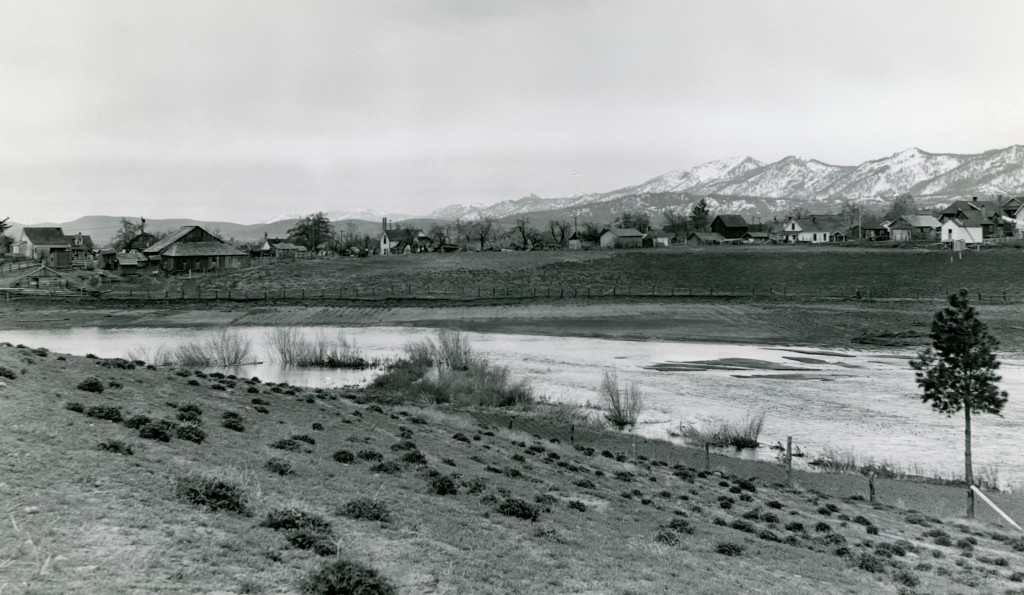
In its earliest days, Johnstonville suffered an identity crisis. In the mid to late 1850s, a whenever a warm spring/ summer rain storm hit that area and its aftermath caused a swarm of frogs/toads to appear and someone gave that district the name of Toadtown. In 1864, when Lassen County Board of Supervisors were busy with the formation of the county, they named the voting precinct there Toad Town. At the same time, the board named the school district there Susan River. There were some people who did not like the monicker of Toad Town. A dated petition of November 12,1864 signed by 41 individuals asked the Board of Supervisors to change the name to Johnsonville, the “t” omitted. Another peculiar thing about this petition besides the spelling, was the majority of the people who signed it, lived in Susanville. On December. 7, 1864, meeting of the Board of Supervisors they approved the petition as submitted,  changing the Toad Town Voting Precinct to Johnsonville. As to the Susan River School, they did not change the name to Johnstonville until 1878.

Subscribe

Your Vote Counts

1927 holiday greeting card from the Lassen County Sheriff’s Office. Left to Right, Sheriff Jim Leavitt, Deputy Tom Massey and Deputy A.C. “Cass” Hunsinger.

Today, residents in far northern California will go the polls in a special election to elect a new State Senator. Having worked elections for many moons, so I want to give a special thanks to all the poll workers that make it possible.

With that in mind, here is a bit of local election history.  The race for Lassen County Supervisor, District No. 2 was a cliffhanger. On Thursday after the November 1936 election, incumbent Seymour Case had 1,055 votes and challenger, former Lassen County Sheriff Jim Leavitt had 1,026 votes. There were still ninety absentee ballots to be counted. When the final count was tallied Leavitt won by two votes—1094 to Case 1092.

Subscribe

Barnes Hog Law

Piute Creek
Piute Creek, April 9, 1938. Courtesy of Betty Barry Deal

In 1870 the California Legislature passed a law that prohibited hogs from running at large in the village of Susanville. This was serious business, since the problem was so bad, the residents had to petition Sacramento for assistance! Take for example that on May 22, 1864, Isaac Roop, the owner of the town’s water system sued Hiram Teft for allowing his hogs to roam freely. It should be noted the town’s water supply was from Piute Creek, and was distributed through open ditches. In Roop’s court complaint he cited, “ Teft’s hogs has entered and wallowed in my water ditch and has urinated and deposited excrements therein whereby the water running in said ditch has been muddied and rendered filthy and make unfit for use.” Roop sought $50 in damages and loss of water sales. As no judgment was entered into the court, Teft and Roop must have reached an agreement.

Subscribe

National Forest Receipts Program

Timber fallers, Lake Almanor, 1927. Courtesy of Roy Rea

Once upon a time, this program established in 1908, had a major impactof funding for local governments where national forests were located. Initially, twenty-five percent of timber sales were distributed to counties where government timber was sold. These funds were earmarked for roads and schools. For many decades in Lassen County it was a huge deal. For example in 1926 Lassen County received $33,886.28–the third highest amount in California. While that figure may seem small by today’s standards, that sum represented one-quarter of Lassen County’s budget.

Subscribe

Riverside Park Revisited

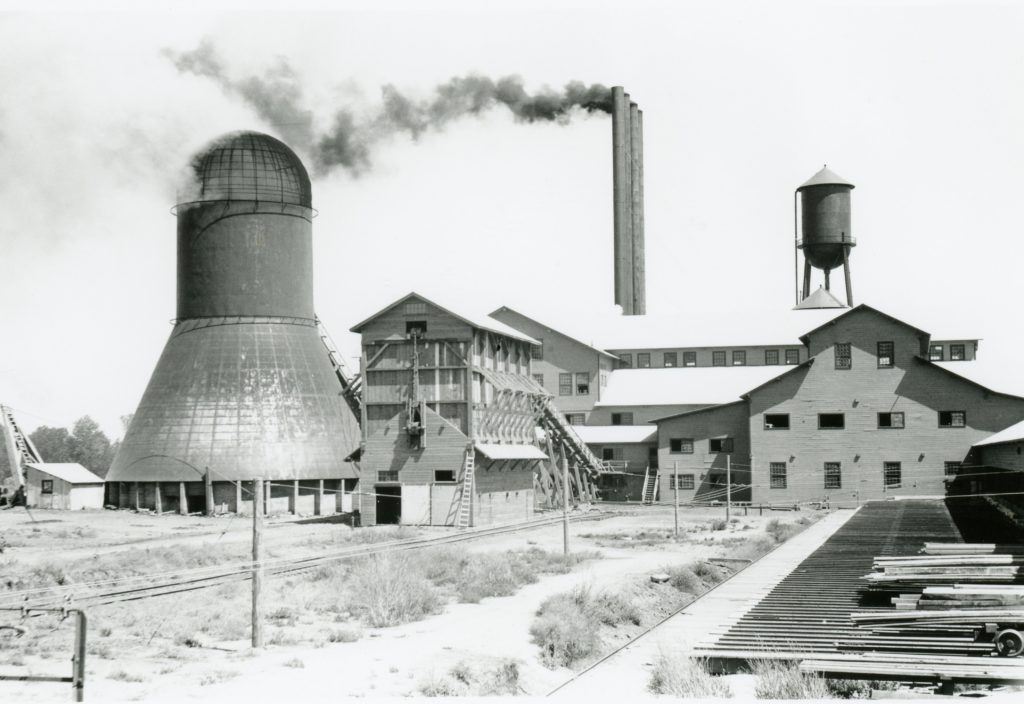
The Susanville plant, 1921. Courtesy of Ed Standard

In this era of being bombarded with the term “fake news” the City of Susanville deserves a gold medal award to distort the record to accomodate someone’s warped mind. It should be noted, after all, I have spent the majority of my life researching the region’s history to provide an accurate record versus false statements, which is different from folklore. For instance, when my Eagle Lake book was published in 1988, Bob Amesbury congratulated me, since he had written a book on the lake, too. Bob went onto say that he had all the bullshit and I had all the facts.

Fast forward to the summer of 2018, when at the City’s urging I met with with two officials, Mr. McCourt and Ms. Schuster, concerning the history of Riverside Park. It was an exercise in futility, for this dynamic duo, could care less about the history of site, and were bound and determined to change the name of Riverside Park to Fruit Growers  Park, regardless of the facts, which ultimately they were successful, using a deceptive survey, that the general public was excluded.

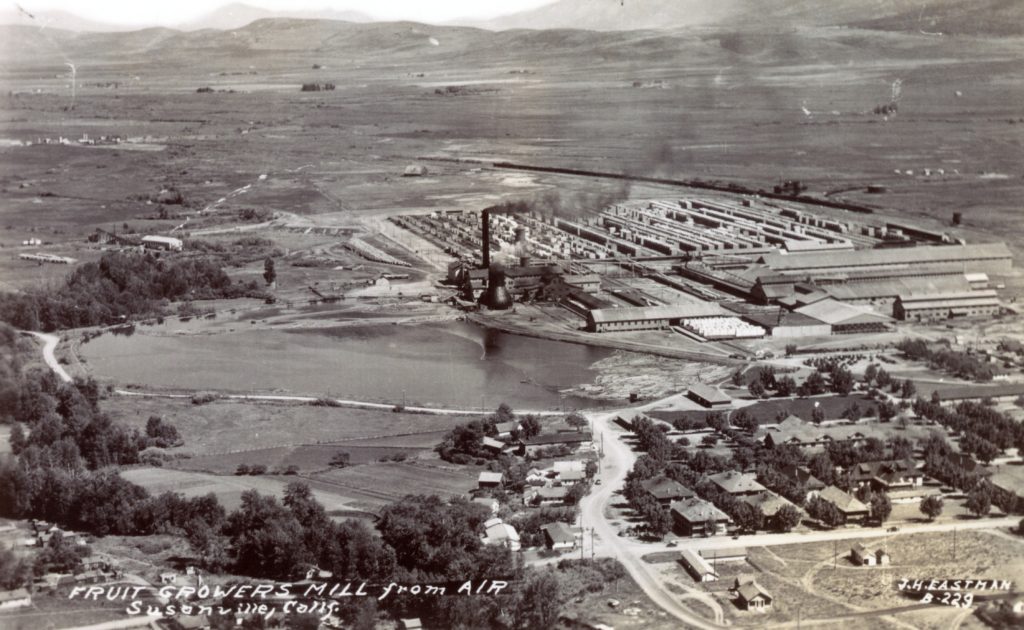
Fruit Growers Supply Company, 1936

Oh, dear reader, it gets worse. To support their claim they lied on the record at a city council meeting at the September 5, 2018, and that information then appears in the local newspaper only to get perpetuated. One of Schuster’s first comments that the city gave Fruit Growers the millsite property consisting of 256 acres, which it should be noted was larger than the city itself, and was located over a mile away from the city limits. Just the twenty acre parcel where the park is located, Fruit Growers purchased that from George and Pearl Bassett for $9,500. In all, Fruit Growers spent more than $60,000 for the millsite property and water rights. It just gets worse. Schuster noted that Fruit Growers sold the mill to Eagle Lake Lumber Company in 1944. Fact, Fruit Growers sold to Eagle Lake Lumber in 1963 for $875,000. Later on it was mentioned that Fruit Growers donated the park property.  Excuse me. The city purchased it in 1976 for $23,000 from Sierra Pacific Industries, and it was not the city’s first choice. The city was trying to buy Vallejo Meadows along Piute Creek, north of Willow Street, and west of Parkdale, as part of a greenbelt program, but that deal fell through.

In closing then, with the City’s current thinking, Riverside Hospital where I was born and lots of others could not have existed under that name, as it must have been Fruit Growers Hospital. 

Subscribe

Virginia’s Black Face Controversy

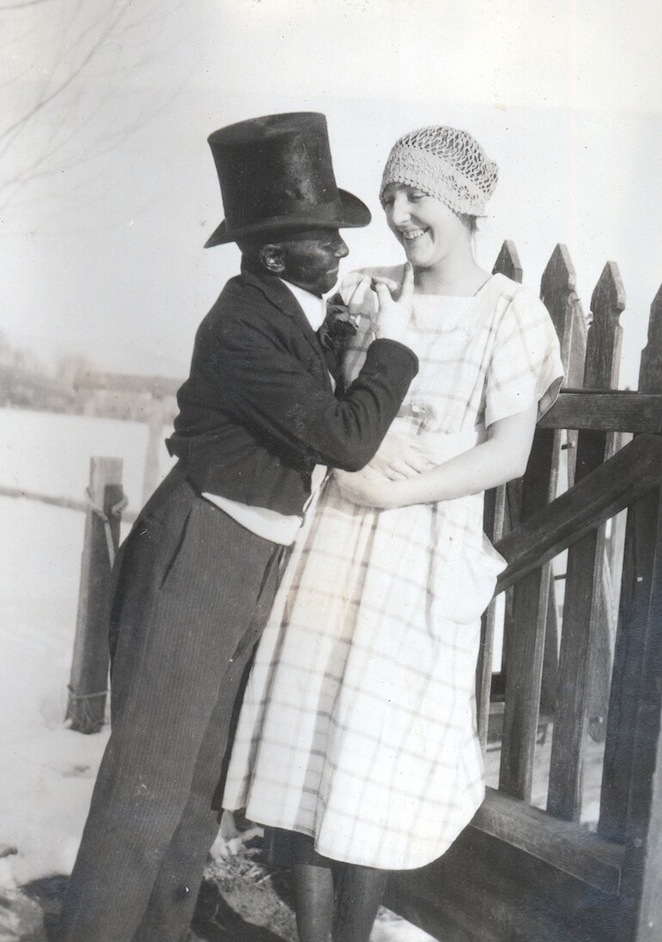
Susanville resident, Fred Brockman, dawning a black face for a 1918 event.

If you have been following the national news, then you aware of the Virginia governor linked to a “black face photograph” in his college yearbook.

So you maybe thinking, what does this have to do with Lassen County history.  In the annals of its history, it is something that was part of the culture across the country over a century ago. Take for instance that on Thanksgiving Day 1900, the Milford Dramatic Club held its first entertainment—a Coon Dance.  While attendees were not required to dawn a “black face,” those who wanted to participate in the “Cake Walk” were required. The cost for attendees was $2.00 that included a midnight supper, and to pay for Susanville’s Pastime Orchestra, who provided the music.

Subscribe

T.N. Long – A Lassen County Politician

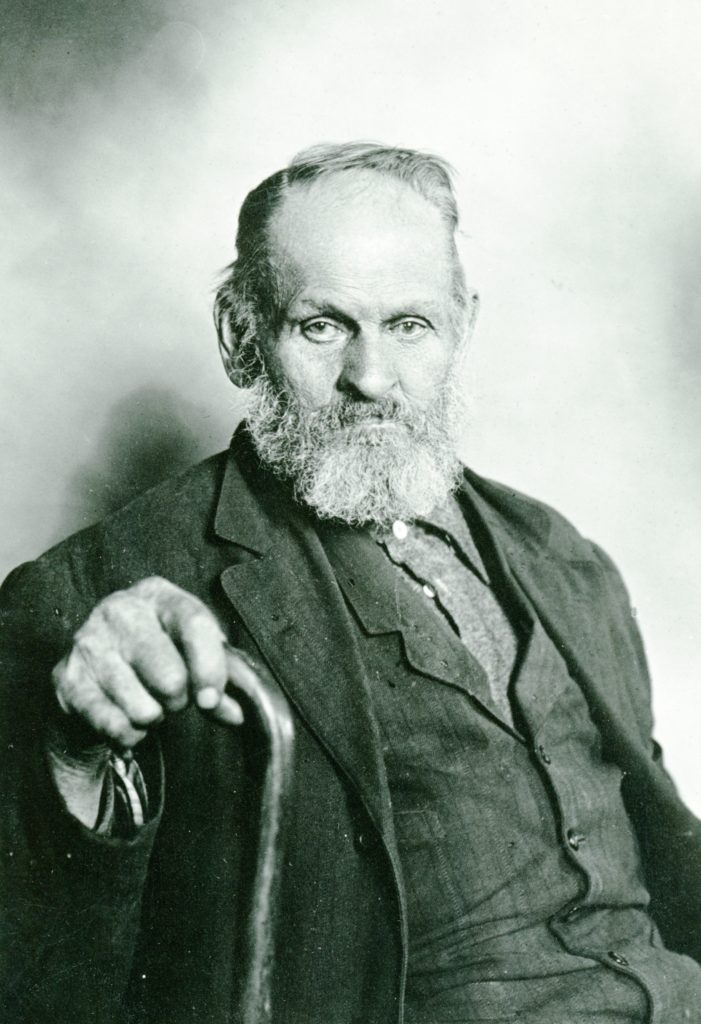
T.N. Long-Courtesy of his grandson, Jack Howard Long

It should be duly noted, that Thomas Newton Long (1833-1917) is not related to the other Long family of Susanville. It is somewhat similar to the Doyle Doyles and the Milford Doyles, as they are not related, just makes things confusing.

This Alabama native came to Susanville in 1861 and with A.R. Leroy operated a saloon. He would have a colorful career in county politics when in the fall of 1867 he was elected sheriff of Lassen County and re-elected in 1868. In 1871 he ran for county treasurer and lost. In 1874 he was elected Lassen County Supervisor, District 1. In 1877, he was elected county treasurer and served one term.  In 1882, he was elected Supervisor District 1 and remained in that capacity until 1900. Outside of county government he operated a livery stable and had a family of fourteen children. On footnote, the location of the livery stable, would later become the Telephone Building, and also the first location of Safeway.

Subscribe