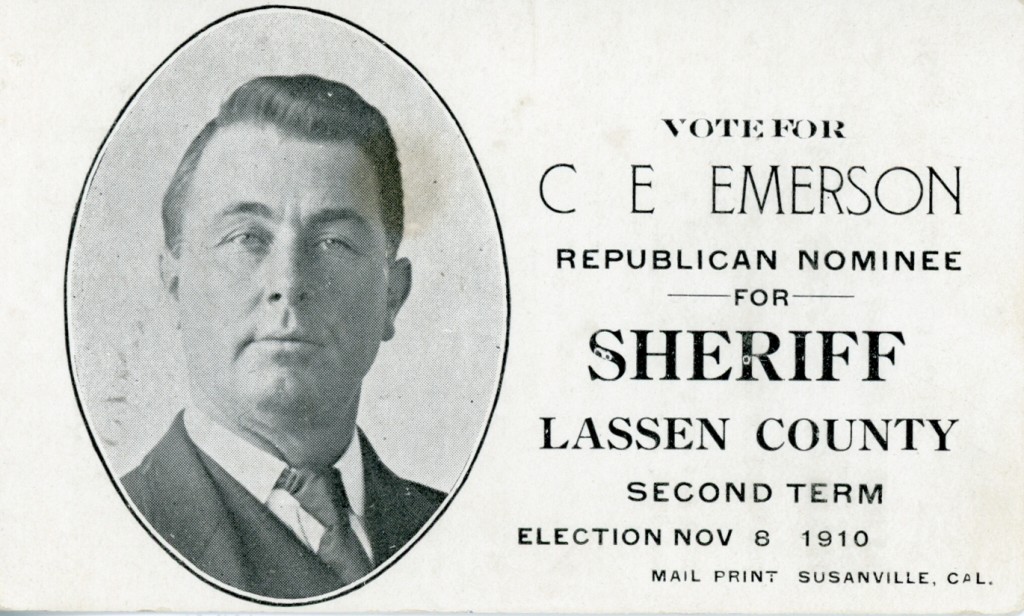
It is Election Day. So herewith is a local election story. In 1910, Charlie Emerson was in a heated race to retain the office of Sheriff of Lassen County. His calling card was rather unique and very interesting. Below, is what appeared on the reverse side. Continue reading Election Season – 1910→
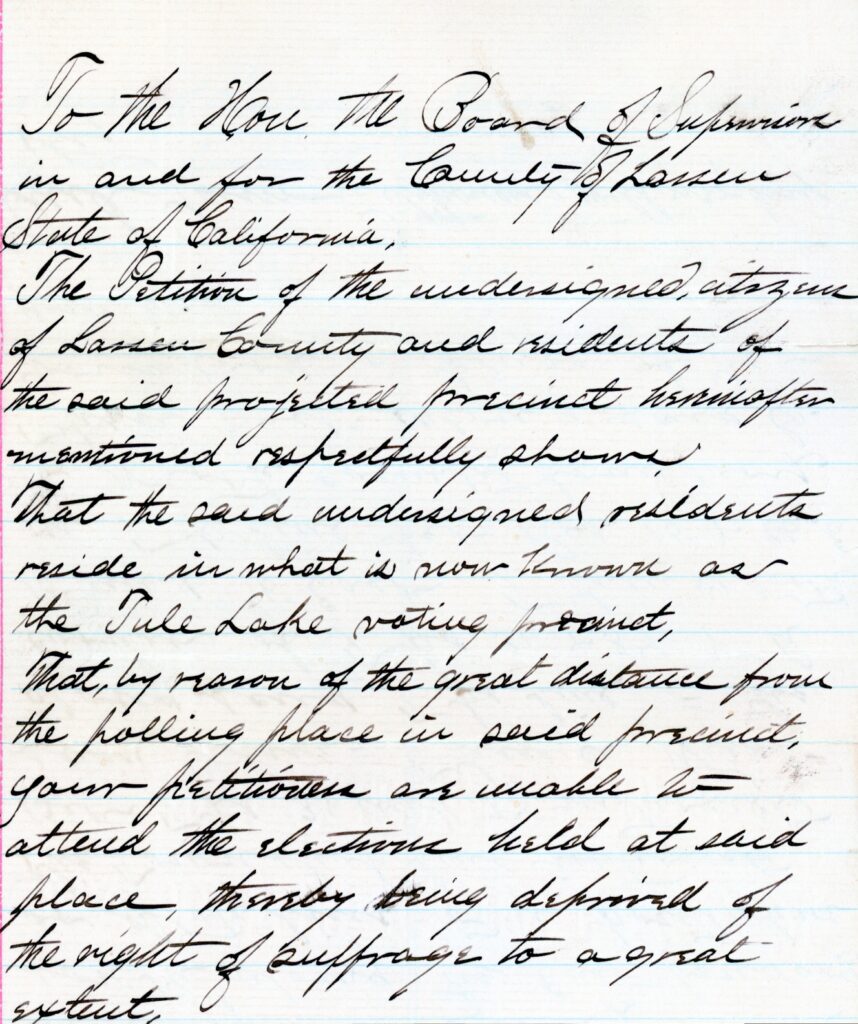
Since Election Day is upon us, I thought I do a piece on some early election history. Just as a region was dotted with rural one-room schools and post offices, there was another feature–voting precincts. Like schools and post offices it only made sense. To create a voting precinct was simple process. One petitioned the County Board of Supervisors.
On September 29, 1886 a petition was submitted to the board for the creation of the Tule Lake precinct. It contained nine signatures. The proposed boundary was in the very far northeastern corner of Lassen County, the area known as the very southern end of Surprise Valley. The Board obliged and the voting precinct was established.
In the spring of 1902, E.W. Hayden, editor/publisher of the Lassen Advocate raised the issue for the need of a high school. Hayden proposed a district high school, rather than a county one. Hayden felt that all the school districts in the county would not support a high school.
In the fall of 1902, Hayden again revived the issue for a high school. This time he succeeded in generating more interest. In September, John Spalding and Franklin Ward circulated petitions to have the matter placed on the ballot for the November election. On October 2, 1902, those petitions were presented to the Lassen County Board of Supervisors and they approved the ballot measure.
Proponents were worried that the voter’s might confuse the issue as a bond measure. Yet, funding for a high school still had to be addressed. It was proposed that the property tax be increased by one cent per $100 assessed value. This tax would generate $3,700 a year-more than sufficient to operate a high school.
As the ballot proposition called for the creation of a county high school, there was Hayden’s concern that it might not pass, especially with the voters far removed from Susanville. Surprisingly many of the outlying school districts were supportive of the measure. After all, the nearest high school available was Reno, Nevada.
On November 4, 1902, the voters of Lassen County went to the polls. Th voters approved the creation of the Lassen County High School by a large majority with 637 votes in favor and 295 opposed.
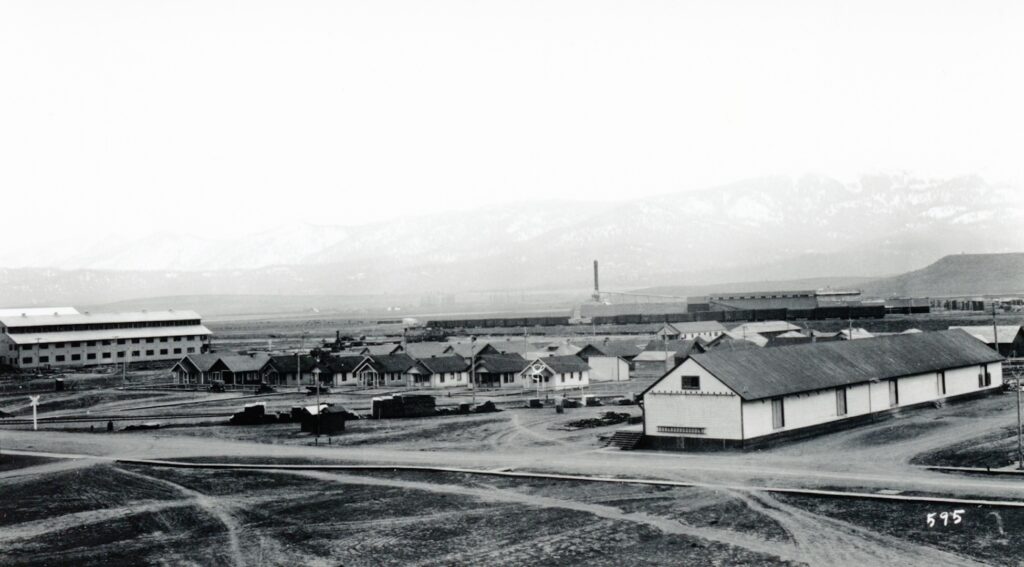
Fruit Growers Supply Company had another issue besides the housing shortage when they opened their Susanville plant in 1921. Inflation had a been issue not just locally, but nationally. However, Susanville’s prices were higher than elsewhere. There were accusations that the local merchants were gouging consumers to take advantage of the tremendous population growth.
Fruit Growers employees complained. Did they ever. Fruit Growers even hired an undercover detective to investigate. It turned that yes, Susanville prices were high, but the local merchants were not gouging any one.
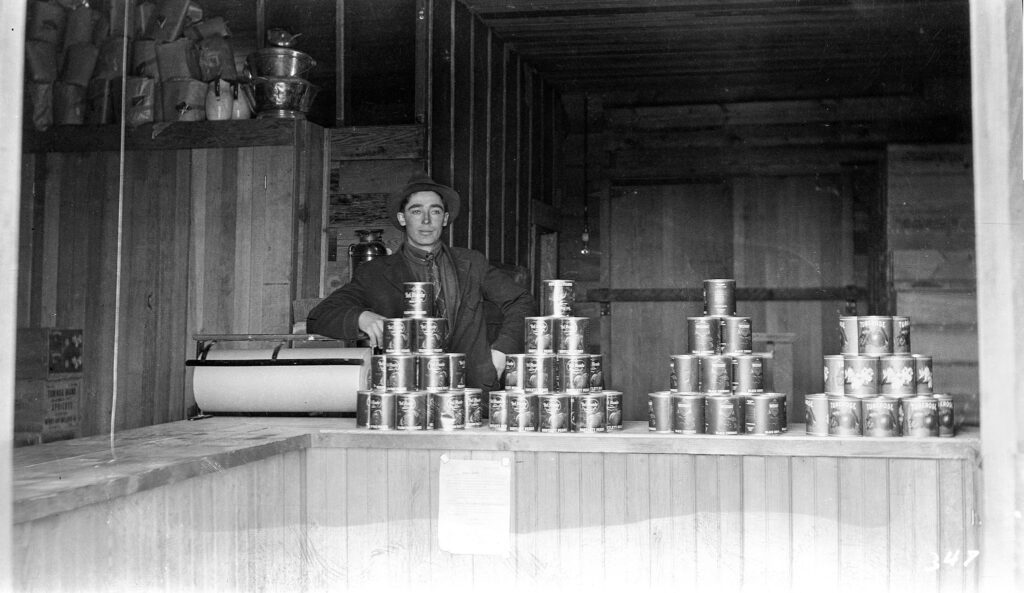
Fruit Growers Commissary, 1921–Ed Standard
Fruit Growers solution, they opened a commissary. It ws nothing fancy and carried the necessary staple items. The commissary opened on December 12, 1920 and the discount store was only available to Fruit Growers employees. Local Fruit Growers manager, S.M. Bump wrote in a memo “Merchants can exploit all they want.”
Over the ensuing years the commissary evolved and would eventually be open to the public. Its name became Sunkist Grocery. While the store no longer longer exists, the building does. It is now the Lassen Senior Center at 1700 Sunkist, Susanville.
In September 1933, the City of Susanville had transferred the right-of-way of Main Street to the State of California. This was in accordance with State legislation for integration of city streets that were part of the state highway system. In the beginning all worked well.
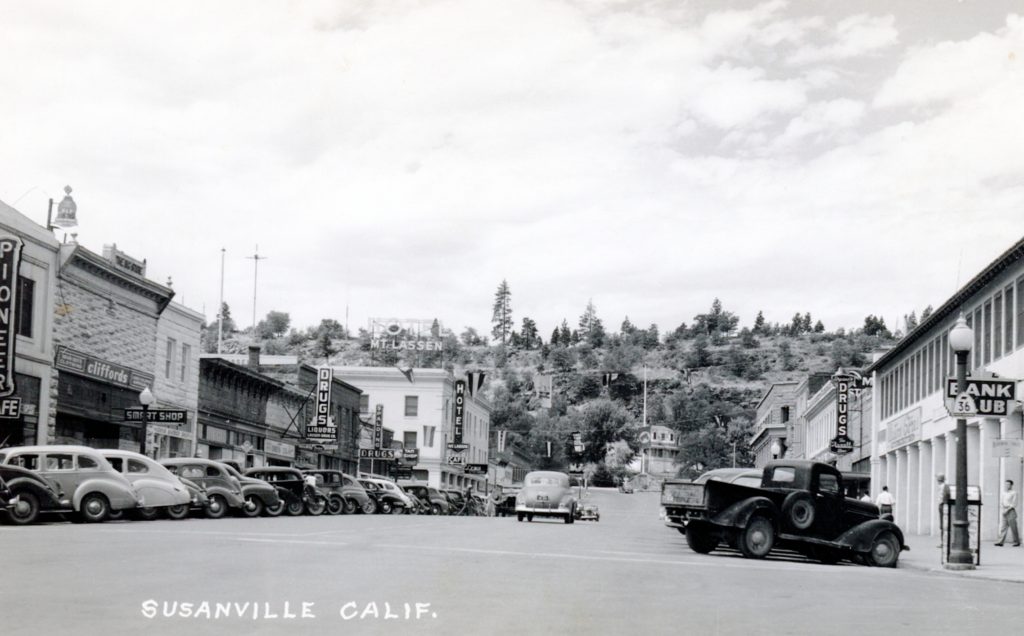
After World War II when life returned to somewhat normalcy, the City learned a few lessons of what they could and could not do—the hard way. In 1947, to alleviate congestion on Main Street, the City proposed to install stoplights at the intersections of Main with Lassen and Weatherlow. When the State Highway Division learned of this, it objected. The State said Main Street did not meet the requirement of 100 cars per hour passing through the intersections. Their solution to relive the congestion, introduce parallel parking on Main Street, then striping to make four lanes—two in each direction. That went over like the proverbial lead balloon with the merchants.
Over the next couple of years it was a highly debated topic. The resistance group was no match for the State.. In 1949, State Highway Engineer R.N. Putnam informed the City that it must discontinue angle parking on Main Street.
On July 10, 1950, the City Council moved forward to adopt parallel parking for Main Street. The Council no doubt was concerned that if it was not in compliance with State law, the State conceivably could withhold the City’s apportionment of gasoline tax money. The parallel parking ordinance went into effect on August 10.
There was, of course, public uproar. It was not until the summer of 1952, the issue had simmered down, and slowly everyone adjusted to the fact that parallel parking was here to stay.
One of the many wrecks at the retaining wall entering Susanville.
Susanville’s main thoroughfare has been an interesting political foot ball since the town incorporated in 1900. Initially, the major debate was fire issues. As the town progressed, some wanted civic improvements, others did not. Of course, those opposed, while they wanted nice items such as sidewalks, gutters, and paved streets, they did not want to pay for them.
The town’s Main Street would be and still is a contentious issue. The bickering between California Highway officials and the City began in 1920. The issue then, was the during construction of Highway 36 and its approach into Susanville.
The first battle was the approach. The City refused to give the State Highway Department the right-of-way to the town’s Main Street. The state would only build the highway to the city limits. To connect the highway to Main Street resulted in a nasty “S” curve. This was an internal problem with the city and problems with property owners not willing to grant right-of-ways to correct the situation. The retaining wall entering Susanville was the scene of numerous wrecks. But changes were on the horizon when the cash strapped city made a major concession that has ever since affected its main thoroughfare. More about that tomorrow.
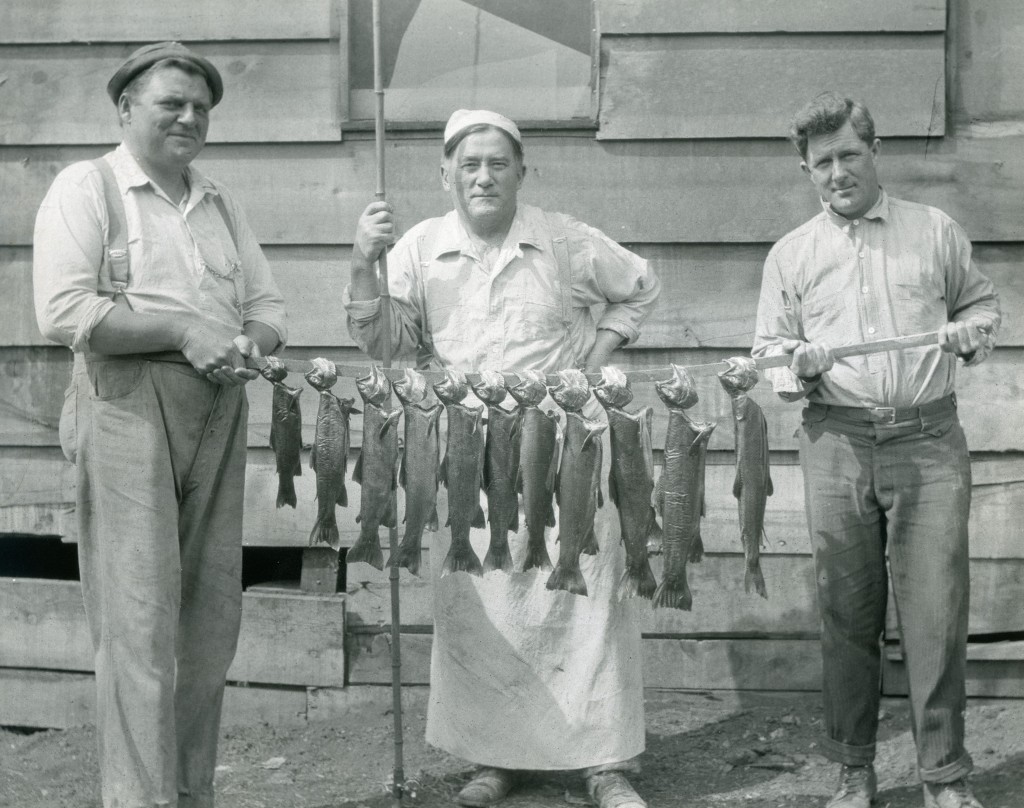
Bass fishermen at the south shore of Eagle Lake, 1914.
Having been a long time observer of local politics, I am past the stage of shock and awe. Every now and then in my research I come across some things that leave, well just plain dumfounded. Today’s topic is one them.
For unknown reasons on April 28, 1924 the Lassen County Board of Supervisors held a special session—the agenda item to ban fishing. The supervisors gave no rhyme or reason why such action was needed. It did not stop them from proceeding. They drafted an ordinance and they would adopt it at their regular meeting on May 5.
Camp 38, Red River Lumber Company at Lake Almanor circa 1925—Hank Martinez
The California Division of Fish and Wildlife was not amused. They informed the county supervisors the matter was unconstitutional. In addition, their local game wardens were told not to enforce it. The local nimrods were not pleased either and they let their voices heard. Needless to say when the board of supervisors held their regular meeting, the matter was tabled.
When Lassen Volcanic National Park was established in 1916, Congress only approved an annual budget of $5,000. This meager funding was a far cry from what was needed for basic improvements in a park that had none.
Yet, Lassen Park advocates were a persistent bunch and they explored a variety of avenues. Whatever the case may be, their lobbying tactics, however, were unsuccessful..One of the park’s boosters came up with an interesting idea upon the passing of former U.S. President Theodore Roosevelt who died in 1919, It was suggested to rename the park after Roosevelt. Not only would it be a memorial in his honor, but it was considered a venue to overcome its financial dilemma with Congress. An interesting thought that went no where.
It was on March 20,1987, the nurses at Lassen Community Hospital, then affiliated with St. Mary’s reached an agreement ending the eight week strike. Stephanie Kruse representing St. Mary’s stated, “Everhting went very well. It is over.” While union spokeswoman, Noreen Frieling added, “The ink is on the paper. It’s done.”
North Lassen Street, Susanville, showing City Fire & Hall, circa 1930
Tuesday, is primary election day in California, so I thought it only fitting to have an election story—oh do I have many having spent many years working as a county election official. One of the most disheartening aspects is when there is low voter turnout. The general public is not aware, just how much work and preparation is involved. Okay, enough of my soap box and on to the story at hand.
The April 1930 Susanville City Council election turnout was pathetic, only eighteen votes cast! Robert M. Cook, editor and publisher of the Lassen Mail wrote:
”On Monday of this week three men were up for election as members of the city governing board. Exactly eighteen votes were cast in the election booth. That number on the face of it shows there is no local interest in how the town is run or who runs it. And the men who are on the town council board are the men who say how and where the taxpayer’s money shall be spent.
”It seems reasonable to suppose that interest, more or less, would be cenetered at election time on whom should occupy places on this governing body. The few votes cast last Monday would indicate the reverse.
”Whether or not he or she should cast a vote is up to the individual concerned. And if a person is not concerned to the extent of casting a vote then adverse criticism should cease.
”The job of councilman carries with it nothing but work and grief. There is no salary attached to the office, nor rarely any credit for work done. It is more or less of a wonder that any one would take the office as a gift, let alone having to ‘run’ for it. The different men who hold places on the board should be given a vote of thanks for accepting the responsibility they do. Instead all they get is a lot of knocks by persons who are too indifferent to express their choice of whom they want through the medium of the ballot box.
”The office of councilman is an important one and should not be treated indifferently. If there is not any interest shown in who runs the town and does the work of planning and directing, then you can’t blame the powers that be if no interest is shown on their part.”