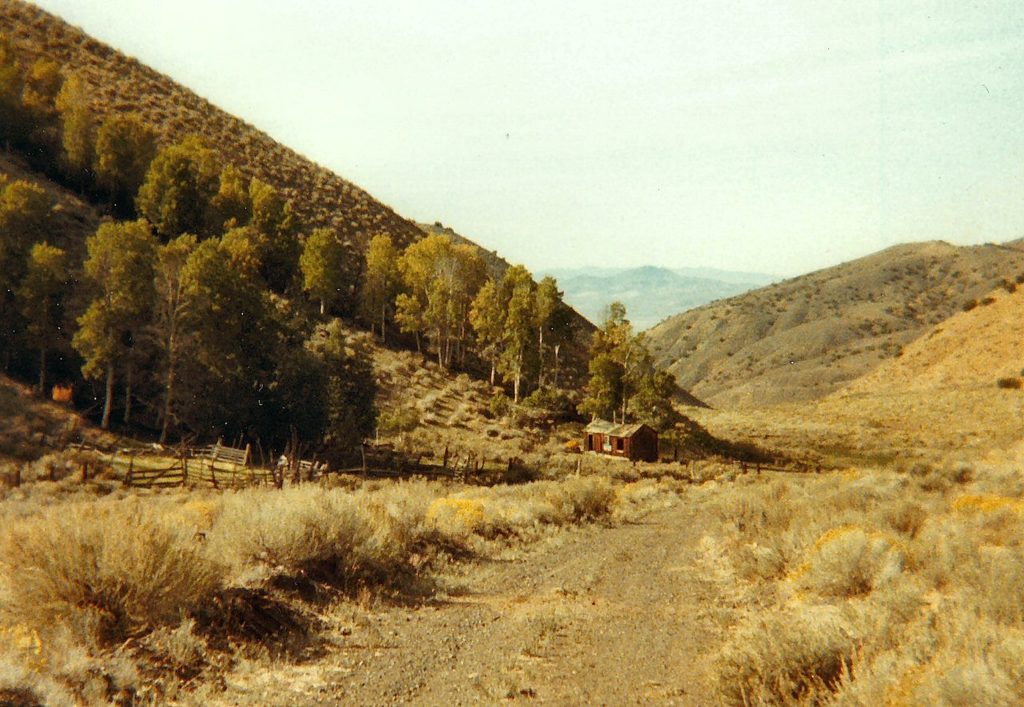
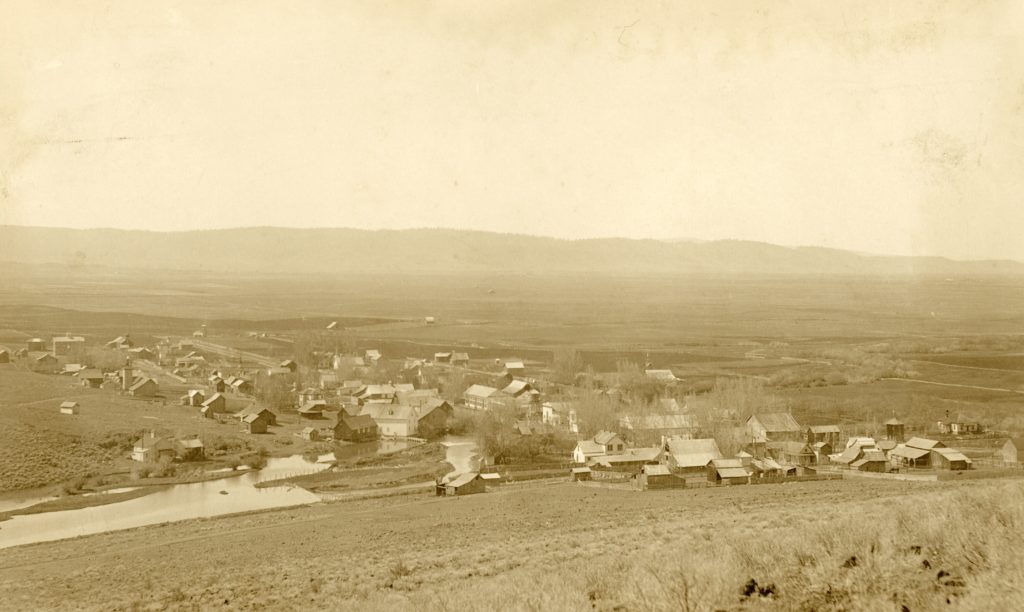
If you recall earlier this year about the mining activity at Rosebud on the eastern edge of the Black Rock Desert, there was also considerable mining activity much closer to the Honey Lake Valley in the nearby Smoke Creek Desert. In 1882, the Cottonwood Mining District was established on the Fox Mountains on the east side of the Smoke Creek Desert. Due to its remoteness and lack of any substantial high grade ore, little mining was development. Continue reading Wild Horse Mine→
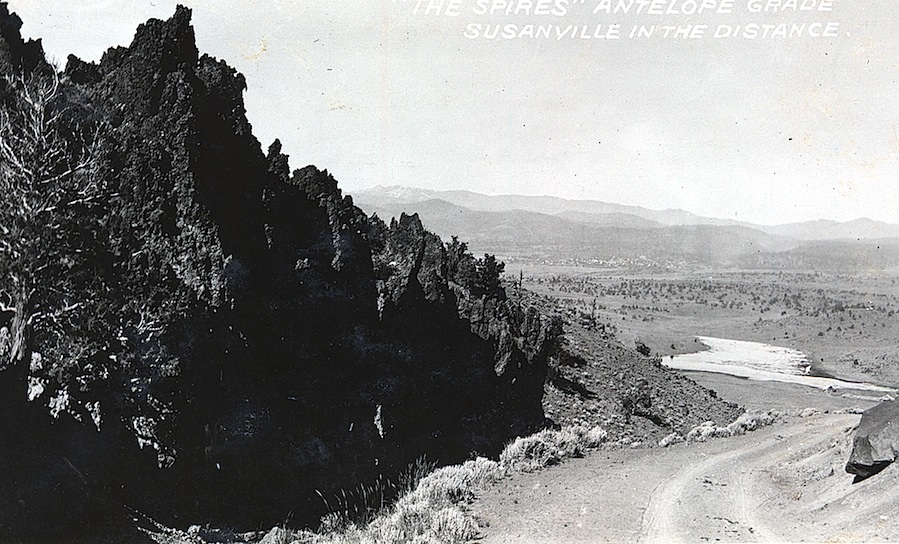
The Spires, Antelope Grade. In 1947 when Highway 139 was constructed it bypassed this feature.
While the bulk of mining was south of Susanville, along Diamond Mountain, there was a bit of mining activity to the town’s north. Some of you may recall the piece about Grabel’s hole that appeared back in September.
For some odd reason, by the 1890s considerable prospecting was done on Antelope Mountain. If one looks closely on Highway 139, one can see small mine tailing piles. At a place call “the spires” there is a small spring. It was a popular rest stop back in the horse and buggy days, to stop and give the horses a rest. Charley Carpenter thought it was the perfect place to call home, and built a small cabin there, while he was search of the next mother lode. He had a nearby counterpart, Sandy Crawford, better known as Round Valley Red, who staked out claims in nearby Round Valley. By the mid-1930s, the two old bachelors, were getting along in age and finally abandoned mining in the area.
Spread the word, and encourage a friend to subscribe.
Longville Hotel, circa 1915. Courtesy of Plumas County Museum
Humbug Valley is located a bit south and west of Lake Almanor. It is an interesting locale, and worth the trip if you have never been there.
In 1855, B.K. Ervine and William B. Long used the valley for stock-range. Two years later, gold was discovered and set off a flurry of mining operations. Long and his father-in-law, Allen Wood, built a hotel there, and a sawmill mill, too, and thus the town of Longville came into existence. In 1862, Long came to Susanville and purchased William Weatherlow’s ranch, known today as Susanville Ranch Park.
Longville continued to flourish, and then came along World War I and everything changed. Like so many places Longville would slowly become de-populated and residents never returned after the War. The Longville Post Office that had been in operation since 1861, closed in 1918.
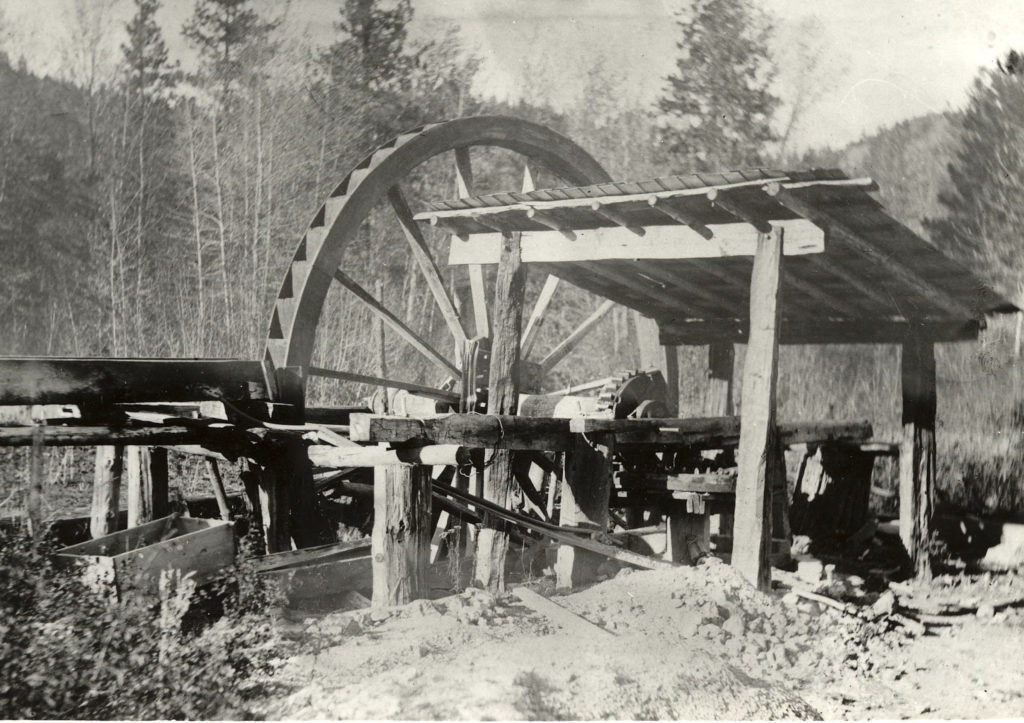
The arrastra mill, 1899. Courtesy of Mary Dale Folsom
Readers may recall last month’s post about the Scottini family. Besides a dairy operation they were involved in gold mining. After all, Diamond Mountain being one of the most important mining districts in Lassen County, and only second to Hayden Hill.
As the majority of mining along Diamond Mountain was that of lode bearing quartz, equipment was needed to extract the gold from the quartz. A simple and inexpensive method was with a arrastra mill which would pulverize the rock. The Scottini mill was unique as it was powered by a water wheel, the water of course from Gold Run Creek.
After the Scottini’s left the area, the mill was abandoned, though L.D. McDow, James Branham and Henry Neff acquired the claim. They did not use this mill, and instead built one of their own. In 1965, George McDow stated “The remains of this (Scottini) arrastra lie buried by flood debris with only a few of the side timbers exposed above the ground.”
Gallatin Peak, with an elevation just shy of 7,000 feet is one of the most prominent features at the south end of Eagle Lake. It is interesting that it is of granite composition, while the surrounding mountains are basalt. Actually, the peak’s original name was Granite, and it was not until the early 1900s that it began to be referred to as Gallatin, after the largest property owner at Eagle Lake.
For those who attended the Inspiration Point Tour, or received the narrative thereof, a geology lesson was given. Four major land masses converge in the Susanville region–Cascade, Great Basin, Modoc Plateau and the Sierra Nevada. This influence at the southeast corner of Eagle Lake is evident.
Because of granite and quartz composition of Gallatin Peak and extending over to nearby Round Valley, caught the interest of gold seekers. From the 1870s until 1942, when President Roosevelt by executive order halted gold mining during World War II, there was considerable gold mining in this isolated pocket.
A native of North Carolina and born on 29 April 1813, is in many ways considered the original dean of Lassen County’s legal community. Like so many, he slowly worked his way west. His first stop Montgomery County, Indiana where his four children were born. Then it was to Iowa for a brief spell. In 1849, Harrison set out for the gold fields of California and like so many others, had never mined before.
Fortunately, when he arrived in Shasta County he was able to fall back on his original profession as an attorney. He served two different terms as county judge in Shasta, and then moved to Red Bluff. There he served a term as Tehama County District Attorney. In 1862 he was lured to the mines of Unionville, Nevada. Again, he fell back on his previous profession and passed the Nevada bar exam.
In 1863 he returned to Red Bluff to spend the winter and the following spring moved his family to Susanville. On October 18, 1865 he was elected county judge of Lassen County. After his two year term expired, he continued with his mining interest. In June 1868, he was appointed to the position of Lassen County District Attorney, as Isaac Roop failed to qualify for that job. He remained in that position until his death on April 24, 1870. It should be duly noted that some of his descendants still reside in Lassen County.
Located just a mile north of the Lassen County line in Modoc County, Adin benefited from Lassen County’s largest mining town of Hayden Hill, located twelves miles to the south.
As a matter of fact in the same year that Adin was founded in 1869, gold was discovered at Hayden Hill. It should be noted that one of Adin’s founders and its namesake, Adin McDowell, was a member of the prospecting party that discovered the gold at Hayden Hill.
When times were good at Hayden Hill, they were even better at Adin. By 1877, Adin was the largest town in Modoc County. In addition, it was only second to Susanville in the amount of business transactions conducted in Northeastern California.
For more information about the story of Adin, see this month’s issue of the Northern California Traveler.
Never miss a story, click here to support and subscribe.
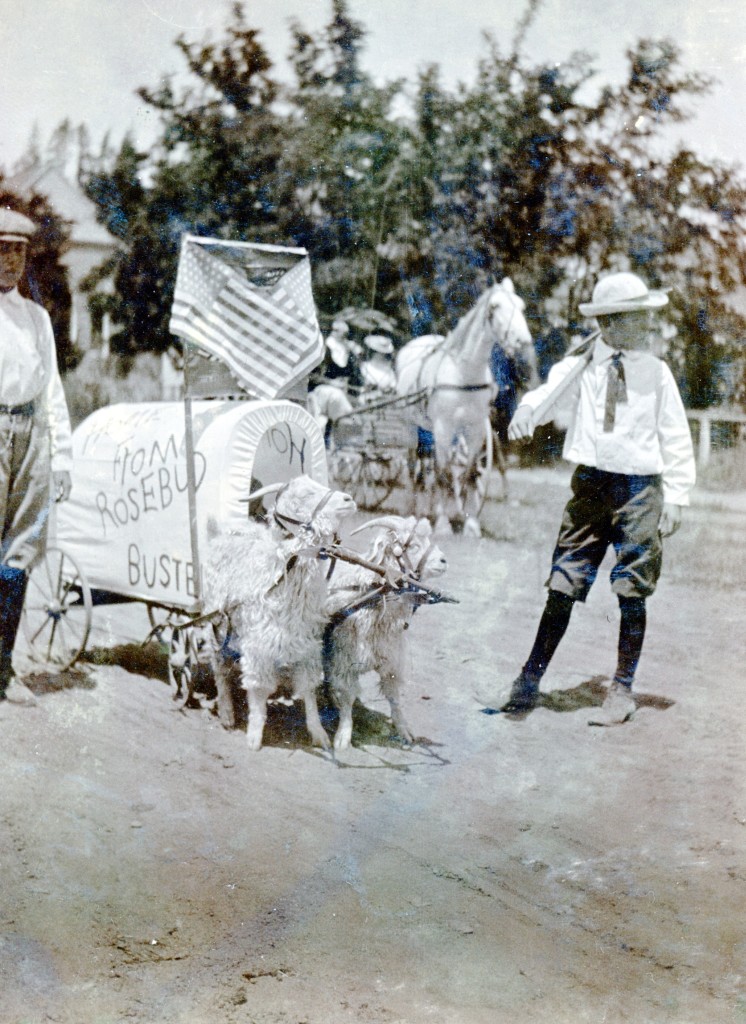
A 4th of July 1908 entry in the parade held in Susanville. Note the writing on wagon “Home from Rosebud Busted” Courtesy of Lola L. Tanner
In 1906, for the first time since the 1860s, Honey Lakers were excited about mining in Nevada. Of course, one Honey Laker, E.C. Brown had done very well in Goldfield. It was not the new mining discoveries of Goldfield and Tonopah, but one due east of the Honey Lake Valley on the eastern edge of the Black Rock Desert–Rosebud, in Pershing County.
It all began in August 1906 when three prospectors from Goldfield, Nevada discovered a gold vein in the Kamma Mountains that purportedly assays ranged from $1,500 to $30, 000 per ton. A mineral report issued from Humboldt County would later state: “This was followed by a senseless boom, in which, as usual, folly played eagerly into the hands of fraud.” Continue reading Rosebud, Nevada→
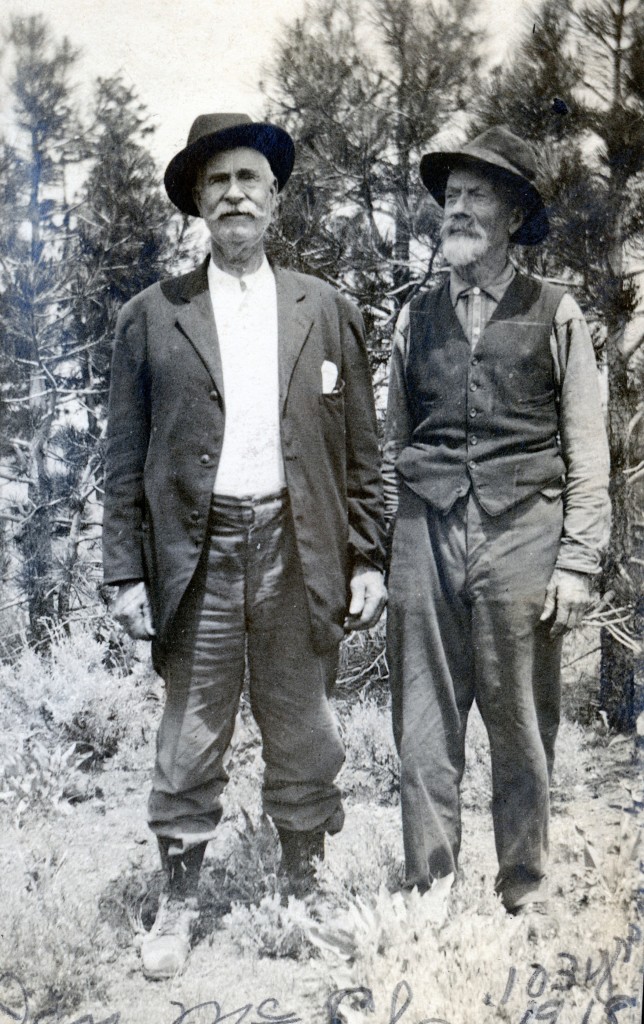
Dan McClane (left) and J.S. Underwood, Juniper Mine superintendent, 1918 at Hayden Hill, 1918. B. Dorsey Collection
In the late spring of 1916, two men, Clarence Williams and Dan McClane set off on horseback on a prospecting trip. It does not appear on the face that remarkable, until you examine the ages of two men–Williams, 36 and McClane 101. That is correct a hundred year old man prospecting on horseback. The duo left the Williams Ranch in Willow Creek Valley, now owned by Five Dot and first ventured to look at the abandoned mines of adjacent Round Valley. From there they went all the way to the top of Green’s Peak looking for the fabled “Grabel’s hole.” The Grabel was a rich lode, that falls into the category of the lost mine tales. They then ventured down to Rongstock Canyon, back up and over to Papoose Meadows and numerous crooks and crannies along the way. Then back over Gallatin Peak and back to Willow Creek Valley. In all, Williams estimated they traveled nearly forty miles that day. McClane it should be noted came to Lassen County in 1872, where he mined there for over forty years.
McClane’s advice for longevity, “Don’t worry about anything, don’t think about getting old, eat plenty of food, but not too much, take regular sleep four times a week and work like the devil at all times.” McClane died at the age of 105 in 1920.
Diamond Mountain, circa 1940. Courtesy of Margaret A. Purdy
In the works in progress of future topics is that of the mining activities of Diamond Mountain. After all it was in 1855 with the discovery of gold at Hills Creek, along the base of the mountain, that was responsible for the initial influx of the Anglo settlers. During those early years one of the main routes to and from the Honey Lake Valley was via Gold Run. To refresh one’s memory you may want to go back and review the Gold Run Road Company. The route also received extensive use in the 1920s to the Engel’s Copper Mine on the other side of mountain near Taylorsville. That, too, will be featured in the future. In addition, the Wild Horse Mines of the Smoke Creek Desert will be featured as it is intertwined with the mining at Diamond Mountain. Finally, this topic was discussed on the Inspiration Point Tour. Stay tuned!
Never miss a story, click to support and subscribe here.