Tag Archives: Madeline Plains

A Marijuana Tale

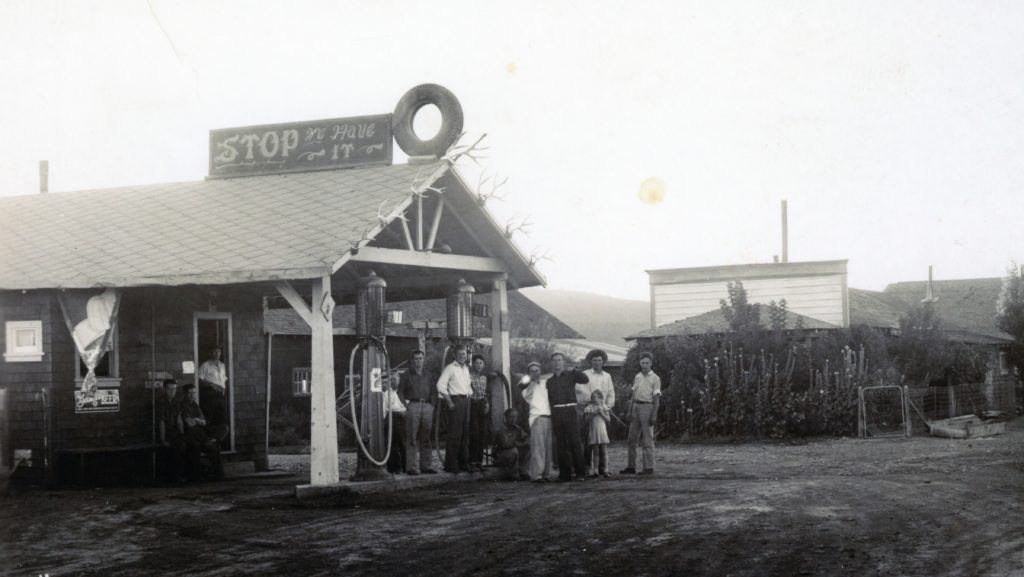
The Ravendale Garage.

While the City of Susanville and the County of Lassen debate marijuana issues, lets take a look of some historic accounts from the 1920s. It was not until the late 1920s that marijuana appeared on the scene locally.  In November 1928, Sheriff Jim Leavitt conducted a raid on the Brunswick Pool Hall near the Susanville Depot.  Leavitt confiscated ten kegs of whiskey and ten pounds of marijuana and arrested Emma and Pete Ovalle on a narcotics charge for the possession of marijuana.

Marijuana was something new to the local residents. The local press described it as a Mexican tobacco that is smoked like a cigarette, and said it has an exhilarating and soothing effect for the smoker and can also make one feel “goofy.” Continue reading A Marijuana Tale

Who murdered Sam Shaw?

A portion of Looper's testimony in Shaw's coroner's inquest hearing.
A portion of Looper’s testimony in Shaw’s coroner’s inquest hearing.

Several weeks ago I wrote about the murder of Sam Shaw on the Madeline Plains. At that time, the sheriff was directed to launch an investigation as to who might have been the culprit. All fingers pointed to Shaw’s neighbor, Jim Looper, who was an employee of George Bayley. After all, Looper was supposed to claim the land where Shaw settled due a valuable spring. During the coroner’s inquest, Looper pleaded ignorance of even knowing Shaw, but when he questioned by authorities, he reversed his testimony. There was one problem with the whole puzzle, where was Shaw’s decapitated head? There were some who thought Looper was hired to murder Shaw, and when Looper died of a drug overdose in Susanville in 1888. Continue reading Who murdered Sam Shaw?

Bayley Creek Sawmill

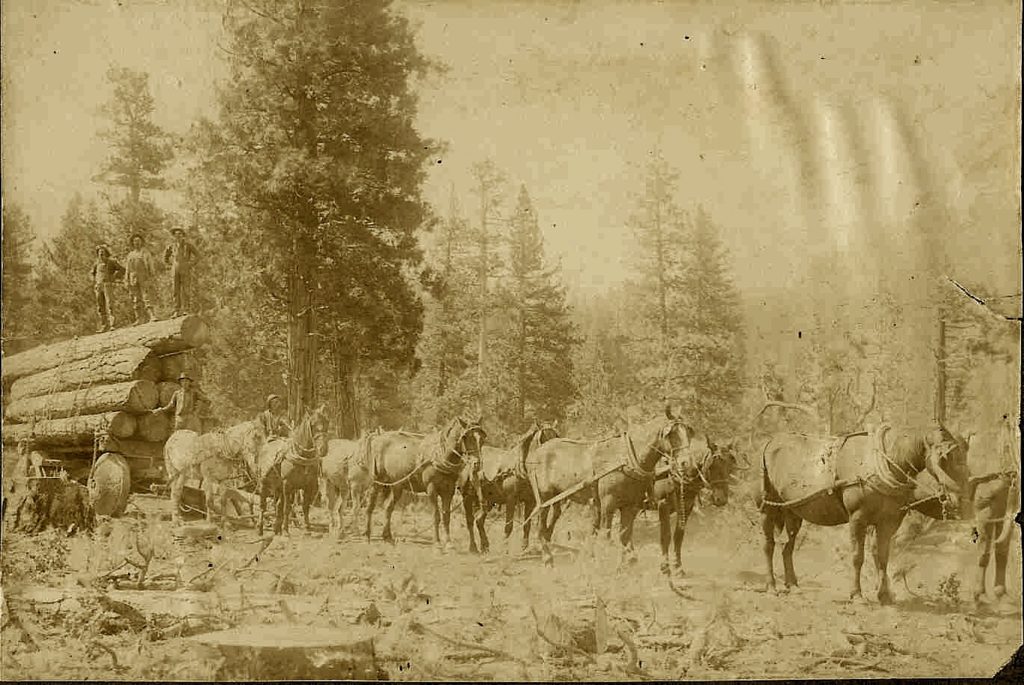
Logging at Bayley Creek, 1915.

There were two different sawmill operations on Fredonyer Peak, north of Eagle Lake. The first one was on the Horse Lake side operated by the Shumway family. The second one, and much later in time was on the north side near Bayley Creek reservoir, the  latter which was constructed in 1899. It should be noted, that many maps misspell it as Bailey, but it was so named after Likely rancher George H. Bayley.

In 1912, H. T. Risdon established the Eagle Lake Lumber Company and constructed a sawmill at Bayley Creek.  Risdon encountered problems finding skilled labor. In time he leased it to Thomas Coulter and Frank Spencer, who in 1919 bought it outright from Risdon. The mill remained in operation until 1942, when it closed for good.

Subscribe now a receive a free 2017 Calendar

The Saga of Samuel Shaw

A view of the western Madeline Plains, August 4, 2016.

On August 4, 1883, 60 year old Butte County resident, Samuel B. Shaw investigated the western side of the Madeline Plains in search of a new home.  To his amazement he came across a fine spring that no one had claimed. It appeared to be a golden opportunity and he wasted no time to file a claim with the Government Land Office in Susanville. With paper work in hand, Shaw began building himself a cabin. His neighbor, Jim Looper, and Looper’s employer, George Bayley was not pleased about this development. Looper thought he filed a claim to it, but it turned out he filed for the wrong parcel.

Whatever the case may be, some one did not like Sam Shaw. On October 13, 1883, an Indian mahala (woman) found Shaw’s decapitated body in his cabin.  The woman notified authorities, and an investigation began. On October 22, 1883 a five man coroner’s jury was held in attempt to find more information about this grizzly murder. However,  they rendered, the following result, “He came to his death by the hands of parties unknown. We would also suggest that the matter be further investigated by the proper authorities.”

To be continued . . . 

Spread the word, encourage a friend to subscribe.

Madeline Plains – Horne Ranch

Horne Ranch, 2003
Horne Ranch, 2003

In 1870, Frank Eben Horne became one of the first settlers of the Madeline Plains. Horne retired from his ranch in 1905 and turned it over to his sons. On March 28, 1917, Frank L. Horne, William R. Horne, and Arthur T. Horne, along with Raglan Tuttle and Grant M. Lorraine, formed the Horne Development Company. On April 27, 1927, the Farmers & Merchants National Bank of Reno, Nevada, foreclosed on the Horne Development Company for $38,791.11 and became the owners of the Horne Ranch. It should be duly the Glade Post Office was located there from 1908 to 1918.

In the 1990s, the ranch had a new lease on life when it was incorporated in R.C. Robert’s Spanish Springs development. This and other properties were made available to guests, whether their interest was equestrian pursuits, hunting, etc.

Never miss a story, click here.

Ravendale

Early day Ravendale. Courtesy of Dorothy Capezzoli

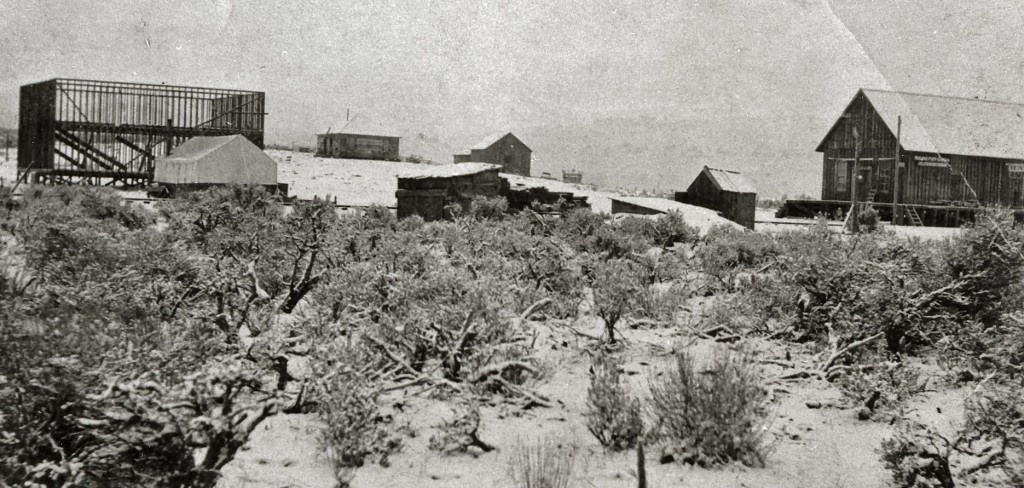
It was the last of three towns established on the Madeline Plains.  It was reported that the end of February 1910,  that the new station of Ravendale  was rapidly being built and rumor had it that it was to become a division point for the NCO railroad.  It was also stated that J.H. Williams and G. Horton were surveying a town plat.  Whatever the case may be, it was not until  November 15, 1913, the official town plat of Ravendale, on lands owned by Jim Coe, was surveyed and recorded with the County. According to Madeline Plains historian, Don Garate, the name Coeville had been suggested for the new town, but Laura Coe already chosen a name—Ravendale.

By the way, in Susanville you can purchase Don Garate’s book Red Rock to Ravendale at Margie’s Book Nook.

Never miss a story, click here.

Madeline Plains

McKissick Ranch 2004
The old McKissick Ranch, Madeline Plains. 2004

This large mountain valley encompasses some 200,000 acres at an elevation of 5,200’. According to Gudde’s California Place Names, Gudde attributed the name to an emigrant girl, named Madeline, who was murdered by the Indians in the 1850s. Gudde’s source was that of H.T. Risdon who established a sawmill on Bayley Creek in 1912. What is rather peculiar is that the thoroughly researched historical works of Davis and Fairfield have no references to this murder. What is also interesting is that the name does not appear until 1854. In that year, Lt. E.G. Beckwith traversed the plains while exploring for a transcontinental railroad route. Beckwith entered the Madeline Plains via Smoke Creek Canyon and the east side of Observation Mountain. He named this the Madeline Pass. In all probability, Beckwith named the place for his daughter, Madeline Julia Beckwith, born January 25, 1853 at New London, Connecticut.

For further information on this historic account see the latest issue of the Northern California Traveler.

Become a supporter for just $5 a month to ensure quality history continues. Click here.

Dodge Reservoir

Dodge
A 1950s aerial of Dodge Reservoir.

With the Dodge Fire in the headlines, I moved this  post for today, which was scheduled for later in the month. As the post concerning wild horses initially scheduled for today will appear tomorrow.

In 1889, Albert L. Shinn formed the Union Land & Stock Company. Shinn proposed that the water from Red Rock Creek could provide irrigation for the entire eastern Madeline Plains. The reservoir was originally named Lake Lockett, for the Company’s Civil Engineer, H.M. Lockett. In the early 1890s, the Union Land & Stock Company started the irrigation project but eventually construction ceased because of lack of funds and other problems. On December 9, 1907, Henry C. Dodge acquired an option to buy the Union Land & Stock Company’s failed Red Rock irrigation system. In 1909, Dodge formed the Madeline Valley Land & Irrigation Company to undertake this enterprise. In the fall of 1909, the Company contracted with August and Alfred Anderson to build the system. In December 1909, Dodge Reservoir was completed. In 1912, Henry C. Dodge died during an altercation in Reno, Nevada. Dodge’s two sons, Carl and Dana, continued with the family enterprise on the eastern Madeline Plains. On January 14, 1949, Bernys M. Dodge, the agent for the Dodge Brothers, sold the Dodge Ranch and Reservoir to George and Jean Smith.

Subscribe and support this site for $5.00 a month, what a bargain. How many spend that much at Starbucks on any given day, or other indulgences?