Tag Archives: Janesville

Janesville Hotel

The Janesville Hotel when it was owned by Justus R. Bailey, circa 1880.

The first hotel in Janesville was built in 1857 by Malcolm Bankhead, which was a two-story structure made of logs. In 1872, Dennis Tanner purchased it, and torn it down. He replaced it with a much substantial larger, two-story wooden frame building, that contained 22-rooms. The hotel had numerous owners over the years. In 1913, B.R. Holmes acquired it, made numerous upgrades and changed the name to the Diamond Mountain Inn. One of its most interesting owners were the Pollocks, as in the famed artist Jackson Pollock. The hotel was destroyed by fire in 1931.
Never miss a story, click here.

Janesville Cemetery – The Slater Graves

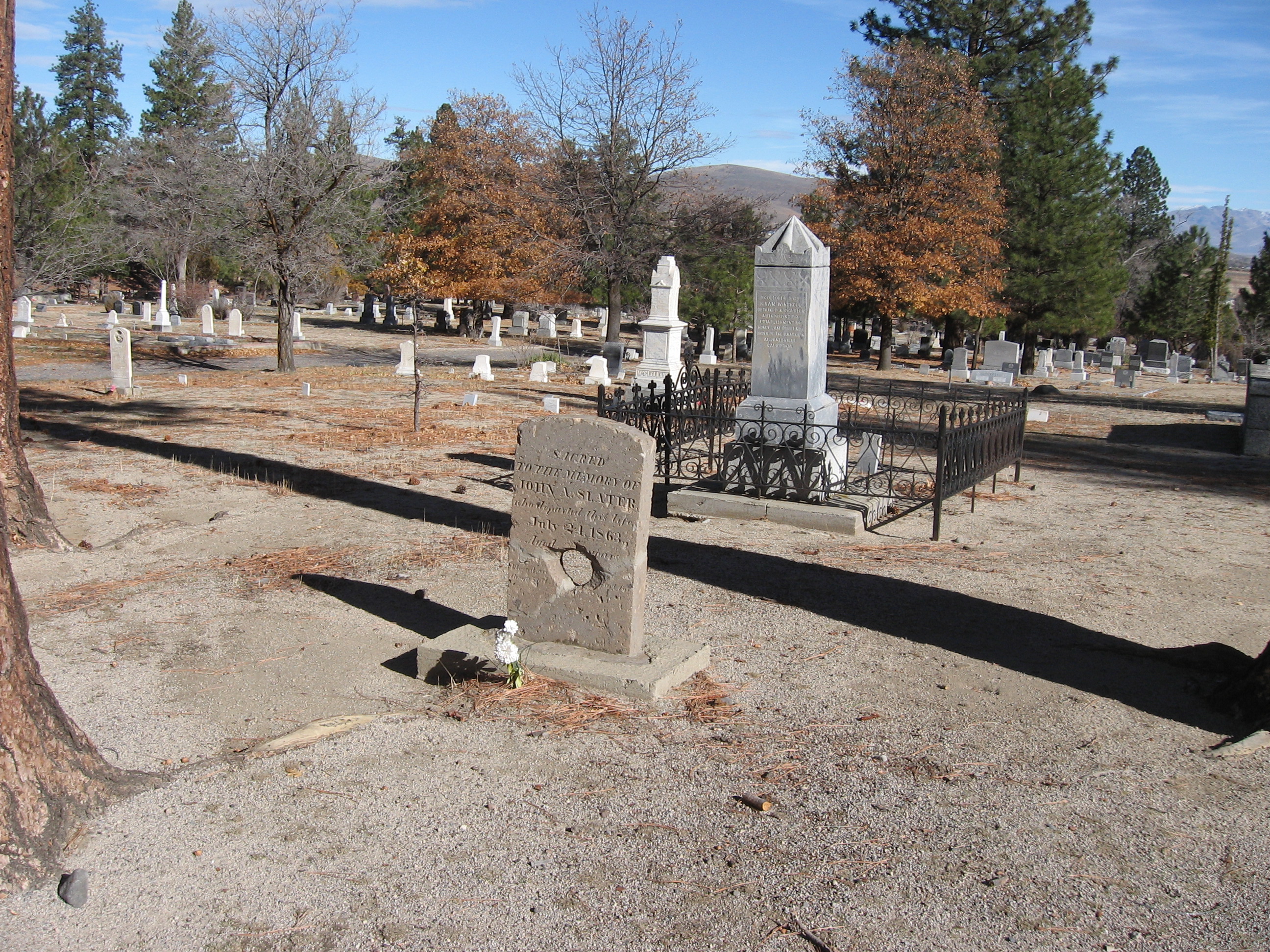
John A. Slater's grave. November 19, 2015
John A. Slater’s grave. November 19, 2015

When Dr. John A. Slater died on July 24, 1863 at Janesville, there was no cemetery. He was buried at the foot of pine tree on the Sloss Ranch, known in later years as the Jim Peterson place.

In 1865, Slater’s two sons, Henry Hunt, age 11 and John Allen age 7, died a day apart from each, respectively on May 5 and May 6. They were buried next to their father.

There was a lot of speculation as to the cause of their deaths, some attributed to it spotted fever and others said it was poison from eating wild parsnips. What was later revealed the boys had played around the house all day and never ventured away from home. Henry was taken ill with a pain in his heal in the afternoon, and died that night. On the same evening, John was reported to have a pain in his next week and died the following morning.

In the summer of 1915, John S. Partridge, a grandson of Dr. Slater, contacted local historian Granville Pullen to move the graves to the Janesville Cemetery, which Pullen obliged.

Never miss a story, click here.

Thompson Peak

Thompson Peak
Thompson Peak, 1952

In December 1856, Manly Thompson located near the base of this mountain and built one of the first cabins in the region. Like so many of the original settlers of the Honey Lake Valley he moved onto he did remain in the region and moved on. On October 27, 1875, Thompson sold his 276-acre ranch to James P. Sharp for $6,000 and moved to Elko, Nevada. His lasting legacy of the region is his name applied to this prominent peak.

Recently, I had accidentally stumble upon this most interesting website concerning Thompson Peak. It is worth the gander. For me it brought back some interesting memories when my brother, Gary and others, including yours truly, gave serious consideration of climbing its rock face back in the mid-1970s.

Subscribe and support this site for as little as $4.17 a month.

Janesville Flour Mill

Flour Mill
Janesville Flour Mill, 1913.

In the spring of 1882, Hiram Dakin and Hiram McCellan proprietors of the Milford Flour Mill began making plans to build a new mill. After all, the Milford one was constructed in 1861, and it had outlived its purpose.

The first order of business was where to build the new mill—Buntingville or Janesville. Buntingville was just beginning to flourish, it being a popular stop for travelers heading north to Modoc County. After careful consideration Janesville emerged as victor.

On June 8, 1882, construction of the three-story structure began on Main Street, a just a little north of the prominent large oak tree that still remains. When the mill was placed into operation in September, the residents knew it—at seven a.m. every morning the steam whistle blew. In 1886, J.K. Gehring purchased the enterprise known as Honey Lake Mills for $6,000. In 1918, Gehring closed the mill, he being 81 years old, and with the new Honey Lake mill in Susanville, no buyers were interested. In the early 1920s, the mill was dismantled and James H. McClelland purchased the lumber to use on his ranch.

Support this site, Subscribe today!

Leon Bly

Leon Bly
Leon Bly sounding Eagle Lake. Courtesy of Wyn Wachhorst

It is only fitting to note that today’s marks the 100th anniversary when Leon Bly embarked on sounding Eagle Lake to determine the feasibility of an Eagle Lake irrigation project. Since the 1870s, there had been numerous failed attempts. No one knew the true depth of the lake, though many presumed it had depths ranging from 300 to 1,000 feet. Bly spent the summer sounding the lake in Oscar Rankin’s The Pelican and determined the lake’s deepest point at 105 feet, but felt the lake had potential as an adequate water supply for an irrigation project.

Of note, up until the 1980s, this boat was undergoing restoration at Janesville, but since it is not known what became of the project.

Support this site, Subscribe today.

Baxter Creek

Baxter Creek
Baxter Creek

Names of places changed quickly when the gold seekers rushed into Honey Lake Valley. This stream was a prime example. It was first called Commanche Creek, then Irishman’s Creek, and, in 1860, became known as Lakes Creek. Sometime in the early 1860s, it finally became Baxter Creek named for John Baxter (1812-1880), a native of Dundee, Scotland, who came to California in 1849 and to Honey Lake Valley in 1857. Baxter located along the lower end of the creek, about a mile east of Buntingville. On May 27, 1867, Baxter, with his partner, Edward Bartlett, sold this property to Robert C. Hayden for $3,750. This sale led to a fatal mistake for both Hayden and Bartlett.

Support this site, Subscribe today.

Pullen Museum

Pullen Museum
The Pullen Museum, May 3, 2015

Granville Pullen first came to Lassen County in 1870 and worked at various jobs. In the 1880s he located to Sonoma County, but made frequent visits to Lassen County to see his sister, Susan Goumaz. In 1901, he moved back to Lassen County and bought a ranch near Janesville. In 1914, at the age of 76, he retired from ranching and bought a house in Janesville.

Pullen had been collecting various artifacts and curios for over forty years. Not to be idle he opened a small museum in Janesville to display his collection. People fascinated by his collection began donating items to him. In 1920, Granville and his wife Mary, moved to Susanville and bought a home on South Roop Street. Next to his new home, he had a small concrete building built to house his museum. On June 18, 1921, he opened the museum to the public.  When he passed away in 1926, and his wife kept the museum open for awhile, but she did not have the same passion as her husband. Over the years, she donated a portion of the collection to Lassen County. The items were displayed for a number of years in the Veteran’s building, and over time slowly disappeared.

Support this site and Subscribe today!

Amedee Lime Kilns

Amedee Lime Kiln
Amedee Lime Kiln, 1975

In the early 1890s, when the railroad town of Amedee came into prominence, led to many interesting developments. One of these was the discovery of lime deposits, then a key ingredient used in cement. In 1893, a lime kiln was constructed on the hillside above Amedee. However, due to the nation’s economic depression and the NCO Railroad’s refusal to lower freight rates the enterprise abandoned.

In 1913, with another railroad at Amedee and a surging economy, Susanville businessmen fired up the abandoned lime kilns. After over a year in operation, this they discovered was not the most prudent business investment, and once again the kilns were abandoned.

If you don’t succeed the first time, try again and again. In the 1920s, Janesville resident William B. Hail operated the lime kilns. In 1927, he used the lime for construction of the Bigelow Apartments in Susanville. After that it they were finally abandoned once and for all. Hail stated it was due to the poor quality of the lime.

Support this site and Subscribe today!

Dennis Tanner

Janesville Hotel
Janesville Hotel

Dennis Tanner’s residency in Lassen County was brief but a busy one. Upon his arrival in Susanville, he installed a skating rink in the first floor of the Masonic Hotel. The following year, he purchased the Janesville Hotel, if one could call the structure. It had been built in 1856, before Janesville existed. Tanner dismantled it, and built a two-story 22 room hotel. In 1874 he sold to McClelland and Byers for $3,500. His next venture was a general store at Milford, and then had a brief stint as a innkeeper of the Milford Hotel. In 1878, Tanner relocated to Ukiah where he operated another hotel until his passing in 1898.

Don’t forget to look at the Subscribe feature.


Lassen County Militia

Militia Card
Tro Emerson’s Militia Card

Twice in Lassen County’s history there have local militia units of the California National Guard. The last time was during World War II. Initially, there was to be one large unit for Lassen and Modoc counties. That plan was neither feasible or practical and was dropped.

A new strategy was drafted. Inside each county, especially in large rural counties like Lassen, several local militia units would be formed. There duties were to protect the area in case of enemy invasion. Their involvement was confined to the boundaries of the county. Uniforms, guns and ammunition would be provided to each unit. They would also be trained in guerilla warfare. In Lassen County it fell upon the Farm Advisor (T.S. Brown) to organize these units.

On May 20 1942, the first organization meeting was held in Susanville. Local units were created for Susanville, Bieber, Doyle, Janesville and Standish. By the first of June, the Susanville Militia had 70 members. It became known as Thomas Tucker Militia—named after Thomas Tucker the first casualty from Susanville in World War I. Fortunately, this volunteer force never had to be activated. At the conclusion of the war, each individual’s enrollment in the militia was automatically cancelled.

Militoa card

Note: If you were not aware, you can click on the image to see a larger version.

Don’t forget to look at the Subscribe feature.