Tag Archives: Fruit Growers Supply Company

Millpond Madness

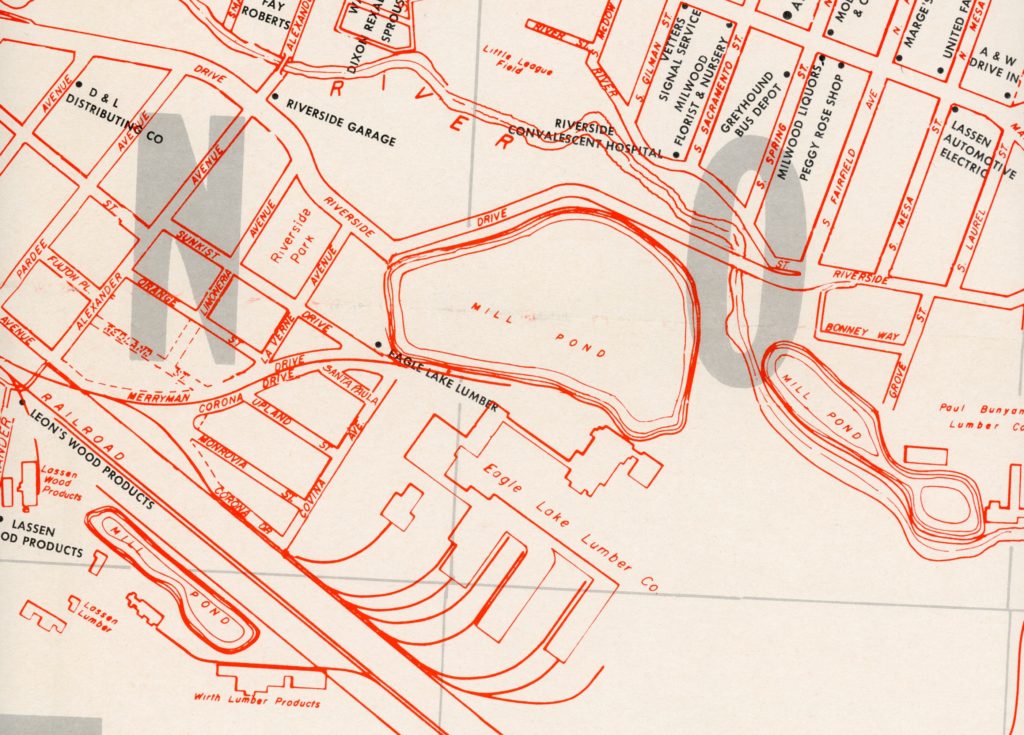
A 1964 Map of Susanville showing three milllponds.

While researching one item, I stumble across material that catches my eye and inevitably get sidetracked. This recently happened when working on an article about the Never Sweat Hills and related topics. Anyhow, while reviewing a 1964 Susanville Centennial publication, I examined the map of the town. In this particular instant what caught my attention was a map. There within a close proximity where three millponds—Lassen Wood Products, formerly Lassen Lumber & Box Company, Eagle Lake Lumber Company, formerly Fruit Growers and Paul Bunyan Lumber Company. Not only are these lumber mills gone, but so are there millponds, once an integral part of the operation. One facet of the millpond that I enjoyed while growing up, was watching a load of logs being dumped into the pond. There was one feature that I did not like—the stench from the millpond in the summer months.
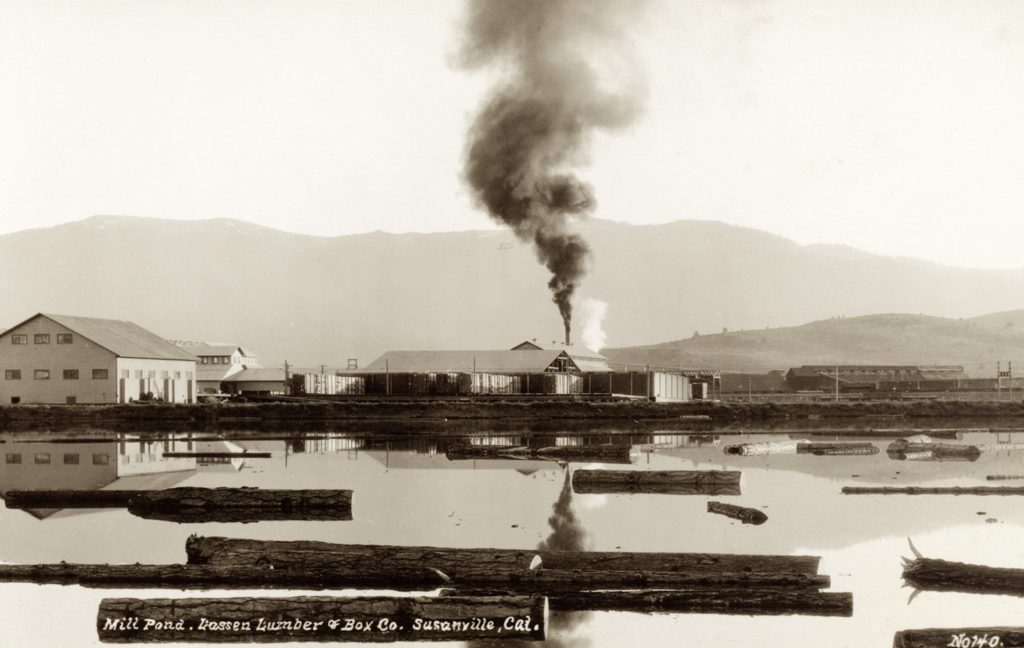
Millpond, Lassen Lumber & Box Company, 1922

Support

Some One Has A Keen Eye

log train Camp B
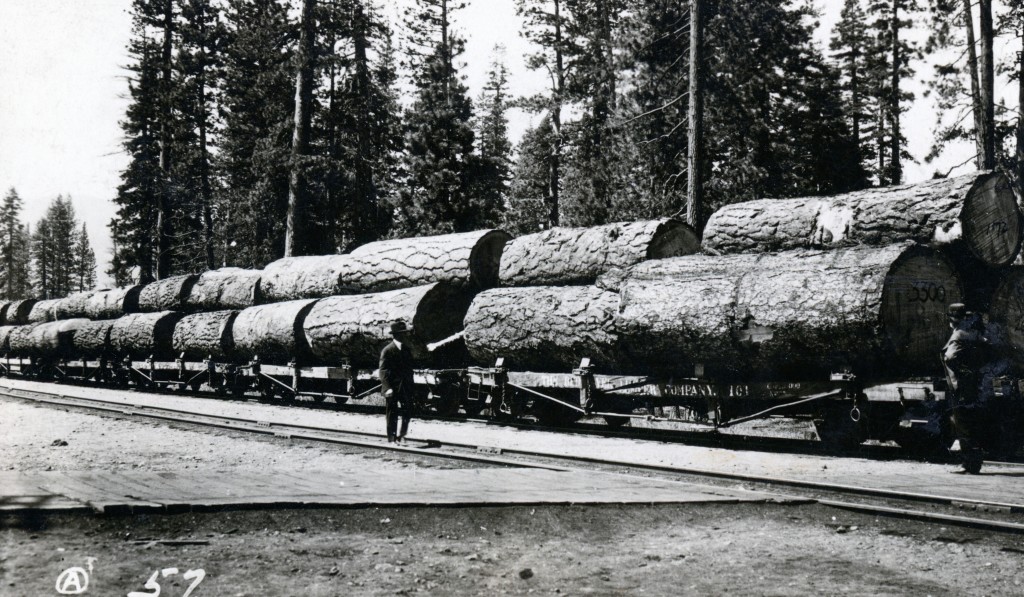
Train load of logs leaving Camp B, Fruit Growers Supply Company, 1922

A reader noticed recently the logs depicted above where on railroad flat cars belonging to the Red River Lumber Company. Fruit Growers found it to be more economical to lease flat cars from the Southern Pacific Railroad, who transported the same from Westwood Junction to the Fruit Grower’s mill in Susanville. Fruit Growers initial operations in the early 1920s, experienced a flat car shortage with Southern Pacific. Red River being a good neighbor obliged to provide Fruit Growers with flat cars until the matter could be resolved with Southern Pacific.

Another point I might add, the above was not a typical load of logs. These type of images, are common among lumber companies. They were used to show investors, bankers and the lot the most premium logs, to show them where the money was being spent. In Fruit Growers case, this photograph would be published in a portfolio to show the citrus growers where their money was used to provide them wooden boxes to ship citrus.

Support

The Wooden Box Campaign

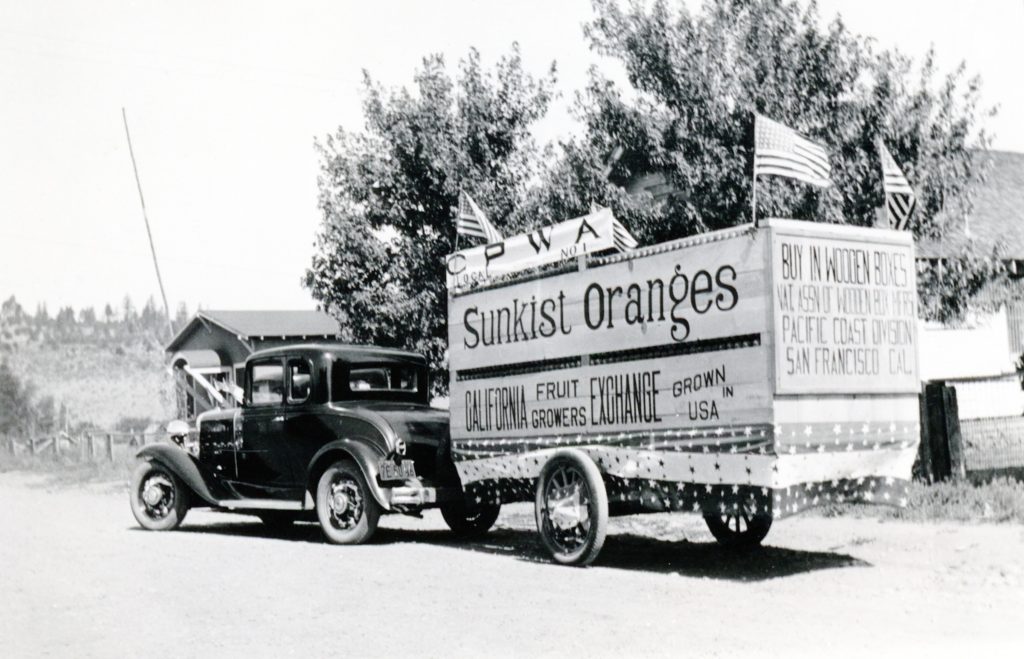
A1937 Lassen County Fair Parade Entry, featuring an oversized wooden box.

At the onset of the Great Depression of the 1930s, the Pacific Northwest lumber industry launched various campaigns to educate the public about the many benefits of timber. Recently, readers many recall the Forestry Essay Contests in the schools.

In the late 1930s, witnessed the organized wooden box campaigns. In 1938, according to the Wooden Box Institute over 50,000 employees of the lumber industry representing an annual payroll of $50 million were participating in the movement. It should be duly noted, that in this era, one of the major components of a sawmill was the box factory division. The manufacture of box shook to make wooden boxes accounted for nearly half the lumber produced in the 1930s. This was an important factor to the local mills of Fruit Growers and Lassen Lumber & Box which their employees joined the movement. On February 1, 1938 the Susanville Wooden Box Promotion Association was formed.

Subscribe

Sierra Shangri-La —Sponsors

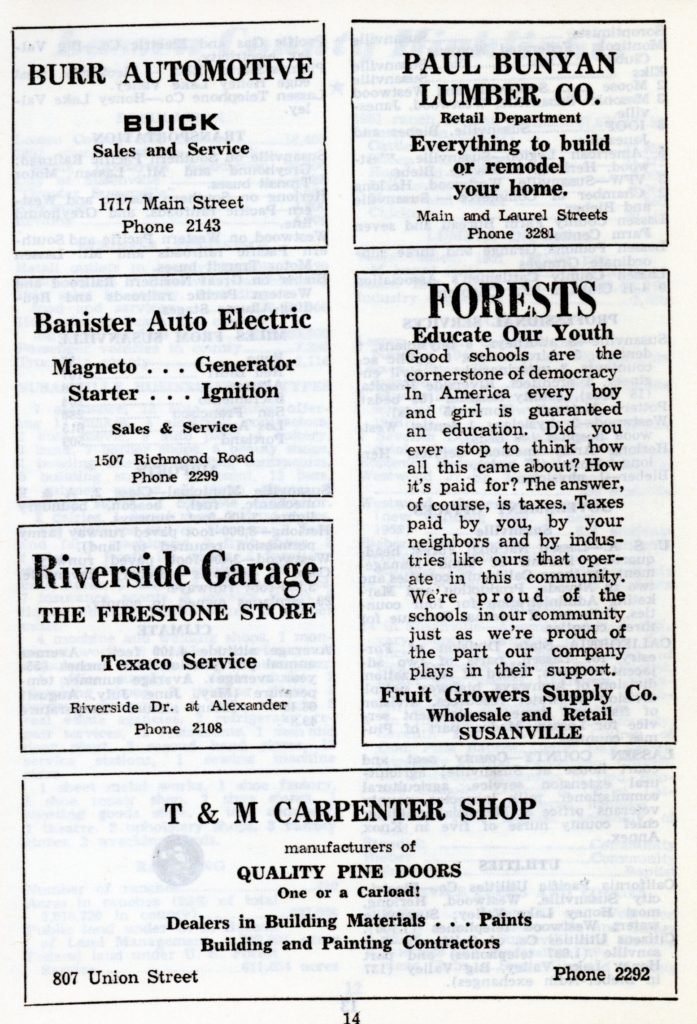
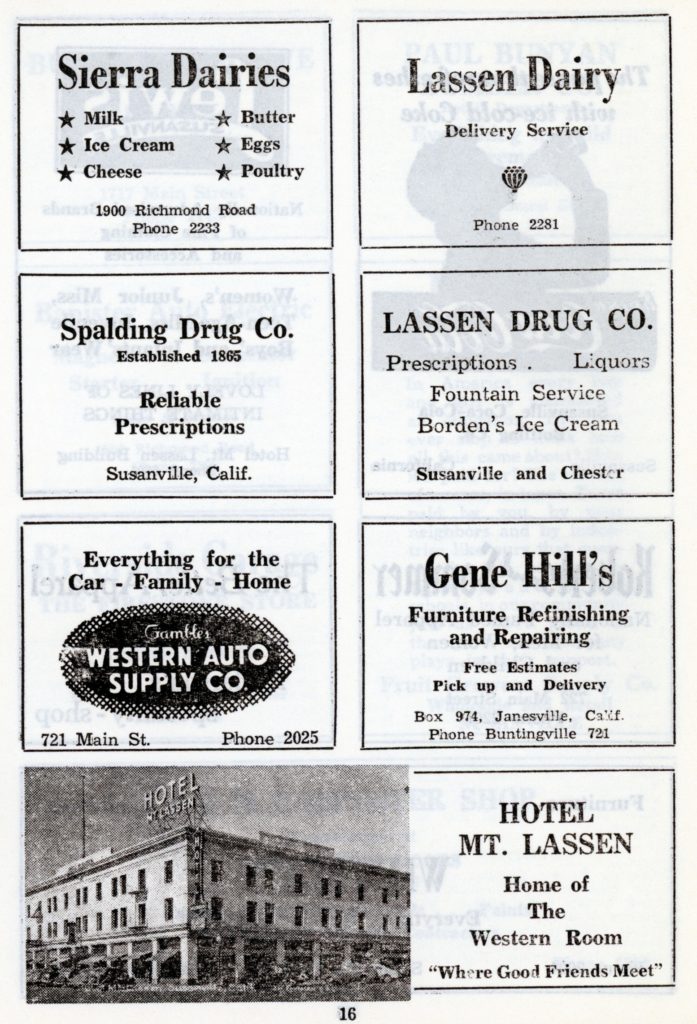
It should be noted that the free publication was financed by advertisements of local businesses. I thought some might enjoy seeing some of the advertisements that appeared. Of the fifty-four businesses that are featured, only one is still in operation—that being the Fruit Growers Supply Company. While Fruit Growers no longer maintains a business presence, i.e., a sawmill, it still owns timberland in Lassen County.

On a somewhat related note, from time to time, I have been approached to place advertisements on this site. My preference is to have a clean appearance, without distractions, as so many websites are cluttered with annoying ads. Some may think I crazy for turning down extra revenue, but if making money was my sole purpose in life I would have found a different line of work.

Support

The Story Club Fire

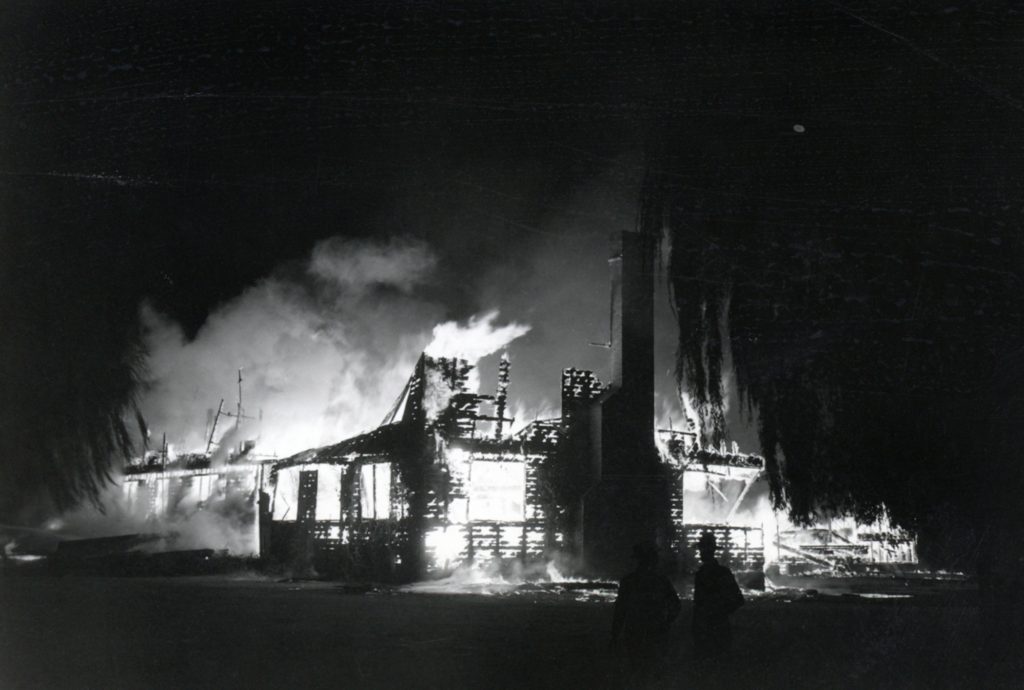
Story Club fire, August 14, 1944

Fruit Growers Supply Company’s famed Story Club was quickly destroyed by fire in the early morning hours of August 14, 1944. By the time the fire alarm went off and the fire crews arrived on the scene the three-story structure was entirely engulfed in flames. The only thing that could be done was to prevent the fire from spreading. By sunrise the building was reduced to rubble. Fruit Growers valued the loss at $40,000. For Stanley Arnold who had leased the club since 1930 now found himself without a job.

Story Club, 1924. Courtesy of Lola L. Tanner

The Story Club built in 1922 was a recreational facility for the employees of Fruit Growers. It was, however, open to all and many local organizations held functions there. Today, the site is now Riverside Park.

Subscribe

McCoy Flat

McCoy Flat, July 11, 2019

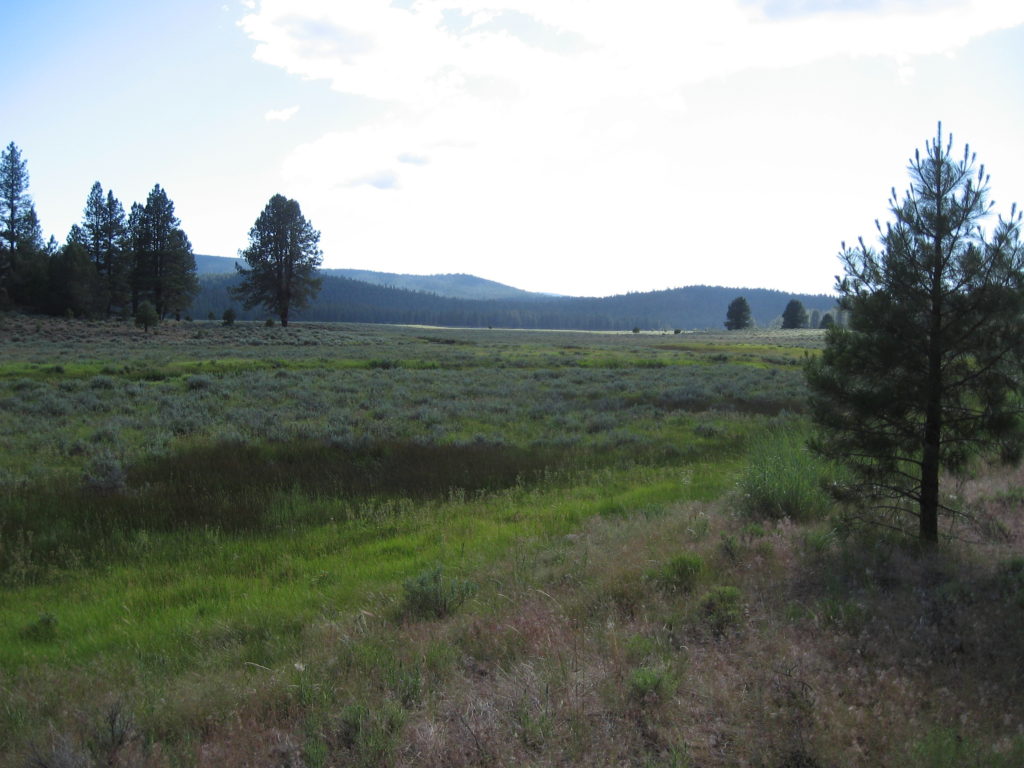
There are three McCoy Flats in Lassen County. Today’s feature is the McCoy Flat located approximately three miles west of Spalding Tract. It was named for Tehama County rancher Leo Lewis McCoy who used this area for summer pasture from 1874 to 1913.

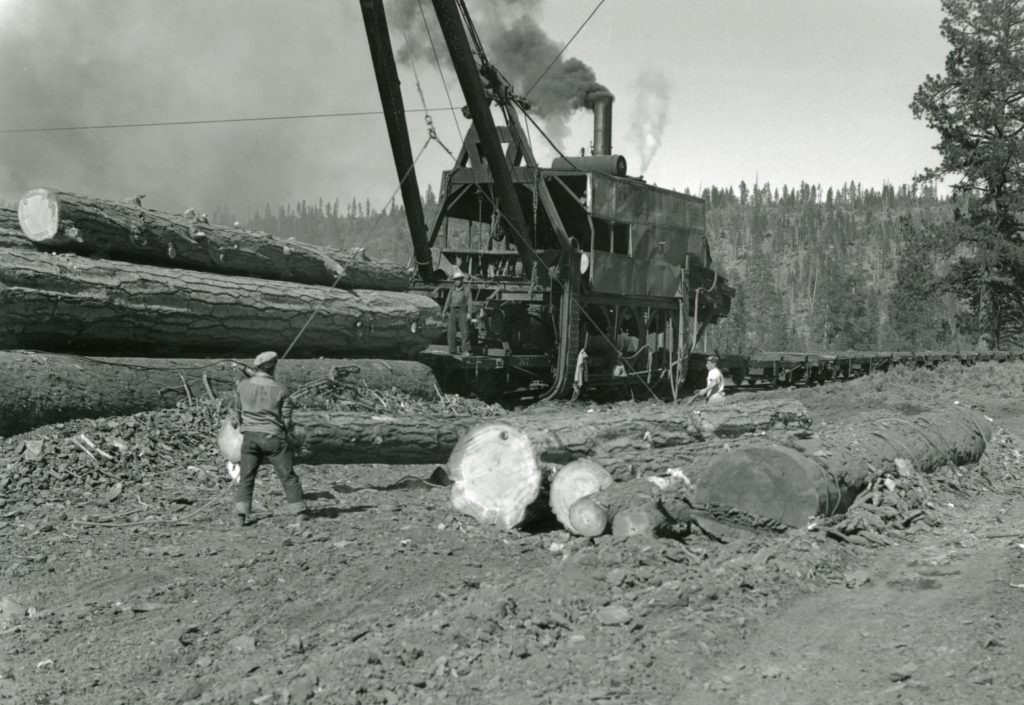
In 1951, there was a lot of activity at McCoy Flat when the Fruit Growers Supply Company logged the region.

Log landing at McCoy Flat, 1951. Courtesy of the Fruit Growers Supply Company

Support

Riverside Hospital Sold

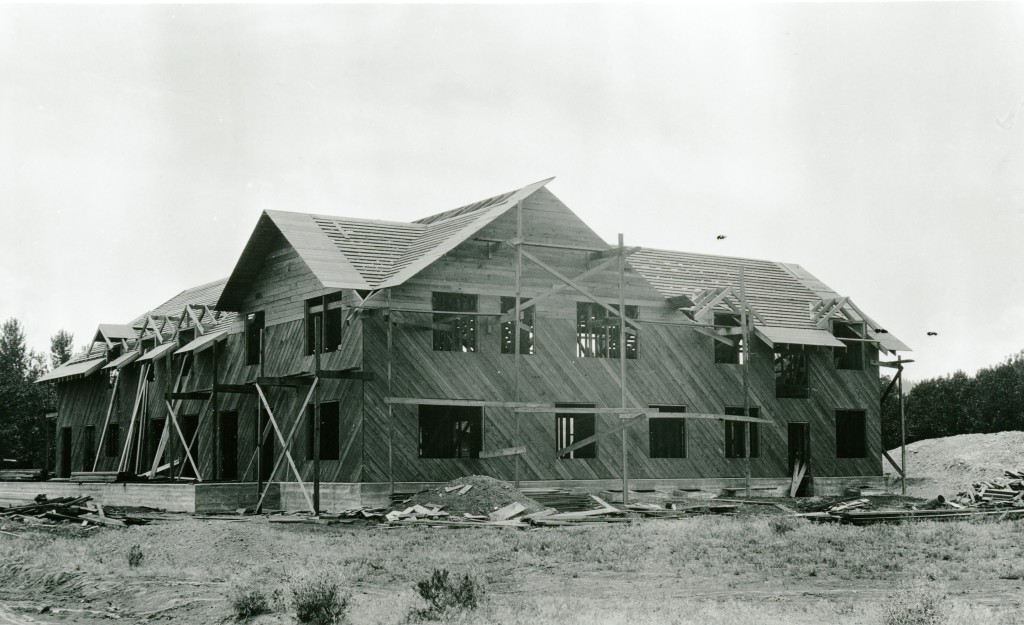
Construction of Riverside Hospital, 1920. Courtesy of Ed Standard

On July 27, 1944 Dr. George S. Martin made the stunning announcement that he sold the Riverside Hospital located at 2005 River Street, Susanville. He sold it to two Susanville physicians Dr. Clair Burnett and Dr. J.W. Crever for a whopping sum of $825,000. It had been a profitable venture for Martin who came to Susanville in 1920 to establish the hospital. He had a lucrative contract with the Fruit Growers Supply Company to provide its employees with all their medical needs. At the time of the sale, Martin noted that over 12,000 patients had been admitted to the hospital in a twenty-three year span.

Riverside Hospital, courtesy of Betty Barry Deal

Subscribe

Large Ranches Sold

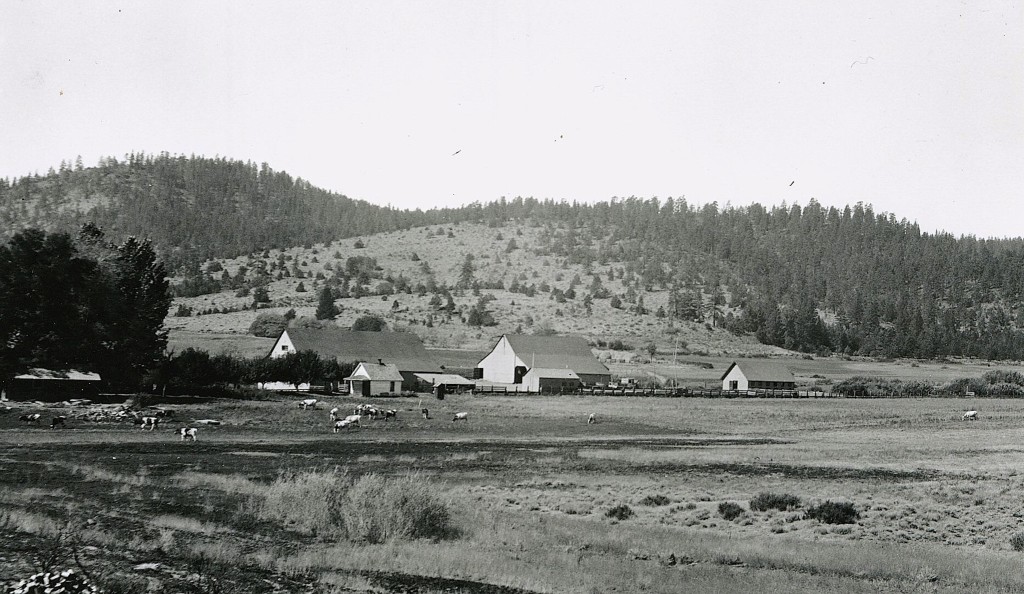
The Fruit Growers ranch as it appeared in 1922.

That was the front page headline of the Lassen Mail of January 31, 1936. the newspaper reported that L.E. “Gene” DeForest purchased the Ramsey Ranch south of Susanville (Many people know this day as Les Allen’s Ranch on Richmond Road. Also included in the sale was the 1,400 acre Swain Ranch on the Madeline Plains.

The other big transaction was Fruit Growers Supply Company sold the ranch north of town along Piute Creek to the Republic Electric Power Company for $35,000. (The property today known as Susanville Ranch Park). Fruit Growers had acquired it in 1919, for Bagwell Springs that they intended use for the mill operation. The company spent several thousand dollars to build a pipeline from their to their mill adjacent to Riverside Drive (that later became Sierra Pacific). Not a drop of water flowed the pipeline. The downstream water users object and through the court obtained an injunction. After that Fruit Growers leased the ranch. Republic Power wanted to water rights to the spring since they also owned the existing Susanville Water Company and local electric company.

Subscribe

Harvey Railroad Logging Line

The railroad bed converted into a road at Camp Harvey. Courtesy of Hank Martinez

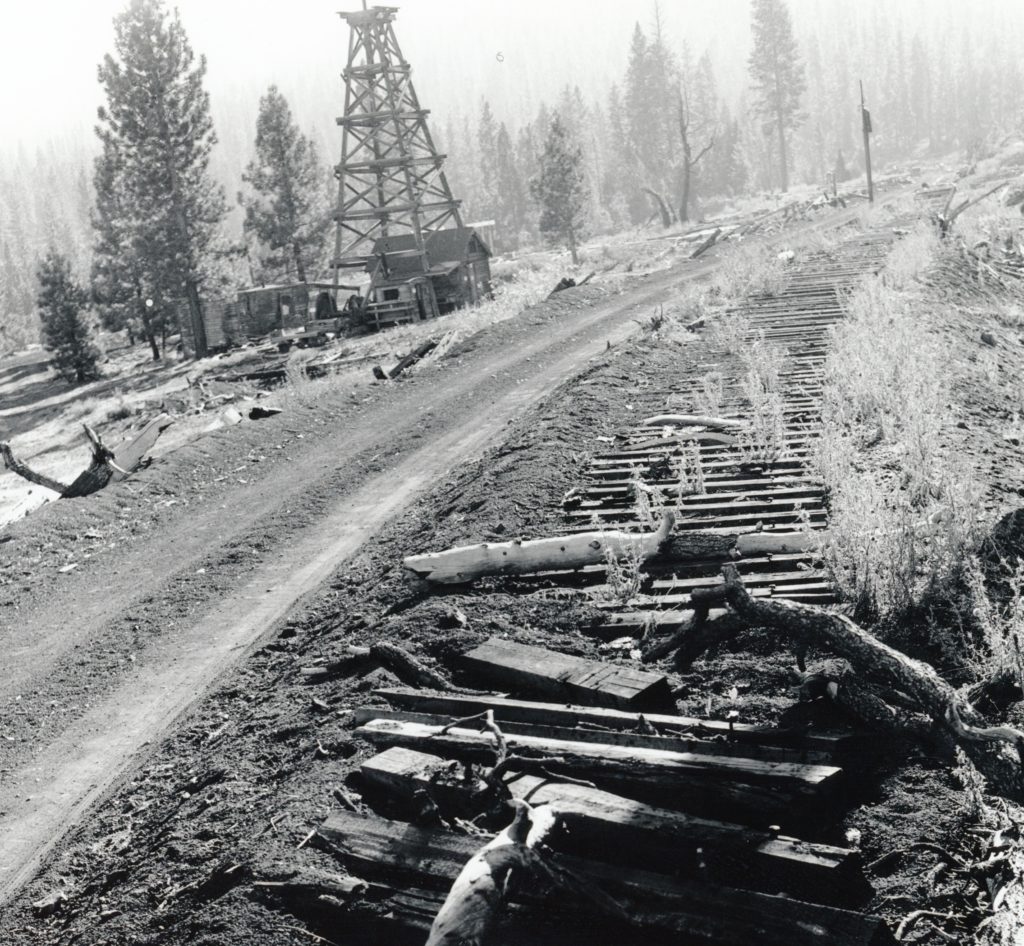
In 1942 this railroad logging line had its origins at Halls Flat, near Poison Lake, headed into an easterly direction towards Harvey Mountain. By 1949, its entire length was just a bit over forty miles ending near Slate Mountain. When the culinary workers at the two logging camps along the line—Harvey and Stanford—went on strike in the spring of 1949, Fruit Growers Supply Company who operated the line decided to shut it down permanently. It was not a drastic action as it appears. They were approaching the end of their timber. In addition, company officials, stated the remaining timber could be removed from and shipped from its Camp 10 line as it approached Upper Gooch Valley. After all, the Harvey line and Fruit Growers Main line that serviced Camp 10 were within two miles of each other.

Never miss a story, click here to subscribe.