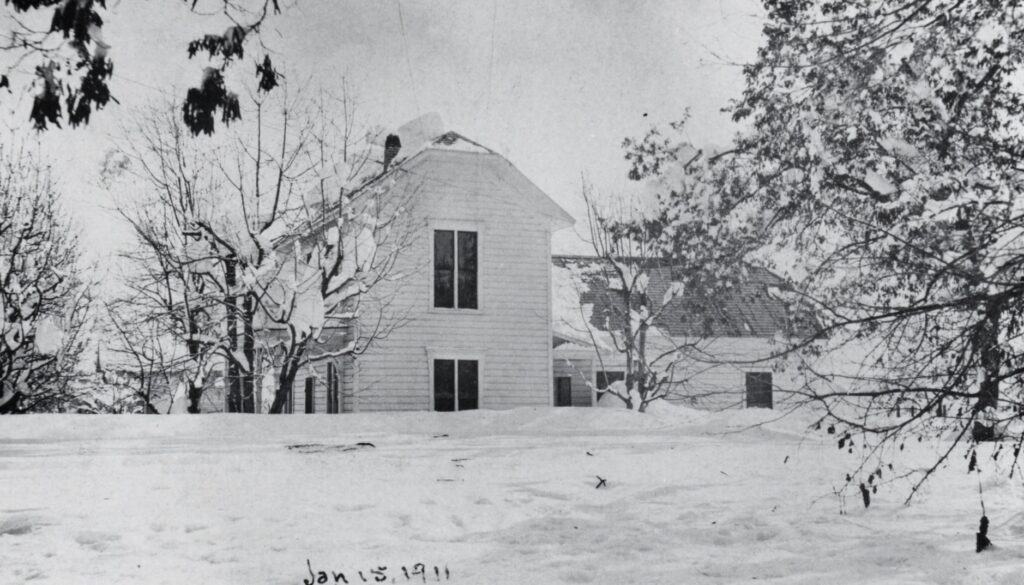
Car dealerships and car styles are constantly evolving. For a brief time, Susanville had its own Edsel Dealership though it did not last long. In 1957 it was housed in a brand new building at 80 North Roop Street. Of course, Ford’s Edsel automobile was a failure and the model soon abandoned. Many seasoned residents will recall this building housed the California Department of Motor Vehicles for many years. It is now the home to Lasco and Rooptown Bicycles.
Sacred Heart Church, 1905. Courtesy of Sacred Heart Church
On August 1, 1869 the first Mass to be held in Lassen County was at the home of Ned Mulroney near Susanville, with the 27-year-old Father Charles Lynch officiating. Since a circuit priest had to cover a large territory in Northeastern California and Nevada, Mass in many instances was only held once a year when the priest made his rounds.
In the 1880s with a larger Catholic population, and the Diocese territory smaller, Mass was held in the Lassen County area twice a year. There was also a movement to have their own house of worship instead of the courtroom in the Lassen County Courthouse or the hall in the Steward House Hotel.
In the spring of 1892, when William Cain, a non-Catholic, donated a parcel land across the Susan River on Richmond Road, the current site of Poulsen’s Welding. In May construction began, the labor from church volunteers. As Father Thomas Horgan later recalled the driving force for the church came from three families—Bantley, Neuhaus, and Mulroney.
The new church had a seating capacity of 120, quite ample for their being about 100 parishioners. On June 26, 1898 Bishop Thomas Grace dedicated the Susanville church as the Church of the Sacred Heart.
This is a little known reservoir east of the Madeline Plains. When the fishing is good, it is worth the trip
In 1889, Albert L. Shinn formed the Union Land & Stock Company. Shinn proposed that the water from Red Rock Creek could provide irrigation for the entire eastern Madeline Plains. The reservoir was originally named Lake Lockett, for the Company’s Civil Engineer, H.M. Lockett. In the early 1890s, the Union Land & Stock Company started the irrigation project but eventually construction ceased because of lack of funds and other problems. On December 9, 1907, Henry C. Dodge acquired an option to buy the Union Land & Stock Company’s failed Red Rock irrigation system. In 1909, Dodge formed the Madeline Valley Land & Irrigation Company to undertake this enterprise. In the fall of 1909, the Company contracted with August and Alfred Anderson to build the system. In December 1909, Dodge Reservoir was completed. In 1912, Henry C. Dodge died during an altercation in Reno, Nevada. Dodge’s two sons, Carl and Dana, continued with the family enterprise on the eastern Madeline Plains. On January 14, 1949, Bernys M. Dodge, the agent for the Dodge Brothers, sold the Dodge Ranch and Reservoir to George and Jean Smith.
Smoke Creek Desert looking towards Sheepshead, fall, 1977
One of my favorite places to spend the day is the Smoke Creek Desert just across the state line in Nevada.
It received its name back in 1844 when John C. Fremont explored the region. His party noted the dust storms created on the playa there cast a smokey hue.
Smoke Creek Desert, 1996
When I conducted the BLM tours in the 1990s,Smoke Creek was a popular one. We did a mixture of prehistoric and historic sites. There are a lot nooks and crannies in Smoke Creek to see.
Apache Tears Mine, Smoke Creek Desert
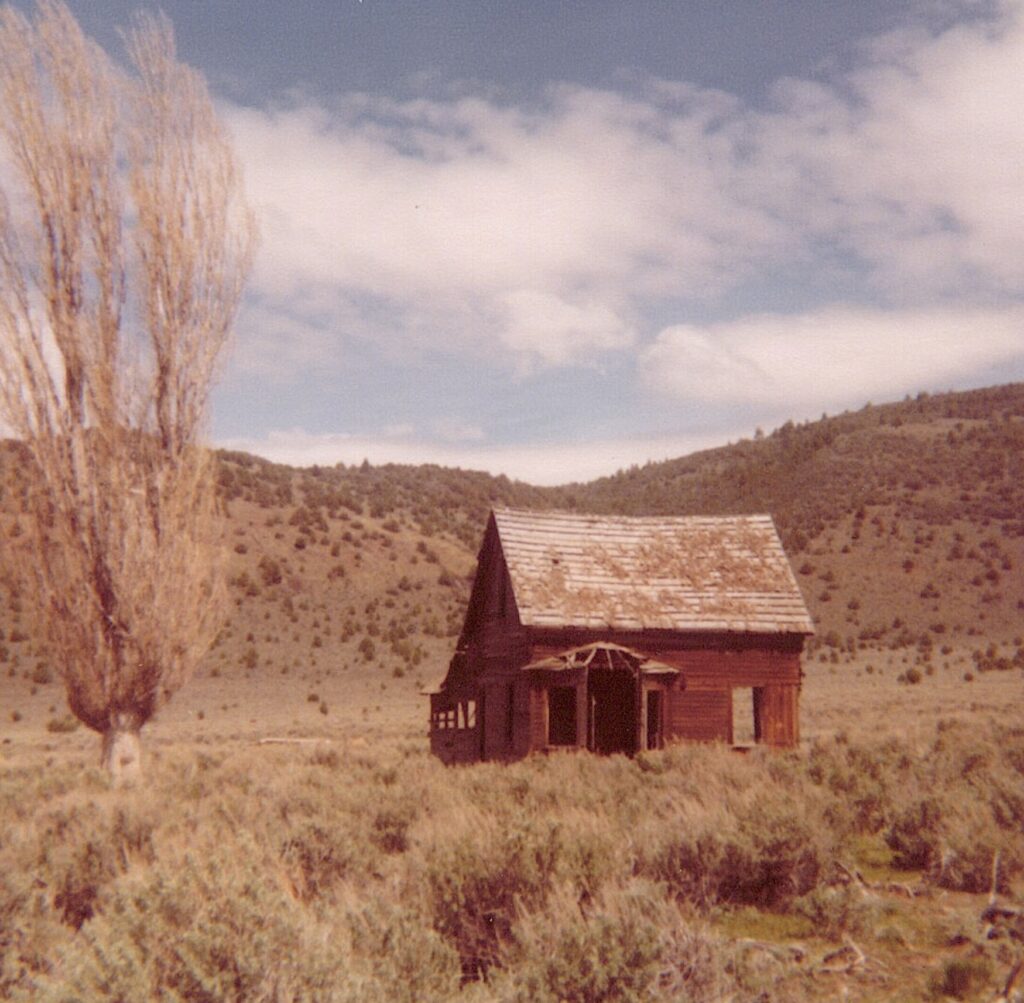
It is an ever changing environment. That is evident as the desert slowly reclaims the abandoned homestead, when those hardy souls tried to eke out a living.
When traveling the back country around these parts. Google maps and GPS not the best move. Use some common sense. Though it should be noted that AAA maps indicated Shinn Ranch Road was maintained. May be it was back in the 1870s when the Shinns lived there.
There are a handful posts that I repeat each year, and for good reason. With summer weather upon us, it is an ideal time to check out the many wonders that surround the residents of the Lassen Region.
Shinn Ranch, 1987
In 1929, the Lassen Advocate published an editorial “Know Your Country.” The gist of it, encouraged residents to get out and see all the various and interesting natural surroundings we have. I am always ready to get out and about to explore. I never know where that might be, but I do have a few obscure historical sites that I want to check out.
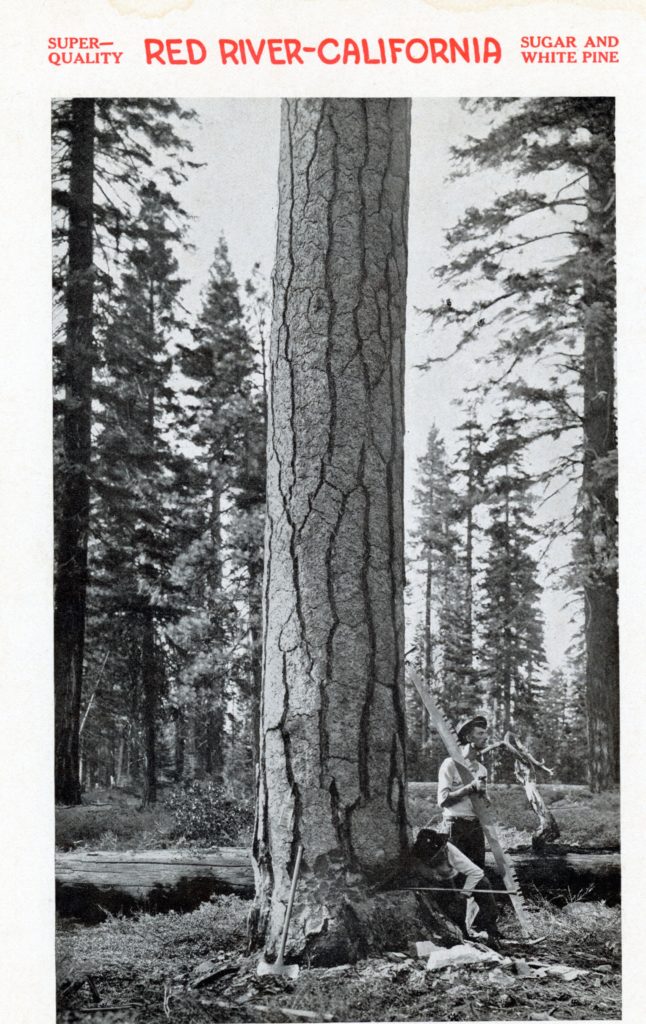
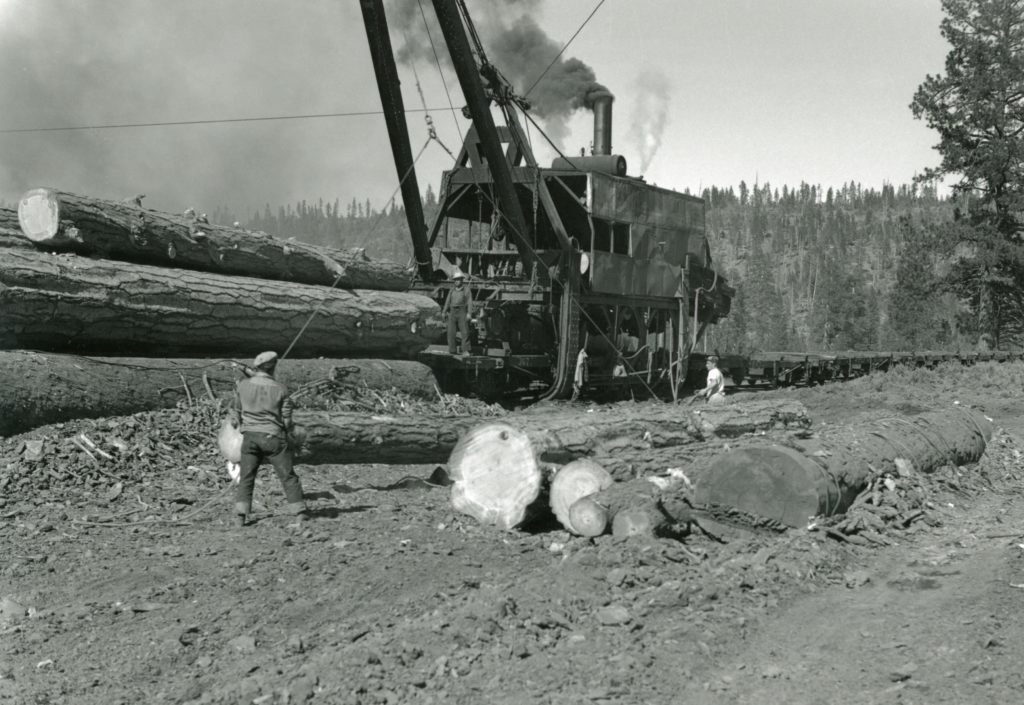
he winter of 1923-24, was one of the driest on record in California. That summer another record would be broken–forest fires. It was June, 1924, when the Red River Lumber Company having been in operation for over a decade experienced its first major forest fire. The fire broke out at Chester Flats between Camps 34 and 38 and burned a narrow strip of land, eight miles in length. Red River’s loss was minimal as the fire burned recently logged over land and the only significant damage was 500 cords of wood burned along 1,000 feet of railroad track. Red River considered its biggest loss was to the men fighting the fire which cost the company a $1,000 a day in wages, and it took a week to contain the fire. Continue reading Westwood’s Fire Train→
1971 Advertisement in the Lassen Cougar Yearbook. Courtesy of Jim Chapman
It was not all bleak during my brief Reno residency. Just down street on Baring Blvd, in Sparks, where I had physical therapy, there is the last sole remaining A&W in the region. I splurged last Friday evening, had take out from A&W as my farewell dinner.
Susanville seasoned residents will remember it was located at the bend in Main Street. It opened for business on May 22, 1961. It was established by John Gilliam and Leonard Porritt who invested $40,000 in this new enterprise. My memory fails me when it was closed. It was first reincarnated as Chinese Kitchen and today it is the home of the Courthouse Cafe.
Unfortunately, not the best photograph of Spoonville.
This was a small town located several miles northeast of Janesville on the way to Standish. In 1897, William E. Spoon established the Honey Lake Creamery near the Missouri Bend School. Spoon also opened a general store and, for a time, it was operated by the Christie Brothers. Thus the nucleus of a town was formed. In 1903, Robert Dunn built the 20-room Spoonville Hotel. On May 29, 1905, Spoon sold his remaining interests there to Ebenezer Cooley Brown, for an undisclosed amount. Though a small town, with less than thirty inhabitants, it was the “corporate” headquarters of the Lassen Mill & Lumber Company, Baxter Creek Irrigation Company and the Pacific Coast Bear Club. Members of the Pacific Coast Bear Club included such dignitaries as President Theodore Roosevelt and Nevada Governor John Sparks. In 1913, the town’s name was changed to Edgemont, as part of a real estate promotion scheme. M.E. “Mul” Mulroney, a native of Spoonville, recalled the town was already in decline and the name change did nothing to correct the situation. In addition, Mul stated that in the early 1920s the second story of the Dunn Hotel was removed and the building was converted into a dance hall. He further stated it was torn down sometime in the 1930s.
One afternoon, many yeas ago, Mul Mulroney and I sketched a rough map of Spoonville. B=Barn, C=Creamery and S=School (Missouri Bend)
Tim
The old Missouri Bend School, December 2020–Smith Properties
Knoch Building, circa 1900. Courtesy of Philip S. Hall
It has been awhile since we last visited one of the oldest and most prominent business buildings in Susanville – the Knoch.
Knoch Building, circa 1940
After the devastating fire of 1898, it was rebuilt. Ten years later, David Knoch passed away and his son, Isaac “Ike” Knoch took possession of the building. With the arrival of the “iron horse” to Susanville in 1913, it brought tremendous growth to the region. In 1914, when Knoch proposed to add a third story, he was told it could not be done. Well, as Knoch recalled years later, “That was all I needed the word can’t.” Work on the third story was to commence shortly after Labor Day 1914, However, with the Moose Lodge proposed a harvest festival in which Main Street would be shut down for several days, the work on the third floor was postponed. When the $34,000 project was completed, Susanville also had its first elevator.
Jacks Valley, located ten miles north of Susanville, along Highway 139, does not seem like much to the untrained eye. In 1865, John C. Wright located on the abandoned homestead of Thomas Pearson, who had perished in a snowstorm on New Years Day 1865. Wright as known locally was Coyote Jack, and hence the name of Jacks Valley. In 1869, he left for parts unknown. By 1880, this had become a crossroads for travelers as five different roads converged in the valley. Frank Fluery took advantage of the opportunity provided by this unique junction and established a saloon. In 1884, as one of Fluery’s patrons noted: “. . . for ten cents he will give you enough to make you happy to cause you to forget all your trials, troubles and tribulations for a time.” In 1889, Fluery sold to A. J. Conklin who operated the saloon for a number of years. In 1907, Conklin ventured into the lumber business and built a sawmill that had a daily capacity of 15,000 board feet. In 1920, Conklin sold the sawmill to William Johnson. Johnson operated the mill for three years and then sold to the Red River Lumber Company who immediately closed it. In August 1926, a forest fire ravaged the region that encompassed some 20,000 acres. The following year, the Red River Lumber Company established logging Camp 70 to salvage the burnt timber. This was one of that Company’s earliest truck logging camps. While those enterprises have long since faded into oblivion, a cement water trough remains and is still a recognized feature to travelers. In 1913, Thomas Hill and the County of Lassen constructed the water trough. For early motorists, it was a wonderful blessing, a source of water for overheated automobiles making the trip up Antelope Grade. For the next 80 years it was popular stop to drink the water and take a break, though it appears the water line has been disconnected.