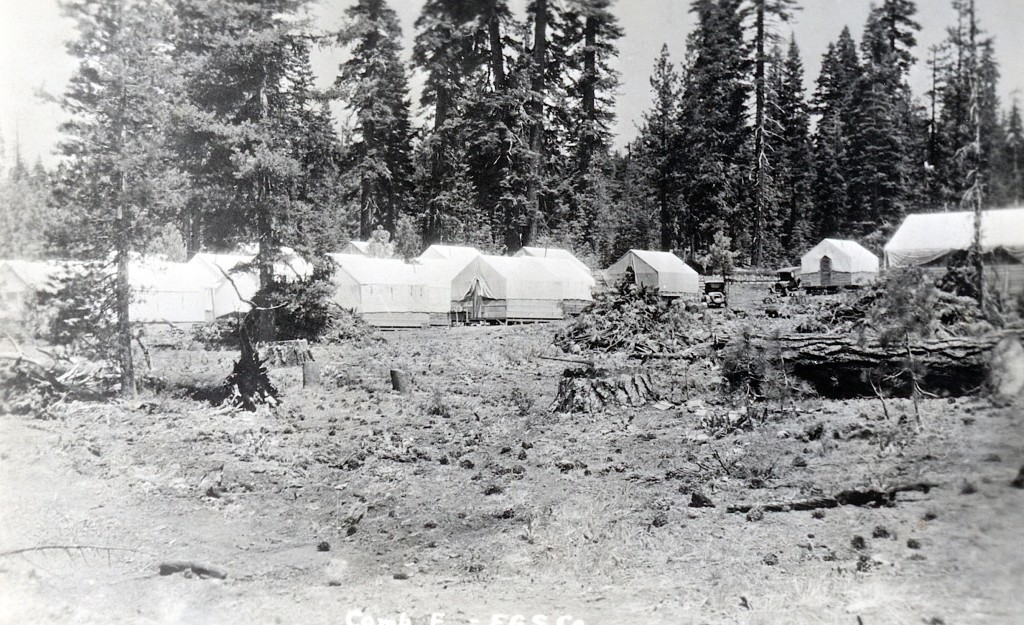
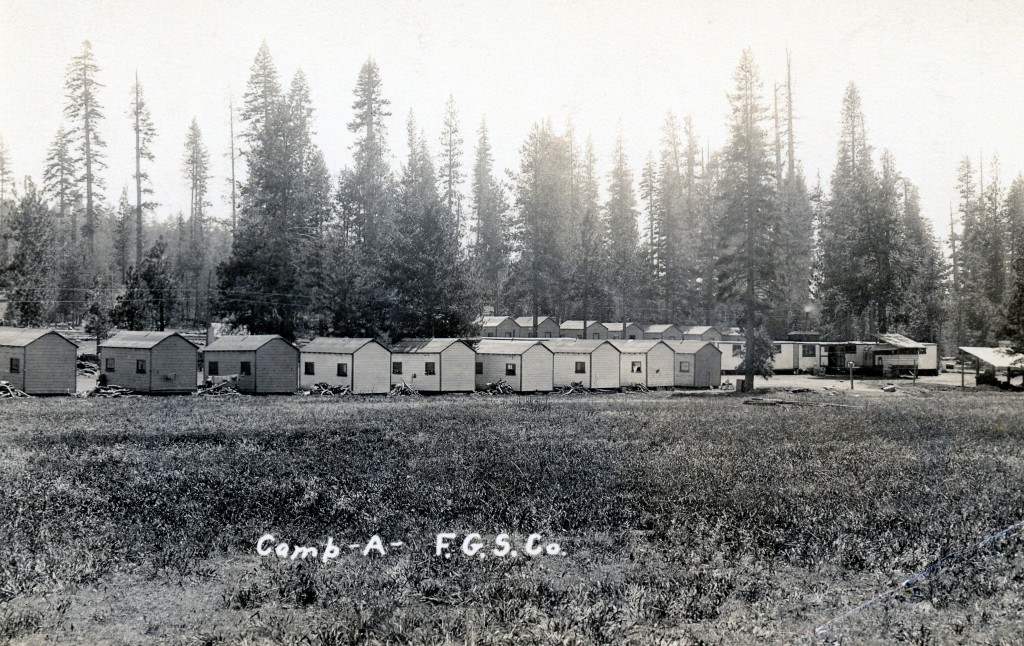
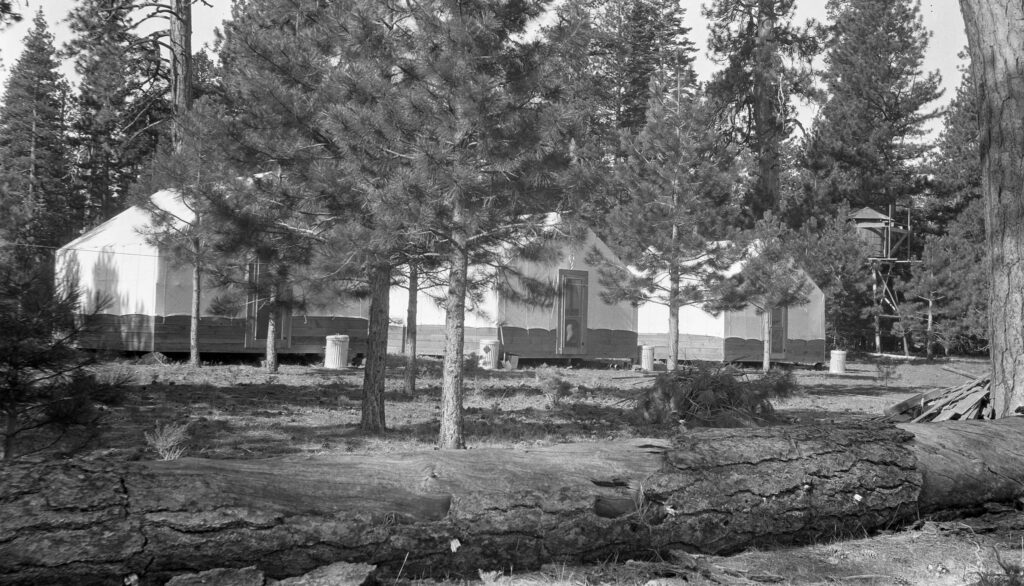
In a ten-year period between 1920-29 Fruit Growers Supply Company established 10 logging camps west of Eagle Lake. Many of these camps were substantial in size, housing over 200 men. There were several smaller camps that only existed for a single season. These small camps differed from their counterparts as they had wooden canvas tests, whereas the others were actual cabins, that could be placed on rail cars to move from one place to the next.
Camp A, Fruit Growers Supply Company, located just north of McCoy Flat Reservoir, 1921
Camp 9, located a few miles west of Camp 8, also known as Summit Camp operated during the 1928 logging season. It was not a full fledged logging camp, and it only housed timber fallers.
For several years prior to 1912, the Pioneer had a biergarten next door. Courtesy of Philip S. Hall
In past, we have explored how instead of demolishing buildings, the buildings were moved to another location. In 1920, W.H. Tuttle purchased the Pioneer Saloon (722 Main Street, Susanville). Tuttle wanted to replace the wooden structure with a new two-story fireproof one.
The late George McDow, who was ten years old at the that time recalled the event of moving the structure: “We kids watched with great interest as they pulled the old wooden structure into Main Street with a horse-powered winch. Turning the building around one-quarter turn, they led it down Main Street hill on planks and rollers by means of the winch anchored at the top of the hill. On reaching the bottom of the hill between Union and Weatherlow Streets, it was turned back the quarter turn to its original position and moved backwards onto a vacant lot, where it still stands.”
In 2024, the building is still there, albeit in an altered state. The location is 924 Main Street.
Cahlan/Mathews family plot, Susanville Cemetery, 2016
The family of Arthur Cahlan Mathews (1922-2024) will be holding a graveside service at the Susanville Cemetery Wednesday, June 5, 2024 at 4:pm Art passed away earlier this year at age of 101 at Florence, Oregon. He was a native of Susanville, born on June 5, 1922, the only son of Arthur J. and Lena Cahlan Mathews. His family was involved in many community affairs. His father was a key figure to establish the local telephone company in 1910. His grandfather, John Cahlan was the Mayor of Susanville and the President of the Bank of Lassen County at the time of his passing 1912. His grandmother Charlotte Cahlan was instrumental in establishing the Lassen County Free Library.
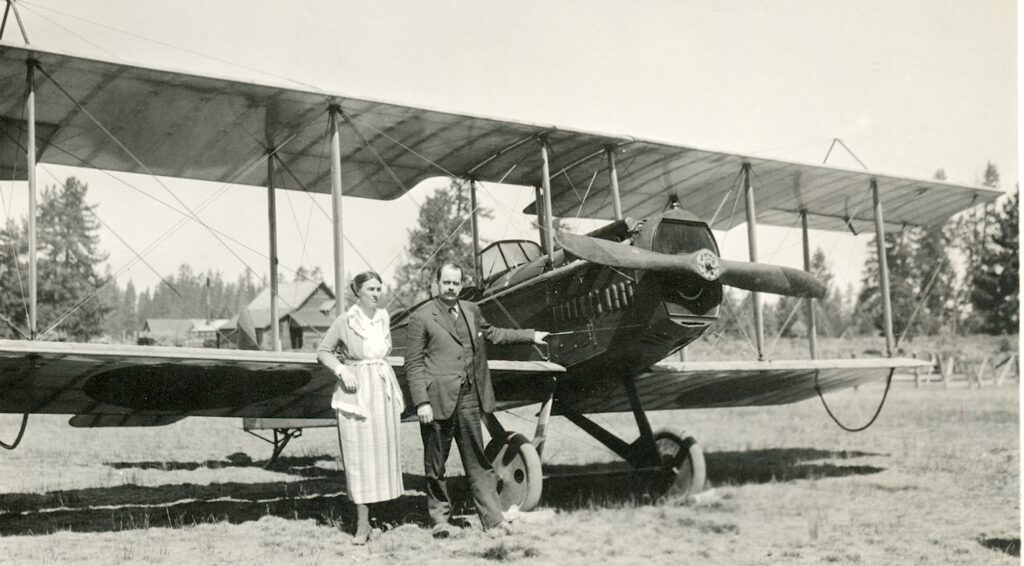
Mr. & Mrs. H. Frodsham in front of Bud Coffee’s airplane at Westwood, August 5, 1920–H. Frodsham photograph
Today, Westwood has no airport. It did, however, at one time had two different airports. The first one which really consisted of a crude landing strip. By the late 1910s, the first landing field was located about a mile south of the Goodrich Ranch, or the current bridge that crosses Goodrich Creek. Interest in flying slowly gained momentum. In June 1928 the Westwood Auto Club spent $100 to clear the landing field of brush and fill in holes to make two 2,200 foot runways. Thus, the Westwood Airport was created—a first in Lassen County. By the late 1930s the landing field slowly declined in use, since the Red River Lumber Company was in a transitory period. In 1944, Red River sold its Westwood operation, thus more changes on the horizon. In 1946, Lassen County bought forty-two acres at $2.50 acre from Red River to provide a landing strip to the west of Westwood. It was subsequently closed. In July 1982, the Lassen County Board of Supervisors discussed re-opening the airstrip, but it never got off the ground.
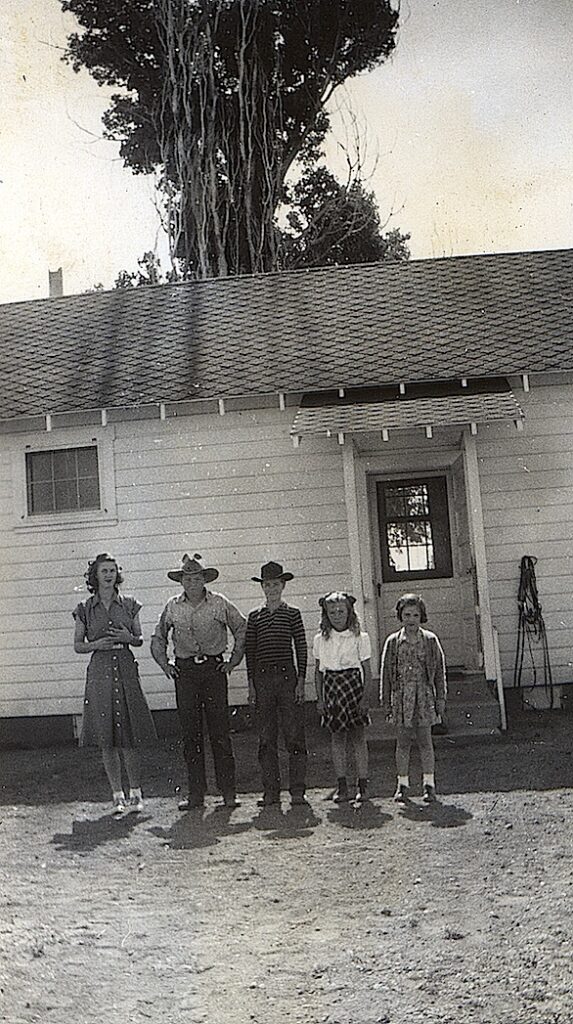
Willow Creek School, June 1946. (Left to Right) Phyllis Wemple, teacher, Elwin Murrer, Bill Daniels, Sally Murrer and Beatrice Walsh—Olive Murrer
Its that time of year, graduation season at local schools. In the 1940s, a number of rural one-room schools would cease to exist due to decline in enrollments and consolidation. Willow Creek Valley some twelve miles north of Susanville was one such school.
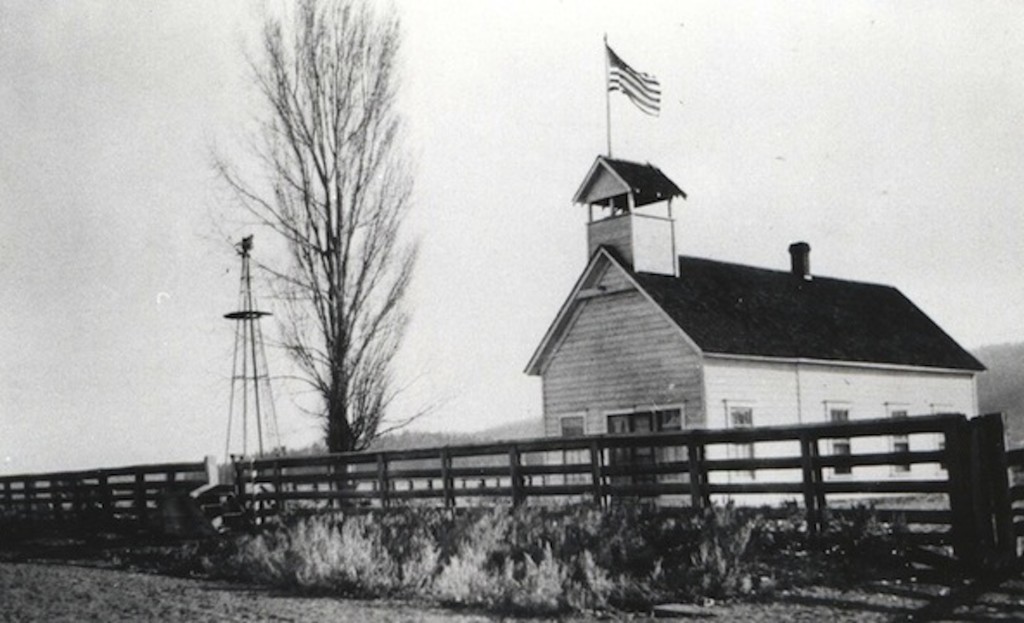
Established in 1871, it was one of the older school districts in Lassen County. As an example of declining enrollments came from Glenn Streshley. When Glenn started school there in 1915, there were twenty-three students. Seven years later, when he finished his studies there were only ten.
Willow Creek School, 1921
On April 17, 1942, the school house was destroyed by fire, caused a by a defective flue. It was a like a omen of things to come. However, a small building was moved to the school grounds, with little interruption of the school’s activities. In 1943, the school was suspended for a year for a lack of thr minimum five-students necessary.
In the fall of 1944, the school was resurrected. The student body consisted of Roy Gene DeForest, Elwin Murrer, Sally Murrer and Beatrice Walsh. Though one student short of the state mandate, the school may have been granted an emergency status due to the prevailing conditions of World War II.
In June 1946, Elwin Murrer graduated from the eighth grade. The school did not open again that fall for lack of students.. By 1950, it was apparent there was not going to be a surge of youngsters in the Willow Creek Valley and the school was annexed to the Susanville School District.
Native Daughter’s plaque for Fort Janesville site.
This was not a military encampment. Susanville’s Roop’s Fort also known as Fort Defiance had no military affiliation either.
By the end of 1859, tensions were fraught between the Indians and the settlers. Then the following spring witnessed the outbreak of the Pyramid Lake War of 1860. Residents of the Honey Lake Valley took precautions and fortified themselves at different places. At Janesville, the residents built a stockade measuring 63’ x 90’ from pine logs that were12 to 14 feet high. After the fears of Indian attacks had subsided, the fort was used as a private school from 1861-1864. In 1865, the school was abandoned and area residents helped themselves to doors, windows and anything else they wanted. Asa M. Fairfield wrote, “The stockade stood for a good many years and fell down a log at a time.”
Probably, one of the most unusual proposals to use the waters of Eagle Lake was for mining operations at Hayden Hill, located some twenty-five miles north of the lake. It just goes to show, there are a lot of creative individuals out there, past and present.
During the 1920s and 1930s, both the mining activity and the population at Hayden Hill declined. In 1934, Stratton & Stratton of Spokane, Washington consolidated the mine ownership. They had high hopes to revive the Hill. One of the main drawbacks that Hayden Hill suffered was the lack of water for milling. In 1938, Stratton & Stratton proposed to pipe water from Eagle Lake, at a rate of 2,500 gallons per minute. This scheme never came to fruition. There was no Hayden Hill revival.
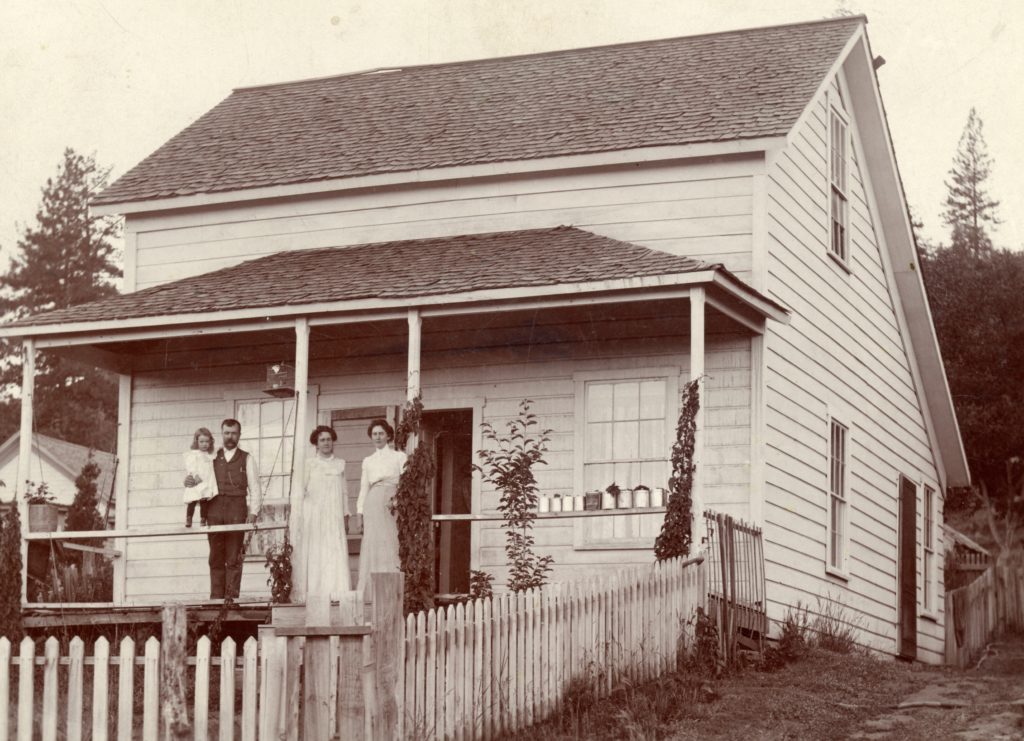
B.R. Zimmerman residence, 45 South Pine Street, circa 1890. Courtesy of B.R. Zimmerman Collection
One of Susanville’s original streets, when the town was surveyed in 1863, it was the most western street. So named for the pine trees that are on the western edge of town. An odd thing about Pine Street, it initially went from Main south to the Susanville Cemetery. What is known as North Pine Street did not come into existence for a number years, and even then it only extended to North Street. For years it was known as Prattville Road, and this was route out of town, and the next town then in existence was Prattville, which the original town no longer exists as it demolished to make way for Lake Almanor in 1914.
North Pine Street, January 1916. Courtesy of Dolores Gasperoni
Beginning in 1922, the street underwent substantial changes when it intersected with Highway36 and more on that shortly.
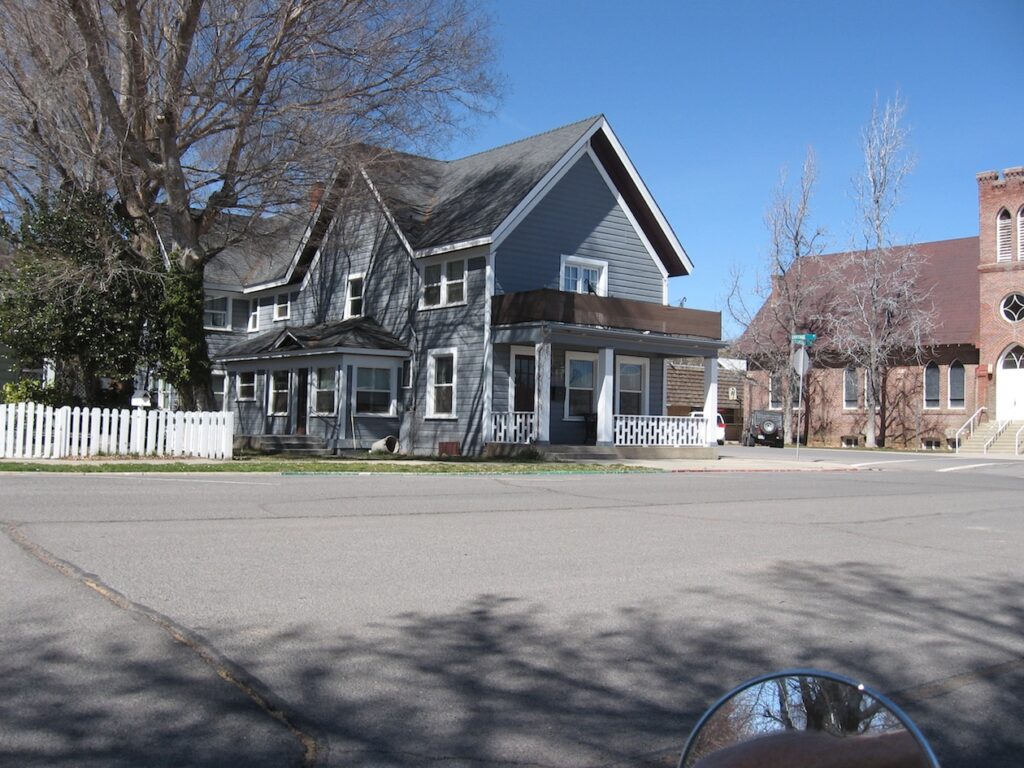
The former Burroughs Building, built 1891, 100 South Lassen Street, Susanville, March 17, 2024
Back in January we explored the Susanville City Hall Centennial. The City Trustees considered moving city hall to a new location. In 1921, the City had created a Planning Commission. The Commission recommended the purchase of the Spencer/Burroughs block on South Lassen Street—just north of the Lassen County Courthouse. The majority of the block was vacant, but it would include a two-story combination lawyer’s office/residence. The vacant block would make an ideal public park/playground, something the residents had desired.* The building could be easily renovated into a city/fire hall or a new structure could be built. The Planning Commission ventured so far that they met with Harry D. Burroughs and the recommended price for the property was $20,000. The Commission’s proposal never went any further.
*In 1924 Fruit Growers built the first park/children’s playground adjacent to Riverside Drive, more about that forthcoming.
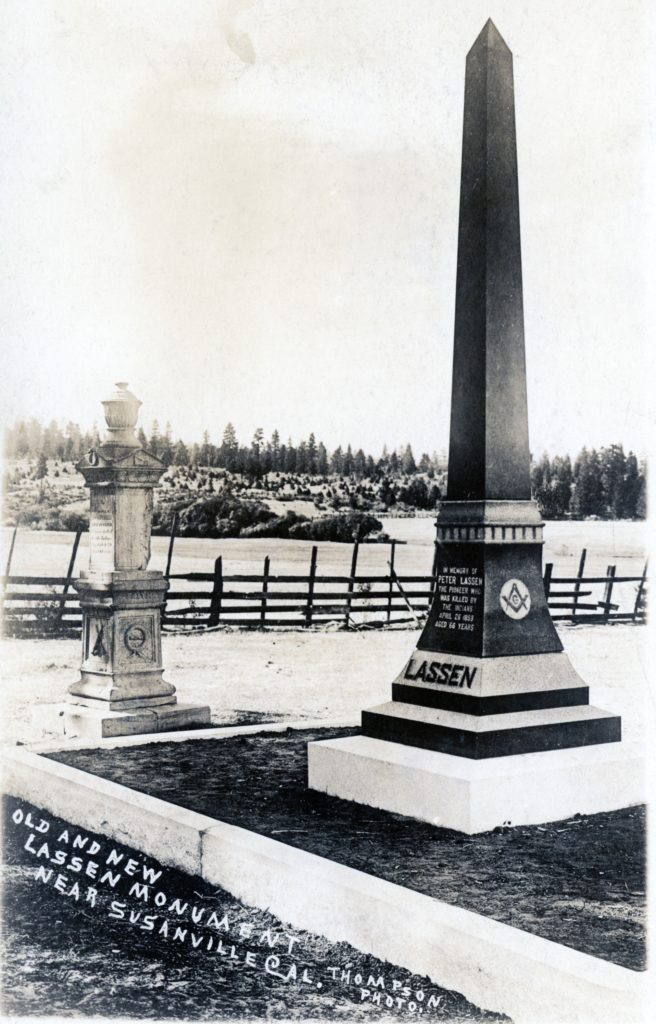
The Lassen Monuments located some six miles south of Susanville at the base of Diamond Mountain marked the finally resting place of Peter Lassen who died in 1859. As the story is told, this is where Lassen first camped in the Honey Lake Valley beneath a stately Ponderosa pine tree. In 1862, a monument was placed on his gravesite.
For those familiar with the site, it is a idyllic setting with a pine grove overlooking an expansive grassy meadow. By the mid-1870s, the place became a popular summer picnic spot.
Fast forward to September 1917, after the dedication of the second Lassen Monument, Robert M. Cook, editor and publisher of the Lassen Weekly Mail wrote in his column that more was needed to be done with the new monument: “The location is of one scenic beauty and it is hoped that it ca be made an official cemetery and thus secure the care of the county in keeping the grounds in first-class condition. There is no fund at present for this purpose and it will be a shame to allow the beautiful stone that has been erected to become the center of unkept and neglected grounds.”
In the 1920s, a movement was started to purchase this property and establish it as a public monument. In 1925, according to newspaper reports, that mission was accomplished when it was revealed that the Hulsman family, owners of the property, donated a small parcel to local Masonic lodge (Lassen Lodge F.&A.M..). This was a bit premature, for no deed was either prepared or more importantly recorded. Finally, on April 23, 1952, Hannah F. Hulsman deeded a one-acre plot to the Native Daughters of the Golden West, Susanville Parlor No. 243. Over the years the Native Daughters found it burdensome to maintain the property and subsequently on June 29, 1976 donated to Lassen Lodge & F.&A.M.. Over the years various community groups, such as Rotary have assisted the Masons with maintenance.