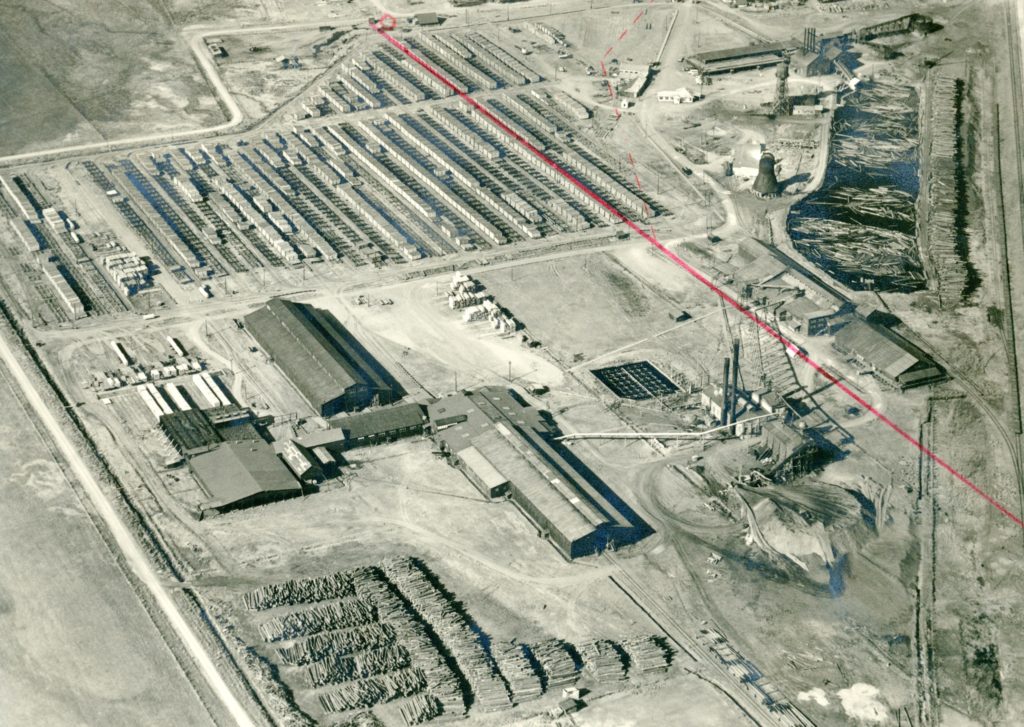
In 1951, Lassen Lumber & Box Company (Lassen Lumber) began to liquidate its holdings. On November 3, 1952, its neighbor, Fruit Growers purchased Lassen Lumber for $1,425,00. On the surface it was puzzling why Fruit Growers would purchase another mill. After all, the need for box shook was in decline with the conversion to cardboard boxes. But Lassen Lumber had one item Fruit Growers needed–water rights. If at some time in the future Fruit Growers decided to convert and manufacture cardboard at Susanville, the purchase of Lassen Lumber would give it the necessary water supply.
On February 8, 1953 the last of the decked logs at Lassen Lumber had been processed, and Fruit Growers closed the mill. It was then sold to Goff Machinery Company of Stockton, California, which immediately dismantled it. On March 11, 1953, Fruit Growers sold thirty acres that contained the box factory to the T&M Sash & Door Factory, operated by A.L. Lucero and Walter Wirth for $125,000. The box factory building was destroyed by fire on April 3, 1966. Today, the property is occupied by Lassen Auto Body on Alexander Avenue.
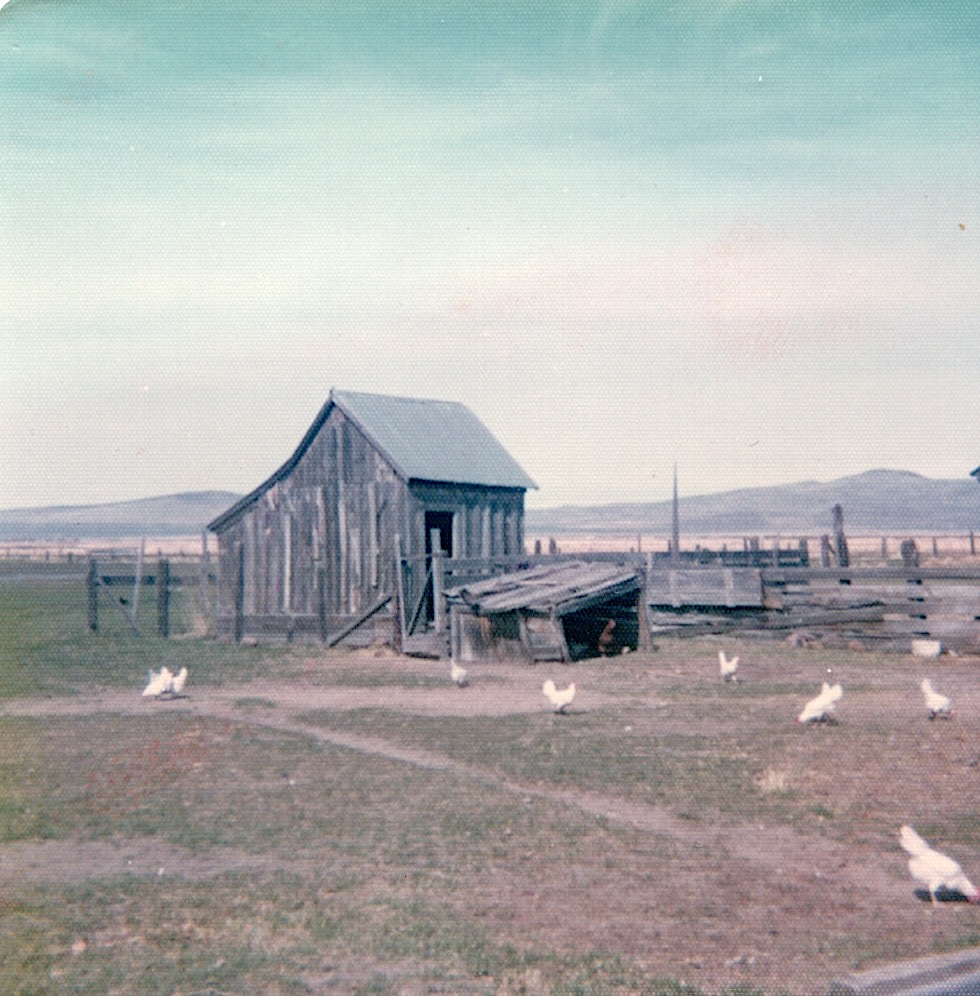
Chicken yard and coop, Tanner Ranch, Honey Lake Valley, April 1974
In the fall of 1927, A.N. Bennett of Bennett & Cardinal, owners of the area’s largest creamery, and a distributor of eggs. Bennett stated for many years, Lassen County produced enough of eggs to meet local demand. That changed in 1922, with the increase of population, but the local egg production had not. In 1922, $140,000 was spent to import eggs into Lassen County. The Lassen County Farm Bureau stepped in, and while local production still did not meet local demand, only $80,000 was spent yearly to import eggs. The farm bureau estimated 20,000 chickens were required to meet local demand. The organization advocated 200 chickens per farm.
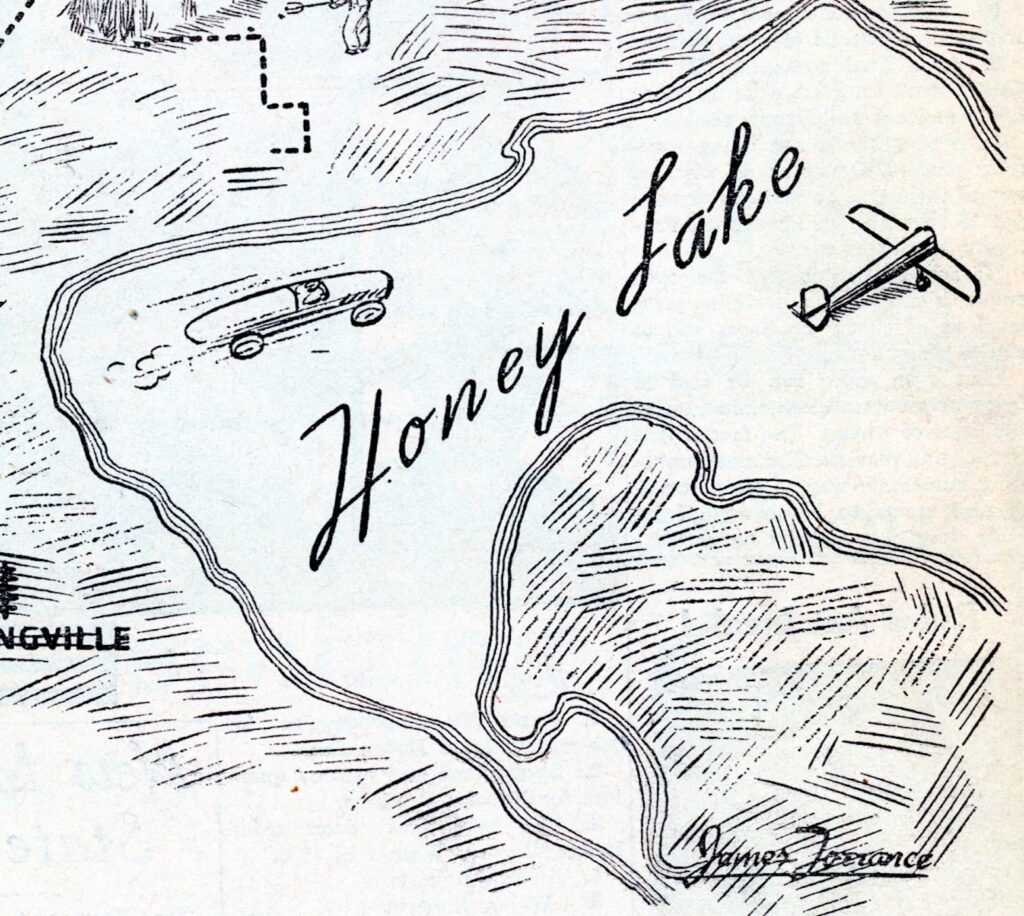
This caught my eye of a 1935 illustration with an automobile and an airplane on Honey Lake. I have many tales, when the lake is dry, that certain car enthusiast had roamed on the dry lake bed. Like a mirage, it is not really that dry. There places that appears to dry on the surface. there are soft spots, and many a poor soul has encountered them, got really stuck and stranded on the supposedly dry lake bed.
In the summer of 1931, there were two notable events on the dry Honey Lake bed. On August 23, 1931, Fred McKinley, a pilot and Miss Barbara McGrath, rodeo air queen of Alturas, landed on Honey Lake on a trip to Alturas for the scheduled grand opening celebration of Laird Airport there. McKinley was arrested in Alturas when statements were made while stopped on the lake bed, he attempted assault and rape Miss McGrath. Rumors and stories abound, but McKinley was found not guilty of all charges. The main incident that forced the landing was Miss McGrath’s taking ill from turbulence experienced in the air.
In a related matter of the McGrath incident, law enforcement officials went out on Honey Lake seek evidence of the airplane’s tracks. During their search they discovered a decapitated and armless skeleton. Identification of the body was impossible. It was judged to be a middle-sized man and that the remains had been on the lake bed for at least two years. The skeletal remains, still clothed, contained $22.12, a suitcase, a pocket knife and a corn cob pipe. The remains were interred in the Lassen Cemetery at Susanville, Case closed.
Cover page of the Lucky Land of Lassen pamphlet distributed at the Panama-Pacific Exposition
In January 1914, Lassen County sought a slogan for next year’s Panama-Pacific Exposition to be held in San Francisco. A contest was held in which public was encouraged submit slogans. Some of the entries, were in my opinion, questionable. A notable one was “The Poor Man’s Mecca.” Other entries submitted were: Seek No Further; Just What I want; Look and Long No Longer; and the Land of Milk, Honey, and Apples. The runner up, Lassen, the Last West. The contest ended on February 6, 1914. The winning slogan was the Lucky Land of Lassen. It was not revealed as to who came up with it. It was widely used for over two decades.
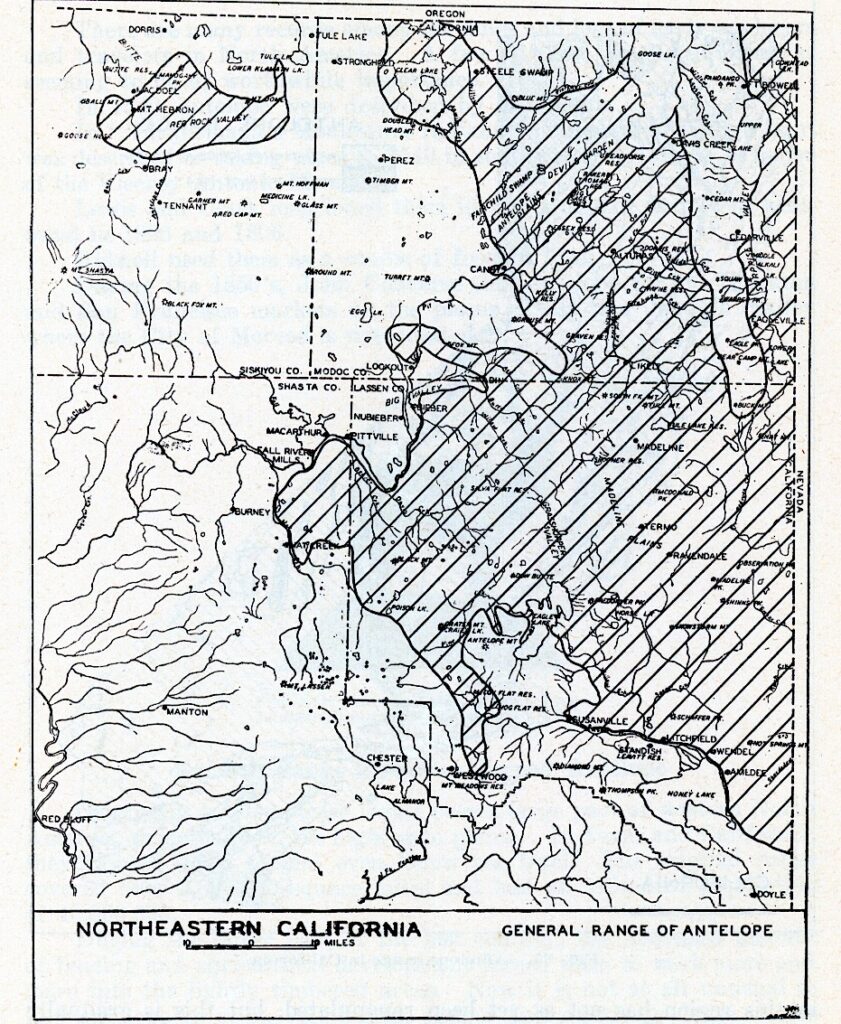
1944 distribution map of Antelope in Northeastern California.
Prior to the 1849 California Gold Rush the pronghorn antelope could be spotted throughout most of California, especially in the Sacramento and San Joaquin Valleys. Fencing and agricultural development in those regions forced them of that habitat. By 1920, some thought the antelope were on the verge of extinction with a population of 13,000 in North America. One of the largest concentrations of antelope were located in Lassen and Modoc Counties. .
A herd of antelope near Secret Valley, 1938.
Antelope are noted for their speed. They are latest mammal in the Western Hemisphere. They are also known for their curiosity. In 1944, Donald C. McLean of the California Fish and Game wrote: “On the Madeline Plains east of Ravendale, four antelope does ran along beside the car for about one-half mile at 42 miles an hour, suddenly put on a burst of speed and tossed directly in front, then raced along just ahead of the car for another one-half mile at about the same speed when they crossed over in front again and stopped about 100 yards from the road. These animals were certainly not particularly frightened. In fact, I think it was curiosity and the joy of a race that prompted them to stay the car for such a distance.”
In McClean’s report he noted that there was 4,504 antelope in Lassen County. The largest concentration was in the Skedaddle Mountain country. In Modoc, the count was 1,167. McClean’s report included a detailed account of census methods. The first two paragraphs are rather informative.
“Formerly antelope were estimated or counted by crews of picked men working from horseback or on foot. About six or seven generally made up a crew, working in twos orthrees in most areas. Occasionally, however, all joined to form one crew in places where large numbers of antelope in a limited area had to be counted one time to avoid the possible duplication that might occur if they were not all counted in one day. Because of soft ground and rocky terrain, most of the counting had to be done on foot. In order to count the two counties, Modoc and Lassen, properly each man of a six-man crew had to walk or ride about 600 miles–about 26 days of effort per man.
“The extensive use of the airplane was started in the late winter of 1941-42. This first airplane census was carried under the Federal Aid in Wildlife Restoration Act as part of Project California 12-R, “Aerial Survey of Big Game in Northeastern California and in the Owens Valley.” James D. Stokes of the Division of Fish and Game was the observer and. A.L. Reese the pilot during the 1941-42 survey. The 1943 and 1944 censuses were made with regular Division of Fish and Game funds, with D.D. McLean as observer and John Allen as pilot. This method is far superior to the old from the standpoint of speed, accuracy and expense.”
In 1860, Zenas J. Brown (1812-1895), a pharmacist, received the nickname of Dr. Eight Square when he constructed an octagonal building in Susanville. Brown, in the scheme of things is known for a lot of things.
In 1861, Brown created Susanville’s first subdivision, located in the vicinity of Lassen High School and aptly named Browntown. In my opinion this just weird. First, the nearby mining town Richmond rivaled Susanville. Secondly, it was not until in 1863, that Susanville plot map had been surveyed and recorded. However, Isaac Roop the questionable owner of said property, did not prevent him in sale of said lots that would become officially known as Susanville. It should be noted that in 1920, what would comprised Browntown was legally subdivided and known as the Armstrong Addition. Furthermore, most that property today is the Lassen High School Campus.
Brown’s lasting legacy, that he is credited with the planting of the area’s first orchard of apple and peach trees. In 1863, one of Brown’s peach trees produced the area’s first peach crop —four peaches devoured by Susan Roop and Mrs. C.W. Fuller. In the fall of 1864, Brown sold his subdivision and left the region.
The Shinn Ranch in remote eastern Lassen County is not a place one just happens upon. It has been years since I was last there with a film crew doing an episode of Off Road California.
It was in 1870, when fifty-year old Oliver Shinn located there with his family of five children from Baker, Oregon. He remained there until his sudden death in 1883. According to his obituary, “Mr. Shinn was awakened from a sound sleep at about 10 o’clock Thursday night by coughing and upon getting out of bed, dropped dead on the floor. It seems that he troubled an aneurism of the pulmonary artery and in his efforts to clear his throat this was ruptured, causing instant death.” The following year, his widow, Louisa Shinn sold the 640-acre ranch to George D. Winters for at that time a substantial sum of $6,000. The Winters family had extensive holdings, which included the nearby Smoke Creek Ranch.
Portion of the Cottonwood grove at Shinn Ranch, January 9, 2021—Greg Johnson.
One of the interesting features found there was a grove of cottonwood trees that encompassed some fifteen acres. The trees were planted by Winters in 1889 in order to increase his property holdings there. On April 3, 1893, Winters was issued a 160-acre land patent that he filed under a section of the Timber Culture Act “to encourage growth of timber on the Western Prairie.”
Shinn family plot, Susanville Cemetery, November 19, 2015
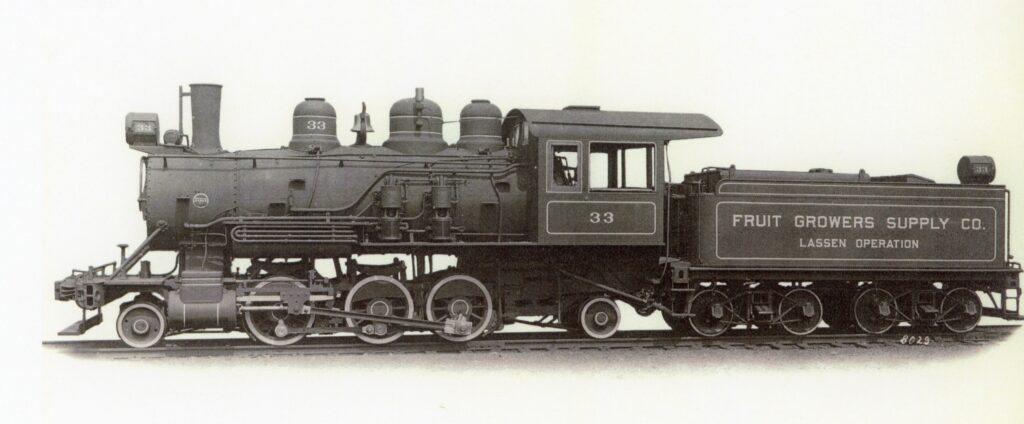
In 1921, Fruit Growers bought a new Baldwin locomotive, that was designated the No. 33. Some where the down line they changed it the No. 2. In 1952 Fruit Growers discontinued railroad logging on the Lassen (Susanville) Operation. In 1955, Fruit Growers announced the closure of Westwood Operation. In 1956, Fruit Growers sold the entire Westwood Operation to a liquidation company Wershow & Weisz. Some Fruit Growers locomotives were included and auctioned off in the fall of 1956. If No. 33 was included, that information would be in my Fruit Growers Westwood file that is in storage.
Viola Roseberry published an illustrated history of California Indian Baskets for the Exposition
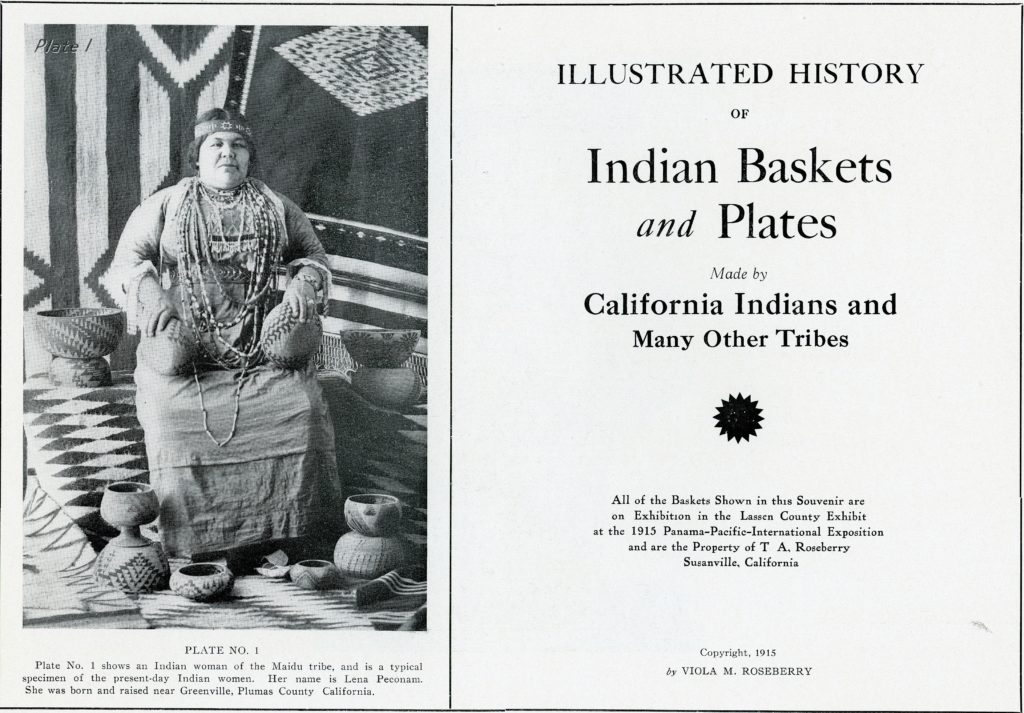
Susanville resident Viola Roseberry (1860-1936) had a special fondness of Native American heritage and that of their basketry. She possessed a large basket collection. In 1915, the collection was displayed at the Panama-Pacific International Exposition held in San Francisco. To coincide with the exhibit she published a book, Illustrated History of Indian Baskets and Plates made by California Indians and Many Other Tribes. Book had a price of 50 cents.
The cover picture is of Lena Peconum who has numerous descendants in this area. Viola wrote stories behind the baskets, such as one Maidu woman Comanche, who at the time was believed to be the oldest Maidu weaver, approaching 100 years of age, and residing in Genesee Valley, Plumas County.
Many of the Indian baskets on display at the Lassen Historical Museum, 115 N. Weatherlow St., Susanville, was a part of the Roseberry Collection.
The grave of Isaac N. Roop, Susanville Cemetery, circa 1966.
It was on Valentine’s Day 1869, that Susanville’s founder Isaac N. Roop passed away from pneumonia. He was only 47 years old. One of the unique contribution that Roop did for Susanville, does not that garner much attention. Susanville which one of the oldest communities of the western Great Basin, has an extra ordinarily wide Main Street. This was a fire prevention measure. Thus, should a fire break out, it could be contained to either the north or south sides of Main Street. It worked very well, and only time it failed during destructive fire of 1893. in which all of the business district was reduced to ashes.