Sunflower demonstration on the A.F. Babcock Ranch, Bieber, 1923. This appeared in one of those reports.
The records salvaged from dumpster dives cover a wide variety of topics. One of those were the Lassen County Horticultural Reports filed annually dating back to the late 1880s. This would later be superseded with the Lassen County Farm Advisor Reports. In the 1920s, nearly every Lassen County agricultural community had a farm bureau. It was the farm advisor’s many duties ro assist each one of the bureaus and would compile all the data collected in an annual report. These reports were meticulous in the information they provide. In certain instances, they included photographs of various demonstrations and/or experiments, such as today’s featured photograph.
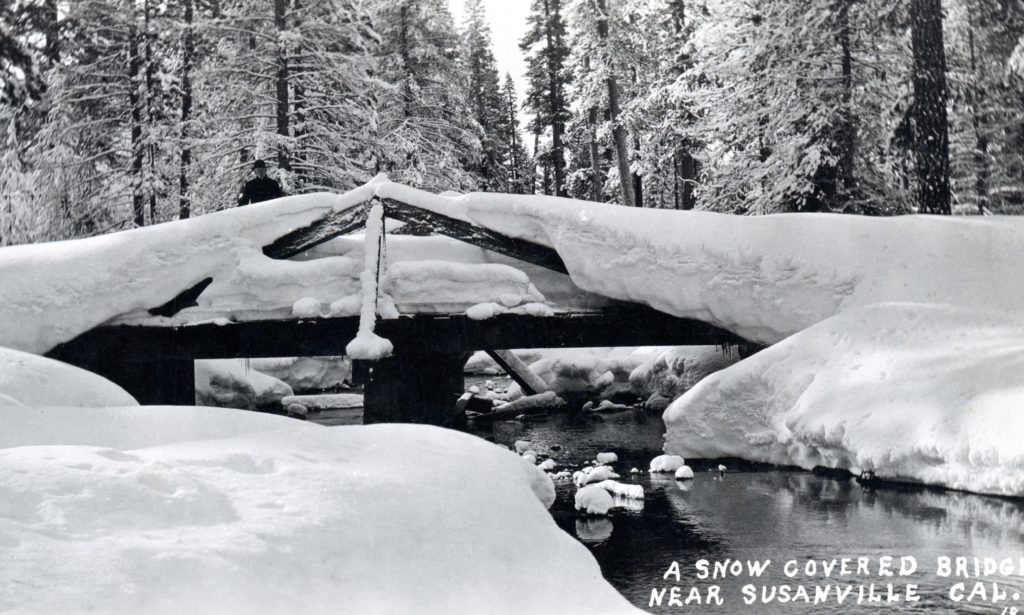
Robbers Creek, 1918, I do not think its near Susanville.
A few years back, I published this photograph. However, I could never figure out the location. Now, I know. It is crossing of Robbers Creek to the north of Westwood. Since this is some twenty miles away from Susanville, in my opinion, I do not consider that near. The photographer named Engel, who I admire his work. took some winter scenes at Westwood in1918, and instead of giving the location of that lumber town, Engel, as he did in the above photograph affixed the label “near Susanville.” I will be including a Westwood photograph by Engel in the 2025 Calendar.
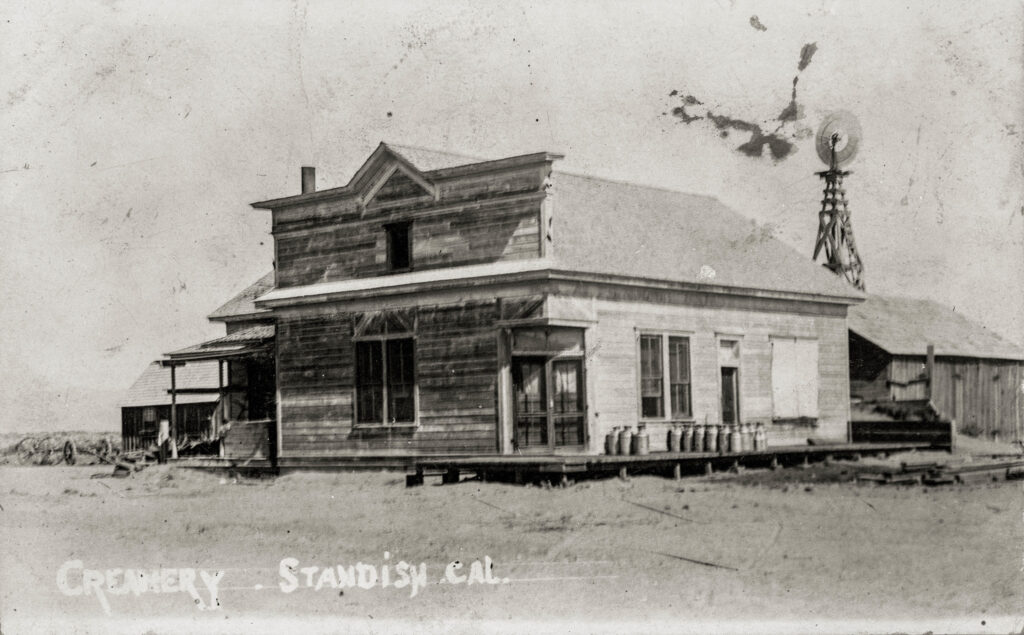
In the past, I have written snippets about the Standish Creamery, so now a complete version. In 1898, Standish was founded as a utopian community based on the belief of Myles Standish. In beginning all worked well. By 1901, the Associated Colonies of New York, backers of Standish filed for bankruptcy. With that entity removed it allowed the community to grow without the former’s restrictions.
In 1901, Buntingville merchant Mike Phillips relocated from the west side of the Honey Lake Valley to Standish. One of his many enterprises at Standish was the establishment of a creamery. In 1904, Phillips for unknown reasons sold his various businesses there and moved to Reno. Susanville businessman, Charlie Emerson bought the creamery
In 1916, Emerson boasted that his creamery had the only pasteurized milk in Lassen County. It should be duly noted that California State Law required all milk to be pasteurized.
In 1929, the creamery was destroyed by fire and not rebuilt.
In the spring of 1902, E.W. Hayden, editor/publisher of the Lassen Advocate raised the issue for the need of a high school. Hayden proposed a district high school, rather than a county one. Hayden felt that all the school districts in the county would not support a high school.
In the fall of 1902, Hayden again revived the issue for a high school. This time he succeeded in generating more interest. In September, John Spalding and Franklin Ward circulated petitions to have the matter placed on the ballot for the November election. On October 2, 1902, those petitions were presented to the Lassen County Board of Supervisors and they approved the ballot measure.
Proponents were worried that the voter’s might confuse the issue as a bond measure. Yet, funding for a high school still had to be addressed. It was proposed that the property tax be increased by one cent per $100 assessed value. This tax would generate $3,700 a year-more than sufficient to operate a high school.
As the ballot proposition called for the creation of a county high school, there was Hayden’s concern that it might not pass, especially with the voters far removed from Susanville. Surprisingly many of the outlying school districts were supportive of the measure. After all, the nearest high school available was Reno, Nevada.
On November 4, 1902, the voters of Lassen County went to the polls. Th voters approved the creation of the Lassen County High School by a large majority with 637 votes in favor and 295 opposed.
There was a sliver truth in yesterday’s article about the town’s infamous hangman’s tree.
On April 17, 1868, Thomas Pearson, his wife, daughter Hattie and Samuel Cooper were massacred by the Indians on the eastern shore of Honey Lake. This episode created a great deal of tension between the settlers and the Indians. Expedition parties were organized to find the guilty parties. who were believed to be members of the Pit River tribe. The Indians who did dastardly deed, however could not be found.
Proximity of the Pearson Massacre Site—-Larry Plaster
In September 1868, Captain Munson of Fort Bidwell still conducted expeditions, but like the previous ones, found no clues. That changed when he arrived in Big Valley, where we met with the Pit River tribe. The tribe turned over to Munson’s custody three suspected Indians.
Later that month, Munson. arrived in Susanville with the three Indians for civil authorities to conduct a trial. The hearing was held at night. The Indians were acquitted and they were released from custody. The Sage Brush newspaper reported “. . . that no evidence of appearing to establish their guilt.” Yet, a number of citizens who had gathered outside the courtroom believed the Indians were guilty. They became a vigilante mob. They escorted the Indians up Main Street to North Pine Street, where they were hanged “. . . from the limbs of a patriarchal oak.”
The saga of the Hangman’s tree was born. As folklore would have it, the tree was used for other occasions, but actually it was not. Again, it has been written the tree was cut down as recently as the 1960s, when in fact it was cut down in January 1892.
Main Street, Susanville, 1885. Courtesy of Betty Barry Deal
A reader remembered a long time ago when visiting the local history museum that there was a reference that Susanville had two hanging trees. and that they were a deterrent for visitors to engage in criminal activity. The Lassen County Historical Society even contributed to the folklore.
In its 1963 Bulletin entitled Susanville there is a short article by Robert H. Amesbury called the “Hangman’s Tree. Here is that story: “The large oak tree located in the front yard of the residence at 60 North Pine Street is alleged to have been used used by the law enforcement in early days of Susanville as an execution tree.
“Here were hanged several horse thieves and other wrong doers. Since the main road west from Susanville went up Pine Street at that time, this tree served as a constant reminder to travelers of the fate awaiting law breakers in this territory.”
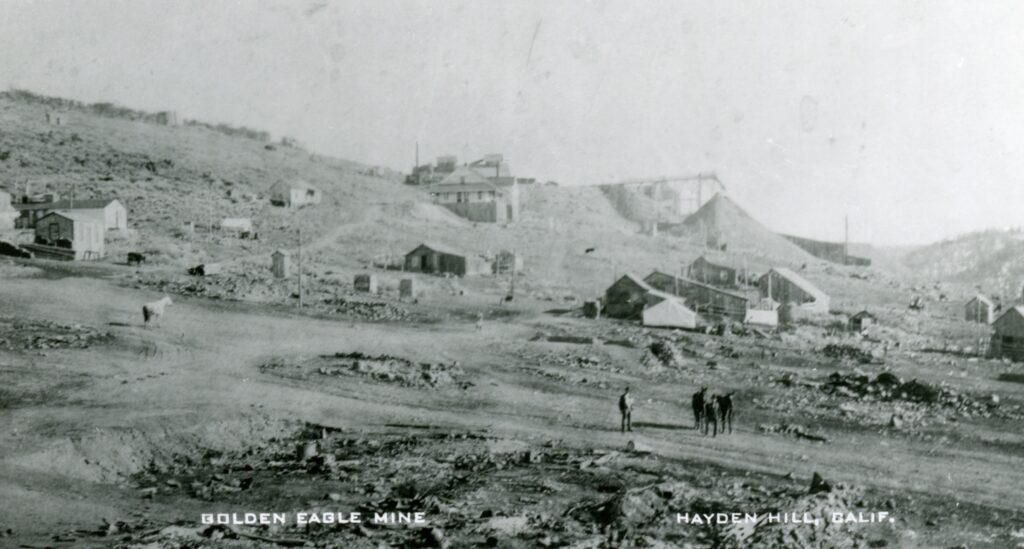
Hayden Hill, located some fifty-five miles north of Susanville, was Lassen County’s largest mining community. Unlike its counterparts in California and Nevada, it was small in comparison. Like so many mining communities, Hayden Hill went through numerous boom and bust cycles.
Of course, in 1870 when word spread of the gold discovery miners flocked hoping to find a new “Comstock.” By the mid-1870s things had fizzled on the “Hill” as locals referred to it. In 1878, several major discoveries and the prospectors returned. For the next eight years it was Hayden Hill’s most prosperous times. It was followed by a downturn, then brief uptick, and continued that way. By 1909, Hayden Hill witnessed prosperity that it had not seen since the late 1870s. In 1910, a devastating fire wiped out a major portion of the town and it never fully recovered.
Hayden Hill. 2018.
When Lassen Gold Mining revived operations during the early 1990s at Hayden Hill, the miners and their families did not reside there, many opting for Adin the nearest community. When Lassen Gold shut down in 1997, the open pit operation scared the landscape forever and its such a mess the entire “hill’ is fenced off.
It is a favorite topic of mine. Just as old photographs illustrate the past, maps do the same. My new scanner is of the flat bed variety and I am able reproduce certain maps. While some larger maps, I am unable to do, I should be able to scan certain areas.
The above map appeared in a Lassen County sponsored home seekers guide. Many of the communities depicted no longer exist. Some of the landmarks, are known today by another name. Lake Bidwell, is now Butte Lake, “Valcano” is Crater Lake and Halls is Papoose Meadows.
Depending upon the water level of Eagle Lake, it can be an island. The pelicans at the lake were a popular early day attraction, though others perceived them and the cormorants (sometimes referred to as shags) detrimental to the lake’s fishery. At sundry times the birds were slaughtered, their nests and eggs destroyed. A prime example is found in the columns of the Lassen Weekly Mail of June 11, 1892: “In Eagle Lake there are two islands (Pelican and Shag) on which large numbers of fowl, known as Pelican and Shag, build their nests and rear their young. The consequences are that vast numbers of fish from the lake are destroyed each year for food for the young birds. Recently a party visited these islands and killed the young birds and a good many of the old ones, hoping by means, if continued persistently for a number of years, to prevent the yearly destruction of the fish of the lake.”
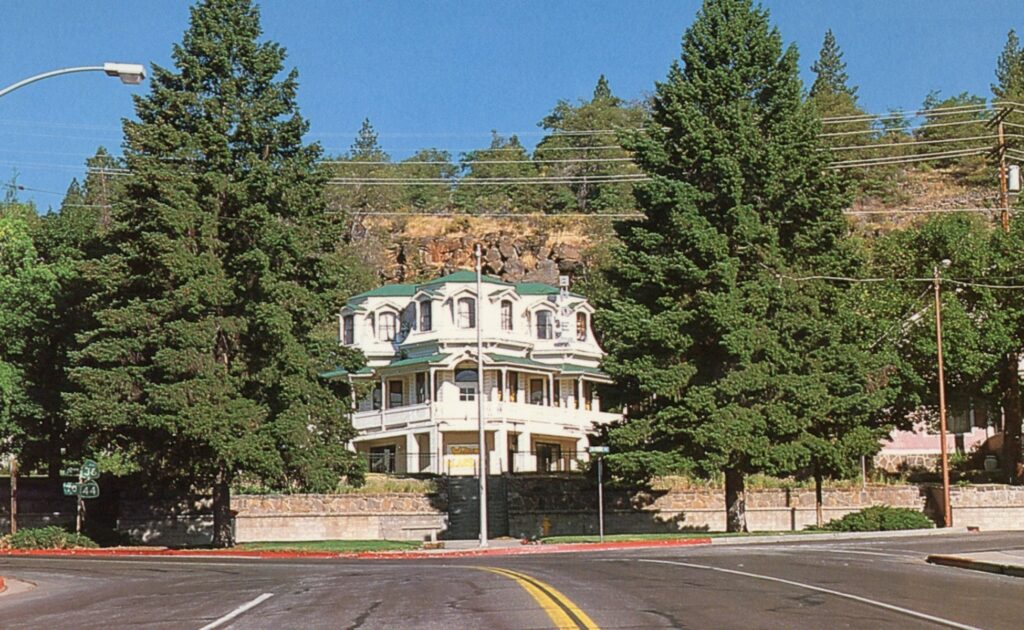
Having gone full circle on this topic of the west end of Susanville’s Main Street.
May be this unique plot of land should have a designated unique name? While the California Division of Highways (pre-Caltrans) created it, at the same time it is not a recognized parcel, thus legal ownership is in question. After all it does not appear on the Lassen County Assessor Maps!
The Monticola Club refers to it as the Triangle and are somewhat the unofficial overseer of it. In 1958, The Garden Section of the Club began planting flowers there. In 2023, the Monticola Club planted daffodils. In 1987, the Monticola Club through the hard work of Patty Davies put together a history of the various activities of that organization. The following is an excerpt from that booklet: “The Triangle. The 50 foot steel flagpole erected in the ‘triangle’ at the west end of town was purchased by the club in 1967. The club also ordered a flag that had flown over the U.S. Capitol. Since then, the club has paid the Lions Club $10 annually to raise the flag on major holidays. Several members donated six junipers for the area and planted lawn and petunias. Almost every year since, the club has been responsible for the beautification of that area.”






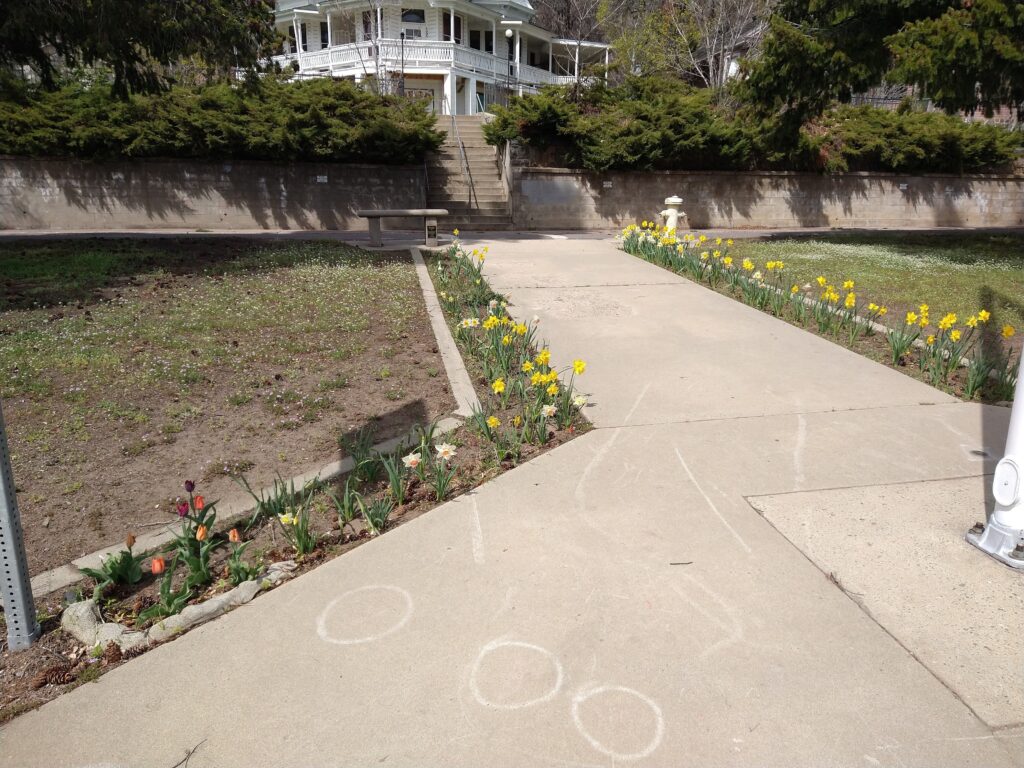 The Monticola Club refers to it as the Triangle and are somewhat the unofficial overseer of it. In 1958, The Garden Section of the Club began planting flowers there. In 2023, the Monticola Club planted daffodils. In 1987, the Monticola Club through the hard work of Patty Davies put together a history of the various activities of that organization. The following is an excerpt from that booklet: “The Triangle. The 50 foot steel flagpole erected in the ‘triangle’ at the west end of town was purchased by the club in 1967. The club also ordered a flag that had flown over the U.S. Capitol. Since then, the club has paid the Lions Club $10 annually to raise the flag on major holidays. Several members donated six junipers for the area and planted lawn and petunias. Almost every year since, the club has been responsible for the beautification of that area.”