Category Archives: History

Byers County

Byers' Store
Byers’ old Baxter Creek general store that was later moved his Tule ranch and operated by his nephew, Jim McClelland, May 1975

Many people may not realize but the original proposed name for Lassen County, was Byers County. So who was Byers, and why was he to be honored? In 1858, James Davis Byers (1825-1902) purchased some property along Baxter Creek near Janesville. However, he remained a Quincy resident for sometime. In February 1863, Byers served as a Plumas County Deputy Sheriff, and played a significant role in the Sagebrush War. The final result of that conflict led to the creation of Lassen County the following year. Plumas County Assemblyman Robert A. Clark introduced the legislation to create the new county. Clark proposed to name it Byers County, but Byers declined. Byers suggested that it should be named after Peter Lassen, and thus the Lassen name was applied to the new county.

More about Byers in a later post, though by 1880 he was one of the ten wealthiest people in Lassen County.

Old Lucy

Old Lucy
Old Lucy

On September 29, 1929 Old Lucy a colorful character on the streets of Susanville passed away, purportedly at the age of 125. While she best known as Old Lucy, she also had another Anglo name, Sally Norman. Dubbed a “picturesque” Native American of the era, she was a familiar sight as she ambled about Susanville, bundled up in numerous clothes, walking with the aid of a stick. People who knew her back in the 1870s considered her old back then. While her age was exaggerated when she died, documents placed her age at around 100.

Camp A – Fruit Growers

In the summer of 1920, Fruit Growers started their logging operations near McCoy Flat Reservoir, while their Susanville mill was still under construction. Since logging then, was seasonal in nature, they wanted to make sure they would have a steady supply of logs ready when the new mill would be placed into operation in the spring of 1921.

Camp A
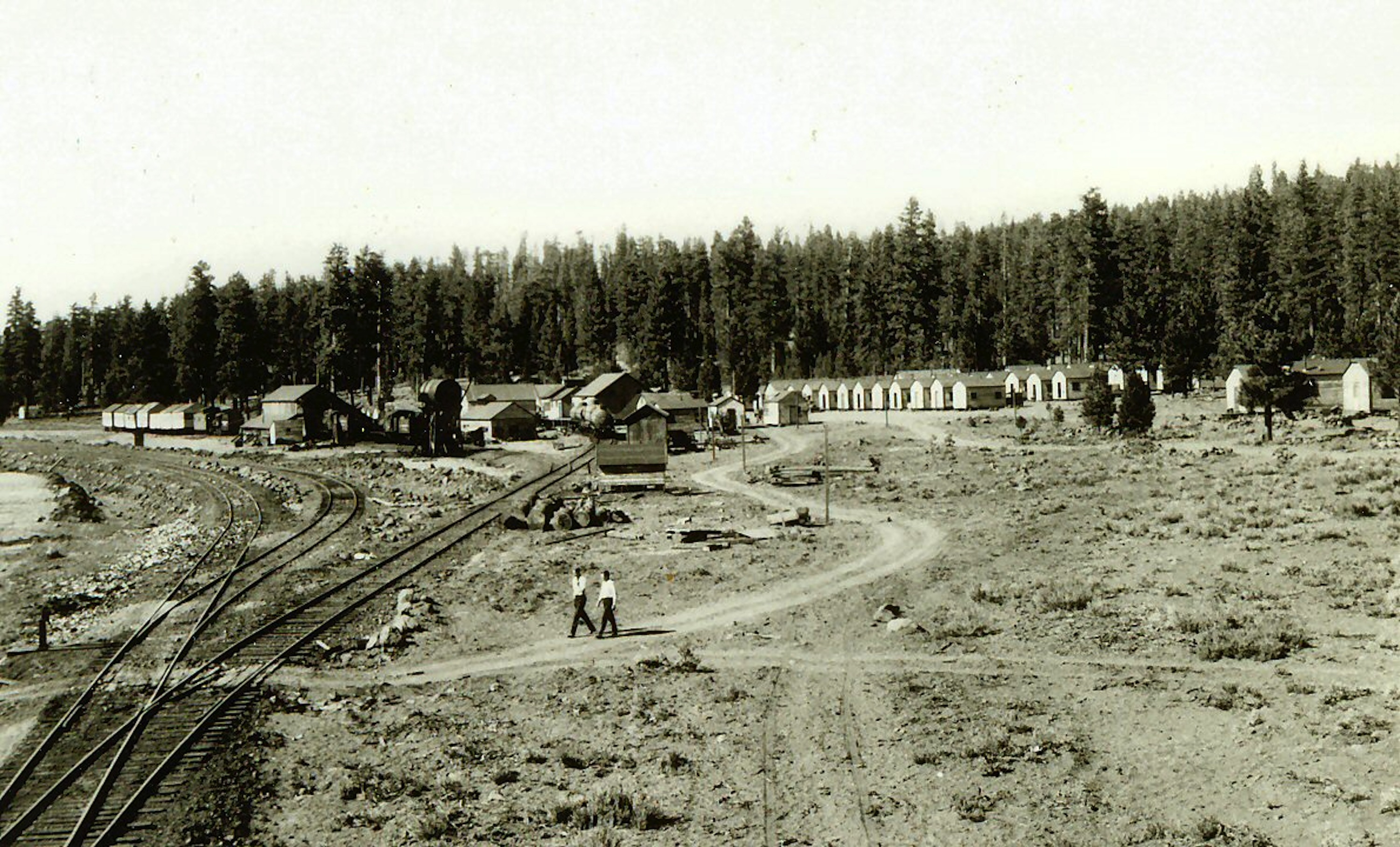
Camp A, Fruit Growers Supply Company, 1921

Camp A was the first of ten railroad logging camps of Fruit Growers Lassen Operation. It opened on July 1, 1920. The operation was comparatively small, only logging 720 acres that season. On April 29, 1921 the first woods crews were dispatched by rail, where they encountered three foot of snow on the ground. The first item of business was to remove the snow from the railroad spurs, so that the timber fallers could start work. Within in a weeks’ time, logs were already being shipped to Susanville. In addition, a second camp, known as Camp B, opened three miles to the north of Camp A. Between the two camps, they housed over 600 men.

Tomorrow: The Chester Causeway

Roosevelt Pool

Roosevelt Pool
Remnants of Roosevelt Pool, February 21, 2015

It is only fitting to begin the daily post with some current and past history combined. In mid-February saw the demolition of one of Susanville’s notable landmarks, the Roosevelt Pool. It is part of the effort to build a new swimming pool adjacent to it. The pool it should be noted had set idle for nearly a decade when it was condemned in December 2004.

How the pool came to be is an interesting one. In 1912, the Lassen Weekly Mail announced that Lassen County had purchased some property near the proposed railroad depot site for a new hospital and cemetery. However, that was not the case. Yet, the county realized it had to seek a new location for its hospital and cemetery.

Continue reading Roosevelt Pool

Daily Post

On March 1, I will start posting on a daily basis. In the meantime, go to Tim’s Blog to see what has been posted so far. In addition, at the bottom of each post is a tag. These are beneficial once a number of postings exist, you can click on the Westwood tag for example, and it will display all the posts about Westwood.

Staff Photo
Staff of the Lassen Advocate, Christmas, 1878. Standing (L-R) Charlie Ward and A.L. Shinn.
Seated (L-R) R.L. Shinn, Edward A. Weed and Rowena Mallett*

*In 1870, the Shinn brothers moved with their parents to a homestead they located on Upper Smoke Creek. A most interesting family, besides the Shinn Ranch itself, both another story for another time.

Westwood Club

When the Red River Lumber Company established its company town of Westwood in 1913, it had to provide numerous amenities due to its remote location at the time. It was necessary to not only attract employees, but to retain them, as the lumber industry experienced a high turn over rate in labor. The Westwood Club was one of several facilities designed to meet the recreational needs of its employees. It included a restaurant, lunch counter, soda fountain, cigar and newsstand, barbershop, reading room and a billiard room.

Westwood Club
Westwood Club, 1920

 On early Friday morning, March 31, 1944 a fire broke out in the Westwood Club though the cause, was never determined. Within twenty minutes the whole building was engulfed in flames. The heat so intense, that Nick Kannier’s automobile which was parked in front of building, burst into flames. Even neighboring buildings from across the street were smoking, on the verge of spontaneous combustion, which with quick action by the fire department prevented the same.

The J.R. Bartlett Company were the concessionaire of the Westwood Club, which included the clubhouse, cafe, pool hall, bar and lounge. There were four other tenants in the building—Ehorn’s Pharmacy, Quitman’s Apparel, Westwood Market and Kilpatric’s Used Furniture department. Estimated loss for all parties was placed at $125,000.

Johnstonville School

Johnstonville School
Johnstonville School, 1916

Johnstonville School was one of the original Lassen County school districts established in 1864, but was originally named Susan River School District.  In February 1878, the name was changed to Johnstonville. On January 20, 1961, a groundbreaking ceremony was held to build a new school to replace the old one. School board members, Harry Reuck, Mary Barr and Leroy Cramer, broke the ground for a new four-room schoolhouse which would cost the district $134,518. When completed the old school house located on an adjoining parcel was sold and converted into a private residence.


Logging

Red River Lumber Company tree fallers
Red River Lumber Company, 1915

Having spent a good portion of my youth working in the woods with my father, Leroy W. Purdy, this topic comes naturally to me. In addition, I have authored several books on the topic, such as the Fruit Growers Supply Company and the Red River Lumber Company. Over the years I have gathered considerable material on not only those companies, but the smaller mills that existed prior to these large lumber outfits. In a future post, I will explore the 1907 logging bonanza of the Honey Lake Valley region. It was the first major exportation of lumber, as prior to that date, must lumber produced was for local consumption. Believe or not Honey Lake played an important role and finished lumber was shipped across the lake from near Buntingville to Amedee for shipment on the NCO Railroad. Stay tuned.

Camp 10 Fruit Growers Supply Company
Camp 10, Fruit Growers Supply Company, 1932

Adin 1879

Welcome, to the new site and hope you enjoy it. Beginning on March 1 , I will be posting on a daily basis, sometimes about an historic event or sometimes about a current news matter. In addition, most all posts will contain a pertinent photograph or two.

Herman Brince was a photographer in Lassen, Modoc and Plumas counties during 1878-79.  I have always been impressed with his photographs, though only dozen or so are known to be existence. Whatever, became of his negatives is unknown, but we do know that he died in New Zealand in 1882. However, in 2003, one of his photographs, an 1879 picture of Susanville’s Masonic Lodge surfaced on Ebay, which I purchased, but that is another story.

Adin 1879
Adin 1879


The picture depicted is that of Adin, taken in 1879. The town was named for Adin Gainey McDowell, who in 1869 was the first person to settle on the east side of Big Valley. Adin flourished during the 1870s because of its close proximity to the mining town of Hayden Hill. As a matter of fact, it was Modoc County’s largest town for awhile.