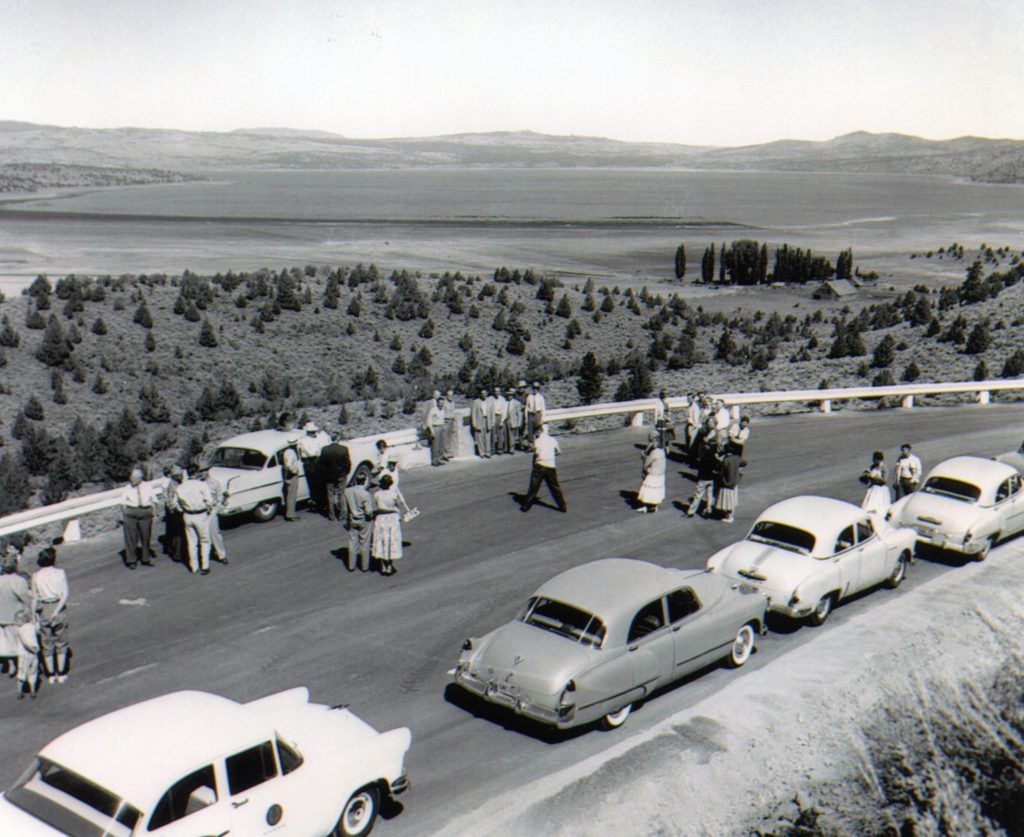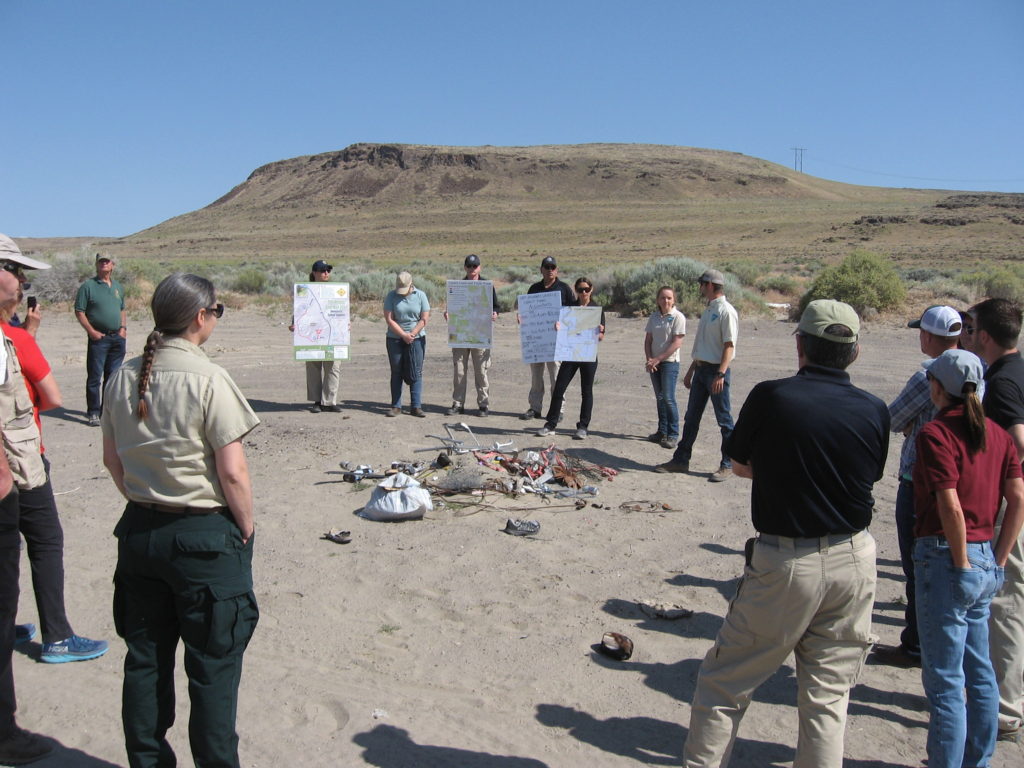
First of all, it is a view of the Amedee Mountains. Gold was discovered there in 1906.
Secondly, one is also looking at the Tommy Tucker Cave. This was a significant archaeological site excavated by archaeologists from the University of California from 1949-195 1. The cave is located 200 feet above the valley floor.
The flooded culvert, 1938. Courtesy of Margaret Purdy
On this rainy day, it seems to be an appropriate topic. What is known today as Arnold Field at Lassen High School was originally a agricultural field, prone to flooding from the adjacent Susan River. After the spring floods of 1938, it was decided to construct a levee along the river to prevent future flooding. Once this was accomplished, the high school made more improvements including a new athletic field. In 1939, it was dedicated Arnold Field, a tribute to Med Arnold. Med was not just a member of the first graduating class of 1907, but was a coach for the school’s sports teams for many years.
The background behind Riverside Park is unique. Prior to the park’s creation, it was home to the Fruit Growers Supply Company’s Story Club, a recreational center for its employees. It was destroyed by fire in 1944. Instead of replacing the structure, Fruit Growers converted the parcel into a park for its employees, and the public, too.
In 1963, Fruit Growers sold its mill properties, which included the park, to Eagle Lake Lumber Company. The City of Susanville, it should be noted took care of the park’s maintenance. In 1976, A.A. “Red” Emerson, president of Sierra Pacific Industries, of which the Eagle Lumber Company was a division, offered the park to the City for $23,000. It had recently been appraised at $45,000. The City accepted the offer and by end of the year the deal consummated.
Initially, Susanville’s water supply came from Piute Creek and wells. In 1864, Luther Spencer claimed Big Springs (Cady) three miles west of town in the Susan River Canyon for a water supply for the community. Spencer’s good intentions never came to fruition.
In 1869, a group of Susanville residents formed the Susanville Water Works with the same proposal as Spencer. Their first priority was to survey a ditch, which they did. Then they went to the community to raise funds for the construction of the ditch and found none. Finally, with due diligence in 1872 construction began on the ditch. It was a modest effort fraught with problems, but it functioned without much change for the remainder of that century.
The Calneva Branch of the Lassen County Free Library, 1920.
In January 1915, the residents of Calneva, a Western Pacific Railroad station in eastern Honey Lake Valley desired the break away from the Fairview School District and form their own. In their petition, they stated nineteen scholars resided in the proposed district. Their request was granted on February 2, 1915 by the Lassen County Board of Supervisors. The new district was named Fort Sage. The school was located in a small one-room building on the Harry Hill homestead. It was later moved to the Aldrich House, a larger building, located in the center of the district. In the summer of 1918, the school was on the verge of being suspended, as enrollment declined to four. The trustees persuaded County Superintendent of Schools, Julia A. Norwood, to keep the school open, as they promised an additional four students would attend in September. The request was granted. The school’s existence was brief and it was closed in 1924. In 1926, the furniture from the school was purchased by the Janesville School District.
Now that election season is in full swing, there was a movement in 1930 to reduce the number of elected officials. Los Angeles County took the lead which officials stated that Sacramento had so much control over counties that there was no longer a need to have so many county elected officials. They proposed besides the supervisors, the only elected officials would be the assessor, district attorney and sheriff. All other positions would be appointed by the supervisors. Lassen County opposed it.
This house was built in 1893, as a wedding present. Susanville merchant Alfred Jackson had it constructed for his bride-to-be Rose Murrer. In the stone mantle he had the letter “R” carved into it. Unfortunately, their happy marriage was cut short, when he died in a deer hunting accident in 1895. In 1914, when Rose’s mother, Franceska Neuhaus constructed the St. Francis Hotel behind her home, she planted an elaborate flower garden for guests of the hotel to enjoy. Rose remained at her home until the early 1940s, when she moved to Reno, to reside with her only child Leona Byars.
Throughout the American West most every region has some sordid lost gold mine tale, and the region around here is of no exception. Of course, over the years the story takes on a life of its own. Holden Dick was a Pitt River Indian who in 1885 was tried for the gruesome murder of Samuel Shaw on the Madeline Plains. Some attribute that it was not actually a mine, but loot from a freight wagon loaded with gold that was robbed when it traveled through Modoc County. Whether Holden Dick was perpetrator is not clear. Whatever the case may be, the gold was hidden in a cave in the South Warner Mountains. Anyhow, from time to time, Holden Dick would show up in the streets of Alturas and Susanville with gold. Where it came from he never said, and he took his secret to grave when he was lynched in 1886. To add more intrigue there is his lost map. Some sources indicate Holden Dick had a map where his bounty was located and he gave it to defense attorneys, Ephraim Spencer and John Raker. What became of the map is pure speculation. The bottom line, to this day, there are people still looking for the elusive mine.
It is always fascinating what one may come across in the most unexpected places. A lava cave near BlyTunnel was converted into a dwelling of sorts by construction workers at the tunnel, and then abandoned after activity ceased there. Jim Martin, a travel writer for the Sacramento Bee did a feature article on Eagle Lake in 1968 and made mention of this unique residence and wrote: “But before you get there, you will notice a metal tank on your left. If you park there, you will find a trail nearby. By following this trail you will come upon a lava cave which has been converted into living quarters. It looks like a place for gnomes or some characters from Tolkien’s Lord of the Rings. It once was used by construction workers and goodness knows who else. It is deserted now.”
Amedee Lime Kiln, 1975Amedee Lime Kiln, February 15, 2018
In the early 1890s, when the railroad town of Amedee came into prominence, led to many interesting developments. One of these was the discovery of lime deposits, then a key ingredient used in cement. In 1893, a lime kiln was constructed on the hillside above Amedee. However, due to the nation’s economic depression and the NCO Railroad’s refusal to lower freight rates the enterprise abandoned.
In 1913, with another railroad at Amedee and a surging economy, Susanville businessmen fired up the abandoned lime kilns. After over a year in operation, this they discovered was not the most prudent business investment, and once again the kilns were abandoned.
If you don’t succeed the first time, try again and again. In the 1920s, Janesville resident William B. Hail operated the lime kilns. In 1927, he used the lime for construction of the Bigelow Apartments in Susanville. After that it they were finally abandoned once and for all. Hail stated it was due to the poor quality of the lime.