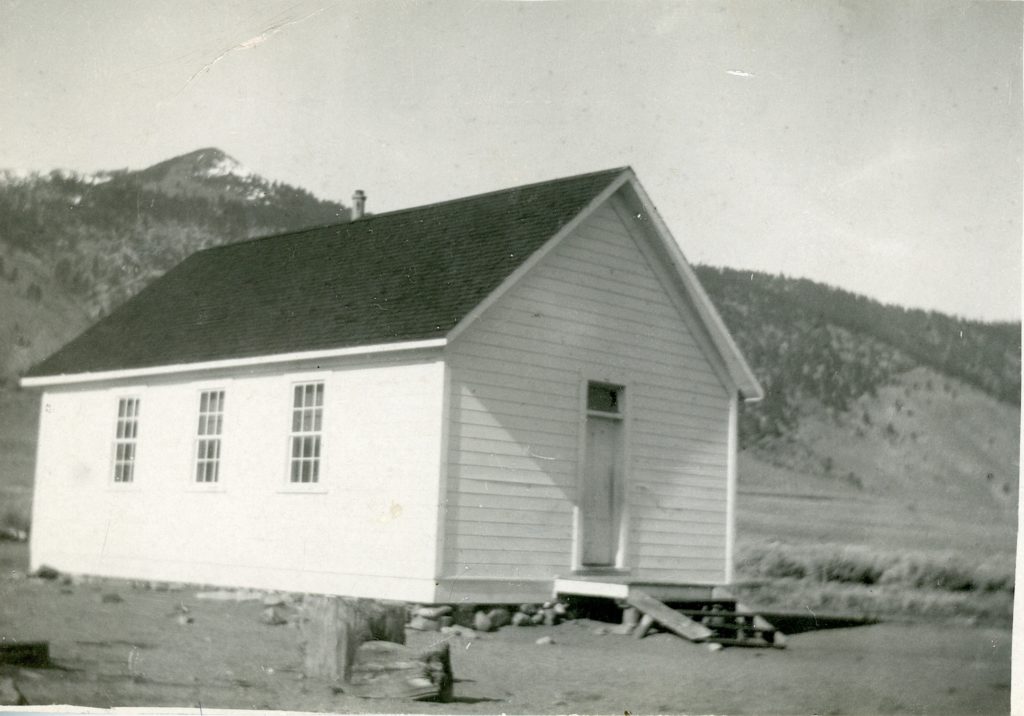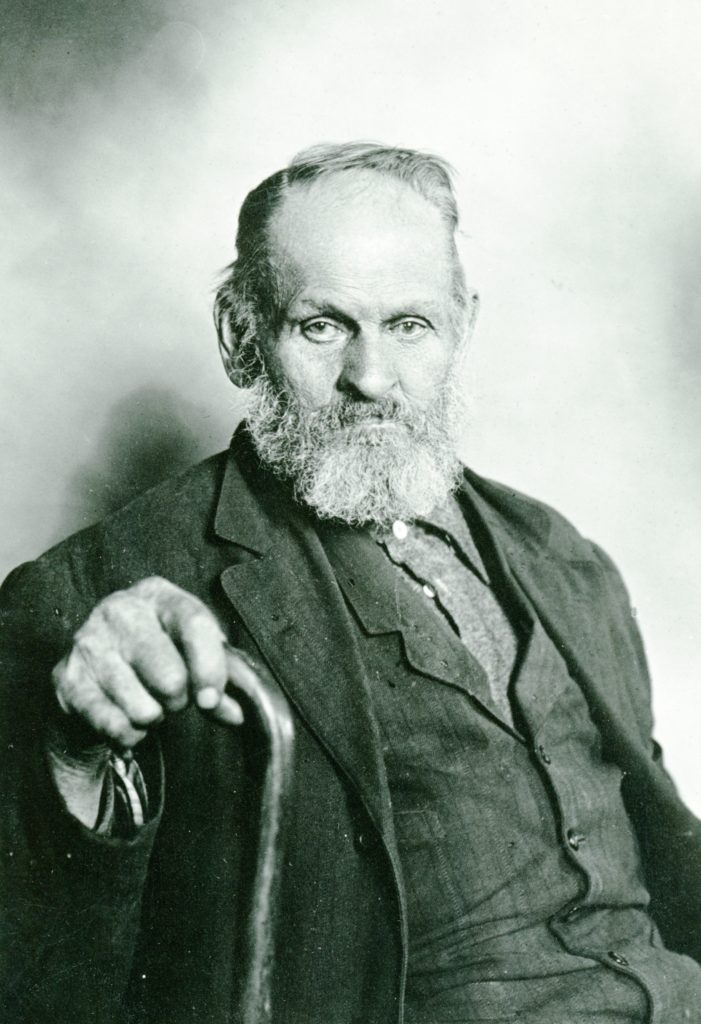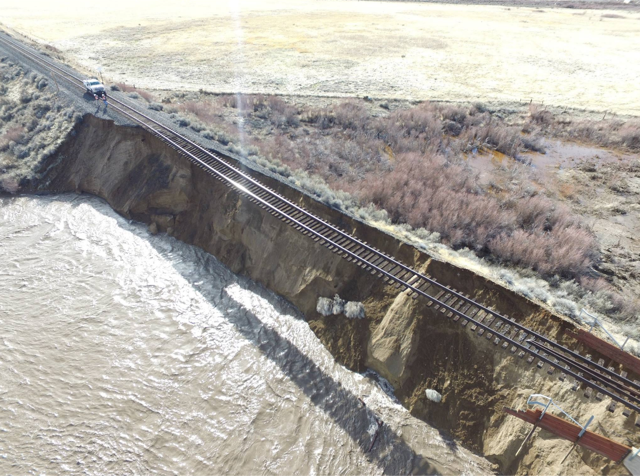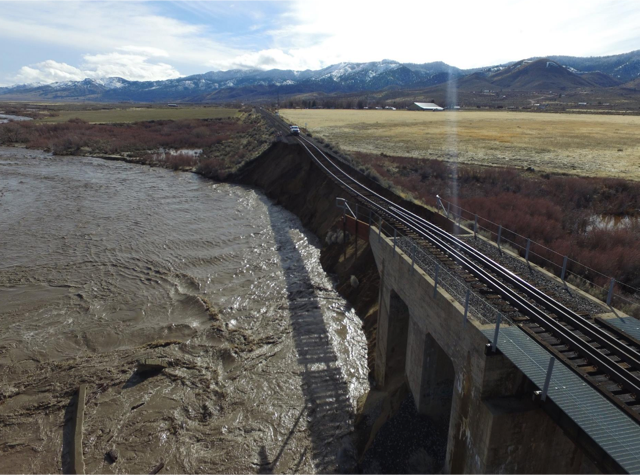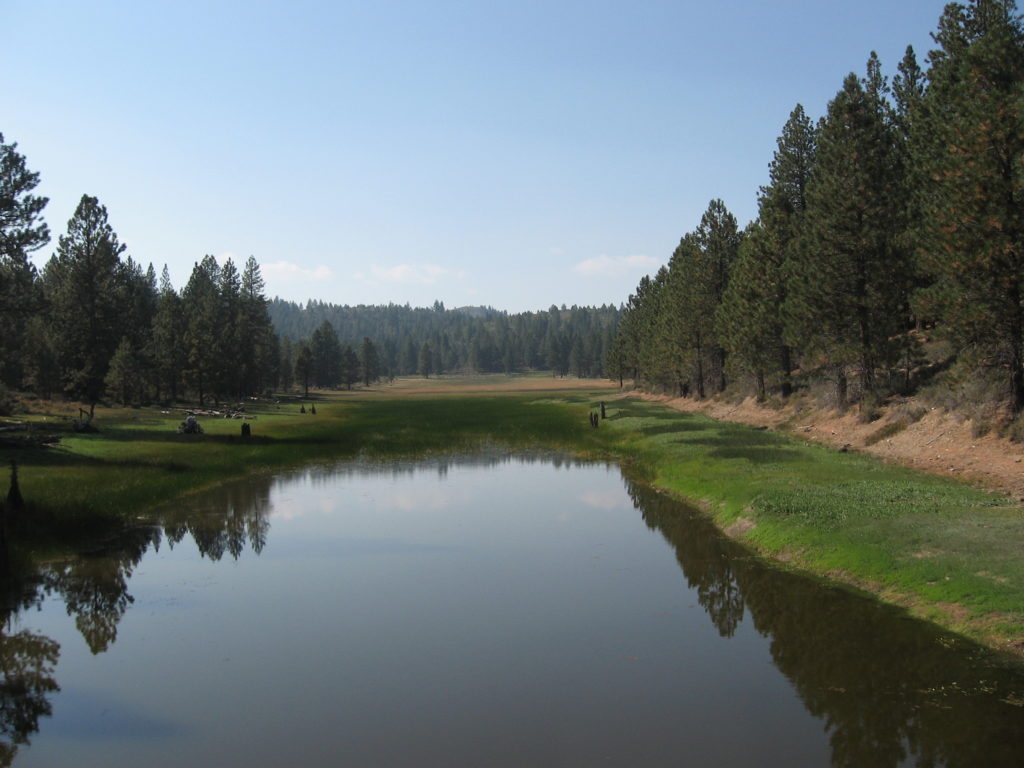
In 1900, there were over seventy rural schools and post offices scattered throughout Lassen County. Little Valley, located south of Big Valley, was of no exception. Its school district was established in 1885, and in 1926, due to a decline in population the school was abolished. In 1929, Mary Gassaway purchased the abandoned schoolhouse from Lassen County for $75. What is rather peculiar the Little Valley Post Office was not established until 1948.
Looking up towards the top on the east flank of the mountain. June 13, 2018
On September 8, 1862, the Shaffer Brothers—James and Uriah- purchased George W. Lathrop’s 1,280-acre ranch and station, that he established in 1859, for $4,250. The station did a brisk business as a major stop on the Nobles Trail/Humboldt Road. However, trade dropped off dramatically with the construction of the transcontinental railroad to the south. In 1868, in conjunction with a depressed economy, the Shaffer Brothers were forced to file bankruptcy. The property was auctioned and purchased by their brother-in-law, Daniel Samis, for $5,347. A month later, on May 19, 1868, Samis sold the property to Thomas J. French and Andrew Litch for $2,500, a substantial loss for Samis. Even though there stay in Lassen County was brief, the mountain that they resided near its base is named for them.
It should be noted that the location of the ranch and station is that of Mapes Ranch, east of Litchfield. In addition, the California Division of Forestry had a lookout on top of the mountain from 1931 to 1949.
The record load of 26,860 board feet being unloaded at the Fruit Growers millpond, Susanville, August 21, 1953. Courtesy of Hank Martinez
Yesterday, it was noted that the massive sugar pine tree felled by the Red River Lumber Company contained 27,570 board feet. To gain a better understanding, the above photograph is a massive truck load of logs being unloaded at Fruit Grower’s Susanville millpond that contained 26,860 board feet!
A question was raised about timber fallers. A good timber faller can determine precisely where the tree will fall. Well, a not so good faller, is another tale. I recall in one instance working in the woods with my Dad. My father gave the faller instruction as to where a particular tree was to land. Needless to say, it did not happen and some one was not happy with the final result.
Log landing at Coyote Hole, August 21, 1953. Courtesy of Hank Martinez
Normal daily posting times are scheduled between 12-1 a.m. Today is an exception to the rule and so it will be later in the day. It is an accidental continuation from yesterday’s topic about a big tree and board feet.
This mammoth tree was cut in 1922 on Fruit Growers property west of Eagle Lake.
In November 1928 the Red River Lumber Company reported that they had felled a 650 year-old sugar pine tree at Camp 74, in Plumas County, west of Chester. It required three railroad flat cars to bring the tree to the mill in Westwood. It was 101 inches in diameter at the stump and 84 inches at the second cut.* The tree contained 27,570 board feet. Red River noted that this was the largest tree ever brought into the mill.
*For those not familiar trees are bucked/cut into 32 foot lengths.
While there are the rumblings to attempt to split the state, there have been from time to time attempts to split counties. After all, Lassen County was originally part of Plumas and Shasta Counties. Take for instance, from that on occasions Big and Fall River Valleys wanted to succeed from their respective counties and form a new county. In 1889, Susanville’s Lassen Advocate was annoyed by the rumors about this particular split and noted that it would not occur as those places did not have a sufficient population to support a new county.
The springs were originally referred to as Lower Hot Springs. In the 1880s they were also known as Brubeck Springs, for the owner of the property, L.W. Brubeck. The name was changed to Amedee with the establishment of the town. A unique feature of the springs was a geyser. In 1854, Lt. E.G. Beckwith, during his exploration of a transcontinental railroad route visited the hot springs and noted that the geyser consisted of a column of water twenty inches in diameter. The geyser was quite an attraction when the town was established. Amos Lane, bartender and inventor, devised a clock to measure spurts of the geyser that rose and fell at intervals of 38 seconds. At times the geyser would shoot as high as eight feet. The geyser ceased to exist in May 1893, as the ground around the springs cracked and allowed the steam to escape.
In the early 1900s what some historians refer to as the Golden Age of Agricultural, the Dry Farming experience had taken hold. Dry farming is a method of growing crops without the benefit of or very limited irrigation. For some homesteaders they initialy turned to this system, while waiting for a variety of irrigation projects in Lassen County to be completed. By coincidence, everything went fairly well since between 1900 to 1916 was an extremely wet weather cycle. Then beginning in 1917 witnessed the beginning of a twenty year drought, and many a homesteader abandoned their property.
Yesterday, I briefly mentioned how Red River Lumber Company sold a mill site at Chester to the Collins Pine Company. What I did not include, was the Red River offered its plant at Westwood to Collins, which the latter declined. Red River was so desparate to unload its Westwood plant, but no one wanted it for various reasons. The plant itself, as one can see from the above illustration, just how large a facility it was. It did not help either that many of its facilities were showing their age. Then, of course, there was one other huge factor was the lack of timber tributary to Westwood.
In the early 1900s, the founders of Collins Pine Company amassed some 60,000 acres of timberland in the greater Lake Almanor Basin. It was not until the late 1930s, that they gave consideration to establish a mill there. In the fall of 1940, after much negotiations the Red River Lumber Company offered a mill site adjacent to Chester, along with thirteen miles of its main line railroad from Chester to Clear Creek Junction where it connected with the Western Pacific Railroad, which Red River estimated its value at $80,000.
Thus, the Almanor Railroad was born. Collins Pine changed it from a private line to a common carrier, should anyone in Chester desire to use it. Collins Pine had a lot of work to upgrade the railroad line. It also needed motive power, as it decided not to purchase any of Red River’s locomotives. At its Grande Ronde operation, it had discontinued its railroad logging in favor of truck logging. There it had at its disposal a Heisler geared steam locomotive, the 104, and it was put into operation on the Almanor. Initially it worked ideally to handle the railroad’s sharp turns and steep grades. It was later replaced with a small diesel locomotive.