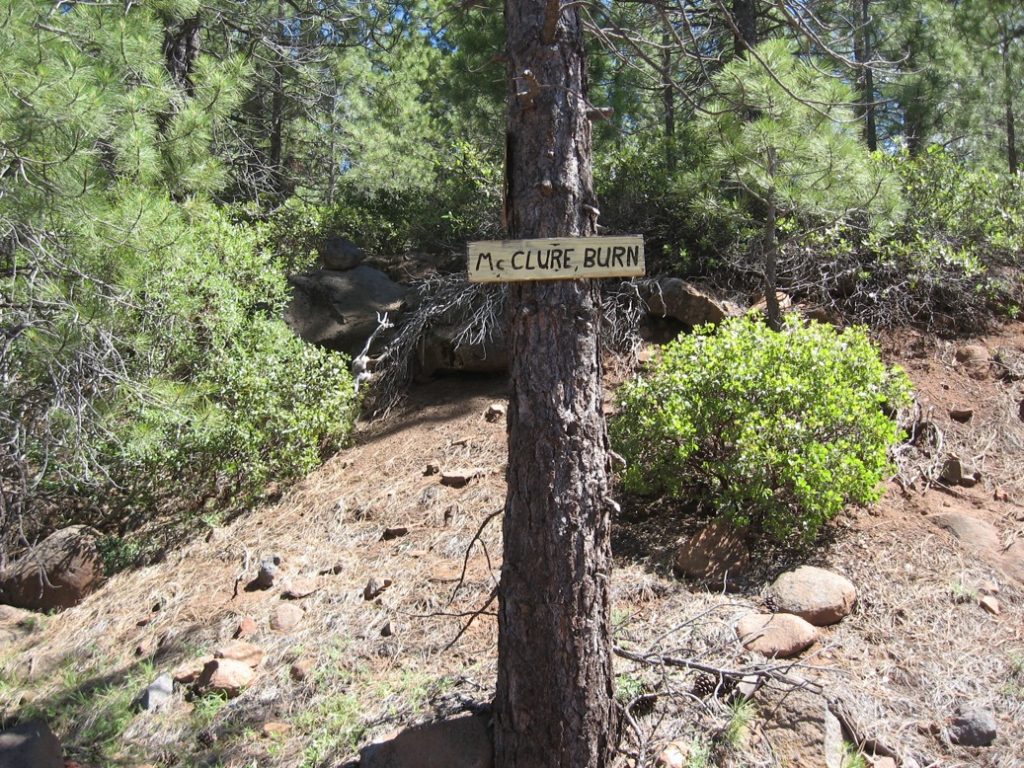
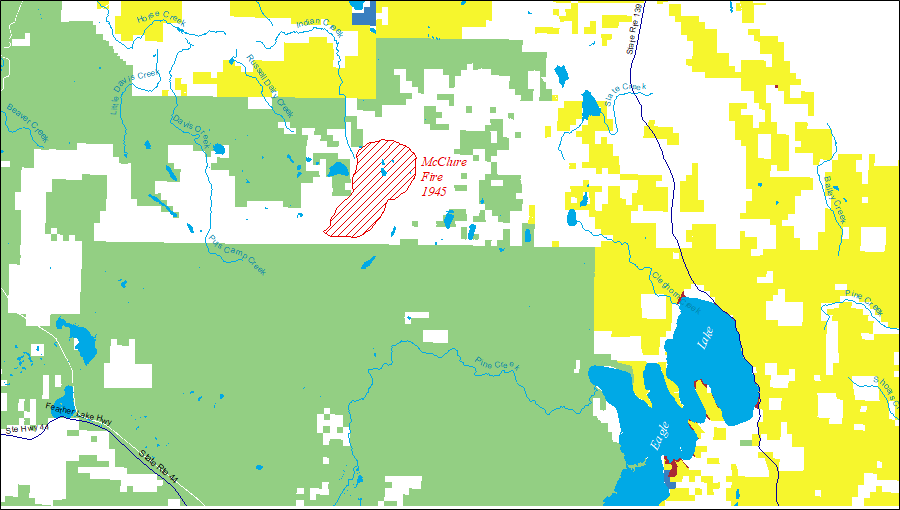
The 1945 forest fire season was a busy one, but acreage was minimal comparison to other years. The McClure Forest Fire was the largest in Lassen County for that year. The fire was spotted at 4:00 p.m. Sunday, September 2, 1945, just south of Big Jacks Lake. It spread quickly, fanned by hot dry winds. As the Fruit Growers Supply Company had two railroad logging camps in the area—Harvey and Stanford—with in no time they had 750 men on the fire line. The Lassen National Forest dispatched a crew of 50. Three days later the fire was contained. In all, 5440 acres was consumed, 4000 of which was virgin timber.
During the reorganization of Red River in the early 1930s, it was only a matter of time that bank issue once again would be scrutinized. On June 6, 1934, Clinton questioned how the bank operated: “As to the Westwood National Bank, I feel that this should be run as a bank and not as a subsidiary financial department of Red River. I think that the Bank board of directors should direct the policy and business of the bank and that the finance committee of the bank should pass on loans and these be on the merits of the loan and not from the standpoints of its convenience of Red River.”
Clinton’s concerns were confirmed when investigations were conducted on the bank’s affairs. It was disclosed that certain family members used the bank to obtain dubious loans, which would not have been approved by a regular bank. For instance, a loan was made to finance a portion of the construction of the Walker-Hovey railroad in Modoc County, which was being bailed out by the same time by the government’s Reconstruction Finance Corporation.
These events allowed Clinton to move forward on his case to dissolve the Westwood National Bank. Clinton cited it was an ill conceived venture as no one in the Walker family had any banking expertise. While it was agreed to dispose of the bank, that was easier said than done. After all bank failures were a common occurrence across the nation, so it was not the best time to put a bank on the market. It was even suggested they could sale it to the residents of Westwood. One of the obstacles to sale the bank was Willis, who also served as the bank’s president. After two years of stalling by Willis, it was decided to put Wellington Henderson (Clinton’s son-in-law) in charge. Wellington, it should be noted had banking experienced as he had worked for Bank of America. On September 18, 1936 Willis made the announcement that the Westwood National Bank reached an agreement with the Bank of America for the sale of the bank. Willis stated “This sale brings an affiliation for our local bank that will enable us to render an even greater service to the local community. Our bank will become a branch of the state-wide institution in the near future. The local officers and staff will remain.” While the bank building has long since been demolished, the concrete vault still remains, a testament to better times.
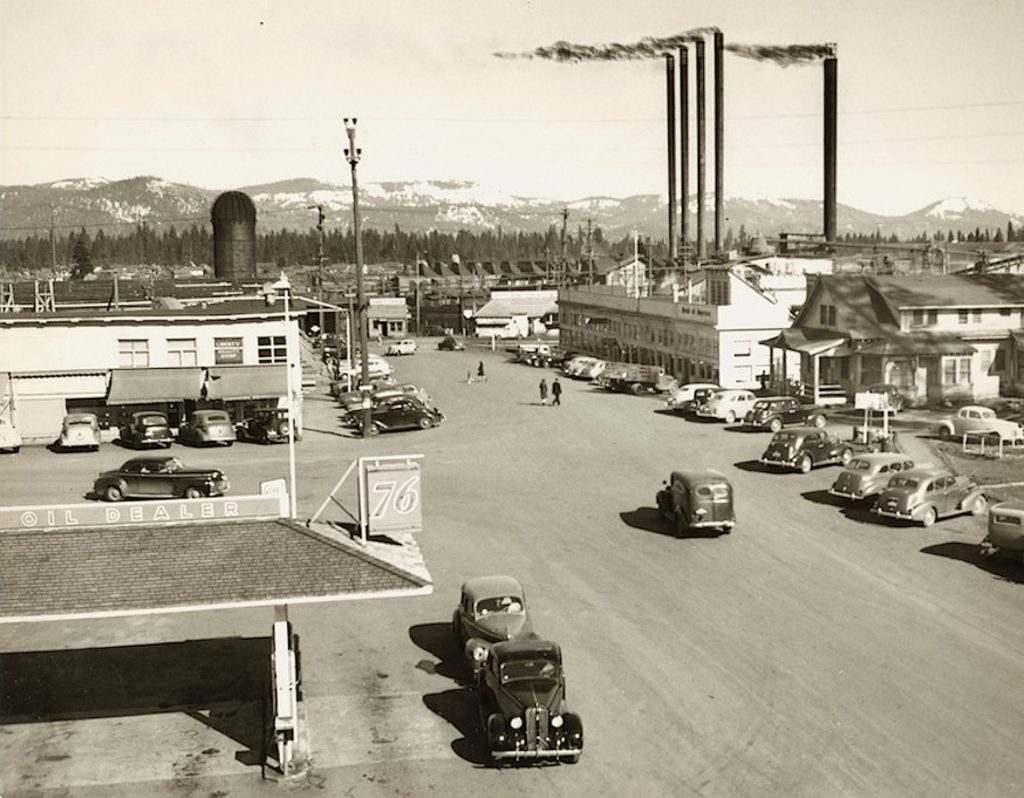
This was no ordinary bank, but then the Red River Lumber Company was not an ordinary operation either. Red River wanted to capture as much of its employee payroll at Westwood, as possible. This was no small sum, with an average monthly payroll of $350,000. Red River was able to retain a majority of the payroll being returned in the form of rent payments, the costs of necessities of life such groceries and other amenities purchased from its company stores.
The Big Store, noted for have everything under one roof, served as a de-facto bank. It was one of few places were employees could cash their payroll checks. In one instance this seemed like a good business maneuver, with an employee having plenty of cash in his pocket might splurge on something in the Big Store after cashing his check. With 2,000 employees cashing their checks, the Big Store was insufficient to handle the volume. A number of employees found that method disagreeable and began doing their banking by mail. It was the latter that concerned Red River watching their money going into someone else hands.
Fletcher Walker, the resident manager, came up with a solution. Why not go into the banking business, after all except for the mortuary, they controlled every aspect of Westwood. Of course, this met with opposition from T.B. and Gilbert Walker, as it was nothing related to the lumber business.
In the spring of 1920, Red River moved forward with its announcement that it was going into the banking business. This was foreign territory with a lot to learn. Much to their chagrin was the amount of compliance of government regulations they had to contend with. While Red River had to deal government inspections, mainly for health and safety issues, for the most part they could do as they saw fit, but operating a financial institution was on entirely different level, since the government placed a series of requirements on the latter.
On October 1, 1920, with little fanfare the Westwood National Bank opened its doors for business. The bank was located in the Red River’s office building across the street from the Big Store and the mill entrance. To greet the new customers, the first manager and cashier was A.G. Graham. The Board of Directors consisted of Willis Walker, president; Fletcher Walker, vice-president, R.F. Pray, C.E. Hunter and Fred L. Cleaves.[
After a year in operation the bank reported having $265,905 in deposits on hand. In comparison, Lassen County’s oldest financial institution the Bank of Lassen County reported $1,208,810.59 in deposits. In time the Westwood National Bank began to flourish and in 1925 saw its deposits soar to $914,384.
The Westwood National Bank was a unique institution. Banks in this era, were very progressive to provide loans for building businesses and homes in an effort the communities they serve would prosper. However, this was not the case with Westwood, as Red River owned all the businesses, and all the houses. The bank did provide loans of a personal nature for its customers to purchase big ticket items such as automobiles. However, in one instant, the bank did assist in financing the ill-conceived Red Rock Irrigation District in northeastern Lassen County.
On September 19, 1935 a Technical Institute course in forestry was offered at Lassen College. There was a lot of enthusiasm for the new course, not just from the college, but the timber industry who would benefit by its graduates. However, there were critics who thought the initial cost to implement it was expensive compared to other traditional vocational courses.
By the time the second semester began word had spread and there was tremendous interest from outside the region. When the fall semester of 1936 began the enrollment at the college had nearly doubled which was attributed to the forestry program. It was a turning point for the college. For the school to thrive it would need to seek out students from other areas, as the local tributary schools was not sufficient enough for the college to expand.
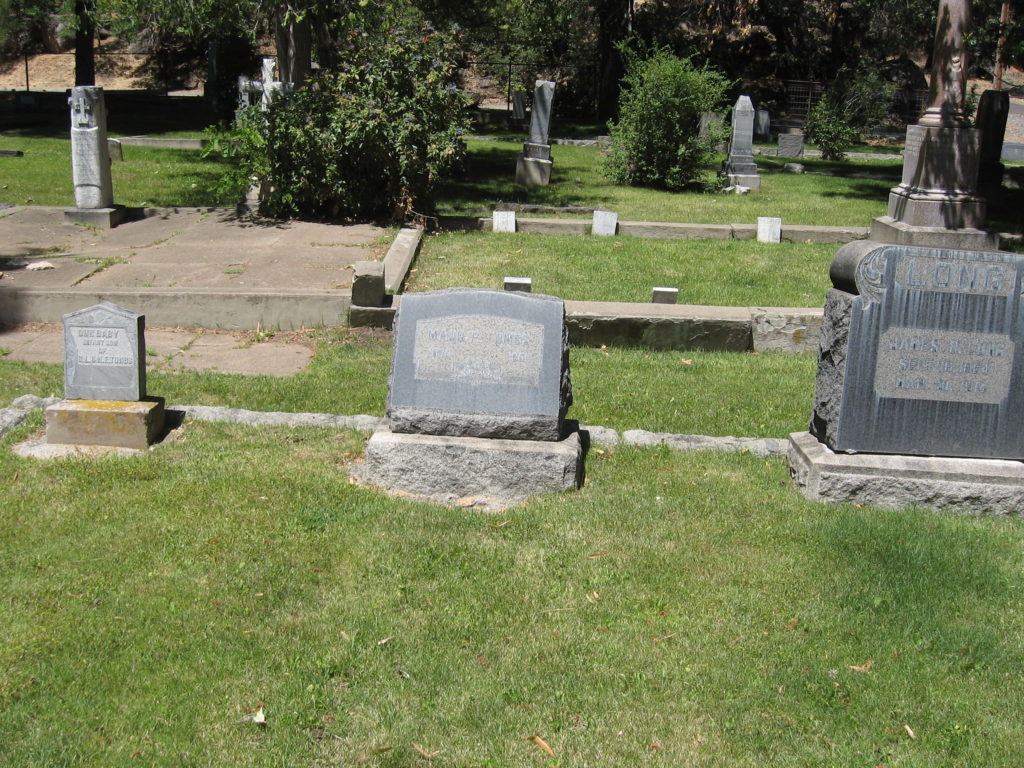
It was my original intention to include a photograph of Maud Tomb’s grave, when I wrote about her. When I went to visit the grave, the headstone needed so much cleaning, that I had to correct the situation. So with a pumice stone and plenty of elbow grease I set out to take care of it. After all, it has been my goal to do about a dozen graves a year, sometimes I do and sometimes I do not. It just depends on other obligations that I have to tend to.
In 2017 when I conducted the Lassen County Courthouse Centennial Cemetery Tour I wanted to include the grave of Lassen County Clerk Maud Tombs. I was prudent in the grave selection, because I had no idea what the attendance would be. If it was large, which it was, I wanted the selected graves easily accessible and eliminate as much possible potential hazardous features such as grave copings. Maud’s unfortunately did not fit into the easy accessible category.
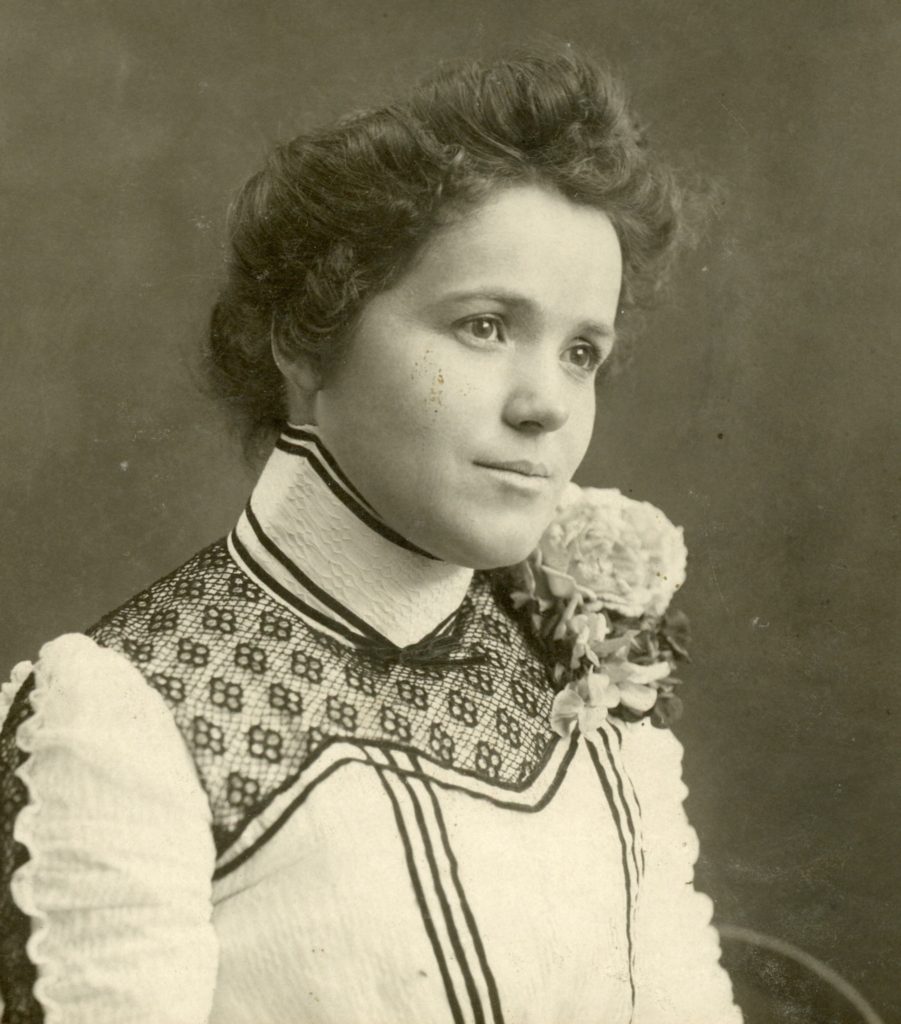
Maud Edna Long was born on May 2, 1875, in Susanville, the eldest of ten children of John and Margaret Long. By the time she was born, her family already had an influence in the region’s history. The town of Longville in Humbug Valley, Plumas County, was named for her grandfather, William B. Long back in 1861.
On August 3, 1897, Maud married George L. Tomb. He was a native of New York and came to Susanville in 1890, no doubt influenced by the Pardee family, relatives of his. In 1898, George entered the politcal arena and ran for Lassen County Clerk and won. In 1902, he ran for a second term and was elected. Going for a third term, the voters rejected him and he was replaced by George Bassett. For whatever reasons, in early 1907, George sold his furniture/undertaking business and moved his wife Maud, and two daughters, Nadene and Gladys to Red Bluff. It did not take long for Maud to discover her husband’s dark side, a gambling problem. Before 1907 concluded Maud left him and returned to Susanville with their two daughters. Upon her return there was a distinct little name change in her last name, an “s” was added and she was now Maud Tombs.
In 1918, Maud decided to run for Lassen County Clerk against the incumbent George Bassett who had defeated her husband. Joining her on the ballot was Robert Kyle of Westwood and Elmer Winchell of Standish. The primary held on August 27 showed it was a race between Bassett with 73 votes and Maud with 66, the other two candidates combined only garnered 25 votes. The general election was a close race, and a problematic one on reaching out to the voters due to the outbreak of the Spanish influenza. Maud won the election with 991 votes with Bassett trailing at 976. Maud would go on to be elected seven more times. In 1951, she was succeeded by her daughter Nadene Wemple who would serve four terms as Lassen County Clerk.
Two final notes. Maud was the first woman elected to a county wide office. Secondly, for over a century a woman has always been elected county clerk.
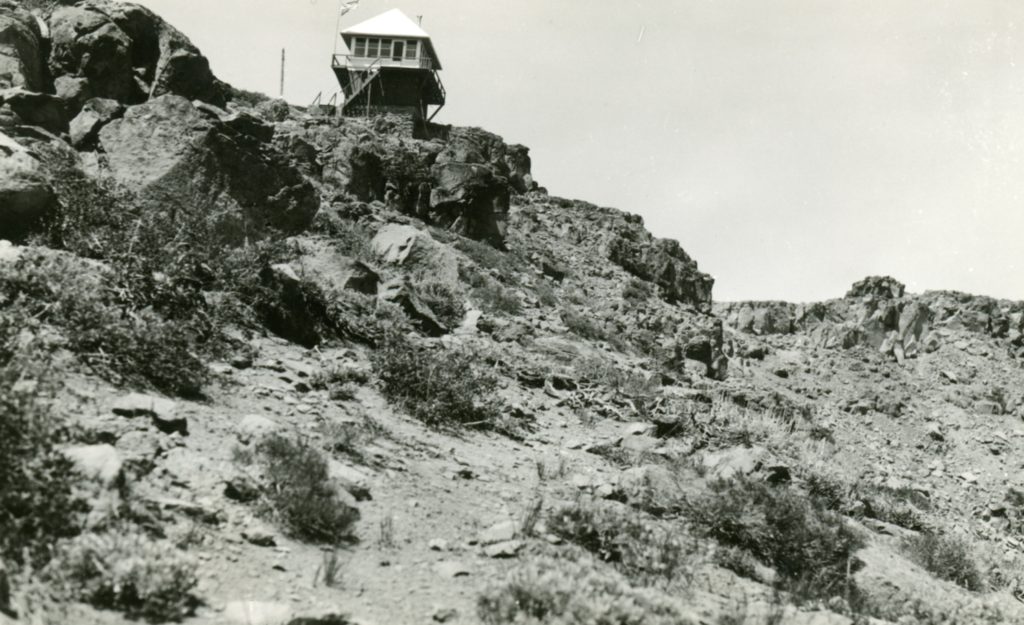
Thompson Peak Fire Lookout, circa 1950–Courtesy of Margaret Purdy
September is a wonderful time to go out and explore, with mild temperatures and in many cases most of the back roads you will have all to yourself. An interesting excursion is the Thompson Peak Fire Lookout that looms above Janesville at an elevation of 7795’. It was built in 1931, and it is still a manned lookout. The view of the Honey Lake Valley and the surrounding territory is magnificent. However, due to the Walker fire it may be awhile before one can access Thompson Peak.
Train load of logs leaving Camp B, 1923–Courtesy of Dick & Helen Harrison
Yesterday’s topic was big timber before the arrival of the big mills. Well, that big timber became big logs. Camp B of the Fruit Growers Supply Company was located just north of McCoy Flat Reservoir. It was their second railroad logging and one of its largest. The camp operated from 1922 to 1925. Similar to Camp Harvey there are still remnants such as the concrete foundation of the commissary and service pits used to work on the locomotives.
Western Lassen County, circa 1915 prior to major logging by the Red River Lumber Company
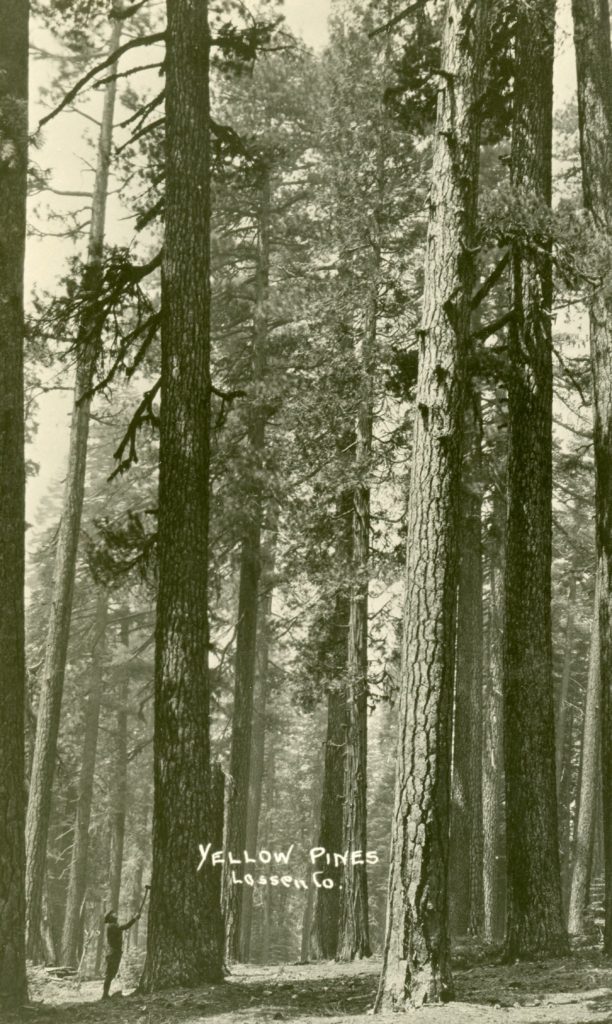
The forested regions of northern Plumas County and western Lassen County remained in an almost virgin state until the early 1900s. Most of the logging done was for local consumption.
In 1849, an emigrant on the Lassen Trail noted that the forest could not be ignored and wrote, “The pine trees are 10 feet in diameter, and 200 feet high, are common sizes—and they are generally as straight as an arrow. Here the traveler may journey day after day, over needle-carpeted or grassy ground, mostly free of underbrush, amidst great clean shafts of really massive proportions, but giving a sense of lightness by reason of their color, symmetry and great height.”
The following is some promotional 1923 literature courtesy of the Lassen County Chamber of Commerce: Westwood is the big lumber town of the Red River Lumber Company and probably the most unique town in the United States. It is a modern town in every respect and entirely managed by the company. The company owns all the houses and operates all the business enterprises at a small margin of profit. But this system enables the company to furnish its employees with good houses, heat, light, food, education facilities and entertainment at low cost and keeps them satisfied.
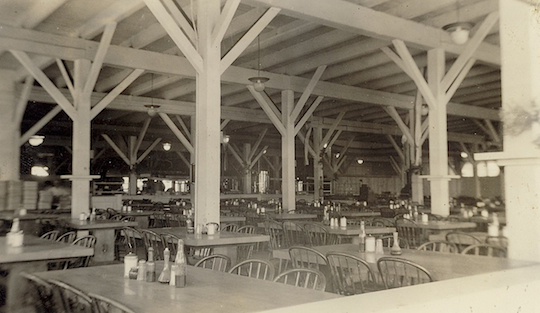
The town is located in the midst of the timber area on a level plateau. It is laid out in wide streets lined with pretty homes with here and there a tall pine as a symbol of the industry which supports the town. The big company department store is the largest in Northern California and there is a cafeteria that feeds over a thousand men an hour, and a great club house where the men can spend their leisure hours.
The schools of Westwood are modern and maintain a high scholarship. There is a union church where all sects can worship, and a Catholic church; and there are libraries, clubs and fraternities. In no aspect is Westwood a lumber camp—it is a city built around one industry and it is a permanent city.