Category Archives: History

Free Grocery Delivery

Susanville’s The Big Store as it appeared in 1916. In front of the store, is their exclusive delivery car. Photograph courtesy of the Worley family

With the advent of online shopping with free delivery, and with the conditions caused by Covid-19 and surge of online grocery shopping, in pre-internet times, such services were available in Susanville. In 1915, Fehr & Worley’s Big Store, located at 722 Main Street (the current home of Margie’s Book Nook) implemented free grocery delivery. Telephone the store, and place your order, simple as that. Over the years, other stores, followed suit. The last to do so was Hill’s Market at 629 Main Street, in the early 1970s.

Spread the word, and encourage a friend to subscribe

A Burney-Little Valley Railroad?

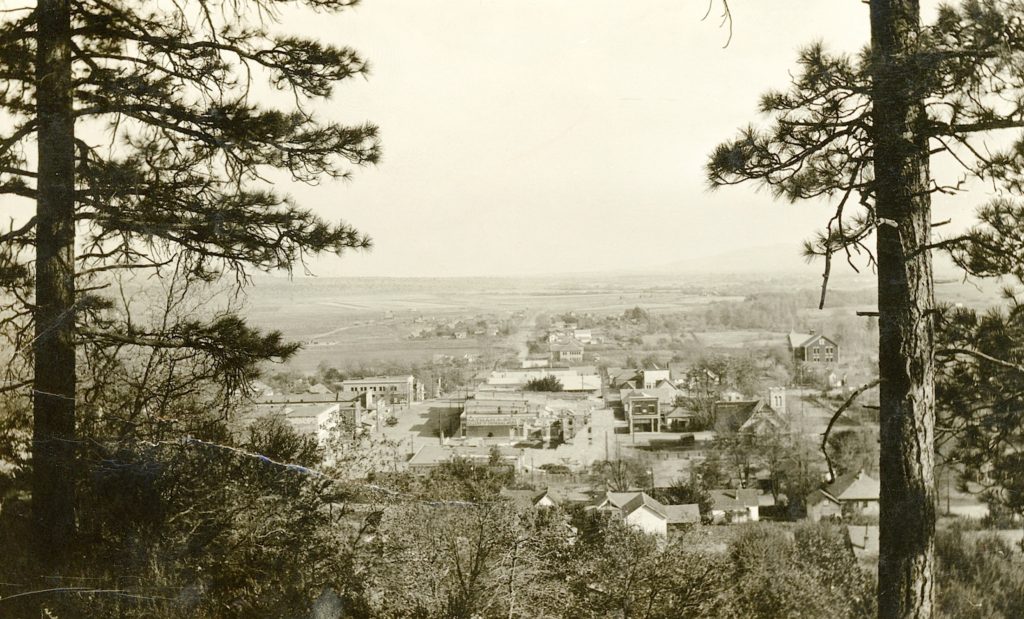
Burney, circa 1940

During the 1930s, Red River Lumber Company’s, Westwood Operation was going through tumultuous times. The one bright spot, and its biggest asset was the Burney Tract of eastern Shasta. It consisted of 83,000 acres with an estimated 2 billion board feet of timber. That’s a lot of wood.

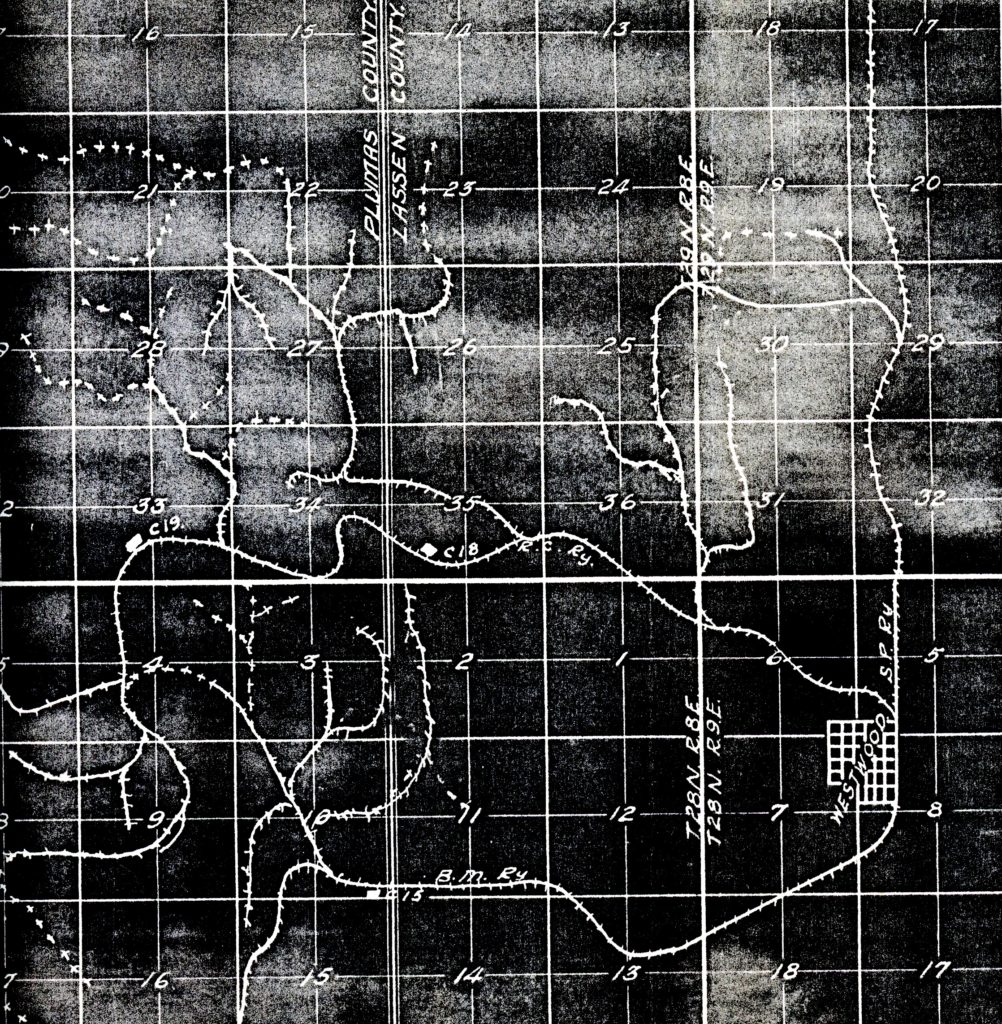
The problem with Burney it was not accessible by rail. In 1936, a proposition was floated internally by Red River management to correct the situation. There were, of course, two obstacles the distance and the natural barrier of Hat Creek Rim. To bypass Hat Creek it was suggested to branch off the Western Pacific Railroad at Little Valley (in northwest Lassen County south of Bieber). Problem solved, or some thought. Then a family feud ensued that logs would be shipped all the way to Westwood to be milled. There were two train of thoughts, one to keep Westwood going and the other Westwood had run its course and time to shutter. Neither side prevailed. Sheer economics won, when it would cost to pay Western Pacific toll fee to haul the logs from Little Valley to Westwood was thirty cents per car mile—way too expensive. The project would be resurrected again, with a different, and closer departure point, which will be examined in a future post.

Spread the word, and encourage a friend to subscribe

Fire (Suppression) Trains

Westwood's Fire Train courtesy of Doug Luff
Westwood’s Fire Train courtesy of Doug Luff

It is interesting to note that the Union Pacific Railroad has a fire train, which was deployed during the recent (2020) North Complex fire, or more specifically that of the Claremont Fire near Quincy, Many may not realize, the Red River Lumber Company had their own fire train.

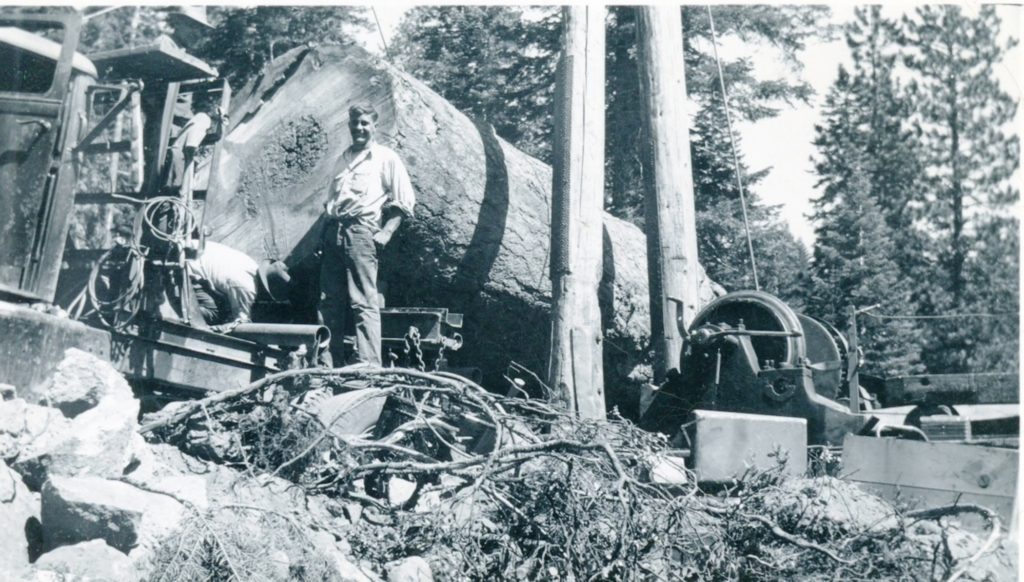
The winter of 1923-24,  was one of the driest on record in California. That summer another record would be broken–forest fires. It was June, 1924, when the Red River Lumber Company having been in operation for over a decade experienced its first major forest fire. The fire broke out at Chester Flats between Camps 34 and 38 and burned a narrow strip of land, eight miles in length. Red River’s loss was minimal as the fire burned recently logged over land and the only significant damage was 500 cords of wood burned along 1,000 feet of railroad track. Red River considered its biggest loss was to the men fighting the fire which cost the company a $1,000 a day in wages, and it took a week to contain the fire.

Continue reading Fire (Suppression) Trains

A Red River Fish Story

The dam at Walker Lake—-David Zoller

In October 1931, the Red River Lumber Company disclosed a whopper of a fish story. First a little background. In the summer of 1922, Red River built the Indian Ole dam on Hamilton Branch just a short distance south of Westwood. The main purpose was to provide water power for a hydro-electric plant located along Hamilton Branch where it enters Lake Almanor. The newly formed reservoir created by the dam was officially named Mountain Meadows Reservoir, but the locals referred to it as Walker Lake. Whatever the case may be, fish flourished there, especially catfish.

Walker Lake aka Mountain Meadows Reservoir—David Zoller

In mid-October 1931, Red River needed to drain the reservoir to make some necessary changes and repairs to the dam. Of course, lots of catfish were sent cascading down Hamilton Branch, or so everyone thought. It turned out the catfish decided to take a short cut and went down to the penstock that feeds the power plant. All of a sudden the turbines at the plant came to an abrupt stop. Upon investigation, it turned out the turbines were clogged with catfish, and a lot. When things were all said and done there was a pile of catfish that measured twelve feet square and five feet deep. A new control gate was installed so that in the future, all fish would be detoured to the natural channel of Hamilton Branch.

Spread the word, and encourage a friend to subscribe

Manzanita Lake Mudflows

Manzanita Lake

During the first half of 1916, Lassen Peak’s eruptions had greatly subsided since the major eruption of 1915. Then things changed suddenly. In August 1916, when Lassen became a national park, the peak began to perform again, as if the mountain’s reputation was at stake.

By fall, ashy mud began flowing in a steady stream from the crater of Lassen Peak and pouring into Manzanita Lake. This continued for several weeks. Lassen National Forest Ranger Fred Seaborn was so alarmed, that he stated if the flow continued at the rate experienced so far that Manzanita Lake would be obliterated within eighteen months. By November the mud flows stopped, as if someone turned off the spigot.

Spread the word, and encourage a friend to subscribe

Burning of the Mortgage

Janesville Masonic Hall,circa 1912.

There was a time, not long ago, when it was customary to through a celebration to burn a mortgage. After all, it was an important milestone to own the property outright.

On October 16, 1935 the Janesville Masons celebrated two events the first being it was the lodge’s sixty-first anniversary. The other they had just paid off the mortgage.

It was a festive occasion with Masons from Susanville and Westwood partaking. Superior Court Judge H.D. Burroughs of Susanville provided a history of the lodge. The Westwood Masons furnished the music. Len Dozier who served two roles one as master of ceremonies and the other to keep watchful eye on Steve Bass to make sure the only thing he burned was the mortgage.

In 1992 the Janesville Lodge consolidated with Lassen Lodge. A few years the Janesville Lodge building was sold.

Spread the word, and encourage a friend to subscribe

1924’s Duck Season Runs Afowl

Eagle Lake, early 1920s—Wyn Wachhorst

The 1919 Federal Migratory Bird Treaty Act, allowed the California Department of Fish & Game to create a large number of game refuges. It should be noted, California led the nation in wildlife conservation. Many may not realize that in 1869, Lake Merritt in Oakland was declared a game refuge, a first in the nation.

By the early 1920s there was a proliferation of state game refuges. Locally, one of the best known was Blacks Mountain. Another was Skedaddle which extended from that mountain range north to Shinn Peaks. There was a quirk in these refuges because they included private property. One of the lesser known was the Brockman Flat Lava Beds region on the west side of Eagle Lake. In the fall of 1924, Fish and Game Warden, C.O. Fisher announced duck hunting along the west shore of Eagle Lake from Christie’s Eagle Lake Resort to Spaulding Tract was prohibited, it in essence being a part of the Eagle Lake Game Refuge.

Subscribe

1929 Lassen National Forest Fire Report

The.aftermath of the fire at Camp D, 1924 —-FGS Co.

After a good cool rain storm over Northern California, W.G. Durbin, Supervisor of the Lassen National Forest declared that on the Lassen the fire season was over on October 11, 1929. At that time the fire protection force, save for two men with lookout duties, were laid off.

Durbin provided some interesting statistics comparing the 1928 and 1929 fire seasons. In 1928 there were 109 fires and 49 in 1929. In 1928 fires consumed 31,634 acres; in 1929 only 3,492 acres. Another noticeable fact was suppression costs $34,674 to $4,168.

Lightning and careless smokers attributed to the bulk of the fire origins for those two years.

Fast forward to 2021 the suppression costs of the Dixie Fire is mind boggling being pegged at nearly $600 million.

Support


Susanville, Idaho?

This movement is different than many secession movements. Instead of forming a new state, like the proposed Jefferson movement, this would change the state boundaries. In this particular instant expanding the boundaries of Idaho. The group called Move Oregon’s Border initially focused on southeastern Oregon counties of Klamath, Lake, Harney and Malheur. Upon greater consideration it was decided to make Greater Idaho’s to extend to the Pacific Ocean to include Jackson and Curry Counties. Finally, why stop there? In their latest proposal includes the California counties of Siskiyou, Modoc, Shasta, Trinity, Tehama and parts of Lassen and Plumas.

Support