Category Archives: History

Postal Cancel – National Air Mail Week

Susanville resident Florence Uptegrove sent this special air mail to Emma Murrell.

One just never knows what can be found on Ebay. Some time ago, I found this Susanville Postal cancel for National Air Mail Week which was held during the week of May 15-21, 1938. It commemorated the twentieth anniversary of the implementation of air mail. Citizens and communities were encouraged to participate.

Postmaster Elmer Winchell with Ben Curler at the inagural airmail flight at the Susanville airport on May 19, 1938.

Of course, Lassen County Superior Court Judge Ben F. Curler an avid flier was more than happy to participate in carrying air mail. For a brief time, when Curler served as magistrate for Lassen Volcanic National Park he would fly to Mineral to hold court. Curler’s May 1938 airmail flight went from Susanville to Reno. At Reno, he picked up his father, Washoe County District Court Judge, Ben V. Curler. The elder Curler, was a pilot, too, having obtained his license in 1935 at the age of 70. The two flying judges departed Reno and flew to various Nevada communities as part of the National Air Mail Week campaign.

Never miss a story, click here to subscribe.

Local Petroglyphs

A view of the Willow Creek Rim from Belfast, June 2, 2015.

Here are some random notes by the wayside about the local petroglyphs that I thought some might enjoy. Belfast, of course, is the best known site, but many might not be aware that are some surrounding Susanville.

In 1918, Russell Brownell, who dubbed the Belfast petroglyphs Council Crest urged Congressman John Raker to designate it as a park. Nothing happened. However, nearly seventy years later as to what is referred to as the Willow Creek Rim was placed on the National Register of Historic Places.

Sunrise Chamber, Balfast, 2015

In 1949, Francis Riddell while engaged in some major archeological work in the region, spent considerable time collecting information on the Honey Lake Valley Paiute Ethnography. He spent countless hours interviewing members of the Joaquin family. The following is a summation about what he was able to glean about the petroglyphs. “The name for the petroglyphs was tumadai, ‘magic” or ‘trick.’ Only certain people knew what they meant. Kitty Joaquin, however, stated a more common name for the petroglyphs was numutubon ‘Indian writing.’ Susy Buster said that the petroglyphs were only known to those who put them on and the snake elements were put on by those who had an understanding of snakes.”

One of many glyphs to be seen along Upper Smoke Creek.

Finally, back in the late 1960s the Lassen County Historical Society published a bulletin on Petroglyphs by Tom Eilers.

Donate

Some Early Susanville Rotary Club Tidbits

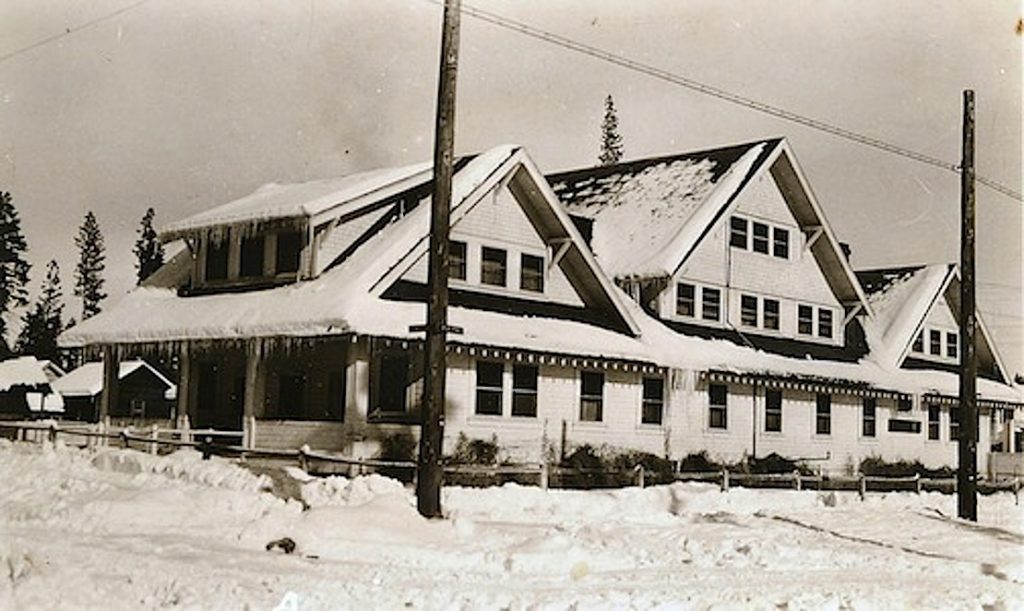
Hotel Mount Lassen

Susanville Rotary Club received its charter on Saturday. May 15, 1926. There were twenty-one charter members: M.D. Collins, Harry S. Coleman, Robert M. Cook, Henry M. Elliott, Dr. Gordon R. Fortson, Thomas E. Hunter, Hans P. Peterson, Arthur J. Mathews, Harry A. McBride, Charles McGowan, James A. Pardee, E.L. Shirley, Ernest W. Smith. John B. Spalding, John J. Woodward, Frank H. Bangham, Thomas W. Blight, Charles H. Bridges, L.R. Cady, B.D. Cardinal and Frank Coffin.

The following Wednesday the Rotary Club held its first luncheon meeting. There were a few kinks. Of the seventeen members present, they gathered at the Republic Grill on South Gay Street for lunch. Afterwards, they proceeded to walk one block up to the Hotel Mt. Lassen for the business portion of the meeting. It was their intention to hold the luncheon meeting at the hotel. However, the hotel was still under construction, and while portions of the building were completed, the kitchen was not. A temporary solution was found were the luncheon meetings were held in the basement of the Methodist Church, with the women of that church doing the cooking and serving. This situation lasted a little bit longer than anticipated, since the Mt. Lassen Coffee  Shop did not open for business until July 20, 1926.

Tim

The Many Facets of Honey Lake

Honey Lake, 1938

Honey Lake is a multi-purpose land unit in planning commission speak, whether dry or full. When Anglo settlement occurred in 1850s lake was a natural asset, initially for recreation. In 1856, a crude sailboat plied the lake, only to turn into a tragedy when the boat capsized, drowning two of its occupants. The following year, one of the west shore’s first established ranches, Clark’s advertised they had two fine boats for fishing and pleasure. In 1881, they still had the only boats on the lake. Of course, in the 1890s, boating both commercial and recreational took off with the establishment on the lake’s eastern shore. If you use the search feature, you can read previous posts about boating on the lake. The lake went dry for a twenty year period (1917-1937), that with other factors boating went by the wayside.

On the recreation theme, there are those rare occurrences when lake is frozen over, turning it into one huge ice skating rink. Like boating, ice-skating had its hazards too. In 1879, Milford school teacher, Truman Ashbrook drowned while ice-skating when he encountered an air pocket, and fell through the ice. There was the 1914 tragedy of Charlie Wilbur. 

Two interesting events occurred when the lake was dry in the early 1930s. In 1931, the dry lake bed was used a summer military camp for training army pilots. More about that in the future. In the fall of 1933, Zeb Johnson and W.H. Tucker were drilling for a water well on the dry lake bed. They struck natural gas. Just like a gold discovery people flocked to file claims. Alas, when analyzed it was low grade, that consisted from decaying vegetable matter.

There is the more recent case of the Honey Lake Conservation Team of the early 2000s that will be explored in the future.

Tim


The Quirkiness of the Westwood Auto Club

Cover of the Westwood Auto Club’s 1919 Map

The Westwood Auto Club  was the oddest creation of the Red River Lumber Company’s operation at Westwood. Since Westwood was created as a company town one would expect that the community as a whole functioned a bit differently. On the other hand, Red River wanted Westwood to assimilate like the surrounding communities. Enter the Westwood Auto Club. It served as Red River’s de facto chamber of commerce. The Auto Club served as a booster organization of Red River products and civic pride as well.

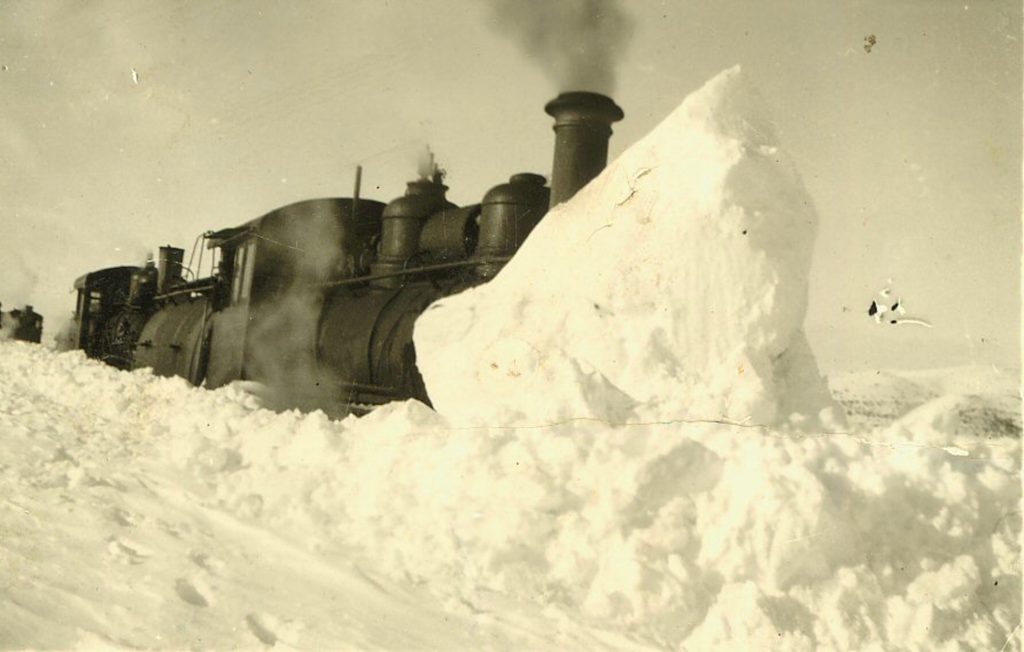
On February 14, 1916 the auto club held its organizational meeting. Its first goal was to open the road over Fredonyer to Susanville, after all this was prior to the state highway system.  On Sunday, April 9, 1916, the Auto Club organized a work party of one
hundred twenty-five to open Fredonyer, with Red River providing
equipment. A much smaller delegation from Susanville was recruited to work on the snow removal from their side of the mountain. The Susanville team was the first to reach the summit, for they had the added benefit that its side receives more sun exposure.  Being of goodwill, the Susanville crowd began snow removal on the Westwood down slope. Once the two groups connected, everyone regrouped to the summit to celebrate their achievement. This became an annual event for the next several years.

Within a few short years the Westwood Auto Club saw its membership swell to nearly five hundred.  Due to its size, the club felt they needed a place of their own. Upon due diligent search they found an empty building at 303 Ash Street, which had formerly housed kindergarten classes. On New Years Day 1921, after a complete remodel the club opened its doors to the membership.
The Auto Club was on a roll, and in the spring of 1921, it obtained a
lease from Red River to develop a park and campground at nearby Clear Creek. This was a popular picnic site, and the club maintained the park until the organization folded when Red River sold in 1944.

By the mid-1920s the organization had over 1200 members. Its biggest accomplishment came in 1929-30. The Auto Club lobbied hard with the California Division of Highways for the winter snow removal over Fredonyer.

Donate

Horse Lake Canal Company

Horse Lake, June 21, 2019

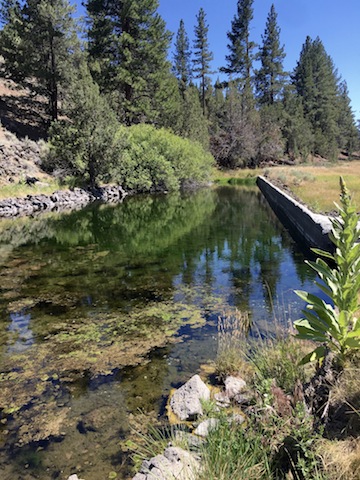
Horse Lake for the uninitiated, is a shallow high desert lake northeast of Eagle Lake and west of Ravendale. On the average in good years covers some 3,200 acres. Water is everything in this section and Horse Lake did not escape those seeking that precious resource.

The lake is an enclosed basin but prior to settlement and in wet winters it had a natural outflow that drained into Petes Creek.. Settlement around the lake began in 1868 and water was diverted from the lake to irrigate surrounding land, thus the outflow was intermittent. In 1893, William Harrison deepened a cut to allow water to flow into Petes Creek. In 1899, the Horse Lake Canal Company was formed and claimed 200,000 inches from the lake to irrigate the lands in the Tule District of the Honey Lake Valley. The next entity to propose a similar measure was the Tanner Slough Irrigation Association. In 1938, the Association actually diverted overflow from Horse Lake due to an exceptional wet winter. Then came along the lawsuit known as Fleming vs. Bennett which resulted in the adjudication of the Susan River and its tributaries thus putting an end to enterprises such as the Horse Lake Canal Company.

Tim

Lasco’s Loggers’ Ball

Lassen Mail, July 16, 1926

Lasco was the logging camp of the Lassen Lumber & Box Company during the 1920s. It was located at the northern base of Peg Leg Mountain. During the summer it was home to 250 loggers. They were a social bunch with special events on Saturday nights throughout the summer. One of their annual events was a Logger’s Ball held there on the last Saturday of July. Lasco’s de facto Mayor, Emille Frizzie always made it a point to welcome all visitors. One time  he made a public invite to everyone from Chester to Doyle, though he made it clear bootleggers were not welcomed.  As was customary then, a midnight meal was served and dancing continued into the wee hours of the morning.

Tim

Susanville Fire Department Turns 100!

Susanville city/fire hall.

Fire and fire prevention played a pivotal role in the development of Susanville. It was fire after all, why the city was formed. The original city/fire hall was a tall wooden structure that was destroyed by fire on November 7, 1921.

At the same time the City Council was dealing with a pressing issue with Fire (Insurance) Underwriters had proposed a hefty increase for insurance premiums of property inside the city limits. The Underwriters two main concerns the water mains were insufficient and the lack of an adequate fire department. The City addressed and worked with Frank Cady, owner of the local water company, to fix that problem.

On May 9, 1922, a newly re-organized Susanville Volunteer Fire Department was created. It initially consisted of five men:  H.W. Wharton, Uel J. Travis, Ted Murphy, John Greig and Walter Agee. Baldwin was named fire chief. One of their first priorities was to recruit and train volunteers. More progress was made that year with the purchase of an American LaFrance Fire Truck.In addition,  a Gamewell fire alarm system was installed throughout the town

In the fall the Board of Fire Underwriters representatives came to Susanville for inspection. While they were pleased with the improvements, there was one additional requirement—a paid fireman. The City obliged and hire Walter Long at $125 a month. The hard work paid off, instead of an increase on fire insurance premiums they were reduced by 10 percent.

Support

.

Family Feuds

Henry L. Hoagland—Betty Gorbet

For many years I was involved with the legal system. One of my introductions was working for attorney Joseph B. Harvey, prior to him being elected Lassen County Superior Court Judge. His office, saw some potential in a young kid, and before I knew it, I was learning probate law. One of the first cases I worked on was a nasty fight over estate with very little value—but the opposing parties fought over everything including the the toilet paper! Who knew years later, that was important lesson learned, and came in handy dealing with my Uncle Jim Purdy’s estate.

Over the years, while the way we live has changed, human nature has not. As usual, while researching one item, in the files, I came across other information, which some may find of interest. This is an 1892 Lassen County Superior Case Hoagland v Shearer.  Henry Hoagland sued his brother-in-law over the care of Solomon Shearer, who at the time was 88 years old. According to Hoagland, it was mutually agreed upon that he care for his father-in-law until April 1, 1891, and Josiah Shearer would pay Hoagland $25 a month. Josiah would take care of his father after the April date. That did not happen, nor did he ever pay Hoagland, hence the suit. A judgement by default was entered on September 10, 1892, but Josiah Shearer sold his Honey Lake Valley ranch and left the area, never paying Hoagland. As to Solomon Shearer, some how he made his way to Missouri where he died in 1902.

A portion of Josiah Shearer’s ranch along Honey Lake, 1997.

There is a irony later on with Hoagland. His family had him admitted to the Lassen County Hospital in 1919, as no one was able or wanted to care for him. The family agreed to turn over his Civil War pension to pay for his care, but they never did. A year had gone without payment to the County, thus the County notified the family he would be discharged. Before the issue was resolved, Hoagland passed away.

Support

A Susanville Chain Store Story

Articles of Incorporation

Many people are indifferent about chain stores, and then there are those who think they are wonderful, and the other camp that truly despises them. In the 1920s, with Susanville’s tremendous population growth, chain stores emerged on the scene. While the old established merchants were not thrilled, the Susanville consumer enjoyed a broader selection. The first chain store to enter the Susanville market, was a Wyoming outfit known as Stevens Store Company and in 1929 it became. J.C. Penney.

Enter R.L. Stone, who had a different approach for shopping in Susanville. Cash and Carry.  It should be noted it was rather customary of merchants, to allow their customers to charge their purchase. It was a risky endeavor at times for the merchant to recover those charged accounts. Stone’s concept a reduced price, but be paid in cash, no credit. It worked beyond expectations. It was in November 1923 when Stone opened his first store in the T.H. Long building. With his brothers they opened additional stores. By 1927, when they incorporated as Stone’s Cash Stores they had nineteen stores in California, Oregon and Washington. In 1929, Stones merged with another chain store MacMarr.   In 1934, Safeway acquired MacMarr.

Support