Category Archives: History

Lassen Lumber & Box Co. Begins Operation

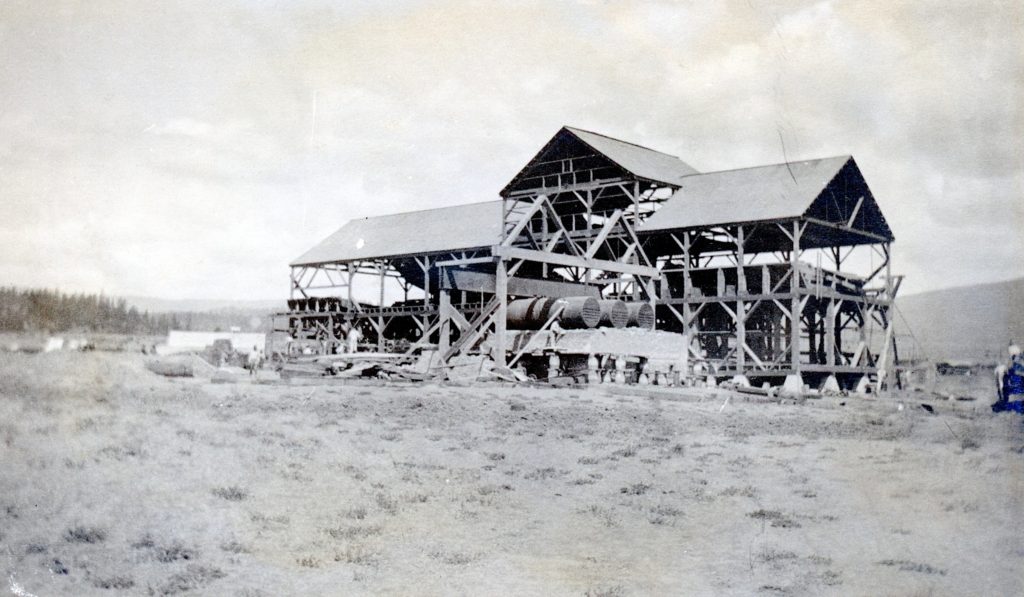
Lassen Lumber & Box Company’s mill under construction, 1918

On July 27, 1918 was a certainly the proverbial red letter day in Susanville history. The Lassen Lumber & Box Company began operations of their mill located on the south side of the railroad tracts and adjoining Alexander Avenue (The site is now Lassen Auto Body). It was Susanville’s first major lumber manufacturing plant. There were attempts to lure Red River Lumber Company’s to locate in Susanville, but the family bickering of Red River dashed that hope.

Anyhow, this brief synopsis how Lassen Lumber came to be. The progressive arm of the Susanville community, as an incentive offered a free mill site and a $8,000 cash bonus for anyone to locate sawmill there. They succeeded. C.E. Cotton, R.D. Baker and Charles McGowan had been inspecting forest service timber lands. They liked what they saw. They contemplated a sawmill site at the base of Peg-leg Mountain. The Susanville business community, led by M.O. Folsom, convinced Cotton & Company to locate at Susanville with the aforementioned incentive. They took it, and a new chapter began in Susanville’s history.

Tim
Hallelujah, The NCO Arrives in Oregon

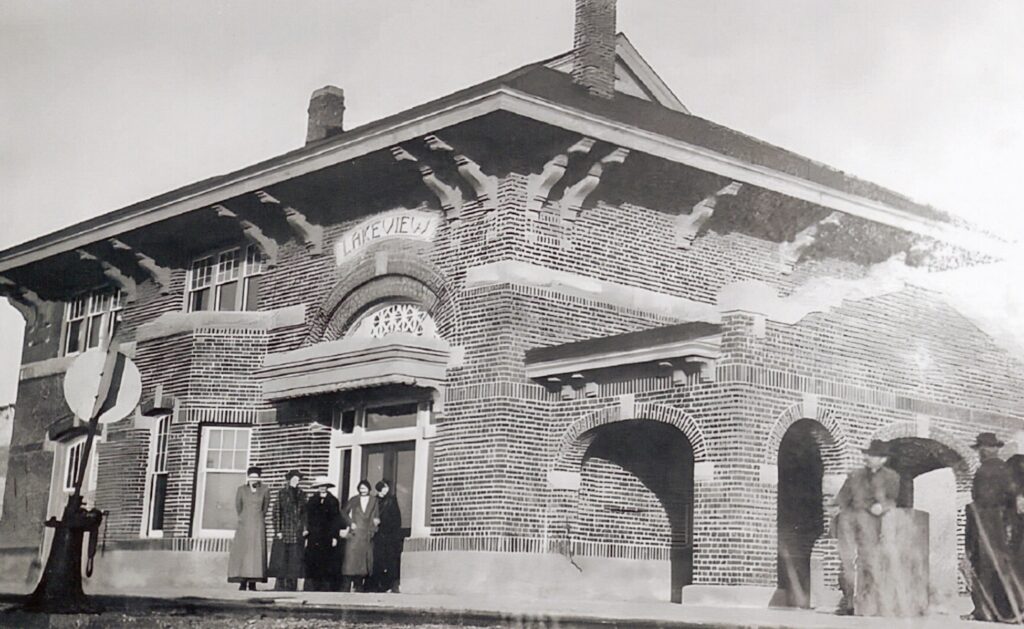
The NCO Depot at Lakeview, Oregon (Note, I purchased this photograph, including postage for $2.14 on Ebay)

In 1887, the newly hired NCO General Manager, Erasmus Gest had an ambitious goal for the railroad to reach its final destination, The Dalles, Oregon. Gest scrapped plans for the railroad to build along west side of Honey Lake and to Susanville. It was Gest’s opinion to build the railroad on east side of Honey Lake to speed up the process. It was not meant to be, in 1890 NCO reached Brubeck’s Ranch, destined to become Amedee construction would stall for nearly decade. In 1900, when Gest retired, the railroad finally reached the Madeline Plains far short of Gest’s goal to Oregon..

Progress was made slowly but surely and by 1908, the NCO arrived at Alturas, the most populous community on the route. On January 10, 1912, it was momentous occasion when the NCO reached Lakeview, Oregon, 238 miles from Reno. Little did anyone know what a historic event it would be. It would remain the northernmost terminus of the NCO, the rails would never be extended beyond that point.

Tim


Kwan Wong’s Grand Cafe

The menu cover of the Grand Cafe, a cherished establishment.

In the early 1900s a number of Susanville’s restaurants were operated by Chinese, though serving American cuisine.  The Grand Cafe was just such an establishment. It was established in 1909 by Kwan Wong in the rear of the Pioneer saloon.

In 1912, O.M. Doyle built a two-story stone building next to the Pioneer, which the latter had used the vacant lot as a beer garden.  Doyle named the building the Wee-Wee, a nickname given to his daughter, Marie. On May 3, 1912, Kwan Wong opened the Grand Cafe in that building, where it has been ever since, though the original building was accidentally  demolished in 1934.

Wong operated the Grand off and on for several more years. On trips back to China, he would lease it, and other times just close it until his return. On January 15, 1915, the Lassen Weekly Mail reported: The Grand Cafe closes its doors. The Grand Cafe is without an angel. Kwan Wong, its late proprietor, has quit for good, as he could not do enough business to make expenses.” 

It would not be until 1921, that the Grand Cafe found stability in its ownership with Sam Vucanovich and Steve Sargent. That is another story, for another time.

Support

A Troubled Irrigation District

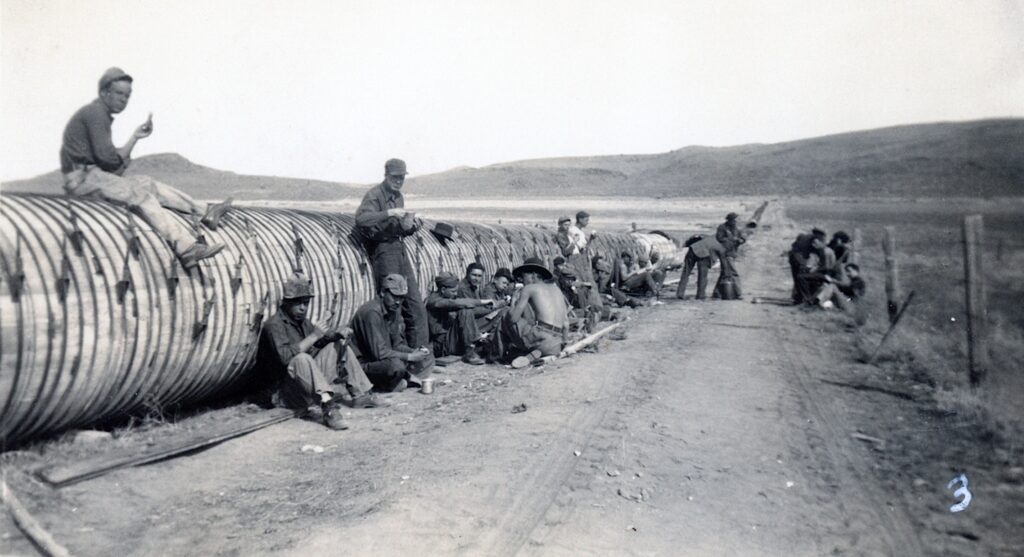
Secret Valley CCC’s doig repair work on the Baxter Creek siphon, 1936—C.H. Bennett Collection

In 1947, the Baxter Creek Irrigation District, along with its counterpart the Tule Irrigation District filed for bankruptcy. On October 16, 1952, Baxter Creek was dissolved. Tule would have suffered the same fate, but last minute legal strategy was saved by W. Cobun Cook*

For Baxter Creek its origins began in 1911,  with the creation of the Baxter Creek Irrigation Company. While it looked good on paper, it never materialized.The saga did not end there.

Baxter Creek, circa 1950s

On February 8, 1917, the Baxter Creek Irrigation District was created, a public district, not private entity. While similar in scope of the irrigation company, the district proposed comprised of 9700 acres. When they went to secure a bond measure, the State Engineer’s Office intervened, citing the district’s main water supply was insufficient.

The neighboring Tule Irrigation District was encountering a similar problem to secure bonds for Leon Bly’s Eagle Lake irrigation system. A solution was found where the two districts agreed to pro-rate the costs and secure the bonds for Bly’s irrigation system.

The Bly tunnel outlet as it appeared in 2012. Courtesy of Barbara White

For those in the Baxter Creek system, it required a series of canals and siphons to transport the Eagle Lake water to the west side of the valley. However, the theory of a reliable water supply proved wrong. In 1935, Bly’s Eagle Lake Tunnel was abandoned. For the next decade the two irrigation districts sought solutions, but bankruptcy prevailed.

*Tule Irrigation District is a dormant state. Former Lassen County Counsel Dawson Arnold did not want to abolish it. It was his reasoning if the County wanted an irrigation district, they could simply revive Tule, thus bypassing a formal process to establish one from scratch.

Support

Tuesday Tidbit Returns

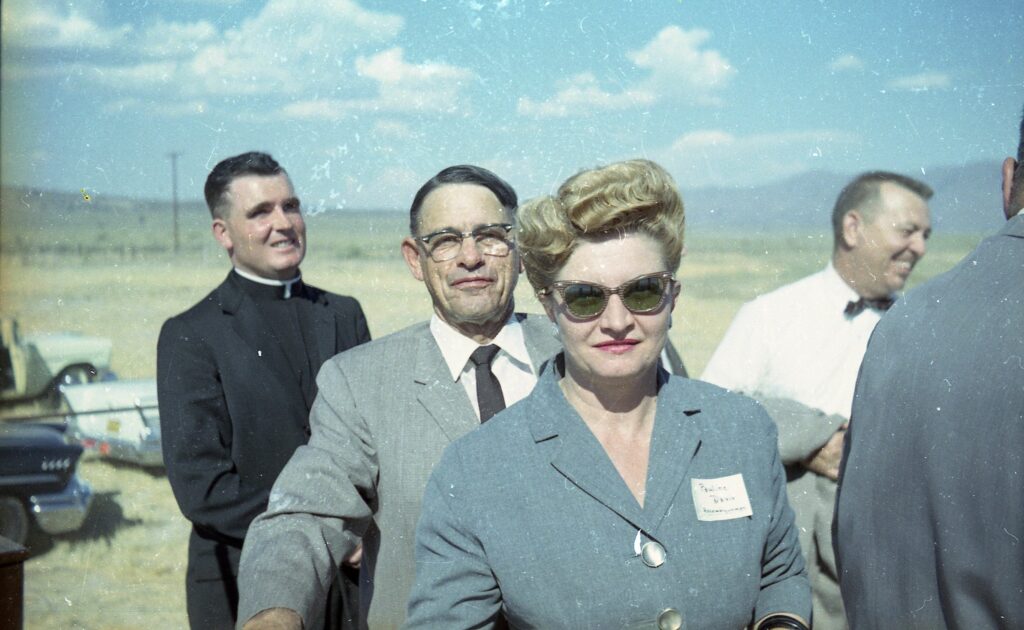
California State Assemblywoman,Pauline Davis, with Lassen County Supervisor Jim McQueen behind her, att the groundbreaking ceremony of the California Correctional Center, 1960.

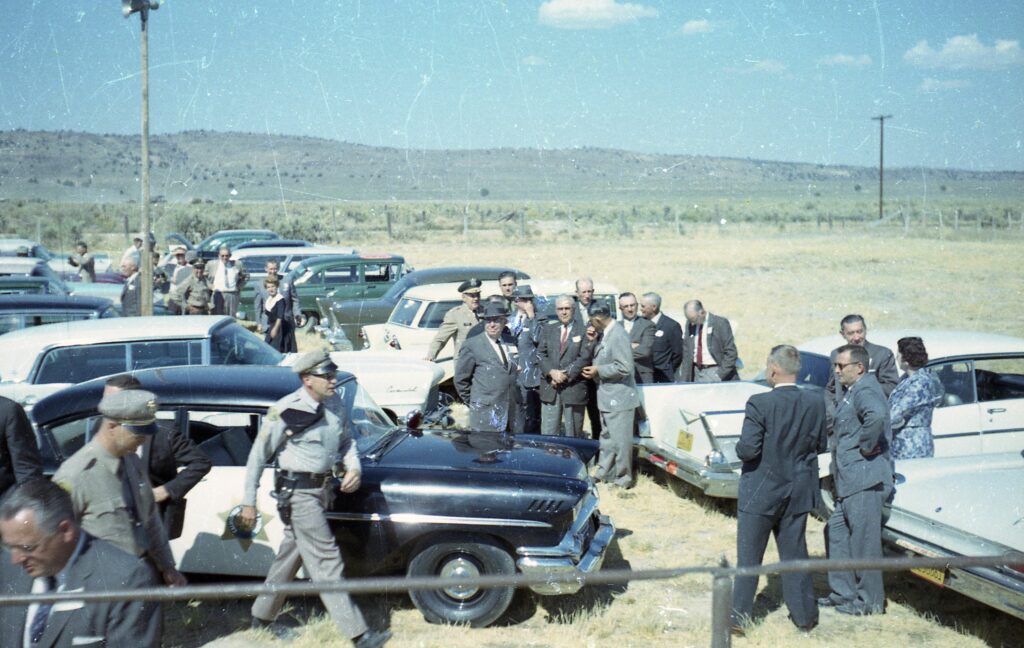
Tuesday Tidbits has always been sporadic. Having discovered an interesting a packet of color negatives of 1960 taken during the groundbreaking ceremony of the California Correctional Center. There were not photographs of formal ceremony itself, but when the crowds started to assemble. In addition, there were random scenes taken in Susanville, that I thought many would like to see them in the forthcoming Tuesdays.

A scene at the groundbreaking ceremony of the California Correctional Center

Tim

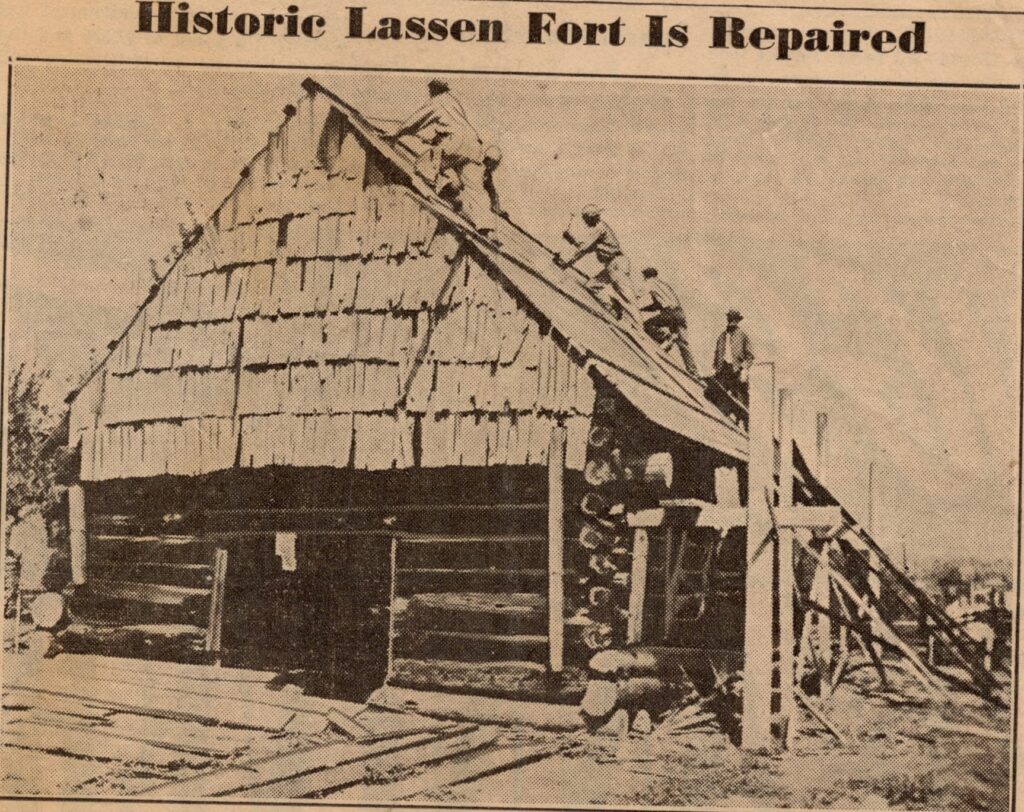
Roop’s Fort Rehabiltation, 1937

Sacramento Bee

The 1930s were a financially difficult time for Med Arnold, the grandson of the town’s founder, Isaac Roop. In a desperate need of funds, on October 8, 1936, Arnold put Roop’s iconic landmark up for sale. This in turn spurred a grass roots campaign movement to raise funds.  In May 1937, the City of Susanville purchased it.

Some thought that property could also be developed for a sorely needed children’s playground. While the city thought was admirable, it had no funds to make it a reality. Then there was issue that fort, which been used a hay barn and storage, had fallen into a disrepair. Since, it was the town’s oldest structure, it was deemed the foremost priority to do the needed repairs and new roof. The community once again rose to the occasion, and volunteers came to the rescue.

Roop's Fort
Roop’s Fort, 1940s

In 1974, Roop’s Fort was entered into the National Register of Historic Places.

Subscribe

Our Water Year

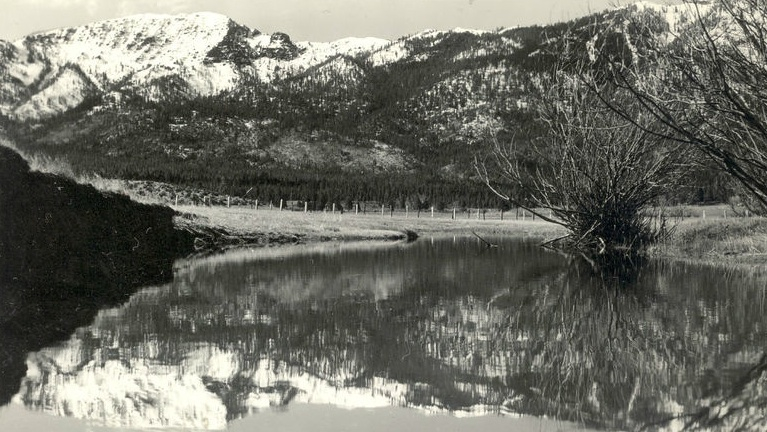
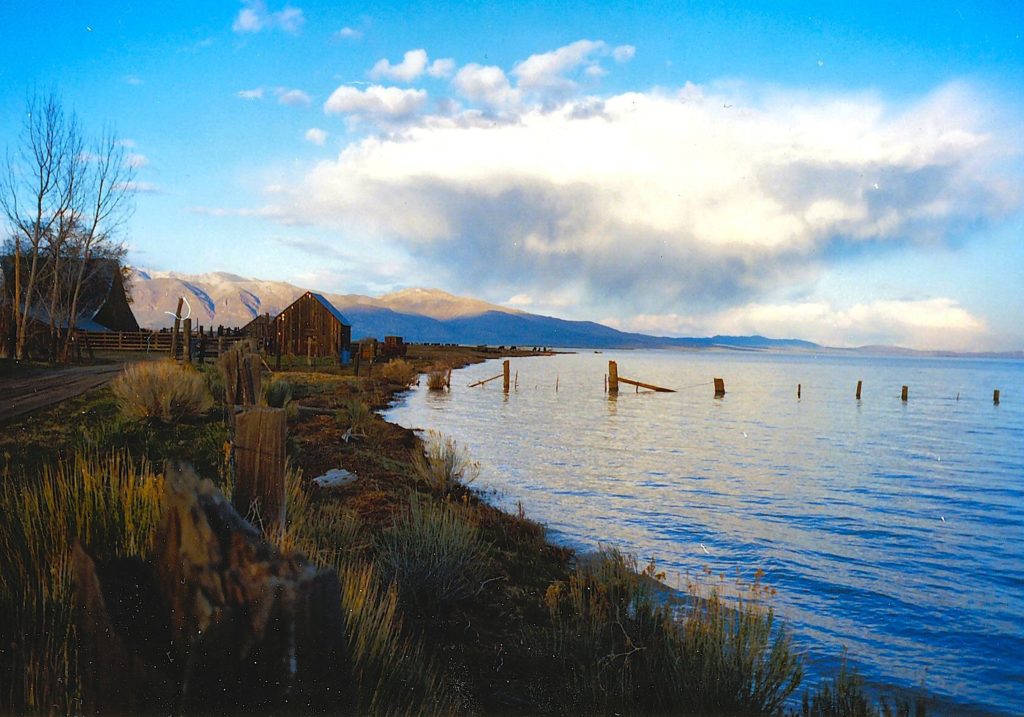
Honey Lake, from Tanner Ranch, January 1997.

The current precipitation water year ended on September 30, and now begins a new year. According to California Water Watch Susanville received, or more precisely at the airport, which is Johnstonville recorded 19.07″ of rainfall. Accordingly it is 116% of average and the average being 16.38.”  However, if one resides at the base of Diamond Mountain or even in Susanville proper the precipitation totals will be greater.

Tim

Dedication Day – The Honey Lake Pumping Plant

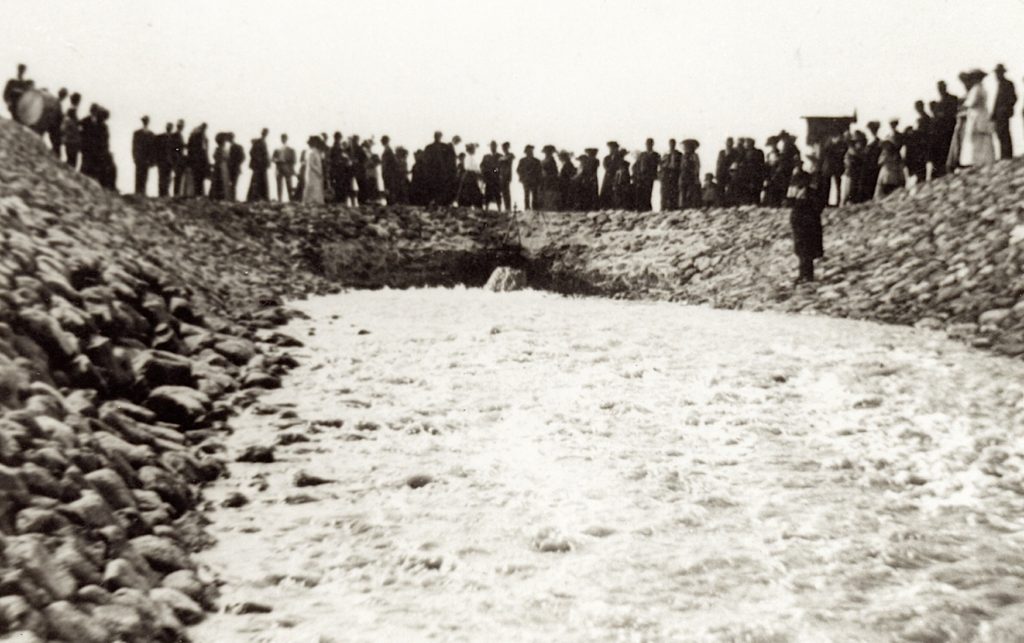
Dedication of the pumping plant, October 4, 1910–Prentice Holmes

For many it is hard phantom that Honey Lake was source for water for major reclamation project on the east side of lake. Yet, it was and a costly endeavor.

One hundred fifteen years ago on this date, dedication ceremonies were held the Standish Water Company’s newly built pumping plant on the shore of Honey Lake. It was  one of those beautiful falls days the region is noted for, set the mood for the inauguration of the pumping plant. During the morning people began arriving from around the Honey Lake Valley to partake in the festivities. Of course, the customary local dignitaries were on hand to provide their accolades. Shortly after noon, the visitors were instructed to assemble along the banks of the main canal to anxiously watch awaited event of pumping water into the canal. At one o’clock the whistle blew from the engine house, and within moments water burst through the pipes to fill the canal.

Standish Water Company’s pumping plant on the east side of Honey Lake, 1911. C.R. Caudle collection

On the surface it appeared the Company was off to a successful start. In addition, Mother Nature contributed to their efforts, when a snowstorm in January 1911 dumped six feet of snow there! Actually, the weather gods for the next several years were very kind to the east shore residents by providing higher than normal precipitation.

In the Company’s first year 1,000 acres had been planted with sugar beets, with a successful harvest. The following year was a success, too. This changed in 1913, in one of those bureaucratic snafus, as the federal government revoked the canal right-of-way across federal land until California clarified about granting water rights with a lake with no outlet.

Foundation of the pumping plant, 1984.

To make a long story short, when all was said done by 1917 the area entered into a twenty year drought, and the abandoned pumping plant could no longer be used, due to the lack of water. ln October 1918, there was a scarcity for machinery from the effects of due World War I. At this time, the United States Government seized the pumping plant’s machinery, where it was  dismantled and shipped to San Francisco. From there it shipped to Siberia to generate power.

Donate


A Western Pacific Disappointment

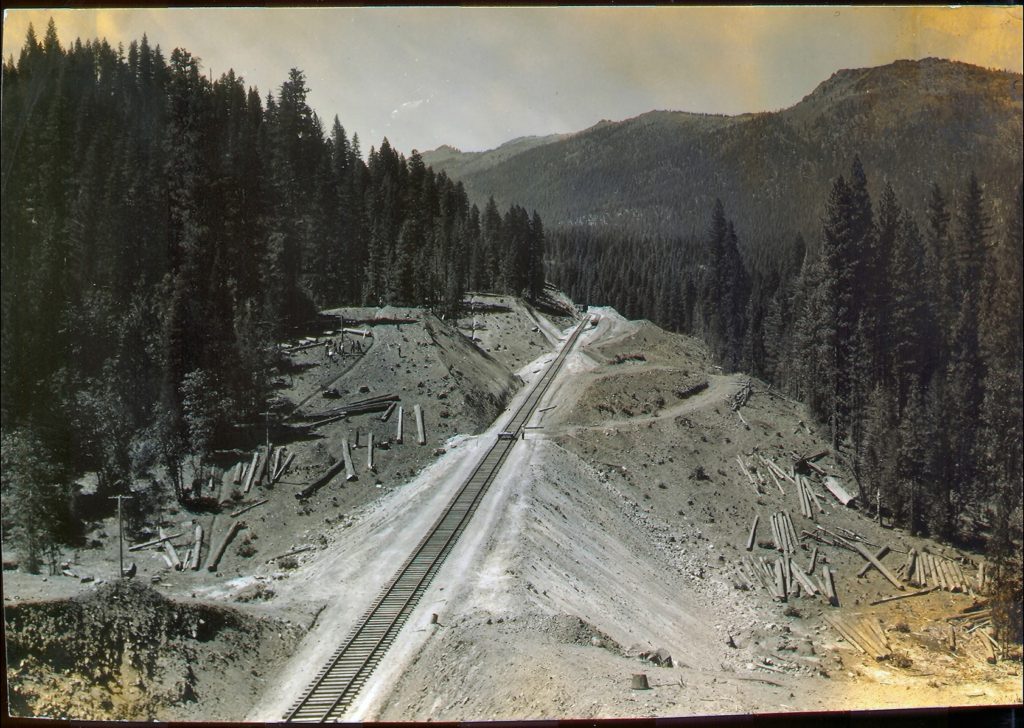
Mohalla Siding, south of Lake Almanor, July 18, 1931. Courtesy of the Plumas County Museum

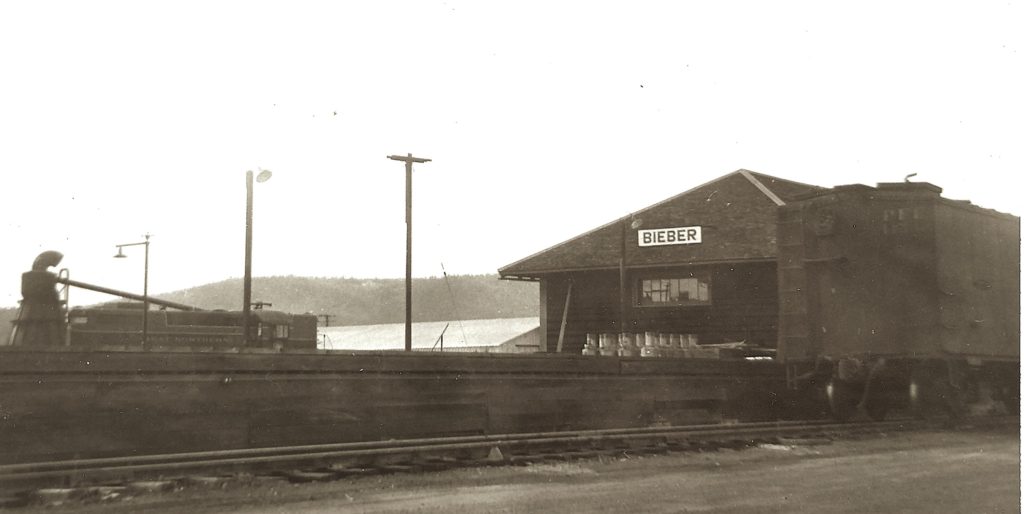
On February 14, 1929, the Western Pacific and Great Northern Railroads petitioned the Interstate Commerce Commission to link the two railroads from Keddie to Klamath Falls, it was a bold move. For Western Pacific it would consist of a 112-mile line from Keddie to Bieber. The route has many names, Inside Gateway, Northern California Extension and the widely used Highline.

Great Northern’s Depot, Bieber.

It was not a slam dunk proposition. Numerous public hearings were held, as well petitions and legal briefs during the fourteenth month period. To  broaden support the railroads offered passenger train service. The residents along route were excited about this prospect. On June 30, 1930 the ICC granted the railroads permission to build its proposal. On November 10, 1931 a golden  spike ceremony was held at Bieber to celebrate the completion.

One of the promises broken was regular passenger service was never instituted. There were would be special excursion trains and those were few and far between. However, Western Pacific did offer limited passenger service between Keddie and Bieber., in which passengers were placed in freight train cabooses. Between 1953 and 1958  the Western Pacific said this service provided $380.89 in revenue. In 1959, Western Pacific petitioned the State Public Utilities Commission to discontinue the limited passenger service and that was granted.

To Support, Please Donate or Subscribe

Eastman Studio No. 2

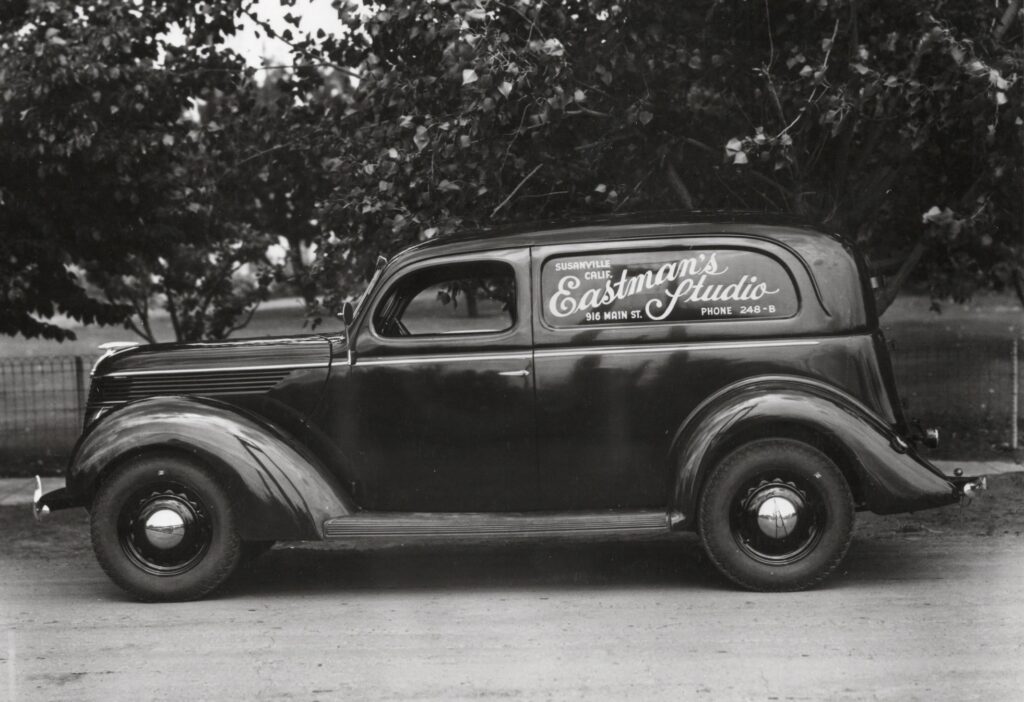
Jerive Eastman liked his cars.

Susanville photographer, Jervie Eastman, (1880-1969), opened his studio in that community in 1921. He constantly expanded his enterprise, first by buying the local competition, Thompson Studios.

In the fall of 1931 he unveiled his traveling photography studio. It was customized trailer complete with bedroom, bathroom, kitchen, living room/reception room and a photography studio. It measured 8 feet wide, 20 feet long and six feet high.  The announcement stated “The Eastman Studio No. 2 is wired so that it can be connected to the light lines in any community in which the owner decides to stop. Photographs can be taken and completed without the photographer stepping outside.”

Tim