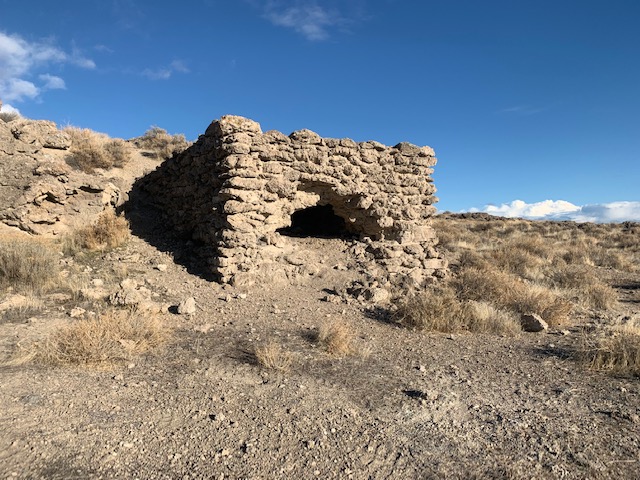
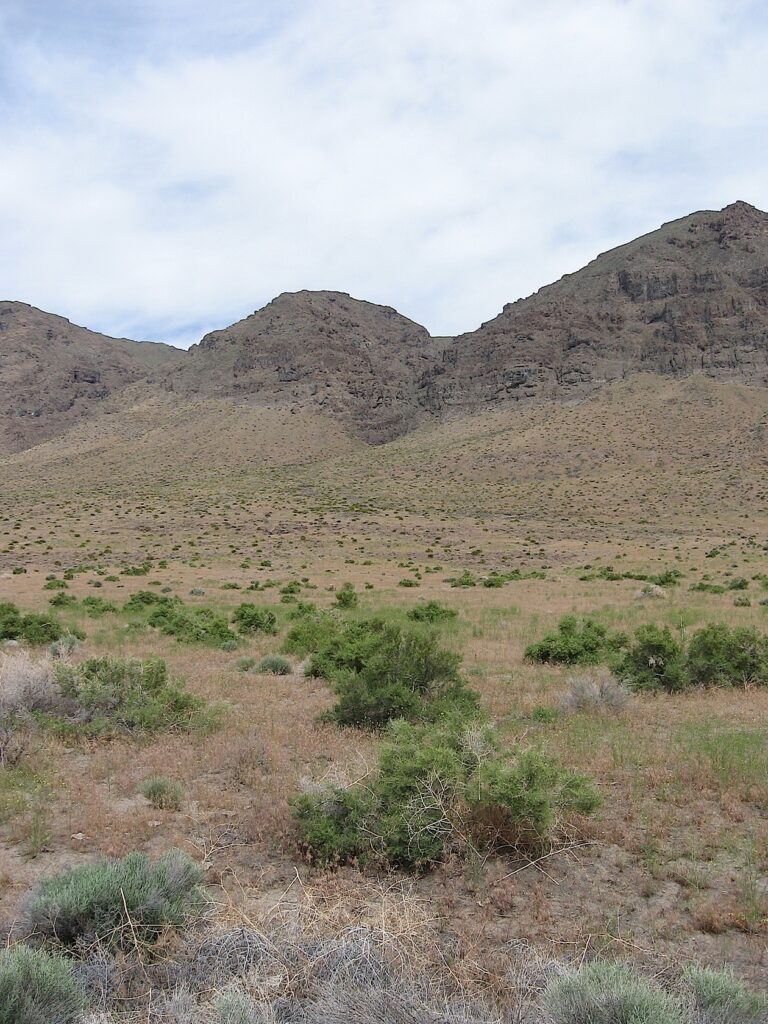
An astute reader, asked an astute question. Why the kiln, and where did the lime come from? Very good questions, indeed. Lime is found in rock deposits of calcium carbonate, which the rock has to be heated to extract the lime.
It should be noted, there is an interesting lime kiln remnant near the Wendel Hot Springs, but as it is on private property not accessible to the public.
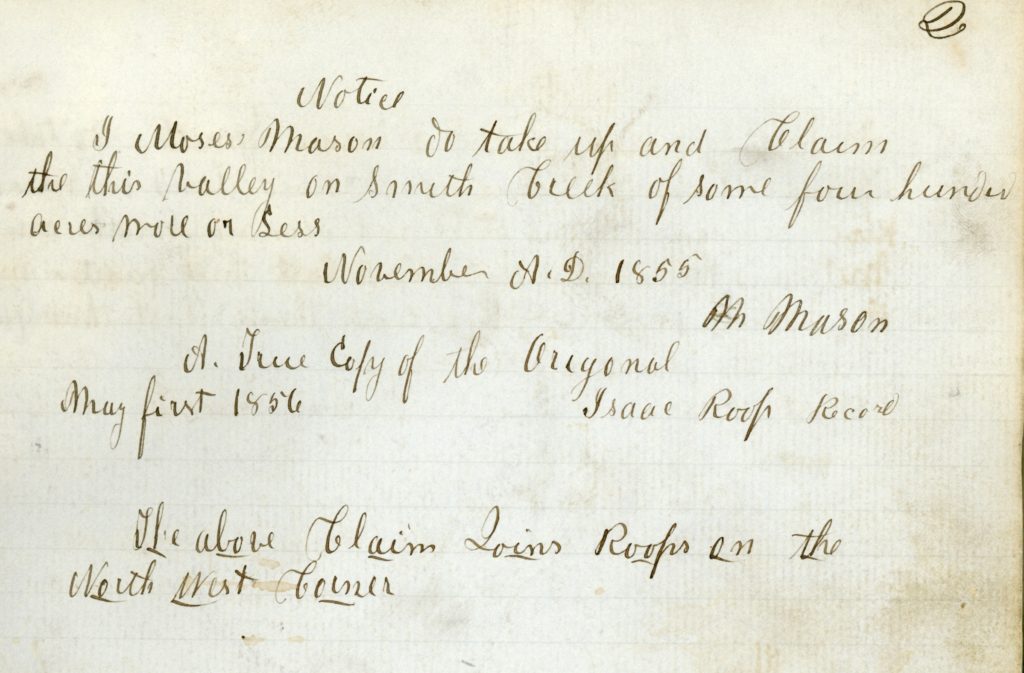
M. Moses was the second claim recorded in Roop’s Land Register. He settled on present day Susanville Ranch Park and referred to Piute Creek as Smith’s Creek.
This small stream a tributary to Susan River is approximately ten miles in length. For a brief period it was originally known as Smith’s Creek, who and why it was so named such we may never be known.
Another peculiarity is the spelling of Piute. Back in the 1850s and 1860s that was how the Anglo settlers of the western Great Basin spelt the name for the Native American tribe now referred to as Paiute.
Piute Creek was also the source for the original water supply for Susanville. It would be replaced with what is now known as Cady Springs in the Susan River Canyon.
Flood waters from breached earthen fill trestle, April 1938. Courtesy of Betty B. Deal
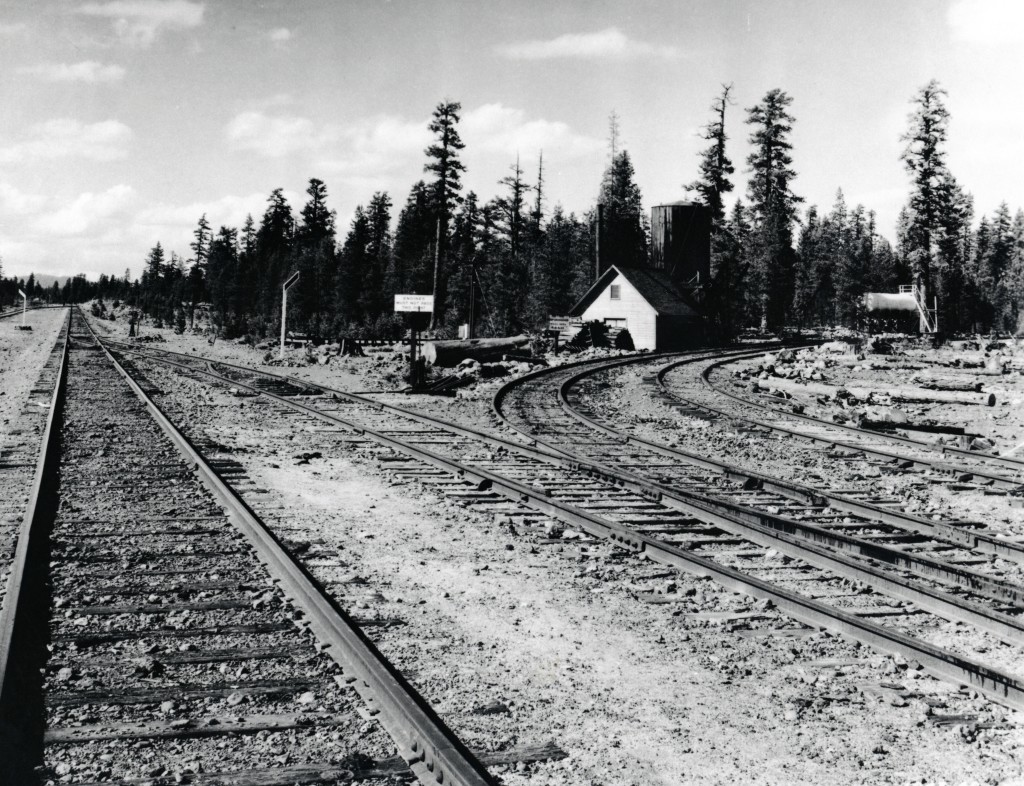
In 1935, the Red River Lumber Company completed its railroad logging line known as the Piute that traversed a portion of the canyon the creek flows through. Just above Desmond Meadows, the Piute line crossed Piute Creek. In an effort to save money, Red River decided to forgo a wooden trestle, and substitute an earthen fill. It was a rather substantial one at that, being over twenty-five feet tall. The winter of 1937-38, was one for the record books. By the end of March, 1938, the spring run-off was in earnest. The earthen fill at Desmond Meadows was equipped with a culvert to handle the stream flow. It was no match for this type of heavy water flow and then the culvert became blocked with debris, creating a substantial reservoir. As one eyewitness observed, this newly created lake extended back 300 feet from the fill with an estimated depth over twenty feet. On April 9, the fill breached, sending a wall of water downstream creating havoc in its path and washing away segments of the Piute railroad tracks into the fields of its dairy property now known as Susanville Ranch Park. In the aftermath, Red River decided not to repair the destroyed trackage. Red River took its time salvaging the line, since the company had given consideration to abandon railroad logging. In the 1940s, the abandoned railroad grade was converted into the Paul Bunyan Logging road.
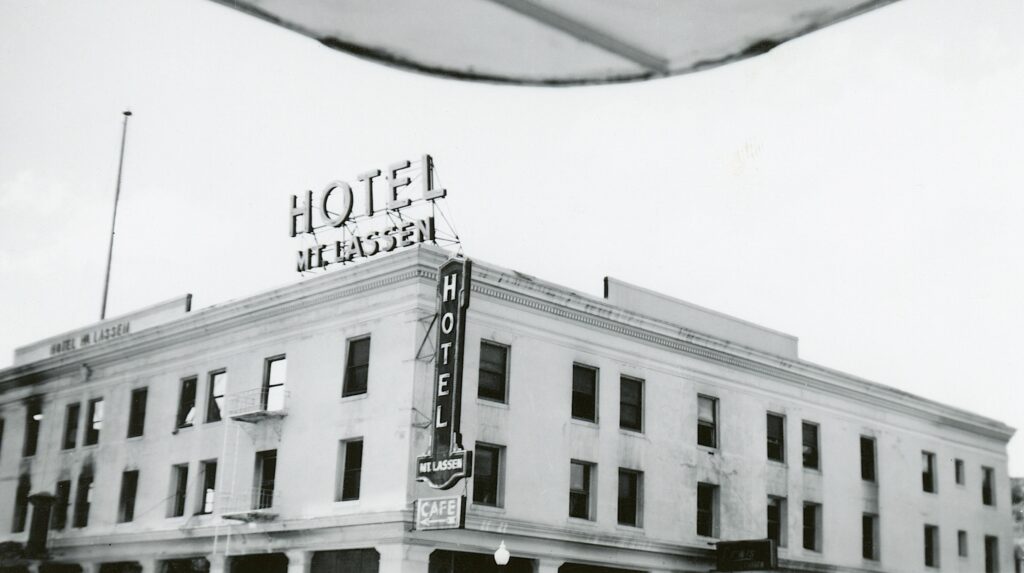
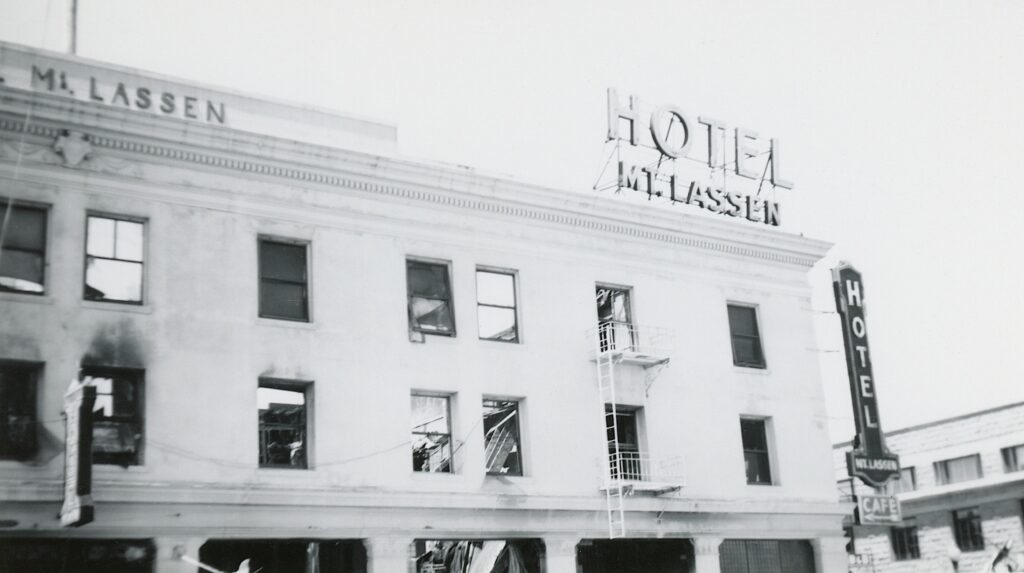
During the winter months, I spend some time cataloging documents and photographs. A tedious chore, but one that has to be done. With that in mind, I came across two 1947 photographs of the aftermath of the fire that destroyed Susanville’s Hotel Mt. Lassen. Since the cement walls were structurally sound, the hotel was rebuilt.
Hotel Mt. Lassen, 1947
The Hotel Mt. Lassen has now been closed for well over a decade. The current realtor has a firm asking price of $1.7 million. Last summer, I happen to had a discussion with a building contractor who inspected the hotel on the urging of the realtor. It was the contractor’s opinion that it would cost at least $3 million to put in back into operation. With inflation since then, the cost is probably higher. It appears the hotel will sit vacant for a long, long time.
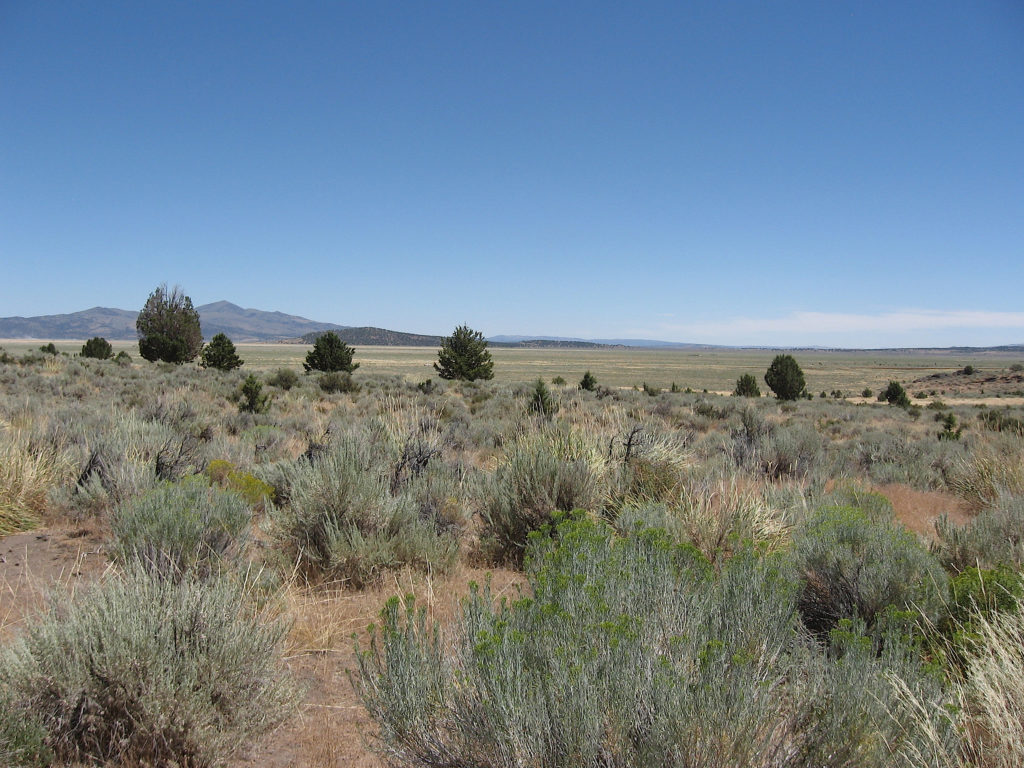
A view of the western Madeline Plains, August 4, 2016.
Moon Valley is not really a valley per se, but a very large subdivision on the Madeline Plains. In 1968, the Occidental Petroleum Company purchased a large portion of the lands owned by the Rees T. Jenkins Land & Livestock Company. On the west side of the Madeline Plains, they subdivided thousands of acres into 20-acre parcels they named Moon Valley Ranch. The first unit was recorded on July 12, 1968.
Moon Valley conjures up many images depending on one’s perspective. For some Lassen County officials it presents many challenges. Law enforcement officials have to contend with illegal marijuana grows and from there the list goes on.
A number of these parcels are sold sight unseen. Once sold the new buyer who finally makes the pilgrimage there, realizes the land is not what they envisioned and that it was not such a great deal after all. I recall, in one instance a young man from England came into the Lassen County Assessor’s Office wanting to know about a parcel he recently inherited there. Of course, in his mind, he thought he found the proverbial pot of gold, after all it was real property in California. The Assessor’s Office did the best they could to describe the property, yet the young man was undeterred. After he left, we all agreed that he probably spent more money to make the trip from England than what the property was worth.
Smoke Creek Picnic, 1915. Courtesy of Fred Nuckolls
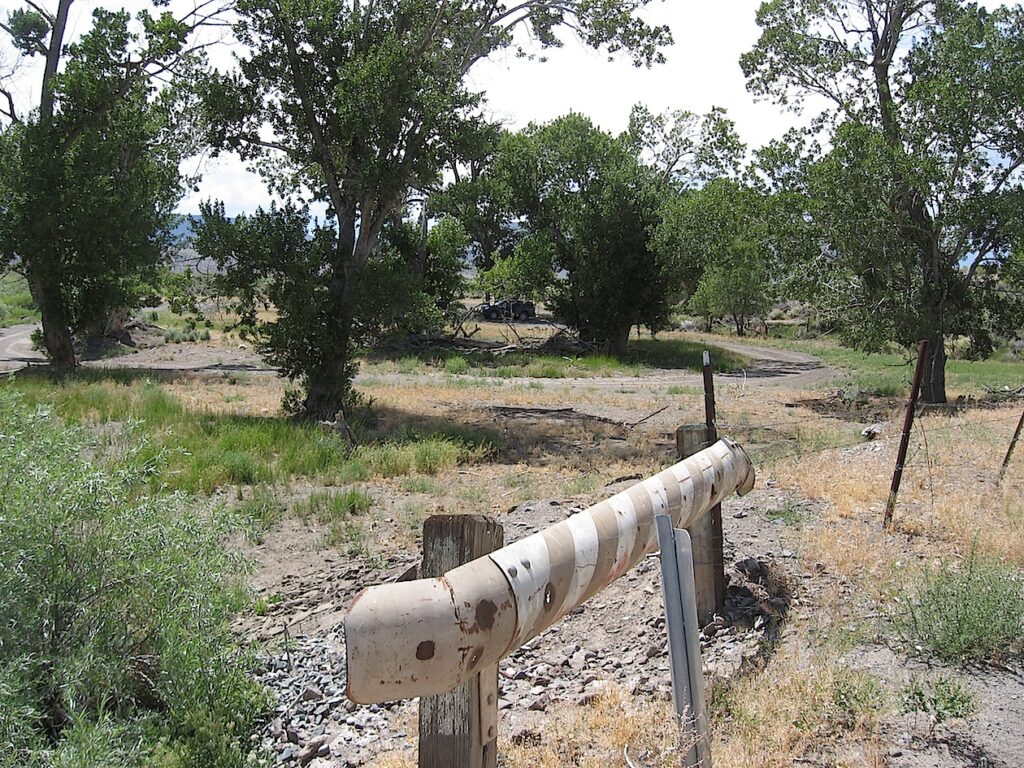
Sheepshead, Nevada was a stage stop in the Smoke Creek Desert dating back to the 1870s. It was so named as a big horn sheep’s head was nailed to a cottonwood tree there. It should be noted that the last big horn sheep in that vicinity was killed on Skedaddle Mountain in 1881. Sheepshead was a popular gathering place for the residents of Smoke Creek, due to the creek flowing through, along with the cottonwood trees, made for an ideal setting. It should be noted that the Sheepshead Post Office operated from 1879 to 1926, and upon its closure the duties were transferred to Flanigan.
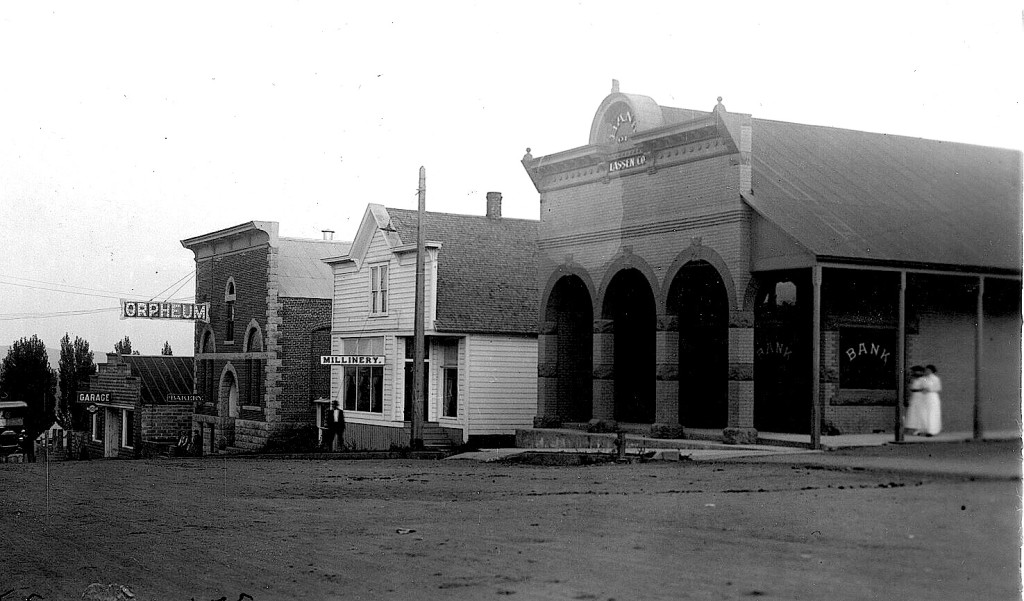
The name Orpheum was practically a generic name for theaters across the country, and Susanville was of no exception. The Orpheum located at 804 Main Street was constructed in 1913. It was a multi-functional building and when completed housed the town’s first movie theater. It should be noted that the first movies to be shown in Susanville occurred in 1907. When the Orpheum first opened, movies were shown usually two to three nights a week. Besides showing movies, the building was the scene of numerous dances and other activities. Whatever the case may be, it became one of the most popular social hubs in town. It should also be noted, that the basement of the Orpheum housed a bakery.
In 1921, the Orpheum had competition when the Liberty Theater opened at the present site of Sierra Theater. The Orpheum adapted and at times had a skating rink and bowling alley. Many a civic organization held meetings and social fundraisers there.
However, times were changing and fifty years later the Orpheum had outlived its original purpose. On May 16, 1963, Paul Langslet had the building demolished for a used car lot.
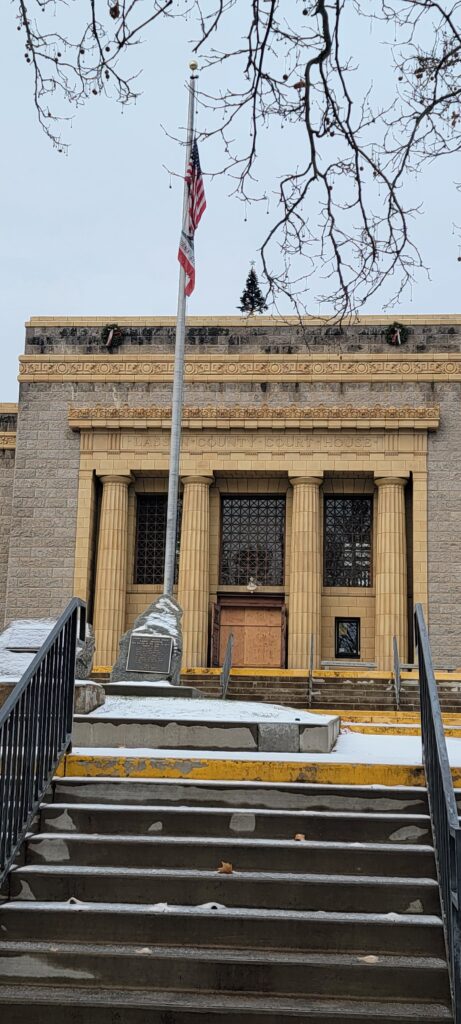
While we embark the end of the holiday season, this year witnessed a first for the Lassen Courthouse. The contractors on the renovation process adorned the top of the building with a Christmas tree. Personally, and one who spent decades there doing research, I found it very touching.
Westwood Junction was that of the Fernley & Lassen branch of the Southern Pacific, built by an agreement with the Red River Lumber Company. At this point the railroad constructed a spur line to the south of the newly created town of Westwood. The Southern Pacific’s goal was to extend the line north to Klamath Falls, Oregon. It was after all, the Red River Lumber Company’s intent to build several mills, the next one scheduled for near Lookout. By 1917, the Southern Pacific was anxious to extend the line north, but Red River was not ready. The mammoth mill at Westwood was more than it could handle. In the meantime, the Southern Pacific was nervous that its competitor the Western Pacific might extend a branch to Westwood and siphon off traffic, since Southern Pacific’s five-year agreement with Red River which the railroad had all inclusive freight deal was about to expire.
Then came along World War I and that changed everyone’s plan. When the war ended, the nation went into a severe recession, so expansion was off the table for many. . In the meantime, the Southern Pacific focused on the troubled Nevada-California-Oregon Railroad, as an alternative route north to Oregon, which it eventually did.
This site, it should be noted, also served as a junction for the railroad logging operations of the Fruit Growers Supply Company and the Lassen Lumber & Box Company.
Every year has its high and lows. Personally, the beginning of the year was off to a rocky start. There was, of course, the never ending winter weather that did not cease until early May, that did not help matters. In March, came the computer malfunctions and I appreciated those readers who provided me with assistance. But to make up for the computer issues, that month I received C.H. Bennett’s photograph albums when he was the Company Clerk at the Secret Valley CCC in the mid 1930s.
In June I was able to experience some wonderful outings including the Smoke Creek Desert. This particular trip was significant to visit Edward Laird’s grave. The outing was exceptional with not only cool weather, but at the end ofJune that country’s vegetation was still very green.
The last half of the year, was hardly smooth sailing. November was a sad moment when the community and my personal close friend Noreen Frieling passed away. I, determined with Nor’s spirit, needed an attitude adjustment in December. It was the perfect dose of medicine.
I am ready for 2024 to spread good cheer to all throughout the year. Shucks, believe it or not I already have about half of the 2025 calendar done. Happy New Year to all.