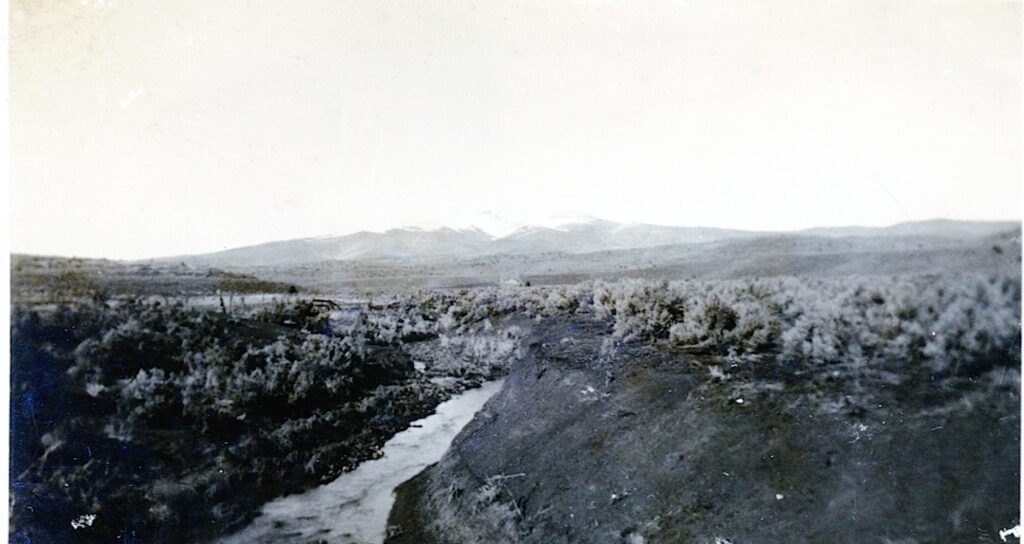
Secret Creek is a small desert stream of approximately forty miles that originates from Shinn Peaks in eastern Lassen County. While spring run-off of snow melt from Shinn Peaks at times can be substanial, it is the numerous springs of the upper watershed that sustain the creek. When the stream departs Secret Valley, it enters Balls Canyon and near Belfast empties into Willow Creek.
Secret Creek, as seen from the lower end of Secret Valley.
In 1889, a diversion of the creek was built after it leaves Balls Canyon. The sole purpose was to collect spring run-off to store at Ward Lakes Reservoir, for irrigation. There were actually two reservoirs, hence the plural of its name. The upper reservoir was significally smaller..
In 1889, the Balls Canyon Reservoir Company was formed to build a dam on Secret Creek where it enters the Honey Lake Valley, about five miles west of Litchfield. The company employed surveyor, Frank Gates Ward (1857-1895), to survey a dam and reservoir site. In 1889-90, the first reservoir was constructed. In February 1890, a flood washed out that dam. As one observer noted, the waters of Secret Creek began rising at a rate of two feet an hour and within three hours the 27 foot high structure, that measured 150 feet in length, was swept away. The company planned to rebuild but never did. In 1895, Edward T. Purser took over the project and a new reservoir was constructed, along with a twenty-mile ditch to his property near Wendel.
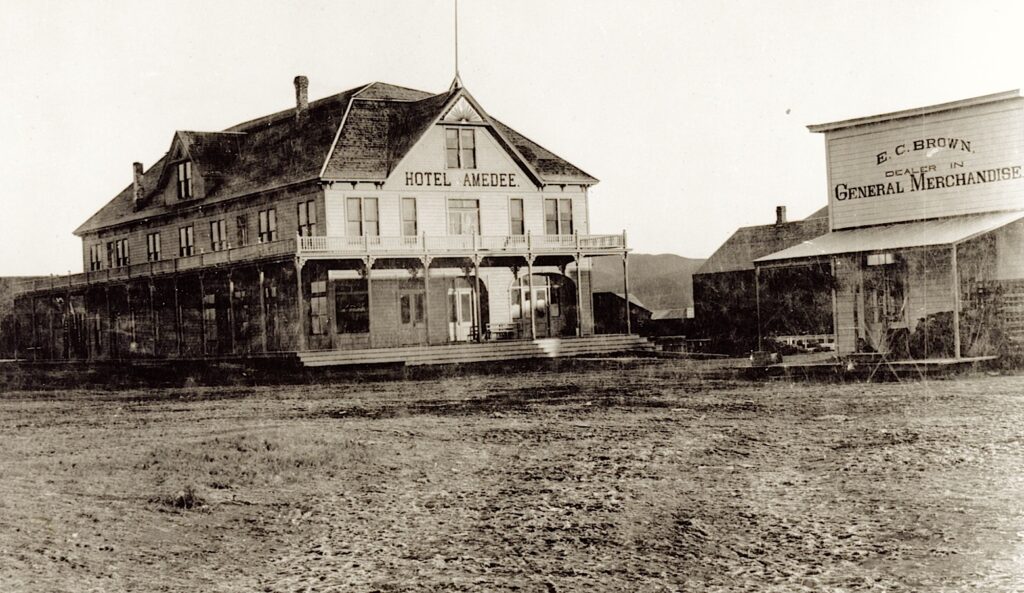
By the spring 1892, the Amedee Boomtown was in its full glory. In the fall of 1891, Erasmus Gest invited investors and speculators to Amedee to promote and a develop the town. On March 30, 1892, the Truckee Republican had story about Amedee. It stated: “These conditions are needed for a desert boomtown- 1) A live man 2) A railroad and 3) Water.”
1) On January 9, 1892, S.N. Griffith a Fresno, California capitalist entered to an agreement with Erasmus Gest to develop and promote Amedee. The contract contained specific requirements for Griffith to undertake. Griffith agreed to construct a hotel, bath house and livery stable from plans submitted by Gest. A townsite needed to be plotted and surveyed and the contract even designated A.J. Chalmers as the surveyor for the work. The necessary projects had a deadline of six months. Gest was under no obligations or responsebility for this promotional venture. The boomtown began.
2) A railroad. The NCO Railroad arrived ion November 1890 on the east side of Honey Lake.
3) Water. There were several reclamation projects in the works. The Eagle Lake Land & Irrigation Company focused on the Amedee region. In fact Eagle Lake water flowed to Amedee in the fall of 1892.
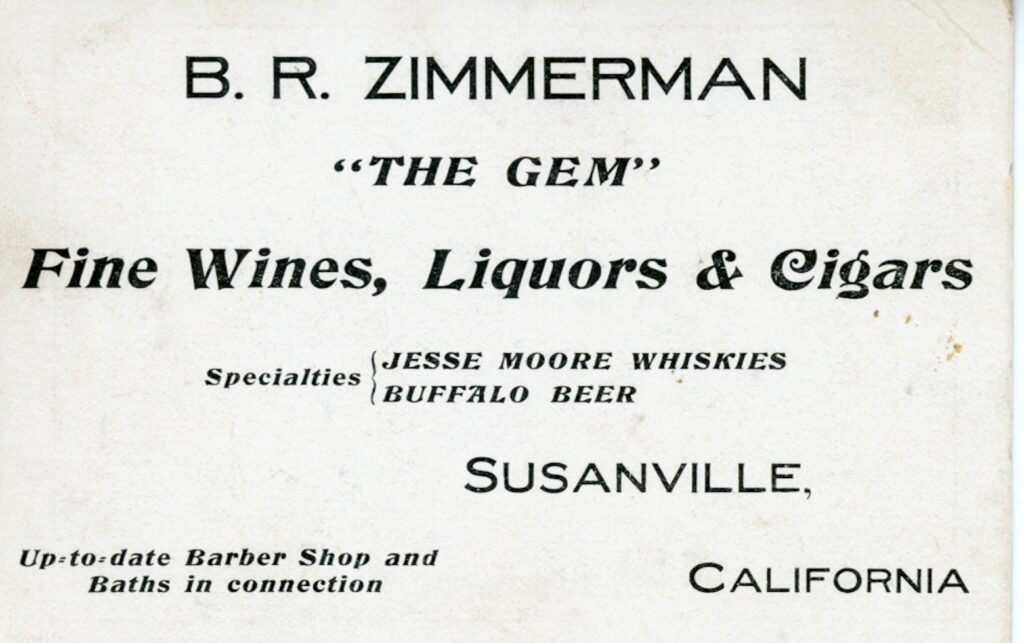
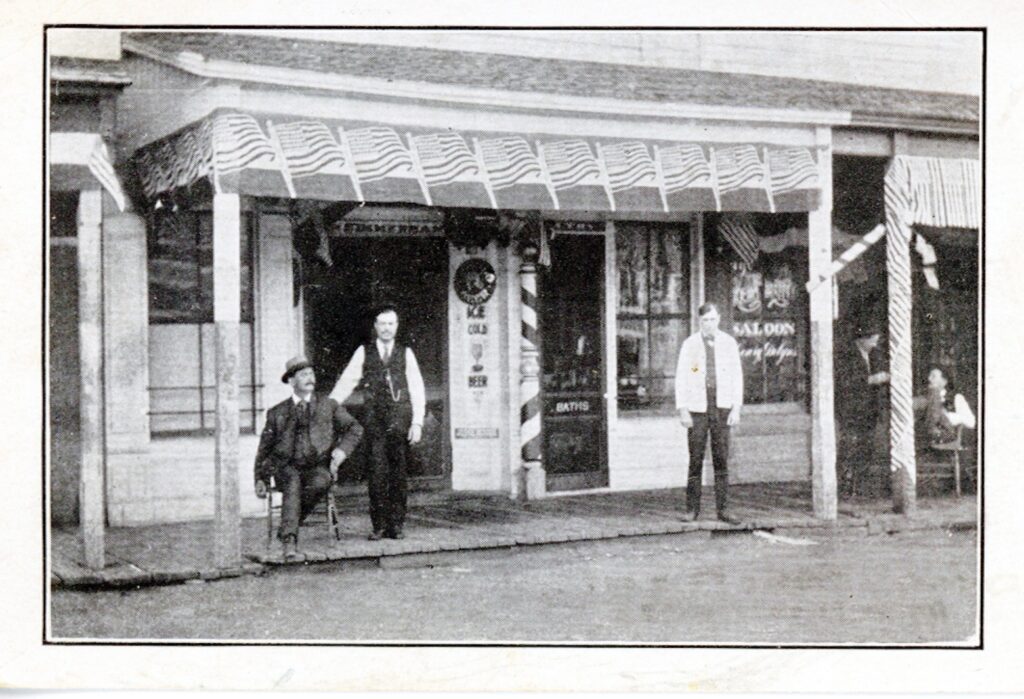
Business cards in this electronic age are becoming obsolete. Over a century there was a standard size card. However, there were individuals that were creative types who did not follow standard norms. Such was the case of Susanville businessman Ben Zimmerman. His card was twice size of a normal one, and not only that it was printed on both sides.
The other side of Zimmerman’s card, featuring his saloon.
Zimmerman came to Susanville in 1874, at the age of 14. The first trade he learned was making harnesses. The next thing, he has graduated to saloon operator. This he soon discovered was a very lucrative business. All was well, until 1919 and the Volstead Act, better known as prohibition put an end to his business and so he opened a restaurant. Zimmerman died in 1943 in Susanville.
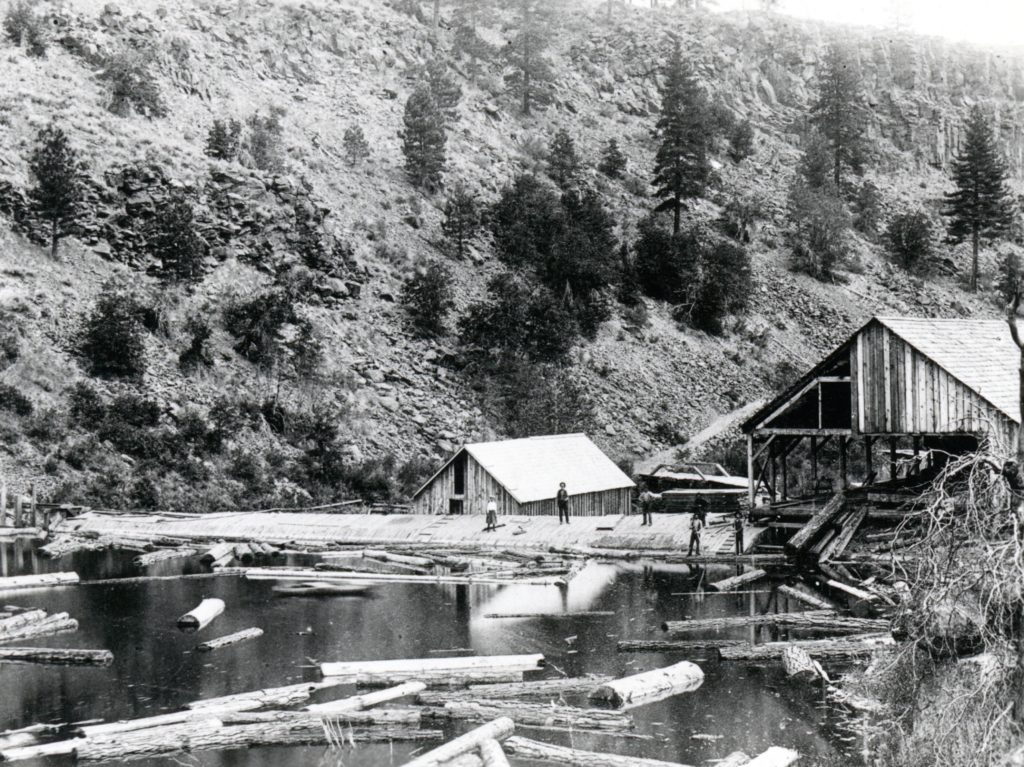
Bremner dam and sawmill, Susan River Canyon, 1891 . Courtesy of Betty Barry Deal
In April 1963, the Lassen County Historical Society issued its Bulletin 10 entitled Susanville. It included a story by Med Arnold (1885-1967) The Susanville I Knew Over Seventy Years Ago. Those not familiar with Med, he was a grandson of Susanville founder’s Isaac Roop. Susanville’s Mark Street was named for his brother. Lassen High School’s Arnold Athletic Field, was named after Med.
Med recounts the annual practice of ice-harvesting. One must remember this was before refrigerators. Med wrote: “Ice was cut on the mill pond [Bremner] just above town on the Susan River. Usually a foot and a half to two feet thick, the ice was hauled into town by sharp shod horses, and was stored in ice houses for summer use by saloons, ice cream parlors, and a few private families. Sawdust used to cover the ice, and kept it nicely from one season to the next. We did, however, have one mild winter in which no ice was harvested. The users solved this problem by hauling in snow from Diamond Mountain.”
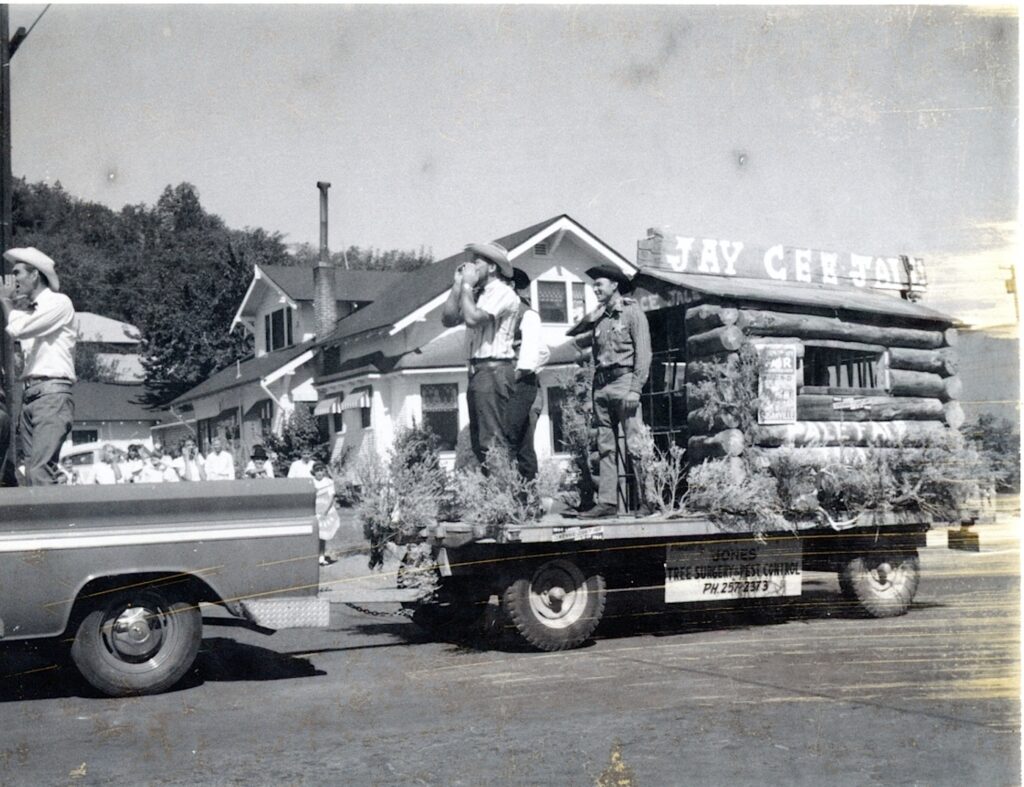
JC Lassen County Fair Parade, no date-Courtesy of Fred & Theresa Nagel
Over the holidays, Fred and Theresa Nagel shared the above photograph of Jay Cee’s parade float. In the early 1950s and to the mid 1960s there was the Susanville Junior Chamber of Commerce, hence the nickname “J.C.” It was my understanding that the members were in the 20 and 30s. It was like the reincarnation of the “20-30 Club.” It was the promotional arm of the Susanville Chamber of Commerce. One of major goals of the JC’s was to promote and organize events of Susanville Centennial of 1954. This is not be confused of centennial of the City of Susanville, but rather the centennial of when Isaac Roop settled there in 1854. It was a success. It was decided to keep the organization, and prepare for the Lassen County Centennial of 1964. After that event, the Susanville Junior Chamber of Commerce faded into oblivion .
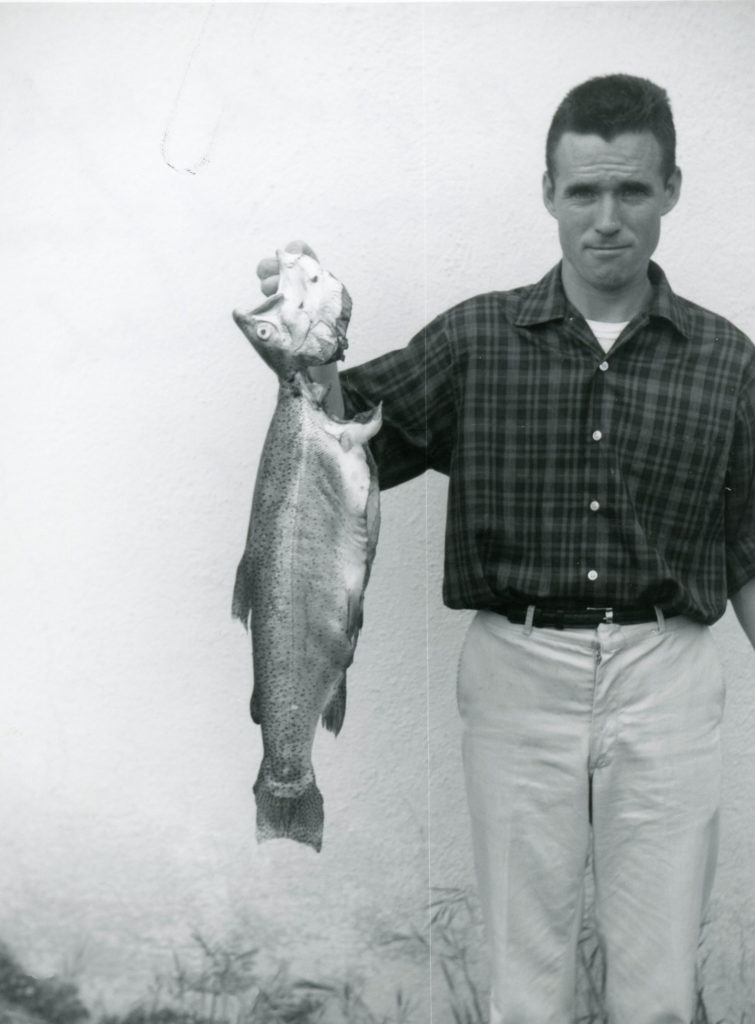
James Stokes holding “Old Lady of the Lake, a 8 pound Eagle Lake Trout caught in 1961.
It was interesting in yesterday’s post that in the. late 1800s and early 1900s Pyramid Lake Paiutes would sale Lahontan Cutthroat trout in Susanville. On the other hand it was common for the Anglo settlers during the spring of catch and haul wagon loads of Eagle Lake trout to sale on the streets of Susanville for twenty-five cents a pound. Yet, the local Native American populace did not harvest the trout like their counterparts of Pyramid Lake. This practice of harvesting Eagle Lake trout came to abrupt halt in 1917 when the State of California adopted. legislation, making it illegal to sell trout (excluding domesticated stock) from lakes and streams.
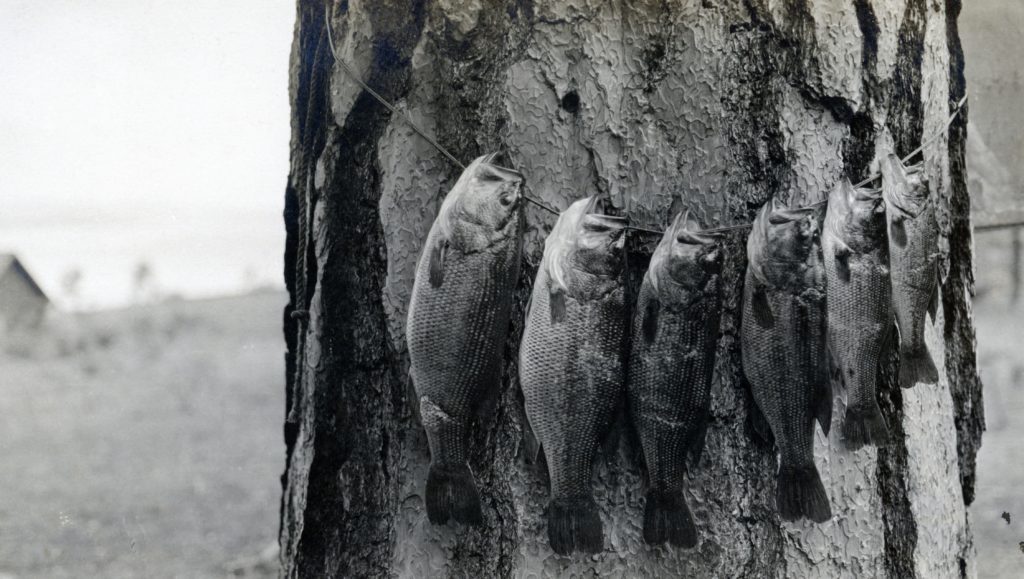
An Eagle Lake “catch,” 1916. Courtesy of Wyn Wachhorst
In the early 1900s bass were planted in Eagle Lake and they thrived. Some ambitious fishermen would from time to time would sale their bounty catches. It should be noted, that the bass population was greatly diminished and finally disappeared the lake in the 1930s. This was due in part of the lake’s water quality, with an increased alkaline content and reduction of marsh areas where the bass thrived caused by the lowering effects of Bly’s tunnel and the drought years.
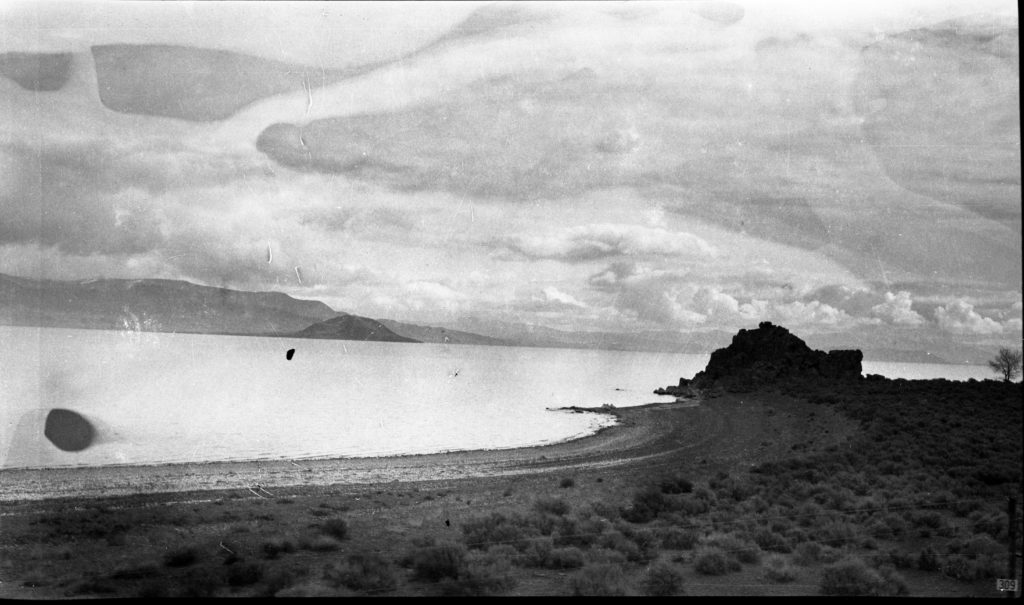
Pyramid Lake, 1915. Courtesy of the Otto Kratzer Collection.
Nevada’s Pyramid Lake is known for many things. The lake is home to the Lahontan Cutthroat Trout. In 1859, Nevada’s Silver Discovery, i.e. the Comstock, changed the landscape forever.
While the U.S. government granted the Paiute tribe Pyramid Lake and the surrounding territory into reservation. It is a stand alone story. Members of the Paiute tribe capitalized on its prized asset the Lahontan Cutthroat Trout. The fish were plentiful and trout not were only abundant, but a single fish weighing over twenty pounds was common. The enterprising Paiutes realized that there was market in Virginia City, Reno and surrounding territory. One of those markets was Susanville, and which the Lassen Advocate duly noted on May 5, 1892 5;3 – A load of Pyramid Lake trout arrived in town by a couple of Indians today and were disposed of on short notice.
The good times would not last forever. First, there was a complex beaucracy between State of Nevada and Pyramid Lake Reservation, that the former wanted protect the lake’s fishery. The. commercial fishing by the Paiutes had greatly diminished the stock. Second, the other blow was in 1902 with Newlands Project that diverted water from the Truckee River (Pyramid’s water source) to form the agricultural district of Fallon. One of the side effects was decreased inflow water to Pyramid resulting in lowering lake levels.
By 1910, Nevada authorities had legislation in place restricting commercial fishing of Pyramid. While it looked on good paper, it was not easily enforced. By the early 1920s, Pyramid Lake trout could no longer be transported out of state.
In the Honey Lake Valley that ban went largely ignored. In 1921, C.O. Fisher, was made Lassen County Fish & Game Deputy and he was to enforce the law. On January 27, 1925, Gee Hong, the proprietor of Susanville’s Republic Grill pled guilty of fish from out of season. Hong stated he purchased the Pyramid Lake trout from Indians, who are allowed to fish commercially. but he did not know they could be sold only in Nevada. Hong was fined $25.00. Fisher issued a warning that even local anglers who fished Pyramid Lake would be fined too, as well the Indians who transported them.
Local anglers were not pleased that they could not bring their catch back home from Pyramid Lake. In 1935 the local sportsmen petitioned the Lassen County Board of Supervisors to lobby the State of California Fish & Game Code Section 623 to exempt Lassen County residents from such. The petitioned stated “Whereas, a great many sportsmen in Lassen County, California, do considerable fishing in Pyramid Lake, and believe that they should have the privilege of bringing their entire catches into Lassen County, California.” The Board approved a resolution, but the State did not budge, and it would decades later before the restrictions were lifted.
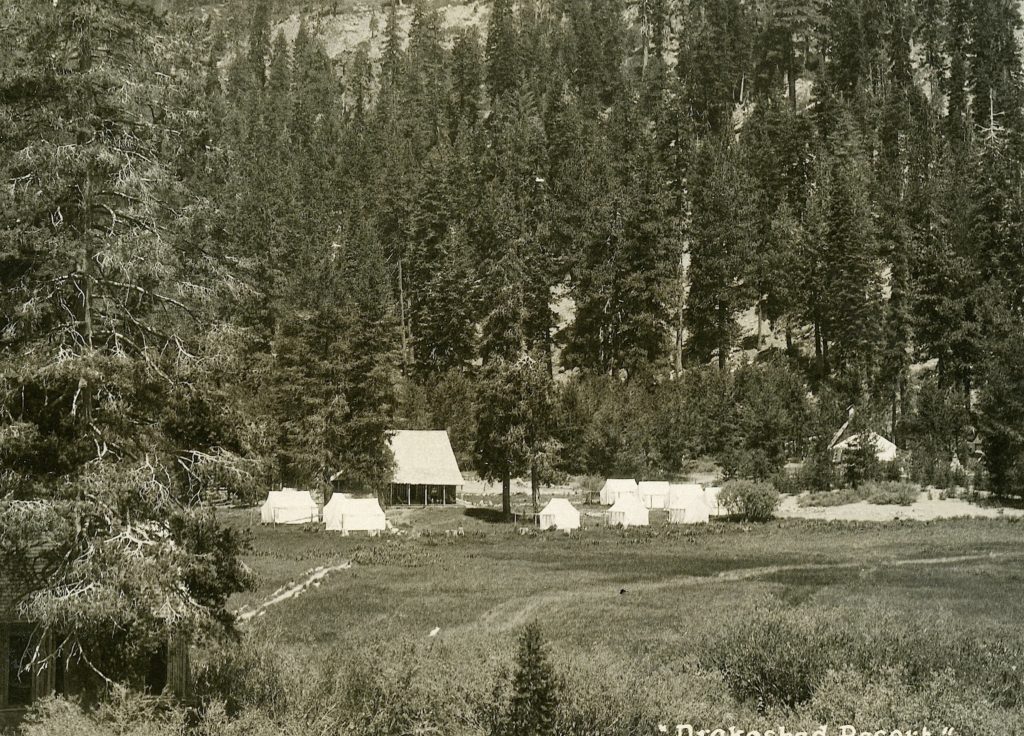
Drakesbad, circa 1930. Courtesy of the Sifford Collection
What is known as Drakesbad Guest Ranch inside of Lassen Volcanic National Park was slow to evolve to what is now. In 1900, Susanville school teacher, Alex Sifford, purchased Drakes Spring from Edward R.Drake. A decade later, Sifford was at crossroad as what to do with the summer resort. Each summer the crowds kept getting larger. If Sifford was going to continue, he would need capital and some one to assist in operations.
Sifford consulted Susanville banker Jules Alexander. Alexander was familiar with property since he was a frequent visitor to Drakes since the early 1890s. The solution was to form a corporation, sell stock and hire a manager. On January 16, 1914 Drakes Springs Company was incorporated. The principles were: Alex and Ida Sifford; Jules and Rae Alexander and Juan Brambila. the latter of whom would assume management.
The first order of business was the upgrade of the facilities for the 1914 season. This included a new dining room and kitchen, a cement pool and twenty-five campsites equipped with tents with wooden floors and canvass tops.
The original dining hall at Drakesbad. Courtesy of the Sifford Collection
For marketing purposes is decided to rename Drake’s Springs. It was Rae Alexander who came up with the new name. It was the general consensus to keep the Drake name. Mrs. Alexander’s parents were from Germany and the German word for spas and baths was bad. In it was announced the new resort was to be named Drakesbad.
The Drake’s Springs Company was a short-lived affair. It was dissolved in July 1915, with Sifford taking back the ownership.
On a quarterly basis, I ask you the reader, if there is something you would like to learn more about or maybe its something you heard, but question its validity. So here is an opportunity to participate. I will do my best to answer any questions. It should be noted, it may take awhile for the answer to appear as a post. The primary reason, many of the daily posts are done nearly a month in advance. So by the time you read this I am already working on posts for the middle of February, or at least I should be. Whatever the case may be, I look forward to hearing from you. Of course, it should be noted that paid subscribers requests receive priority. In addition, you can always send a request at any time.
I have addressed this issue before, but there was an amusing editorial comment that appeared in the Lassen Advocate of December 23, 1914. One key background of information to make sense, in the fall of 1914, a Russian colony of immigrants of some fifty families had located on the eastern portion of the Madeline Plains.
Herewith: “It would seem that the ‘pesky jack-rabbit” is doing someone good in the world after all. The Russians in the northern part of this county are using the flesh for food, and caps are made of the fur. Recently a number of Reno sportsmen killed 518 rabbits and these were given to poor families in Reno for food.”