Lassen High School Trivia

Diploma Cover

In the beginning of time, the school’s colors were not purple and gold. I know that sounds almost sacrilegious. Back in the earliest years of the school’s history, it was the seniors who chose the colors for the year.  The first graduating  class of 1907 selected the colors of green and gold and this proved popular for the next few years.  The Class of 1911 were a bit more rebellious and opted for blue and white. By the end of the decade purple and gold were adopted, and its been that way ever since.

Tim

Lassen National Forest Deer Hunting Statistics for 1935

A typical deer hunting postcard of the era

Since this end of deer season in these parts, it is fitting to examine past historic statistics. During the 1930s and 1940s, Lassen National Forest monitored the deer hunters. It was not easy task to register some 19,000 deer hunters on the Lassen. Data compiled relative to age, antlers, weight and condition of the deer, as where as the location where they killed. While there were check stations, they are also sent checkers with scales to weigh animals in the deer hunting camps.

Over 2,000 deer were killed in 1935 season on the Lassen National Forest. They consisted of 35% were forked horns; 32% had three points; 29% carried four points and the remainder 4% had five, six, seven or more points.

Tim

Boyd, Lassen County

Wendel Hot Springs, circa 1940.

Wendel has had many names over the years. In the 1860s, it was referred to as Upper Hot Springs to distinguish from the Lower Hot Springs. In 1890, when the Nevada-California-Oregon Railroad (NCO) extended its line to Amedee, the Lower Hot Springs took on the name of town established next to it. Upper Hot Springs simply became known as Hot Springs. In 1899, the NCO extended its line further north and at Hot Springs established a new station named Boyd.  When T.F. Dunaway became General Manager of the NCO in 1900, he renamed the Boyd station to Smithon. Two months later, in January 1901, he again renamed it to Hot Springs. It would be another fourteen years before the place became known as Wendel.

Tim

Levi Button-Eagle Lake’s First Resident

McClellabd’s Summer Camp at Eagle Lake, 1912-Pierce & Elburna McCleland

Eagle Lake’s first settler was.a thirty-three old New Yorker by the name of Levi Button, who recorded a claim to 160-acres on the northwestern shore on January 4, 1870. Button had resided in Lassen County since 1863, making living from prospecting and trapping. He built himself a cabin at the lake and resided there periodically until 1875. He then departed for eastern Oregon. Before leaving he remarked that the wildlife had greatly diminished due to the influx of livestock grazing on the surrounding mountains.

A number of individuals had become occupants of Button’s abandoned homestead. In a five years period, Isaac Adams, Frank Day, Samuel C. Dibble, Hiram Sewall and Daniel Cramer claimed possession of the place, but none them remained there for any length of time and failed to gain. title.

In the early 1880s, a German immigrant, Adolph Schuler took up Button’s abandoned claim. He had several improvements and secured 166-acre federal land patent. In 1885, Schuler sold the property to James D. Byers who had an extensive livestock operation in the Honey Lake Valley. Byers incorporated the property for summer grazing. Schuler worked as a ranch hand and. reminded on the property for most of his life. Byers who died in 1902, was a bachelor and he left the bulk of his estate to his nephew’s wife, Sarah McCleland. Since then, has it remained in the McClelland family.

To Support, Please Donate or Subscribe 


St. Mary’s Chapel aka Constantia Church

Constantia Church
St. Mary’s Chapel as it appeared in 1971. Courtesy of Robert Williams

Five miles south of Doyle is a place known as Constantia, though not much remains today. In 1896, Henry Butters purchased the ranch and gave the place its name of Constantia. Butters transformed the place into a small village and next to his home had a small Catholic church built—St. Mary’s Chapel.

As a child, Roberta Turritin Weaver lived at Constantia from 1913 to 1923 and recalled: “The church was beautiful with stained glass windows and the pews were made from the oak trees in back of the ranch. As long as were in the big house Father Horgan came out several times a year. We were all very fond of him. My twin sister, Catherine, and I considered him a good sport since he put up with all our didedos.”

Constantia Church, Doyle, July 12, 2021—Ronda Dockstader

By the mid-1920s services were discontinued and the church abandoned. In 1994, the Doyle Historical Society moved the church to Doyle and restored the building.

Tim

Ask Tim

Honey Lake Regatta, 1987

On a quarterly basis, I ask you the reader, if there is something you would like to learn more about or maybe its something you heard, but question its validity. So here is an opportunity to participate. I will do my best to answer any questions. It should be noted, it may take awhile for the answer to appear as a post. The primary reason, many of the daily posts are done nearly a month in advance. So by the time you read this I am already working on posts for the middle of November, or at least I should be. Whatever the case may be, I look forward to hearing from you. Of course, it should be noted that paid subscribers requests receive priority. In addition, you can always send a request at any time.

Tim

Nataqua versus Mahala

A gathering of Maidu women at Johnstonville, 1900

On April 26, 1856, twenty settlers in the Honey Lake Valley gathered at Isaac Roop’s Trading Post and held a “mass convention” to establish a territory of their own. They named their new republic Nataqua.  It was purported that the name was a Paiute word for woman. That claim is rather dubious. Nataqua Territory was a short lived affair, and it was soon replaced  with the Sierra Nevada Territory.

Locally, the Anglos used term Mahala for designation of Native American women. A number of these women worked as domestics such cleaning and washing. Willow Creek Valley resident Abe Tunison for instance wrote in his diary on May 28, 1877 “A Mahala was here and washed.”

During the late 1800s’ the term squaw was used infrequently and usually derogatory manner, i.e, there are many newspaper citations  of a “drunken squaw.”

Tim


Lassen County Farm Bureau Reports

Sunflower demonstration on the A.F. Babcock Ranch, Bieber, 1923. This appeared in one of those reports.

The records salvaged from dumpster dives cover a wide variety of topics. One of those were the Lassen County Horticultural Reports filed annually dating back to the late 1880s. This would later be superseded with the Lassen County Farm Advisor Reports. In the 1920s, nearly every Lassen County agricultural community had a farm bureau. It was the farm advisor’s many duties ro assist each one of the bureaus and would compile all the data collected in an annual report. These reports were meticulous in the information they provide. In certain instances, they included photographs of various demonstrations and/or experiments, such as today’s featured photograph.

Tim

A Mystery Solved

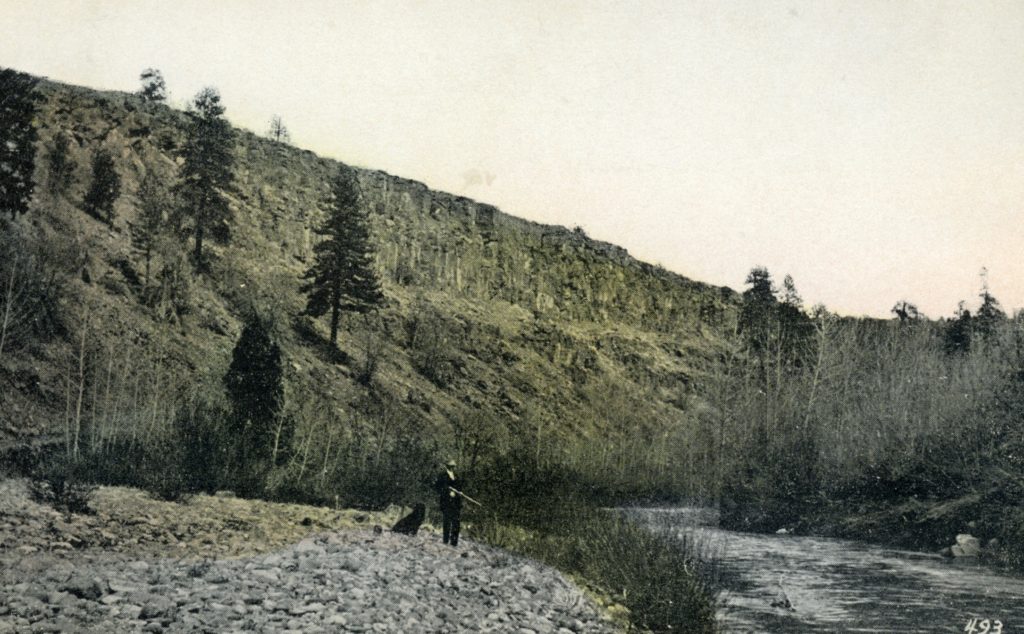
Robbers Creek, 1918, I do not think its near Susanville.

A few years back, I published this photograph. However, I could never figure out the location. Now, I know. It is crossing of Robbers Creek to the north of Westwood. Since this is some twenty miles away from Susanville, in my opinion, I do not consider that near. The photographer named Engel, who I admire his work. took some winter scenes at Westwood in1918, and instead of giving the location of that lumber town, Engel, as he did in the above photograph affixed the label “near Susanville.”  I will be including a Westwood photograph by Engel in the 2025 Calendar.

Main Street, Susanville, 1918.

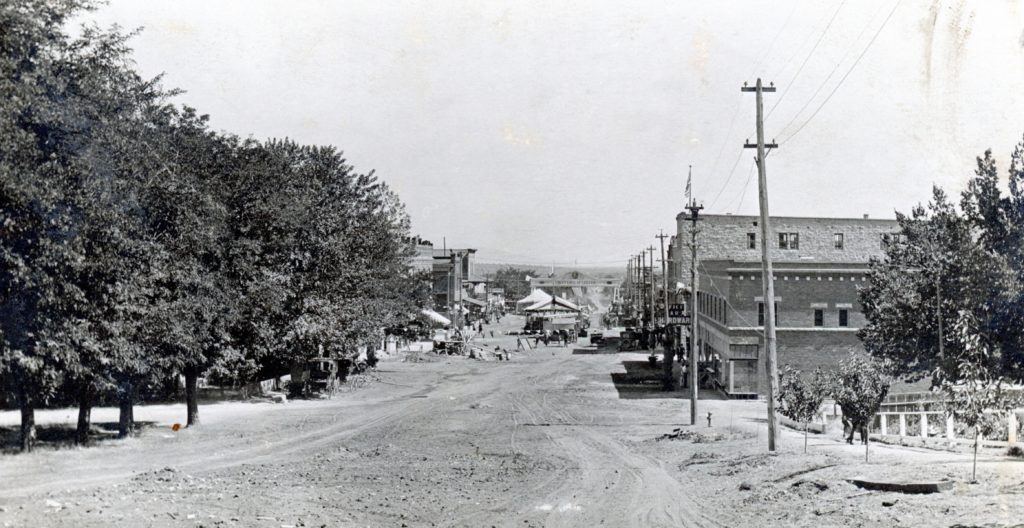
Here is a Engel photograph of Susanville.

Tim

The Standish Creamery – A Refresher

Standish Creamery—Dorothy Story

In the past, I have written snippets about the Standish Creamery, so now a complete version. In 1898, Standish was founded as a utopian community based on the belief of Myles Standish. In beginning all worked well. By 1901, the Associated Colonies of New York, backers of Standish filed for bankruptcy. With that entity removed it allowed the community to grow without the former’s restrictions.

In 1901, Buntingville merchant Mike Phillips relocated from the west side of the Honey Lake Valley to Standish. One of his many enterprises at Standish was the establishment of a creamery. In 1904, Phillips for unknown reasons sold his various businesses there and moved to Reno. Susanville businessman, Charlie Emerson bought the creamery

In 1916, Emerson boasted that his creamery had the only pasteurized milk in Lassen County. It should be duly noted that California State Law required all milk to be pasteurized.

In 1929, the creamery was destroyed by fire and not rebuilt.

Subscribe


Exploring Lassen County's Past