Those Hanging Judges

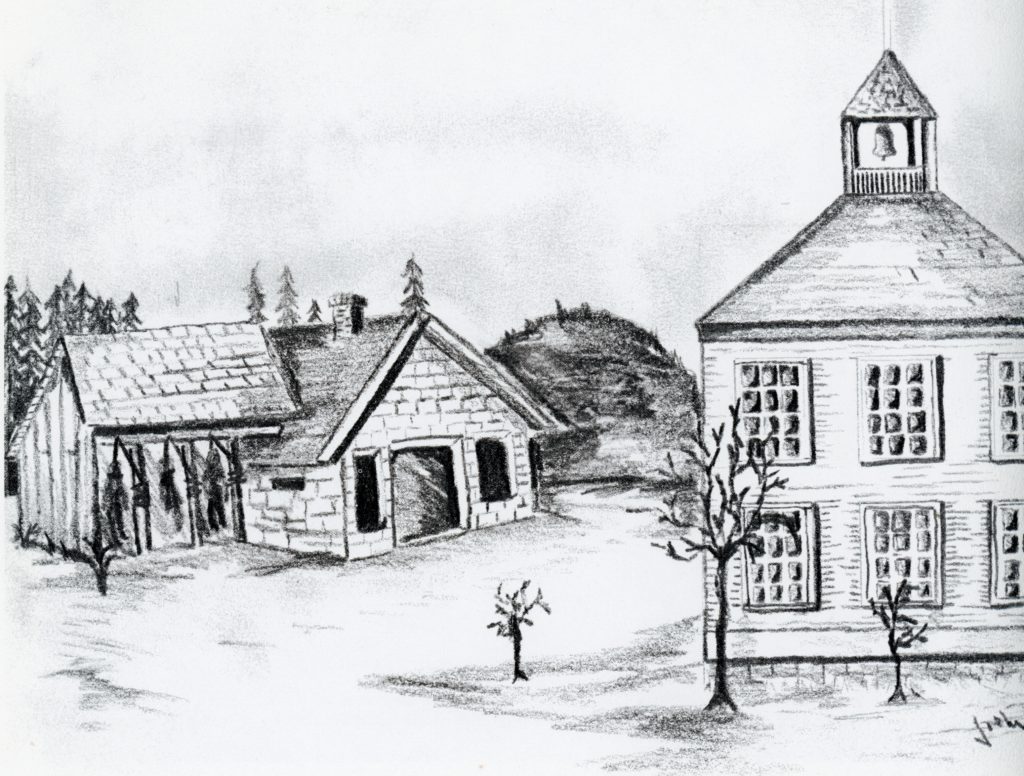
An artist sketch of the lynching of the 1886 Holden Dick and Mexican Ben in the stable behind the original Lassen County Courthouse.

This title should grab a few reader’s attention. While Lassen judges did sentence criminal murder defendants to a death sentence, those people were sent to a state prison facility where the execution was done. There were two instances in 1800s where vigilantes took matters into their own hands. I do recall personally an instance on the other extreme, whereby a justice court judge. instead of sentencing a misdemeanor criminal charged,  used the sunset clause. Those not familiar, the said person instead going to jail, was told to leave the county by sun down and never return.

Actually, this is post is about how the Lassen County Superior Court Judge’s portraits came to be. First, it should be noted that in 1879, California voters approved a new state constitution that revamped many governments functions. The District Court system was abolished and replaced with the Superior Court we have today.

In 1936, Ben V. Curler was elected Lassen County Superior Judge, a position he held until he retired on September 14, 1964. A side line project of Curler’s was to locate photographs of the previous superior court judges dating back to J.W. Hendrick who served as the first judge in 1880. At Curler’s own expense he had prints made, framed and then hung in the courtroom–however Judge Masillon Marstellar’s portrait was elusive. (Marstellar served from 1884-1890). As the story goes when the courtroom was repainted during the late 1960s, the portraits were carefully wrapped, stored in the basement and forgotten.

Enter Nataqua Parlor #152 of the Native Daughters of the Golden West. For the United States 1976 Bicentennial project Native Daughters, with Elberta Fraley at the helm, took on the task to have the portraits restored, rehung and updated to include portraits of Ben Curler, Judge Stanley Arnold and Judge Arthur Anderson. In 1978, a portrait of Judge Marstellar was located and subsequently added.
To Support, Donate or Subscribe 

Lassen’s Unusual Commuter Train

Courtesy of David B. Martin

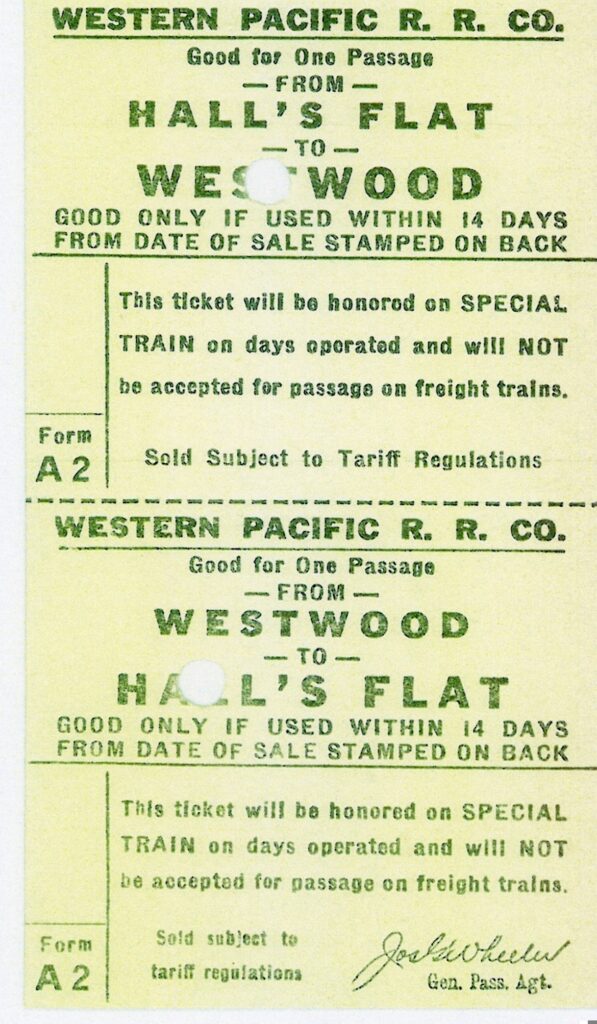
In 1942, Red River Lumber Company’s tributary timber was nearly exhausted. The company was forced to go north some thirty miles to the Poison Lake country. At Hall’s Flat they established Camp Bunyan and the Harvey Railroad Logging line.

One of many obstacles Red River encountered with this expansion, how to get the loggers to work. The highway system, especially for this region was non-existent. There was Western Pacific Railroad’s Northern California Extension that went from Keddie, through Westwood and north to Bieber. It also dissected Halls Flat. In the past, Red River was able to haul logs to its mill on its own private railroad logging network. The same was true in providing transportation for loggers to the camps.

This was a game changer. Red River had to negotiate with Western Pacific on two fronts. First Red River had to contract with Western Pacific to haul logs from Halls Flat to the Westwood mill. It should be noted that Fruit Growers had to do the same with Southern Pacific to haul their logs from Westwood Junction to its Susanville mill.

Transporting the loggers to and from, resulted in a special commuter train dubbed the Paul Bunyan Express.  This special train was not available to the public, nor does it appear on its timetables.  It does explain why Halls Flat had a railroad depot, unusual for a remote location, especially in the 1940s.

In 1949, the Paul Bunyan Express ceased to exist when the Harvey Railroad logging line shut down.

To Support, Please Donate or Subscribe


Some One’s Profitable Dumpster Dive

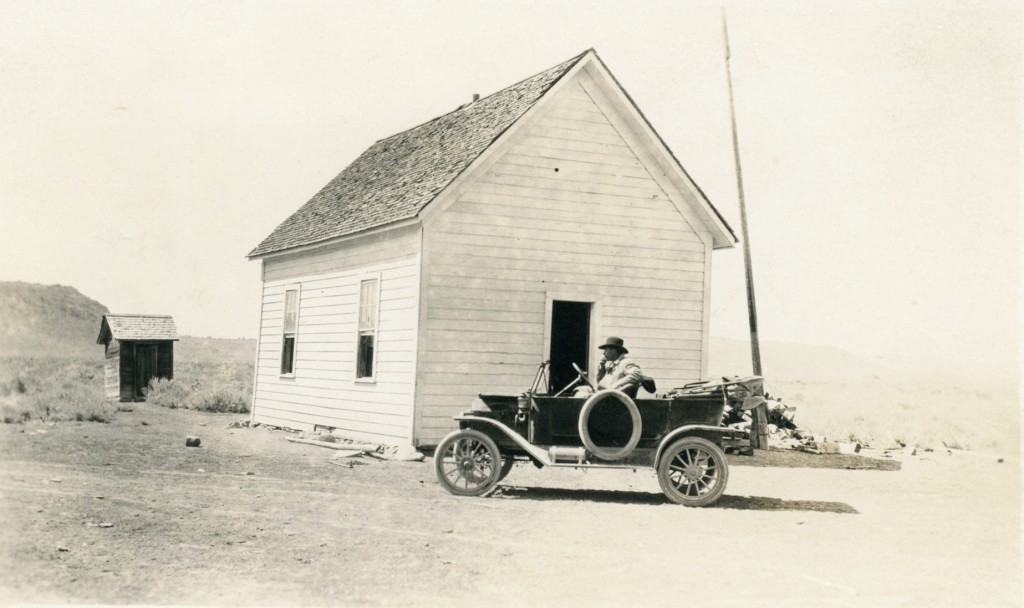
Dry Valley School
Dry Valley School, 1916. Courtesy of D.M. Durst Collection

In 1987, the Lassen County Superintendent of School’s office relocated from the old Roosevelt School in Susanville to the former Eagle Lake Ranger District’s Office of the Lassen National Forest near the Susanville airport. As the case may be, in moving process items are known to get tossed.

Some interesting old photographs and albums were tossed. Among those was an a collection of nearly fifty photographs of rural Lassen County schools. They were taken in 1916, by Prof. D.M. Durst, Principal of Lassen High School. For a number of the schools, this is the only photograph record of the buildings. At this time, the county allowed individuals to salvage at the Bass Hill Landfill. A man approached me with the Durst photographs that he salvaged from the dump. After some negotiations I paid him sixty dollars for them. A couple days later he contacted me again, as he as had some old 1920s photograph albums related to the Susanville Rotary Club. His asking price was too much for my limited means. I learned later that he did find a buyer.

Tim


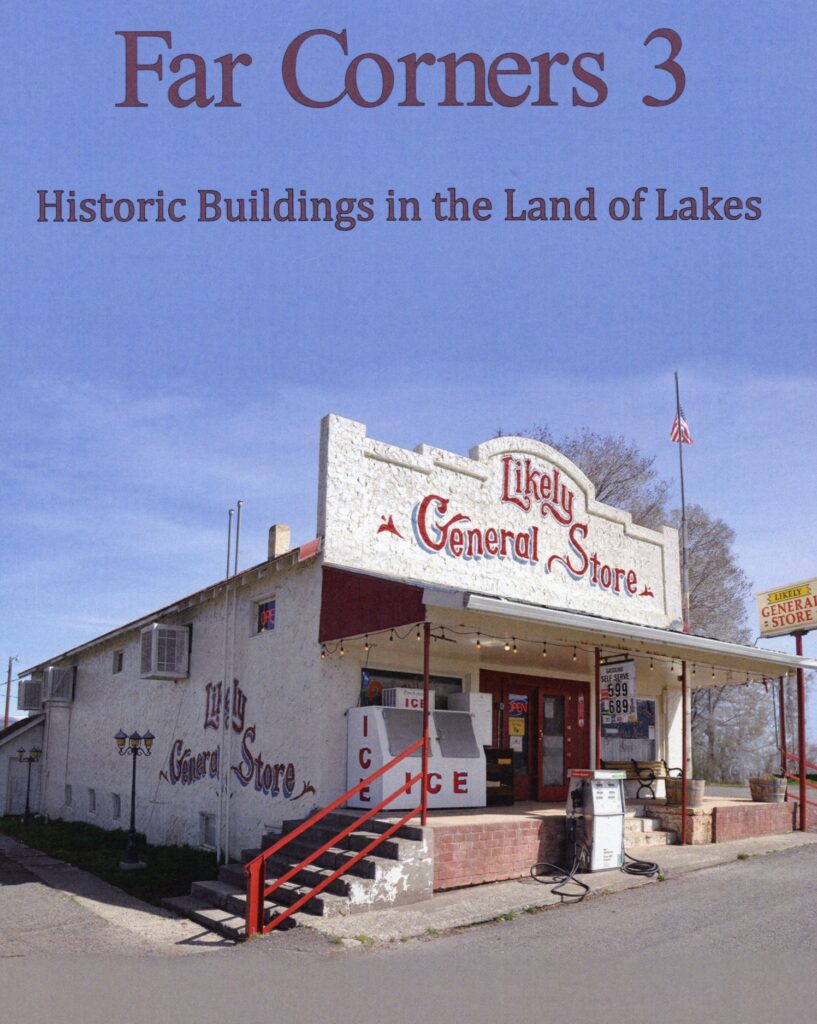
Shaw Library Presents: Historic Buildings in the Land of Lakes

Historic Buildings in the Land of Lakes is the latest annual publication of the Shaw Historical Library.  If you are not familiar with these publications they are quality books in both content and production.
I have not had an opportunity to read my copy yet, since I busy preparing the 2025 Calendar for production. Locally there is a wide range of historic buildings from the Constantia Church to the St. Francis Hotel. The book casts a wide net of structures that will delight many from the Adin Supply Store, the Alturas Depot and one my favorite off beaten path places, Camp McGarry.

Copies of “Historic Buildings” can be purchased in Susanville at Margie’s Book Nook or by contacting the Shaw Historical Library by email at shawlib@oit.edu or by calling 541-885-1686.

Tim

Gratitude Day – Frank Satica & Company

McKissick’s frieght team near Wendel, November 26, 1906. Courtesy of Katie Penning French

Today is World Gratitude Day. When I first began my research, I had no idea that it would be a life long journey. There are some folks from my earliest days, that I want to thank posthumously. First. there was Frank Satica (1922-1982) who started it all. I admit when growing up, I was very naive and believed everything. I was told. When Frank told me the tale that the World’s First Champion Cowboy (John Best McKissick) was buried at Secret Valley some thirty miles northeast of Susanville, I did not believe him. One would think that a person of that notoriety would be common knowledge. My journey began as a novice researcher, who knew almost nothing how to locate this type of information. After all this was  pre-internet days. The first person I contacted was Abe Jensen, a former Lassen County Fair Manager and for whom Jensen Hall is named for. Abe knew about the McKissick story and gave me names of other people that were more knowledgeable. One of those folks was Merlyn “Mul” Mulroney who opened my world to other interesting events of the region. If you are wondering, yes it is true about McKissick.  He won the title at the Centennial World Exposition in 1876 that was held in Philadelphia.

Finally, I want to give a shout out to Tandy Bozeman, and Michael, too. Tandy put together my first website and then in 2015, this one. Tandy is aware that I am technology challenged, so he is always there to give a lending hand. Sometimes, its calls for reinforcement and his son-in-law, Michael steps in for the task at hand. Thank you so much.

Tim

T.B. Walker Visits Westwood

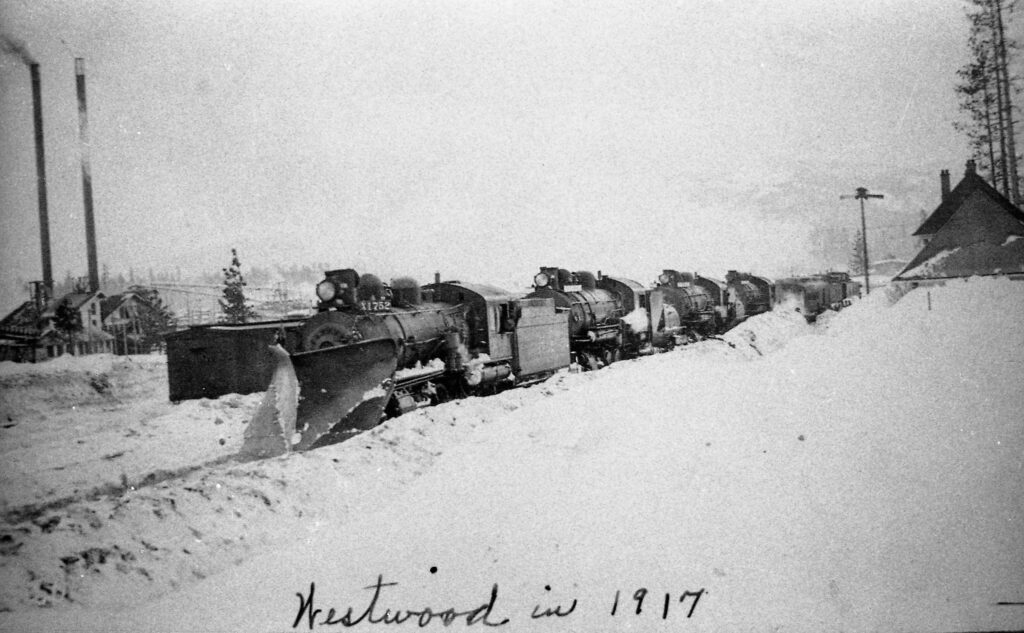
Westwood, 1917–Marge C. Foster

T.B. Walker spent the winter and early spring of 1913 at San Francisco to monitor the progress of the construction of the mill and the future company town of Westwood. Not all was going well. Not only his son Clinton was adamant that Mountain Meadows was not the right place for the mill,  contractor in charge agreed as well.

In the spring T.B. Walker was ready to return home to Minneapolis. He wanted to visit Westwood, but had to decline. He could not travel there via Susanville, since there was a movement on foot to relocate the mill. The other option was take the Western Pacific train via the Feather River Canyon. Walker had a fear of that canyon,  that he could get caught in a rock slide.

It was not until the summer of 1917 that Walker made the trip. He had a special guest, John Andrus. Andrus was a New York investor who help finance T.B.’s acquisition of Northern California timberland. They formed the Waland Lumber Company with the intent to build a sawmill in their holdings.  Andrus had never seen these holdings, thus Walker’s invite. On July 7, the entourage arrived in Westwood. It was a low key affair and most the time was spent touring the Northern California properties.

Subscribe


The Grizzly Name Continues On

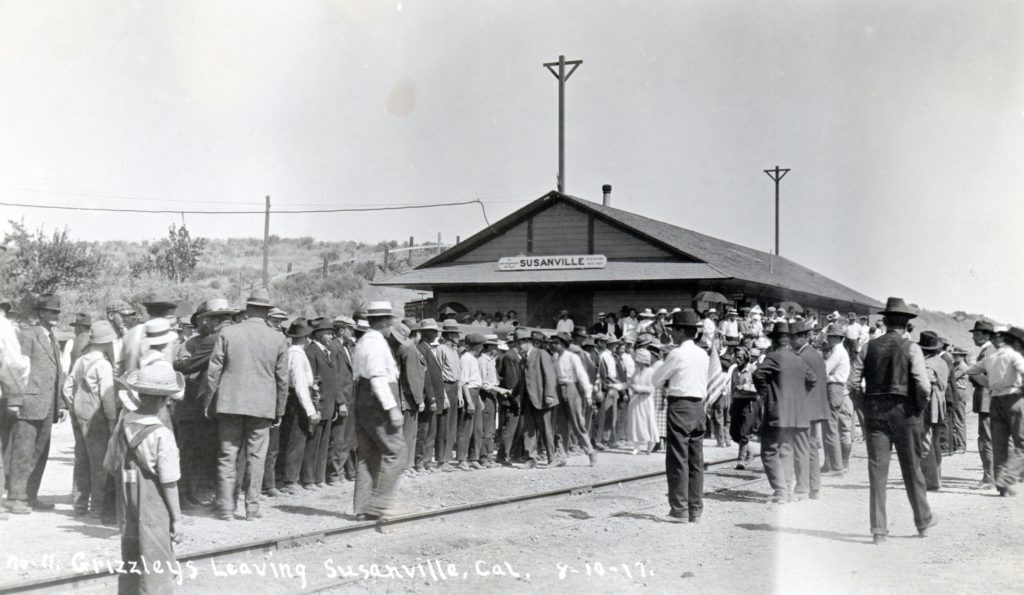
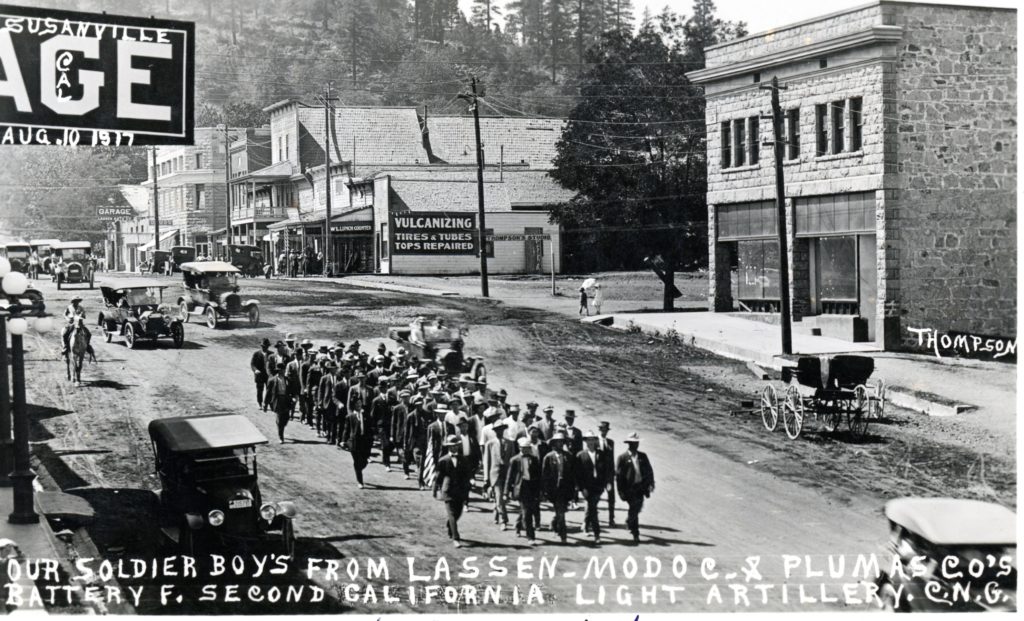
The parade, August 10, 1917. D.M. Durst Collection

While there are no longer grizzly bears in Lassen County, locally the name was a applied to a World War I infantry unit, and the Lassen High School adopted the grizzly as its mascot in 1929.

On April 6, 1917, the United States declared war on Germany and marked its entry into World War I. It was something that President Woodrow Wilson had attempted to avoid for two years. An all effort began seeking volunteers to fight in the war. On August 10, 1917, sixty-five men from Lassen, Modoc and Plumas Counties gathered at Susanville’s Methodist Church for roll call as members of Battery F, Second Light Artillery Division. Afterwards, Susanville’s businesses closed in observance, and the volunteers marched down Main Street, and onwards to the railroad depot on Richmond Road. It was in many ways a solemn occasion. This initial group were dubbed the “grizzlies,” who originated the monicker is not known.

The send off of the first recruits of World War I from Lassen and Modoc Counties at the Susanville Depot. Courtesy of Lola L. Tanner

Tim


Those Darned Grizzly Bears

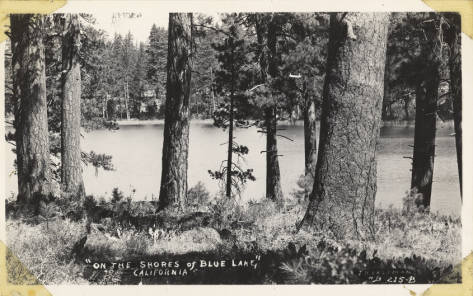
Blue Lake, 1936

Yes, that is correct the grizzly bears once roamed the region, albeit briefly with the settlement of the region. In August 1873, at Devil’s Corral, Morgan Williams spotted one such bear. Further north, in 1878 the grizzlies were problematic for sheep men. In June 1878, J.J. Board spotted four such bears, that killed fourteen of his sheep. In retaliation, Bogard killed three grizzly bears. Finally, the last documentation of grizzly bears in Lassen County occurred in 1879. This happened in far northeastern Lassen County, in the Warner Mountains. In September, George Powers killed a grizzly weighing over 800 pounds at Blue Lake.

Tim


Where The Antelope Roam . . .

A herd of antelope near Secret Valley, 1938.

When I pulled my Lassen County Wildlife file, I realized there were a bevy topics that I thought of  be interest. There subjects of which have never published. Take for instance the Grizzly bears in the region of the 1870s. The Pyramid Lake trout was a local hot issue during the 1930s. Did you know that in 1909 the ring-necked pheasant was introduced in the Honey Lake Valley? The next several months we will explore. those topics and much more.

Tim

Exploring Lassen County's Past