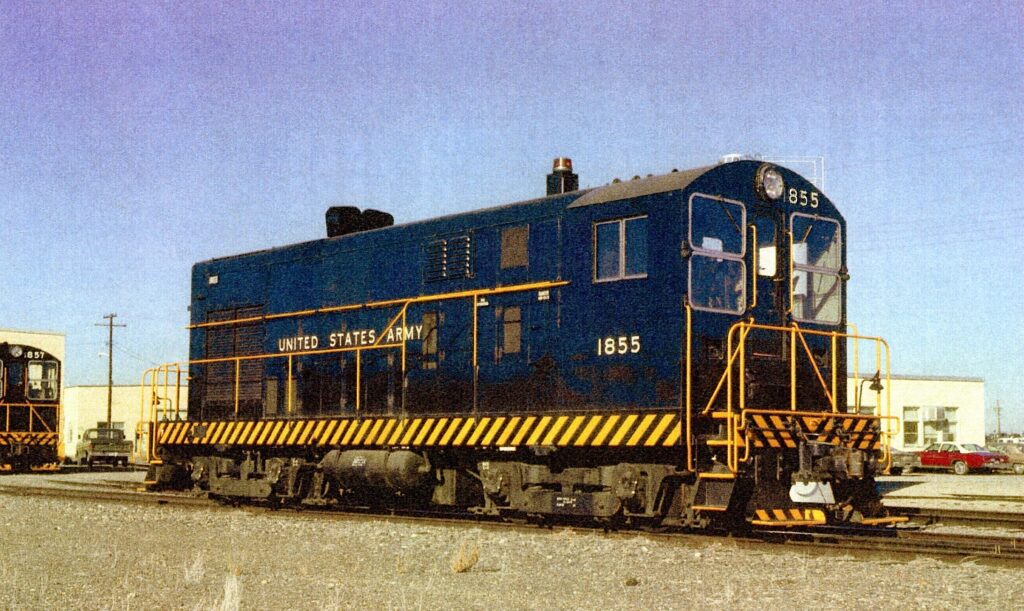
One of three FM locomotives at Sierra Army Depot, 1976-Courtesy of David Lustig, the photographer, published inTrains magazine in October 2024 and David Martin who copied the article and sent it to me.
Note: This is work in progress. It is hoped that when this is posted, some one may come forward with additional information.
The Fairbanks Morse Switcher Locomotives were a rare breed. There were only 336 manufactured between 1950-1961. The Sierra Army Depot, at Herlong, had three. In 1976, the Sierra base railroad operated five days week from 7:30 a.m. to 1:30 p.m. The main purposes were to shuffle cars arriving from the Western Pacific which could range anywhere from two to ninety. I do not know when the depot acquired these locomotives, nor when they were discontinued by the depot..
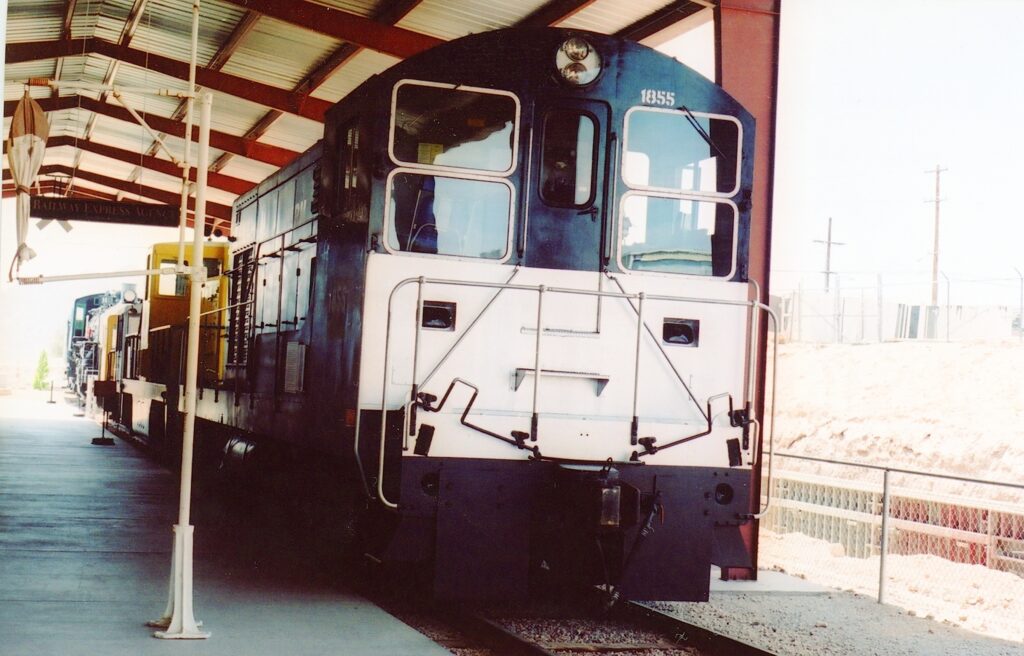
The No. 1855, as seen above is now at the Nevada State Railroad Museum at Boulder City, Nevada. The No. 1857, is part of the collection of the Western Pacific Railroad Museum at nearby Portola, California.
The FM Switcher 1855 now at Nevada State Railroad Museum, Boulder City, Nevada, May 2013. Photograph by David Martin
Hopefully, with this article will flush out other information.
It is official that iconic Susanville Elk’s Lodge is up for sale. If the new owner wants to convert it a residence, that it once was, I do have some information on the matter. In 1908, J. Henry & Annie Swain purchased the building and they moved their family there. It needed a lot of work, since a portion of it was never finished. Improvements were made to the six bedroom house, that would featured not one, but two bathrooms which was unheard at the time.
Top floor sketch by Frances Swain
For years, I corresponded with Frances Swain who grew up in the house. She provided me with sketches of the layout and that I thought some may be interested in.
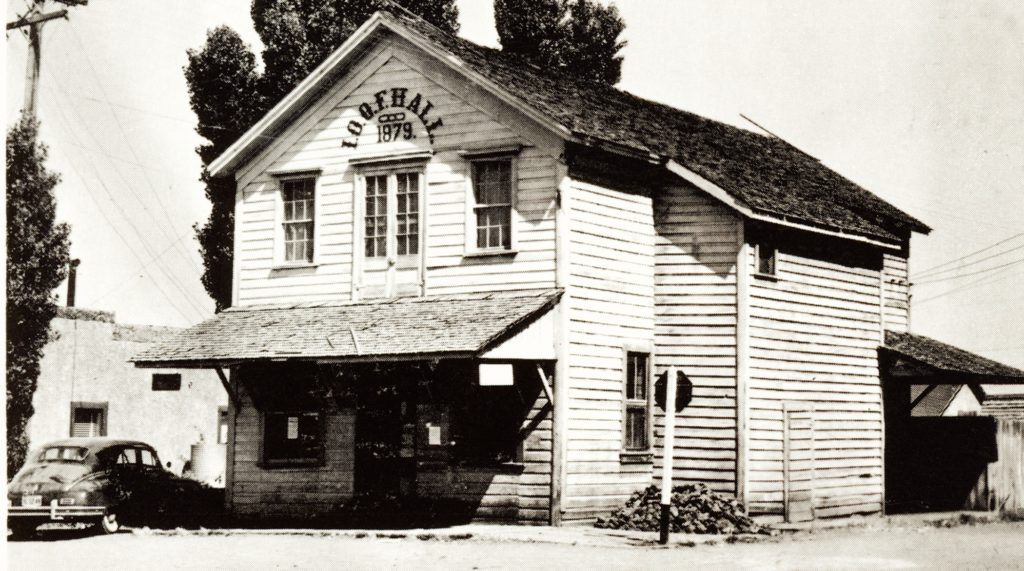
On September 27, 1879 the Big Valley Lodge No. 286 of the Independent Order of Odd Fellows was instituted. It should be noted that in the summer a handful of Odd Fellows under the direction of Clinton “Doc” Philliber constructed the two-story hall in Bieber. It was completed on August 1, 1879. On August 16, 1879, the Odd Fellows, even though not officially organized leased the first floor to the Brownell Brothers-Don Carlos, DeWitt and Duane-who opened a general merchandise store on the premise.
On Saturday, September 28, 1929, the Bieber Lodge celebrated its fiftieth anniversary in style. It was a truly community event. At noon there were was a picnic and reception. In the evening the lodge was packed to capacity by resident and visiting members. There was a special guest of honor-D.R. Brownell from Umatilla, Oregon. Brownell who was the only living charter member and just so happened the lodge’s first noble grand. That evening he presided over the meeting.
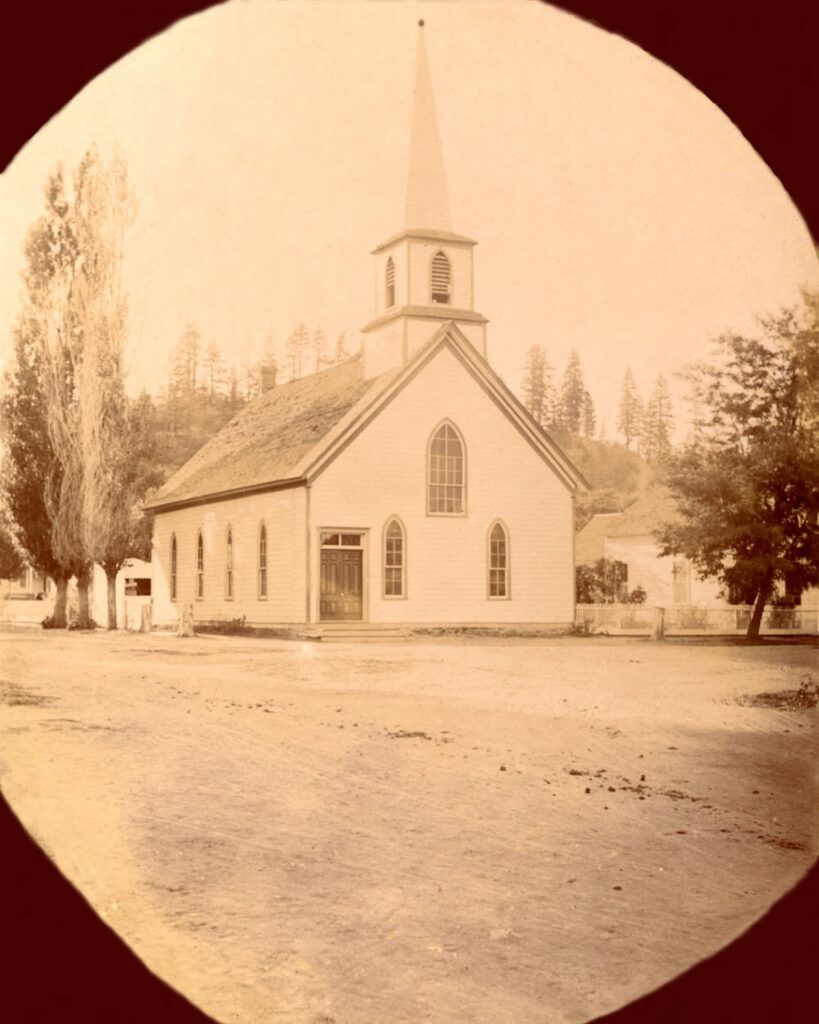
Methodist Church, Susanville, circa 1895-Courtesy of Meriam Library, California State University ,Chico
This photograph I came across in the Special Collections, Meriam Library, California State University, Chico. It was mislabeled as a Catholic Church. I informed them that it was not, that it was the Methodist Church. Lo and behold to my amazement they corrected it. Most institutions and professionals just ignore my input, especially archeologist because they can get away with a lot of atrocities since their work is hidden from public view. Oh well, so much for my editorial.
The original Methodist Church was located on the corner of Cottage and Lassen Streets, where the present church stands today. In the fall of 1875 the Reverend Warren Nims announced his intention to build a church in the following spring. Work on the structure was sporadic. On June 23, 1877, the Lassen Advocate reported: “The bell is already hung in the tower of the new M.E. Church. It is a real tony bell, its reverberations are heard for miles around. Our town is gradually taking on city airs.” Work was rushed to completion and it was dedicated in September 1877. On June 6, 1900 three blocks of Susanville’s business district was destroyed by fire, including the Methodist Church.
In the spring of 1914, Lassen County Deputy Horticural Commissioner, L.W. Boggs, paid the community of Doyle a visit. George Thompson had planted 1,000 grape vines the previous year. Thompson informed Boggs that he intended to plant 4,000 grape vines for 1914. His neighbors were interested in doing the same. In addition to Thompson’s visit Boggs complimented the citizens of Doyle for grading the town’s streets and planting shade trees along them.
The following year the Sunnyside District near Janesville was promoted as an excellent wine producing region. There were no takers. In the meantime, Thompson’s grape vines did not work out. However, Ben Gibson of Litchfield was successful in growing commercial Concord grapes and more notably watermelons.
Main Street, Susanville, October 1924—Boyd Benham/Connie Boomer
This anonymous piece appeared in the Lassen Advocate in 1924. I think it is timeless. What do you think?
“Is Susanville Different.” – When it comes to some needed civic improvement we often hear the expression ‘our town is different, it can’t be done.’ Then someone ventures that ‘there will be some funerals here before we can get this and that done.’
“Now the truth of the matter is, our town is no different from any other, unless, indeed, it is after all better than most towns. Human nature is same everywhere, and we are all human. What we should remember is this; our town is not different , because other towns have the same troubles as we do in bringing public opinion to the. point of civic action. Individual minds move faster than the entire body of people. Opinions differ even as to methods granting that it is mutually agreed as to the necessity for certain developments. After all, the campaign is wholesome. Time usually brings about the happy medium between conservative backwardness and on the other hand the headlong optimism on the other. Susanville will have all she needs-better streets, tree plantings, parks, playgrounds, better traffic regulations and other other community aspirations fulfilled if we will all buckle on the armor of civic righteousness and quit trying to excuse ourselves with word on thought that ‘our town is different, it can’t be done.’
“And as to necessity for a few funerals-we can not agree with that, neither can the so common expression be other than deplored. Instead of a few funerals, we would suggest a few births of civic interest on the part of a greater number of people who have so long stood on the side lines and watched a few of the community boosters carry all the load.”
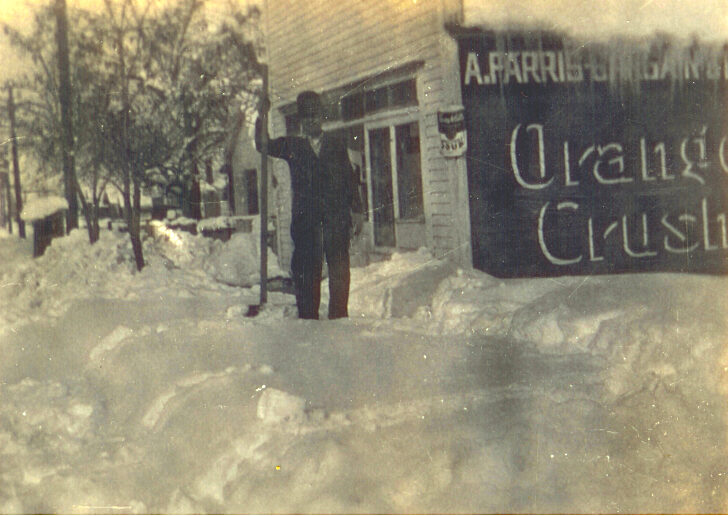
Abraham Farris in front of his store, 1937. Courtesy of Calvin Farris
The Lassen Townsite Company, incorporated in1912, was and still is Susanville’s largest subdivision. A topic for a future post. However, Lassen Townsite is a focal point on today’s topic.
In September 1912, Abraham Farris, who was operating a store in Clio, Plumas County, paid Susanville a visit to relocate. He liked what he saw and made arrangements to move. The Lassen Advocate duly noted, “Mr. Farris impresses us as a man of enterprise and business ability, and as one who will do his share in the up building of Susanville.”
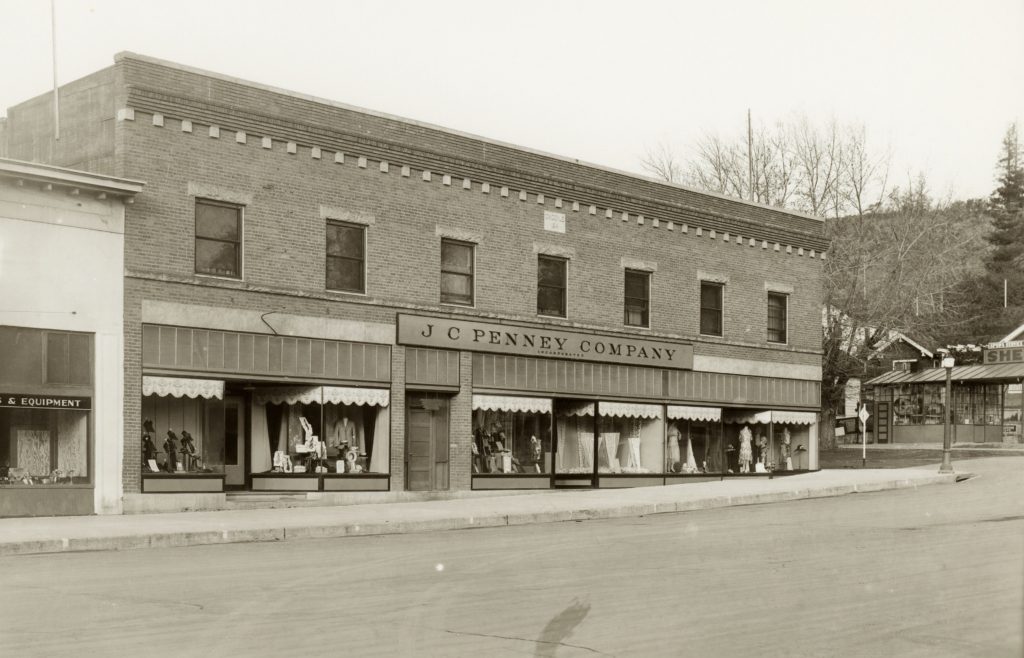
The Del Mar Building, 1937—Jere Baker
Farris, set up shop on the southeast corner of Main and Roop Streets, in the vacant Moody Drug Store building. All went well in the beginning until the owner of the property, O.M. Doyle evicted him in February 1914.. Doyle had plans for the property and in late March ground breaking began for the erection of a two-story brick building on the lot. Seasoned Susanville residents will know the property as the Del Mar.
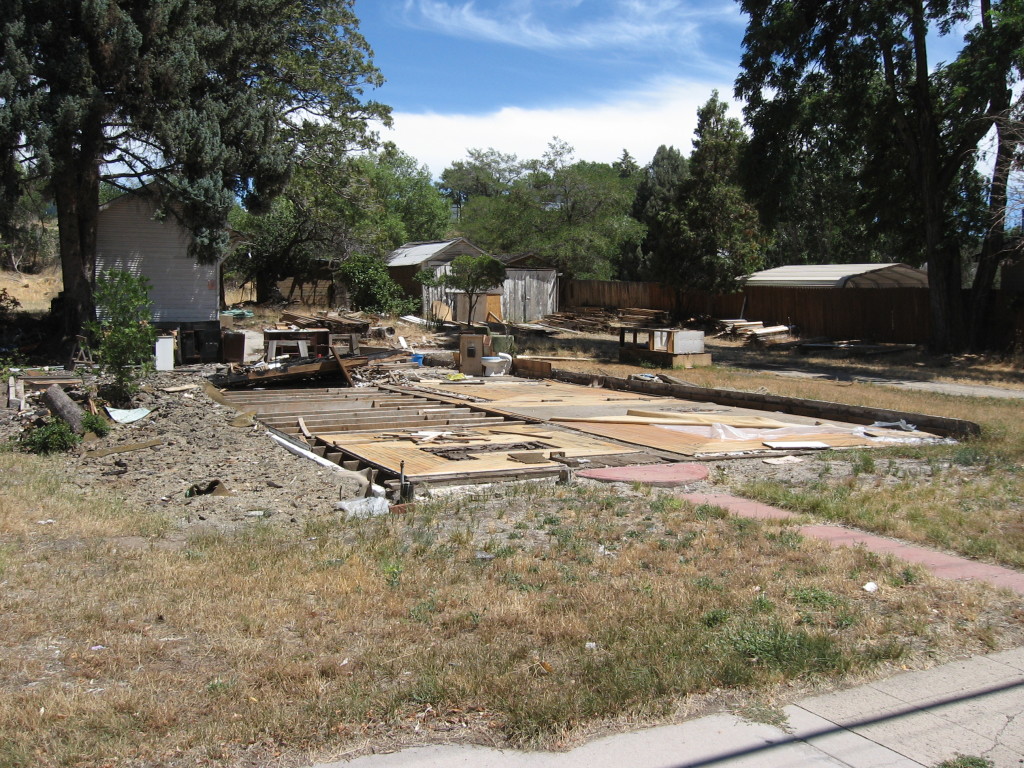
The business district was booming with the advent of the railroad, and Farris could not find a suitable location. He opted to purchase property in the Lassen Townsite on Richmond Road. Yet, this was problematic. Lassen Townsite was owned by several influential Susanville businessmen. They limited commercial development near the depot and it would be kept to a minimum, mainly for businesses affiliated with rail services. To get around this predicament, Farris hired contractor Louis Dimon to build him a house large enough for his family, but with enough space to carry a large stock of merchandise. The store operated until his death in April 1940. In 1942, the store front was remodeled. The building it should be noted burned down in 2013.
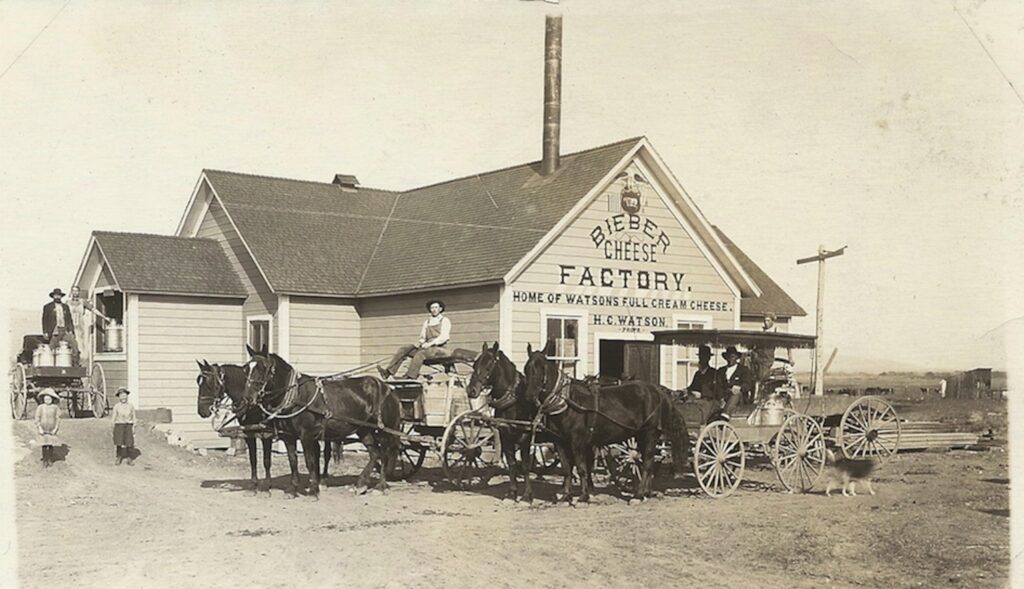
H.C. Watson’s Bieber Cheese Factory. Courtesy of the Big Valley Museum
In 1889, H.C. Watson tried his hand in dairy operation north of Lookout, Modoc County. In the beginning all went well, In the summer it was doomed, due to lack of water and feed.
In 1902, Watson entered the dairy trade again. This time around, he was affiliated with several cheese factories in Modoc County under the name of Mountain Valleys Dairy Products. Watson established the Bieber Cheese Factory. In time, Watson would acquire cheese/creameries at Alturas, Lake City and Cedarville. Watson would sale Lake City and Cedarville operations to Vincil Coppedge. In 1928, Coppedge married Watston’s daughter, Mildred In 1942, Coppedge purchased the Alturas Creamery and he renamed it Mountain Lily Dairy. In September 1944, Watson sold the Bieber Cheese Factory to Vince l Coppedge, Watson died a year a later, and it is my understanding during this time frame the Bieber Cheese Factory was destroyed by fire.
An interesting anecdote of the operation was relayed to me by Orville Watkins. He stated the catfish grew nice and fat in the Pit River at Bieber thanks to Watson-the excess whey that cheese factory produced was disposed by dumping it into the river.
What does Colgate toothpaste and the former railroad community of Wendel have in common? Not much, but a lot.
This is one of those quirky tales that involves an interesting inquiry, those I have numerous to draw from. Certain instances such questions can be rather confusing, because the person making such an inquiry is actually clue less of the topic.
In 1992, I received a call from Germany. The caller was attempting to make some initial plans for her boss to visit Wendel, Lassen County. Some of the questions left me perplexed. The first, I could handle question about the nearest international airport, though caller seemed dismayed that Wendel did not have one. The next question, I knew I was entering the “twilight light zone” wanting to make hotel arrangements at the Holiday Inn in Wendel.
Wendel Store, circa 1925. Courtesy of Alda Riesenman
In due time, I was connected to the inquirer-in-chief, Armin de Wendel. He is a part of the Colgate family The family were quite successful with their toothpaste enterprise and were prominent in New York City society. The family were acquainted with the Morans, also New York City residents, and the owners the Nevada-California-Oregon Railway. The Morans persuaded the Wendels into becoming major bondholders for the NCO. The Moran’s in turn honored the family naming a railroad station after them.
When I explained to Armin Wendel the realities, that Wendel was not thriving metropolis he envisioned, and after he received my photographs, he soon lost interest and cancelled travel plans to Wendel.
In today’s marketing world one of the most used terms is “brand.” However, the agricultural community, brands are more than a marketing gimmick.
One would not think a lumber company would have a brand for livestock. When Red River first set up shop in Mountain Meadows, Fletcher Walker’s goal that the entire operation would be self sufficient, as possible with certain limitations. It was an admirable goal.
Initially, Red River needed horses for logging, which they did not completely phase out until the late 1920s. Red River had its own dairy herd to provide for milk, etc which all was produced in its own dairy. Since Red River owned a sizeable portion of Mountain Meadows, they initially raised their own cattle. Due to the winter weather conditions there, the cattle had to be moved elsewhere. My grandfather, John Tanner, routinely during the 1920s would pasture a portion of Red River’s herd for the winter in the Honey Lake Valley.
It was only fitting that Red River’s used the initials of TB for its brand. For those not familiar with the company, the initials are of its founder, Thomas Barlow Walker, who routinely used his initials, “TB.”