The final segment of the bear dance along Baxter Creek, 1900. Sponsored by Anna Stewart
The spring bear dance ritual of the Mountain Maidu, locally, has been held at a variety of locations. It would be held near a stream, for water was an important element in the conclusion of the dance. One of the earliest sites was near Baxter Creek at Bass Hill referred to as the village of Yoskopin, also known as Lone Pine. This would be the late 1890s, early 1900s
There is not much historical documentation of this particular bear dance, versus those conducted by its Maidu neighbors over the mountain. At the end of the ceremony, the Maidu go to the creek to wash their faces. The inscription on the back of this photograph, provides a little insight: “Last part of the Bear dance. The women put water on their heads to keep them good for the coming year.”
In 1929, a scrappy ten-year-old boy by the name of Ed Allison arrived at Secret Valley. Ed, in a sense, was an accidental visitor. He was originally living with his family in Sacramento. The family doctor thought he might have rheumatic fever and suggested Ed should live in a higher and drier climate. A family friend was Gilbert Menichetti who worked for the Southern Pacific Railroad at Karlo. It seemed an ideal location for Ed and off he went. Upon his arrival the first order of business was to rent Ed a horse for him to attend the Secret Valley school several miles away. Of course this allowed him to explore the surroundings of his new home. For some reason, old time Secret Valley resident, Pete Biscar, took Ed under his tutelage.
For a brief time, Ed attended school in Susanville, and one of his classmates was Francis Riddell. After time, Allison moved back to Sacramento. Lo and behold, Riddell’s family moved to Sacramento, and Ed and Francis attended school once again and became life long friends. Riddell would become a noted archaeologist. It was Allison who informed Riddell of a major prehistoric site known as Karlo. On July 13, 1996 at Susanville Riddell tape recorded an interview with Ed about his recollections of his time spent at Secret Valley. The following is an excerpt about an underground river and petroglyphs.
Riddell asked Ed about Pete Biscar.
Allison recalled, “Pete Biscar showed me different things of the whole Karlo area. What they were and everything. I told you about the time we, for instance, one of the rides we went on, we came back up on the northern part, up from the railroad, it was on the east side of the railroad, where we were riding back and my horse got skittish and I could not figure out why. Walked stiff legged you know and all this. I go something is wrong, I looked for a scent or something. I told Pete there is something wrong. He said yes, get off your horse and you will find out. He said go over there to that cone, a lava cone, a pile of rocks and put your ear down to it. I could hear this roar of noise. It’s an underground river under there. That’s why your horse felt it and that’s why it was skittish This was the type of things that Pete and I did.
Riddell then asked what about the petroglyphs?
Upper Biscar Reservoir
Allison replied: “That was above his [Biscar] reservoir. There was a split in the canyon up there. I don’t remember whether it is a right or. left turn that we would take at that “Y” in the canyon floor, but then he stopped and showed me those petroglyphs. Of course, that was first time I ever experienced anything like that. They were still real legible, I thought. His comment was that those people were here . long before us. And that’s the types of rides that we do and how I became acquainted with old Pete.”
John A. Slater’s grave. Janesville Cemetery, November 19, 2015
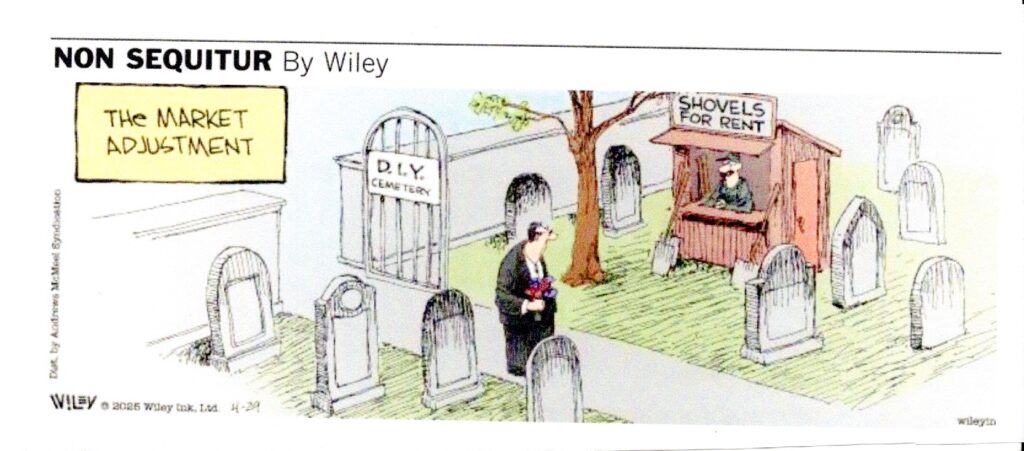
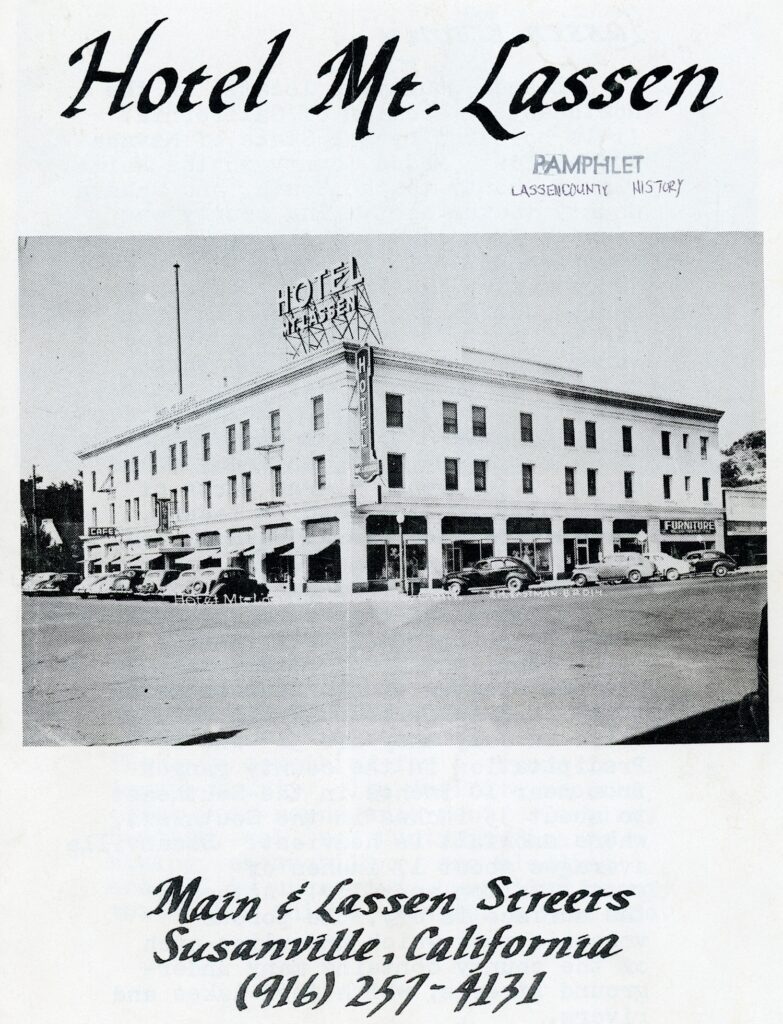
It is the merry month of May, and it means many things to many people. For me it is Memorial Day month. When I was growing up in the day it was a big family gathering. After we cleaned the family plots, place flowers in the Diamond Crest, Janesville, Lassen and Susanville cemeteries the family adjourned for sit down lunch in Pinto Room in Hotel Mt. Lassen.
While those days are. long gone, over the years I have worked in the various cemeteries. I researched the property titles when Lassen County acquired them and have assisted with countless people navigating cemetery plots, assist with inurnments etc. Needless to say there are individuals who think I am in the charge of the Lassen County cemeteries. I am not. That responsibility is the Lassen County Public Works Department. However, I still receive calls and I assist when I can.
I do have an assortment of cemetery stories. One in particular is a stand out. This happened twenty years ago, when I was working in the Janesville Cemetery. A couple approached me, since I knew by their look they were confused and lost. They were lost. When I inquired whose grave they were looking for, I explained that person was buried in the Lassen Cemetery and gave them approximate location of where that was grave was located. Upon leaving, the woman exclaimed, “Why don’t they bury people in alphabetical order?”
The intersection of Main and Gay Streets, Susanville, 1878
In 1880, Edward W. Hayden, a newspaper man arrived in Susanville, and worked for the Lassen Advocate. He would eventually own the newspaper in 1892 and sold it 1921. In 1927, he wrote some memoirs about what Susanville was like in 1880. There were two observations that peaked my interest. One was the water tank on Main Street, that there is very little documentation. The other has me befuddle and may be readers can assist. My interpretation according to Hayden was that there was a bandstand on Inspiration Point. At that time, the locals just called it the bluff and it was not named Inspiration until 1918.
Hayden wrote: “In the center of the intersection of Main and Gay Streets was a water tank four feet high about as wide and eight or ten feet long., a lofty flag pole at is western end. [The flag pole was erected in 1861 by Union sympathizers.]
“Two private residences were in the space between Roop and Pine Streets and the space occupied by the Elk’s Home was vacant. There was a rudely constructed stairway leading up to the bluff to a band stand high above the town.”
This is just a friendly status report on topics requested from April’s Ask Tim post. There is recommended reading of Evans and Riddell book about the Honey Lake and Maidu. The pre-history of Herlong Junction and that of Tom and Zoe Clayburg. The mythical Bloody Springs. Finally, the naming and slow evolution of Susanville’s Mark Street.
If you reside in northwest Susanville and you turn on the water faucet for drink of water, its source Bagwell Springs. That is good thing, as it is pure spring water. It was not until 1935, that it was tapped for domestic water supply.
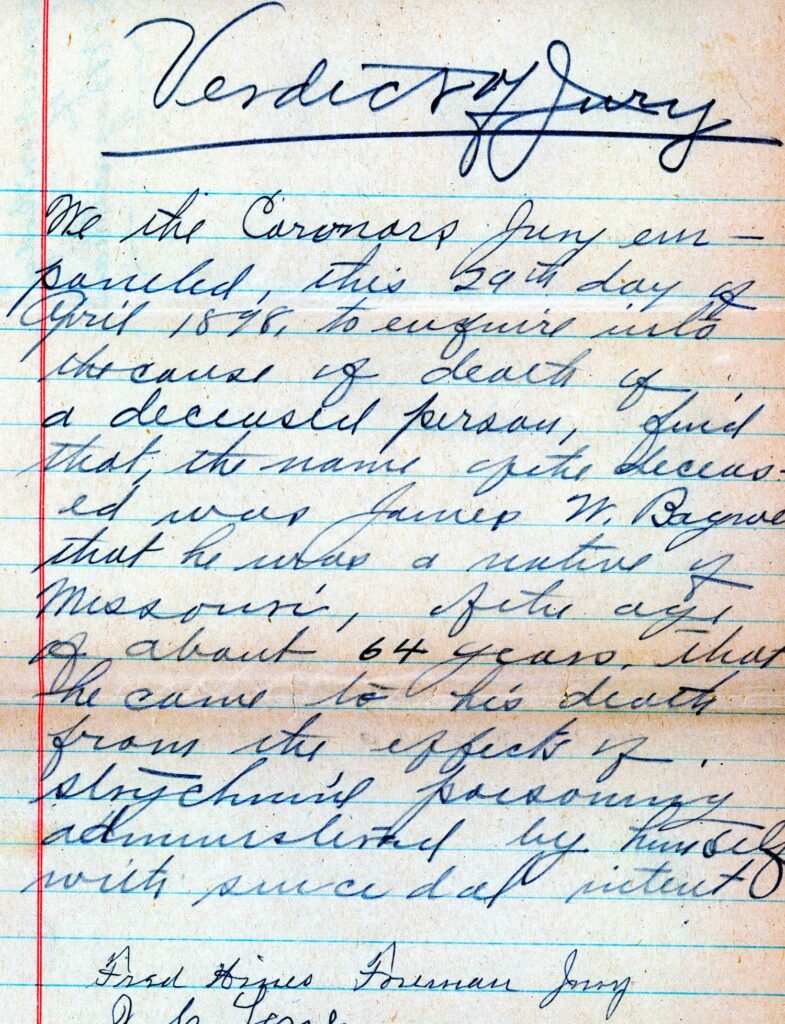
So who was Bagwell that is spring named, which is located north of Susanville Ranch Park, one may ponder.A native of Missouri, James Washington Bagwell (1835-1898) came to Lassen County in 1871. He eventually settled on a 160-acre homestead, north of Susanville, and a portion is now Susanville Ranch Park. Bagwell made a living working odd jobs, primarily selling firewood. In 1893, he sold his homestead for $300. Bagwell moved into Susanville where he was employed as the Lassen Courthouse janitor, earning $20 a month, until his death in 1898. He committed suicide from an overdose of strychnine. Bagwell was known for his interesting wit. In one instance he spoke of the stray horses grazing on the Courthouse lawn, “They got to go, if they continue to browse much longer, they will be applying admission to the bar.”
On a final note, it was not until 1901 when W.B. Long claimed rights to this spring that he designated as Bagwell.
Today marks the 100th anniversary of Lassen Junior College Initially, it was a separate department of Lassen Union High School and classes were held at the high school. In 1941, a separate facility was created. In 1946, with increased enrollment a new college building was built to the west of the high school. In 1965, the college separated from the high school to be known as Lassen Community College. In 1970, groundbreaking ceremonies were held for the initial construction of the current campus on Highway 139. Each week will explore the many facets of its history.
Tim
P.S. – If you have a Lassen College story to share, please by all means to do so, to preserve its history.
Big Meadows Maidu Camp, 1887. Courtesy of the National Park Service
As I slowly compile a list of books pertaining to regional Native Americans this is my first recommendation. The Northern Maidu by Marie Potts. Marie (1895-1978) was born at Big Meadows, now Lake Almanor, Plumas County. She recounts her childhood and the ways of the Northern Maidu. I highly recommend this slim volume.
In 2022, KQED published an article about Marie’s life. You can read it here
While the Northern Maidu is out of print, it is widely available at used book outlets. Personally, I use Bookbinder.com.
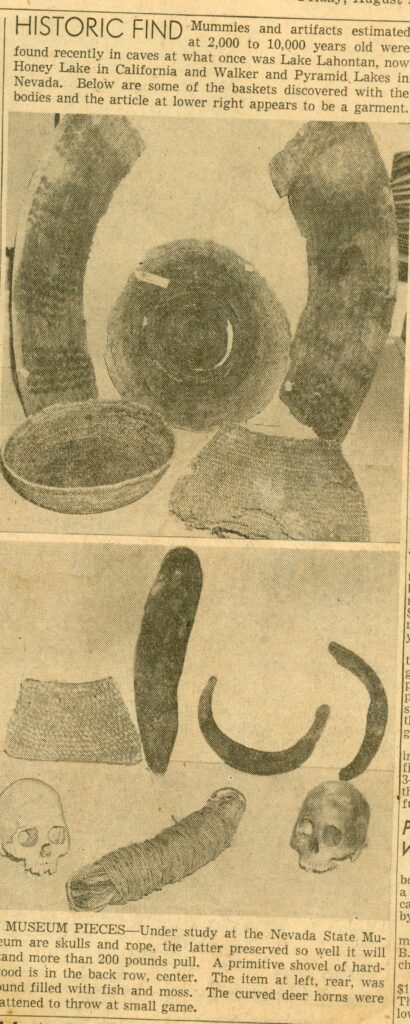
Yesterday’s feature was Go Exploring. Today’s illustration is the cover a 1981 brochure of Susanville’s Hotel Mt. Lassen. It is standard chamber of commerce propaganda. There is usual description of Lassen County weather. It was the last sentence on that topic that caught my attention: “Although the surface is dry, the porous volcanic rock which underlies much of the county contains many underground streams, which feed lakes and rivers.”
Thanks to the late Francis “Fritz” Riddell, a well known archeologist, we have an account of an underground stream and a bonus a petroglyph story as well. I am working on the finish touches so it should appear next week.
This is one my annual posts, since its always relevant, even for those that do not reside here. For those fortunate enough to reside in the greater Lassen environs there is so much to discover and see.
Picnic tables at the Fleming Unit, State Wildlife Refuge, 2016
The Fleming Unit of the Honey Lake Wildlife Area, is great place to start, You can take in bird watching, or just escape have picnic lunch. Of course, before go there, one could take diversion to visit the Belfast petroglyphs and the Willow Creek gorge
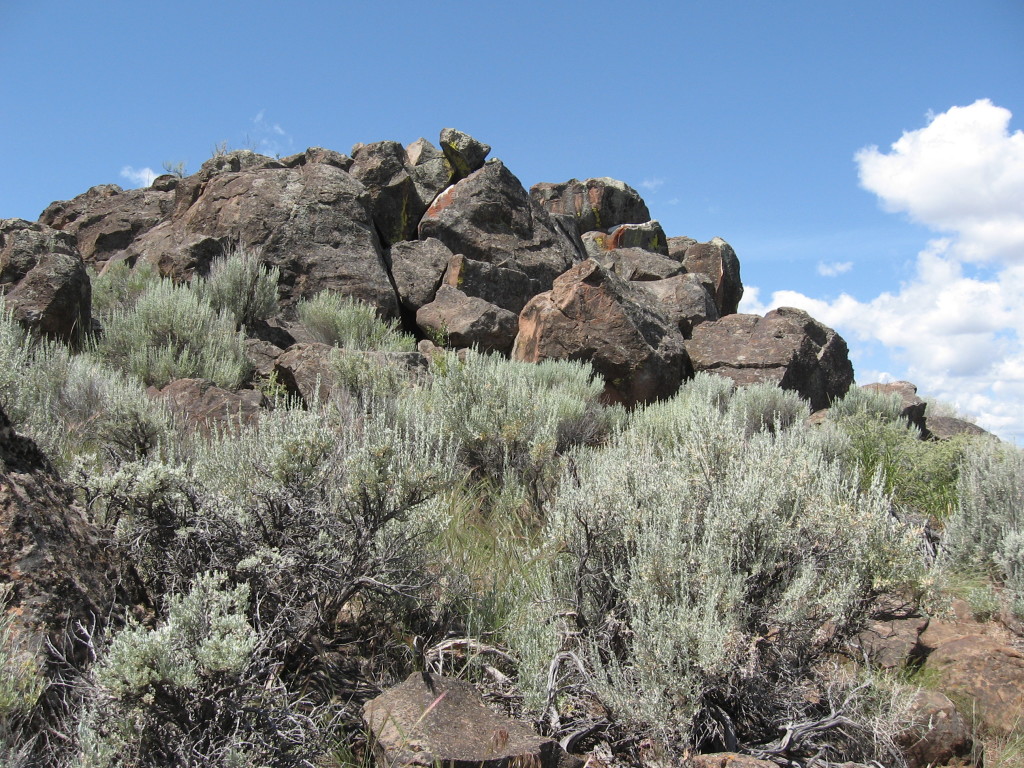
The Belfast petroglyphs looking towards the sunrise chamber, June 2, 2015
Hopefully, I can resurrect some short walking tours like uptown Susanville murals, with a history of particular building they adorn, or a cemetery tour. Most importantly, take a moment to get reacquainted with your surroundings.