An Answer to a Question

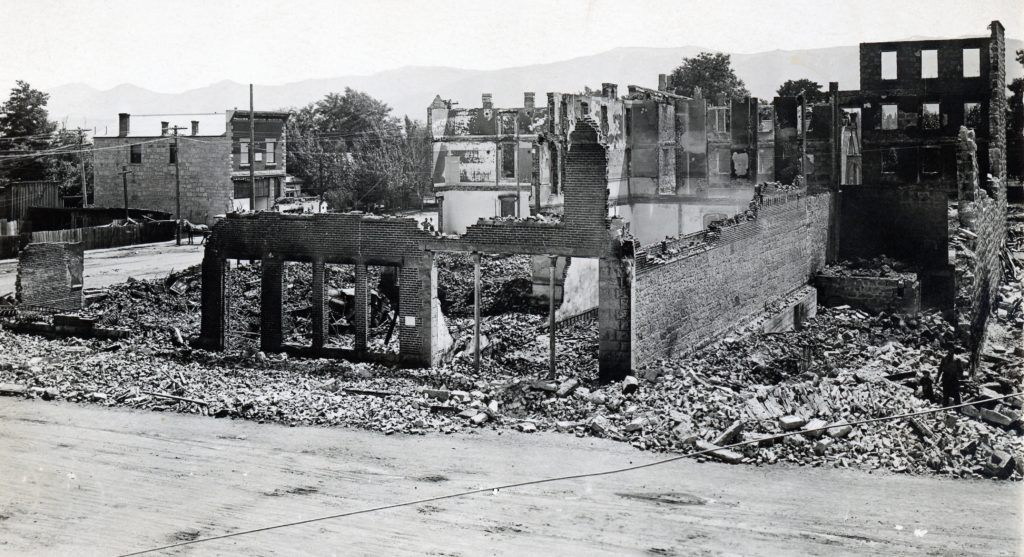
The Emerson Hotel ruins. Courtesy of Vivian Hansen

Someone recently wanted to know how the Emerson Hotel, a three-story brick building caught fire. First, a little background. The reason why Susanville came into existence as a municipality, had to do with the lack of fire protection. Its business district had been devastated by fire too many times.

In 1902, the City of Susanville introduced Ordinance No. 17 that structures in the business district be constructed of fire resistant materials, such as brick, native stone and concrete. The roofs of these buildings would use fire resistant material as well.

The Emerson Hotel was built in 1900-01. The one feature the brick building did not possess was a fire resistant roof. At around midnight on August 5, 1915, Emerson’s warehouse located on nearby Cottage Street caught fire. The wooden structure, built in 1873 originally housed the Congregational Church. By the time the fire was discovered, the building was engulfed in flames, with erratic winds sending embers into the air. In no time, the roof of the Emerson Hotel was on fire and containment was impossible, for now the fire had spread to two nearby structures the Hyer House Hotel and the Methodist Church, the latter a brick building. It should be noted the Methodist Church was built at the same time as the Emerson Hotel, and lacked a fire resistant roof.
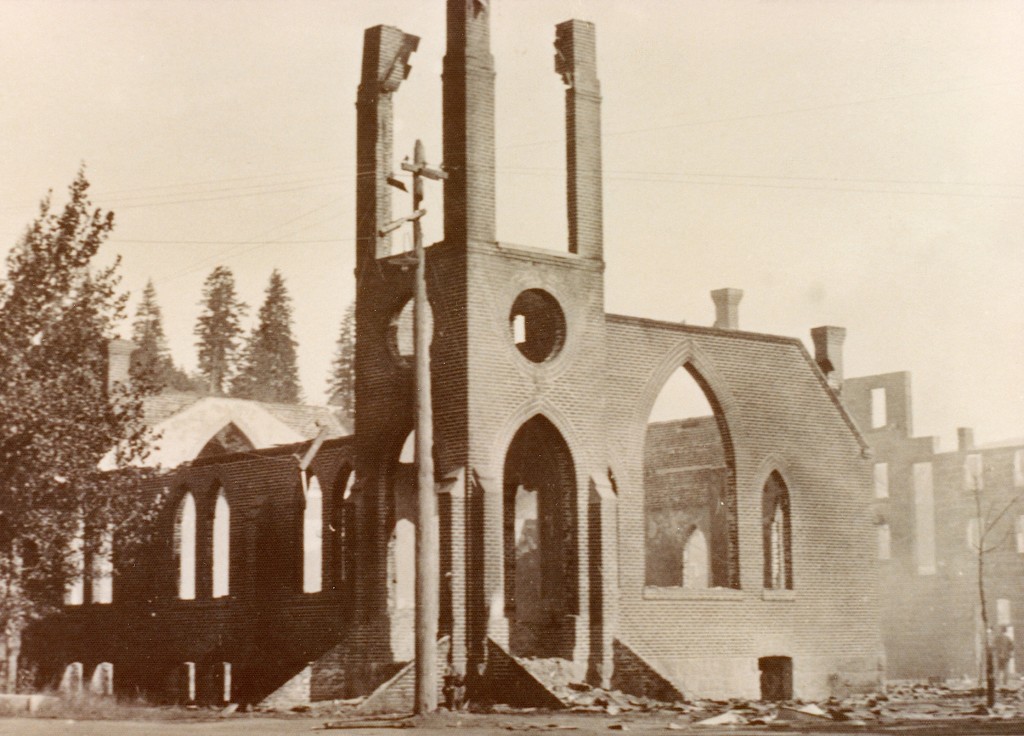
Methodist Church
The aftermath of the 1915 fire.

Spread the word, and encourage a friend to subscribe.

A Name Dispute

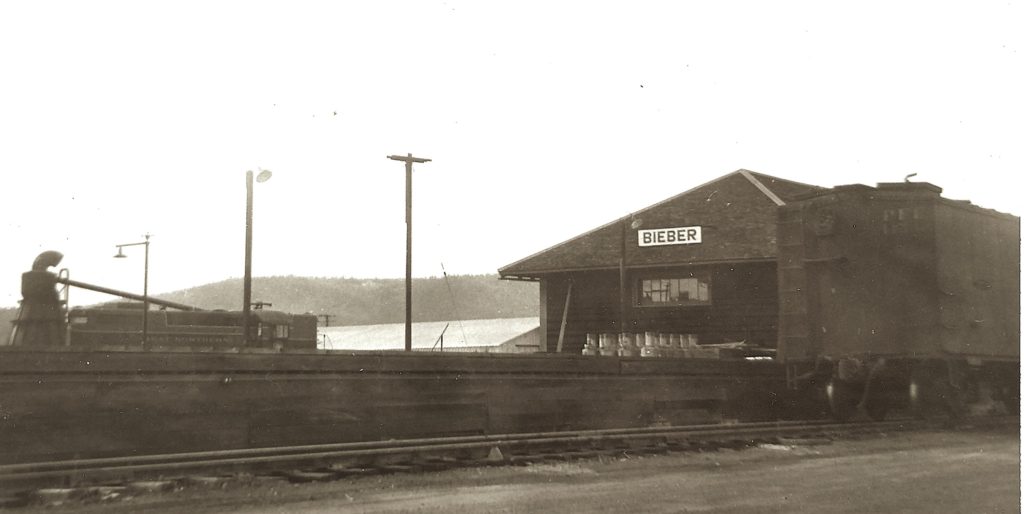
Great Northern’s Depot, Bieber.

In June 1931 progress was in earnest with the Inside Gateway link between the Great Northern and Western Pacific Railroads. The two railroads would connect with each other just west of the Big Valley community of Bieber. Byron Greenwood saw an opportunity and had a townsite laid out where the railroads would connect. He named his new enterprise Big Valley City. However, when Greenwood applied for the establishment of a post office there, postal authorities were not impressed as they frowned on three word names for post offices.

The Great Northern was not pleased and intended to name their new station, Bieber. Some one came up with a compromised name of West Bieber, but it fell flat. While it took some time to resolve the dispute, everyone, but the railroad, finally agreed to the name of Nubieber.

Subscribe

L.D.S. Church Dedication

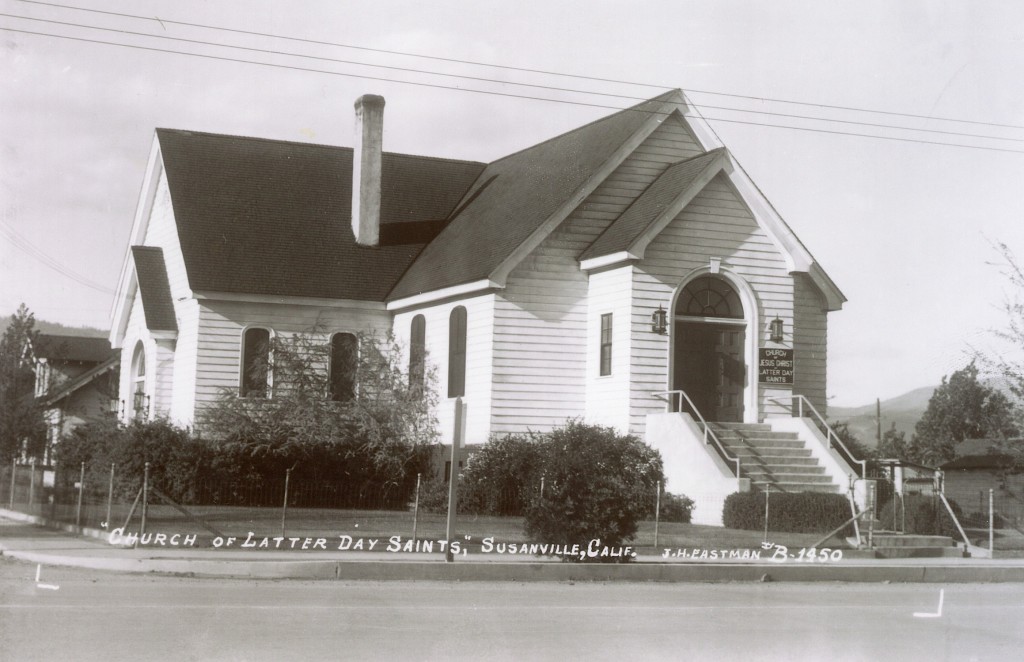
LDS Church
The Church was located on the corner of Main and North McDow.

November 3, 1929 was a big day for members of the Church of Latter Day Saints. The big event was the dedication of their new church in Susanville. According church officials, before it could be dedicated that it had to be paid for in full and the cost of the local church as $19,975.50.

Numerous church dignitaries were on hand including the President of the church, Heber J. Grant who made the journey from Salt Lake City. In addition, non-members from Susanville and Westwood were invited.

Subscribe

The Doyle Revival

Doyle, 1949- Eastman Collection, UC Davis

Doyle was the biggest beneficiary when the Sierra Ordnance Depot was established in the early 1940s. It was a much needed boost as the town struggled during the 1930s, like so many rural communities.

There was a tremendous amount business activity for the small community could boast of three grocery stores, along with other such amenities as two bars that also had restaurants, however, it should be noted after prohibition, a requirement for bars was to provide food service.

Another aspect of the Depot’s effect on the region, was with highway improvements, it created the area’s first commuters. The Janesville and Milford vicinities were popular for Depot employees to make their homes there and make the commute to Herlong.

Subscribe

Books, etc

You might want to take a moment to browse the selection of books found elsewhere on this site. Besides books, there is a lot of material that can keep you preoccupied. After all folks, having been self contained/quarantined from November 15 to February 15, due to my broken leg recovery—its not difficult or the end of world.. With the right attitude you might be amazed of all kinds of things to tend to around your immediate environs. Finally, at the same time be grateful for all things that surround you.

In addition, this is a good time as any that you may want to introduce a friend or two to this site. For some of them, it might be just a needed diversion for them to learn more about this fascinating territory. After all, I have some intriguing posts scheduled—Bocce Ball Courts in Susanville to fossil finds in the area. As always, stayed tuned.

Tim

P.S. – There are a few titles that are at a bargain price, because I never changed the special offer some time ago.

Calneva Post Office

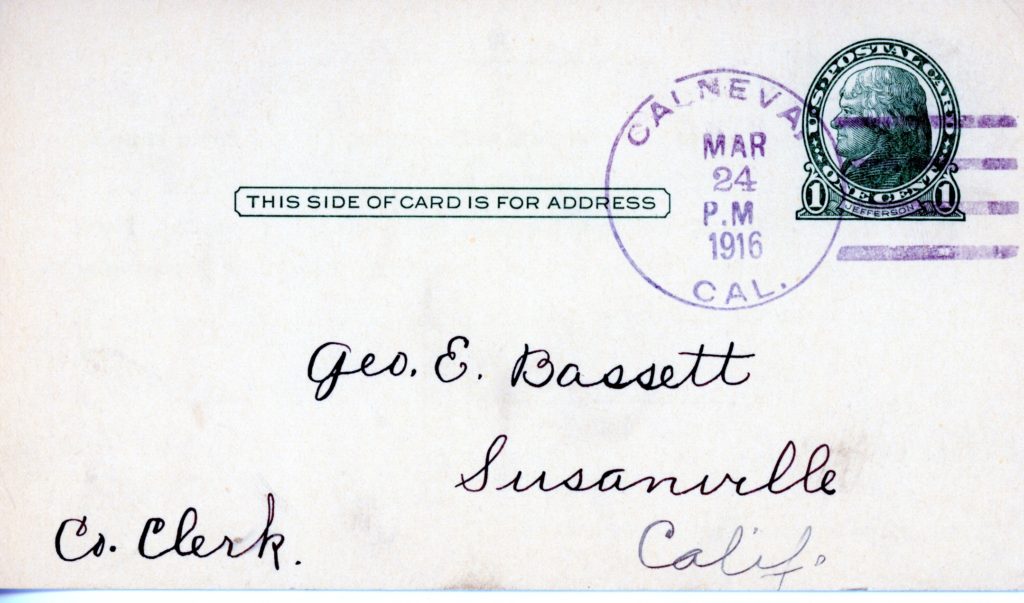
A Calneva postal cancel

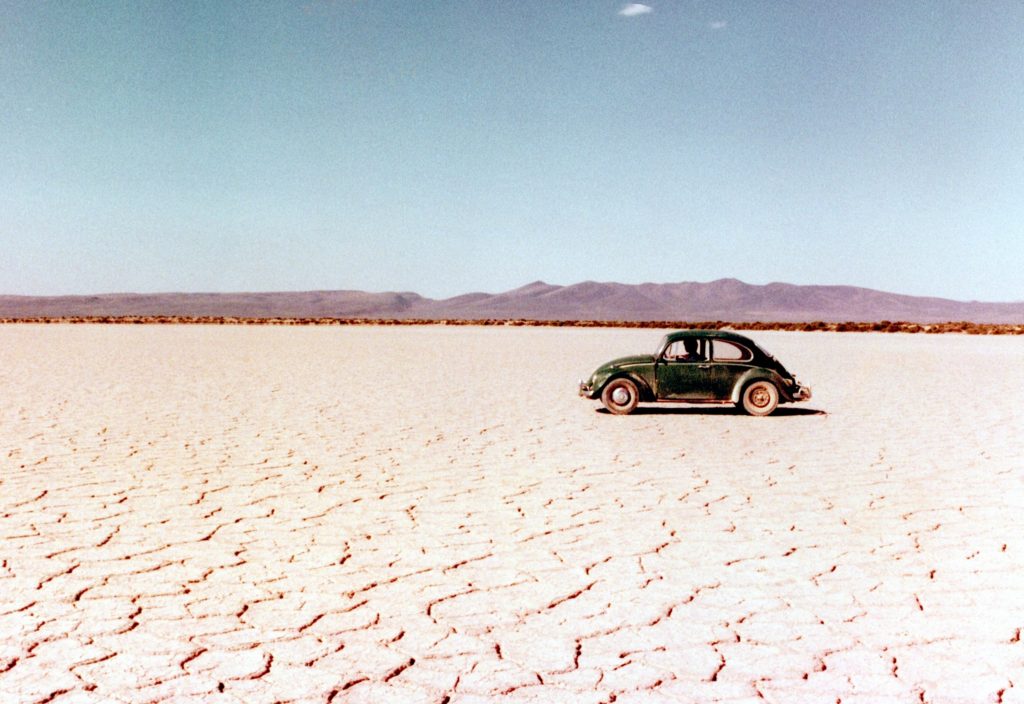
Calneva located in eastern Honey Lake Valley near the state borderline, was a small station on the Western Pacific Railroad. The station operated from 1910-1921. The Calneva Post Office was established on July 8, 1911, with Charles Ammons, as first postmaster. The post office closed briefly during 1919-20. On November 30, 1933, it was discontinued, its operations moved to Flanigan, Nevada. It is interesting to note that Calneva was located six miles east of Herlong and six miles south of Flanigan. However, when the post office closed it would be several years before Herlong was established.

The 1982 expedition in search of Nowhere at Calneva Lake.

Support

Susanville’s Town Hall Crisis

The aftermath of the August 9, 1898 fire.

During the 1880s and 1890s the residents of Susanville struggled with the issue of a much needed public hall. The Methodist Church was used for many public functions, including the annual community Christmas tree. On Decoration (Memorial) Day of 1898, after special ceremonies were held at the Susanville Cemetery, further presentations were then conducted at the Methodist Church. This time, church could not accommodate all those who attended. It was proposed that the community raise funds to enlarge the church. It gained momentum for awhile. Then on the evening of August 9, 1898 disaster struck when Susanville’s most prominent structure the Masonic Temple (better known today as the Knoch building) caught fire and the building entirely gutted. In the end, the Methodist Church was remodeled in the late fall of 1898, that allowed for extra seating, but the building was not enlarged.

In February 1899, the Susanville Town Hall Association was incorporated. It, too, was derailed by a fire the following year, but that event led to the formation of the City of Susanville.

Subscribe

March 1924

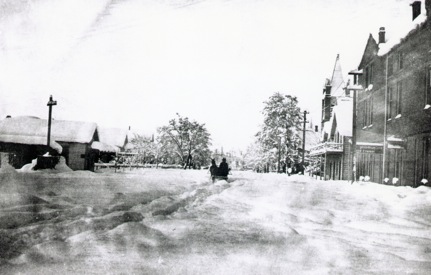
South Lassen Street, Susanville, March 1907 – Courtesy of Gil Morrill

There were several topics in the local news for March 1924. One was a constant raiding of bootleg joints during prohibition. Then, Lassen County issued a quarantine, not for humans, but livestock due to an outbreak of Hoof and Mouth disease in other parts of the State.

It was on March 24, 1924 that a snowstorm dumped 18 inches of snow in Susanville and a similar amount in Westwood. It melted rapidly. Such storms are not uncommon. What made this event remarkable, was it was the only storm for the winter of 1923-24, one of the driest since Anglo settlement.

Note: I am not sure what Big Valley received, because a portion of those archives are off site and currently not easy for me to access.

Spread the word, and encourage a friend to subscribe

Spring!

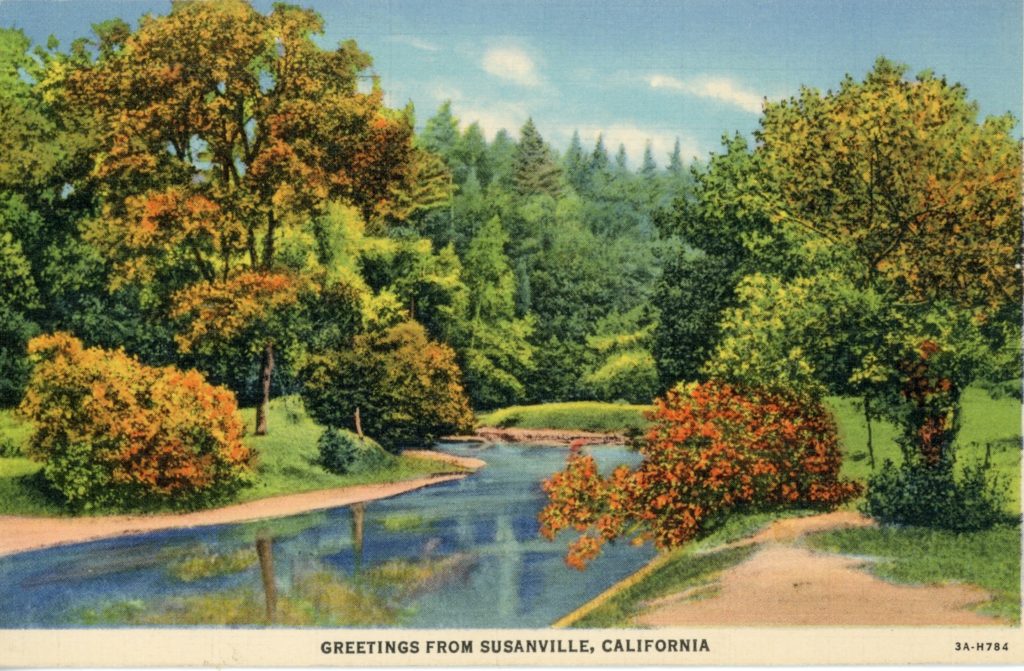
This Susanville postcard has a 1940 Milford postmark. I purchased it on Ebay for $2.53.

Colored linen postcards were quite popular during the 1940s. This particular one caught my interest. There is no place in Susanville that looks like the scene depicted. Every now and then, especially of years by gone, the names of Sunnyvale and Susanville get mixed up. Whether this is a scene in Sunnyvale, I do not know as I have never been to that Bay area community. Then again, the company that made this postcard may have had a standard image that was applied to many communities.

Support

P.S. – I am aware that spring was yesterday, the earliest in 124 years. However, I had obligation for yesterday’s post.

The Mason’s New Home

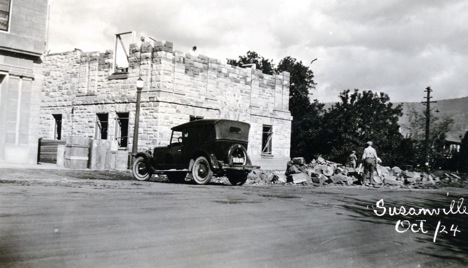
The Masonic Temple under construction, October, 1924. Thank you Uncle Boyd, whoever you are.

In November, 1921, the Lassen Lodge No.149, F.&A.M. found themselves once again homeless due to fire. In 1917, the Mason’s acquired the Native Sons of the Golden West two-story wooden hall adjacent to the City Fire Hall on the corner of Lassen & Nevada Streets. It was those two structures that were destroyed in the November blaze. Finances hindered the Masons, but it did not stop plans for a replacement.

On July 19, 1924, the Mason’s entered into a contract with T.J. Rees of Fallon, Nevada to construct a new lodge. The two-story native stone building carried a price tag of $35,000. It was agreed to have the building completed by January 1, 1925. However, that did not quite happen, and it was not until June 12, 1925 when the Masonic Temple was dedicated.

There are two interesting side-line notes. The Masonic Temple was the last major native stone building constructed in Susanville. When Rees completed the building, he found himself a new job constructing the Hotel Mt. Lassen.

Spread the word, and encourage a friend to subscribe.

Exploring Lassen County's Past